When American troops of the 101st Airborne Division pushed into the Bavarian Alps in early May 1945, they expected to find the last redoubts of Nazi resistance. What they found in a warehouse near Berchtesgaden was something else entirely: a perfectly preserved Mercedes-Benz, a vast armored machine weighing nearly eight thousand pounds and stretching over twenty feet long. It was painted in a distinctive blue-gray that gave it its name. Soldiers recognized it immediately.
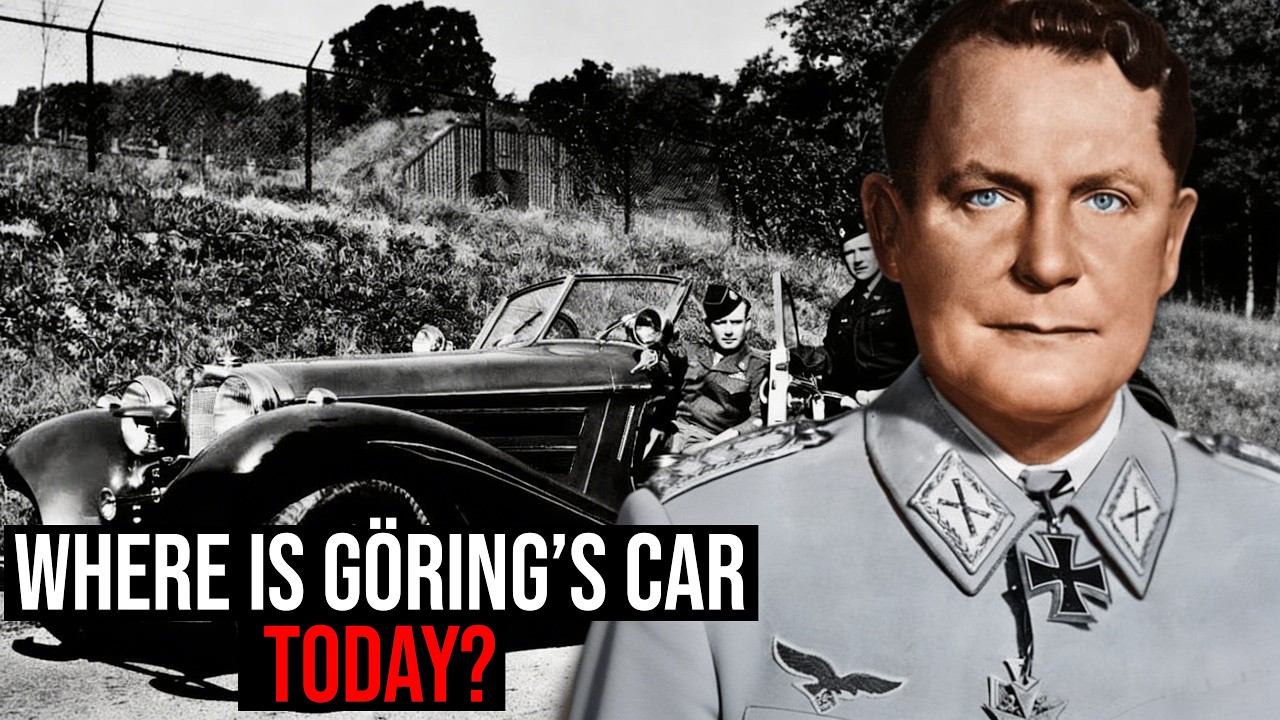
This was the Blue Goose, the personal automobile of Hermann Göring, and the most powerful man in Nazi Germany after Hitler himself had just become a prisoner of his own side. The car had been built in 1939 on the chassis of the Mercedes-Benz 770K, already the most prestigious automobile the company produced, a vehicle reserved for heads of state. But Göring’s version was modified to an extreme that made it unique. The engineers at Mercedes reinforced the entire body with armor plating thick enough to stop machine-gun fire.
The bulletproof windows were over an inch thick and so heavy that electric motors had to be installed to raise and lower them, because no human arm could manage the weight. The floor was armored against grenades and mines. The fuel tank was designed to resist puncture and explosion. The tires were run-flat models that could keep rolling even after being shot multiple times.
At nearly four metric tons, it was one of the heaviest passenger vehicles ever built up to that time, and moving it required Mercedes’ most powerful engine: a supercharged straight-eight that produced more than 230 horsepower when engaged, a staggering figure in an era when most family cars managed sixty or seventy. The man who ordered this machine was unlike anyone else in Hitler’s inner circle. Göring was born in 1893 into an aristocratic family and developed an early obsession with luxury that bordered on madness. He had been a genuinely brave fighter pilot in the First World War, earning the Blue Max and eventually commanding the Flying Circus squadron after the Red Baron was killed.
Wounded during the failed Beer Hall Putsch of 1923, he became addicted to morphine, and over the following decades he rose to become the second most powerful man in the Third Reich. But while Himmler was an ideological fanatic and Goebbels a master of propaganda, Göring was something more medieval: a hedonist who cared more about pleasure and beautiful things than about ideology or even the war itself. While ordinary German families survived on ration cards, he hosted banquets with dozens of courses and wines stolen from French cellars. While soldiers froze on the Eastern Front, he wandered his estate at Karinhall, admiring the thousands of priceless artworks looted from museums and Jewish families across Europe.
He wore custom uniforms in outrageous colors, kept pet lions, and carried a jeweled marshal’s baton. Even other Nazis thought he was excessive. The Blue Goose carried this man through six years of war. It drove him to meetings with Hitler where the fate of nations was decided.
It took him to Karinhall, where he spent hours examining stolen treasures while cities burned. It transported him to air bases where he screamed at his generals about the failures of the Luftwaffe while Allied bombers destroyed German cities around them. Ordinary Germans who saw the car pass knew exactly who was inside, and they knew that while they struggled to survive, the Reich Marshal was living like an emperor. By the spring of 1945, everything was collapsing.
The Allies were closing from the west, the Soviets from the east, and Germany was being crushed between them. Göring made a fatal error. On April 23, with Hitler trapped in his bunker in Berlin and clearly doomed, Göring sent a telegram asking whether he should assume leadership of Germany since the Führer was incapacitated. He thought he was being practical.
Hitler saw treason. Furious, he stripped Göring of all titles and ordered his arrest. The second most powerful man in the Reich became a prisoner of his own side, held under guard at his estate by SS soldiers. The Blue Goose sat in the garage, waiting.
When the Americans discovered the car near Berchtesgaden, they immediately recognized its significance. It was claimed as a war prize, as was common practice when victorious armies took enemy equipment as trophies. Soldiers posed for photographs with the massive Mercedes, grinning and celebrating. Officers argued about who would get to keep it.
Göring himself surrendered to American forces on May 6, two days before Germany’s unconditional surrender. He was fat and sweating, wearing a pale blue uniform covered in medals, and seemed to believe the Americans would treat him as an honored guest rather than a war criminal. He was wrong about that. The Blue Goose was shipped across the Atlantic with other captured German vehicles, and once it arrived in the United States, it became a celebrity.
For several years it toured the country as part of war bond drives and victory celebrations, and thousands of Americans paid to see Göring’s personal automobile, to touch the bulletproof glass and imagine what it had been like to ride inside this mechanical fortress while planning conquest and genocide. Over the following decades, the car passed through various hands. A businessman reportedly used it for promotional purposes. At another point it sat in storage for years, nearly forgotten.
It appeared at car shows and exhibitions, always drawing crowds, its engine still working, the armor still intact. Its original owner was dead, however, having cheated the hangman at Nuremberg in 1946 by swallowing a cyanide capsule the night before his scheduled execution. Today the Blue Goose rests at the Auburn Cord Duesenberg Automobile Museum in Auburn, Indiana. In person, the first thing that strikes a visitor is the sheer size of the machine.
Photographs cannot capture how massive it really is. It dominates the room. The blue-gray paint still gleams under the museum lights. The Mercedes star still shines on the massive grille.
The bulletproof windows still carry a slightly greenish tint. The armor plating is visible at certain angles, as are the unusual thickness of the doors and the heavy-duty suspension required to carry all that weight. The museum treats the car with seriousness, providing context about who owned it and what he did, making clear that this is not a celebration of Nazism but an examination of a dark chapter in history. And that raises a question that lingers in the mind of anyone who stands before it: what should be done with objects like this?
Some argue that Nazi artifacts should be destroyed, that keeping them glorifies the regime. Others argue that they are historical evidence, that standing next to Göring’s actual car creates a connection to the past that books and photographs cannot. The Blue Goose is not just a car. It is a symbol of excess and corruption at the highest levels of power.
The leather seats held a man who signed orders that killed millions. The engine powered a vehicle that rolled past starving prisoners and bombed cities without stopping. The empire it served is gone. The man who owned it is gone.
But the Blue Goose remains, sitting quietly in the museum in Indiana, a masterpiece of engineering dedicated to protecting a man who deserved no protection at all.
