She lay prone in the snow, elbows locked, the Mosin-Nagant 1931/30 resting on a folded cloth she had placed to soften the rifle’s recoil against the frozen ground. The four-power PE scope sat mounted above the receiver on a side rail. A cartridge was chambered, 7. 62×54mm, bolt closed.
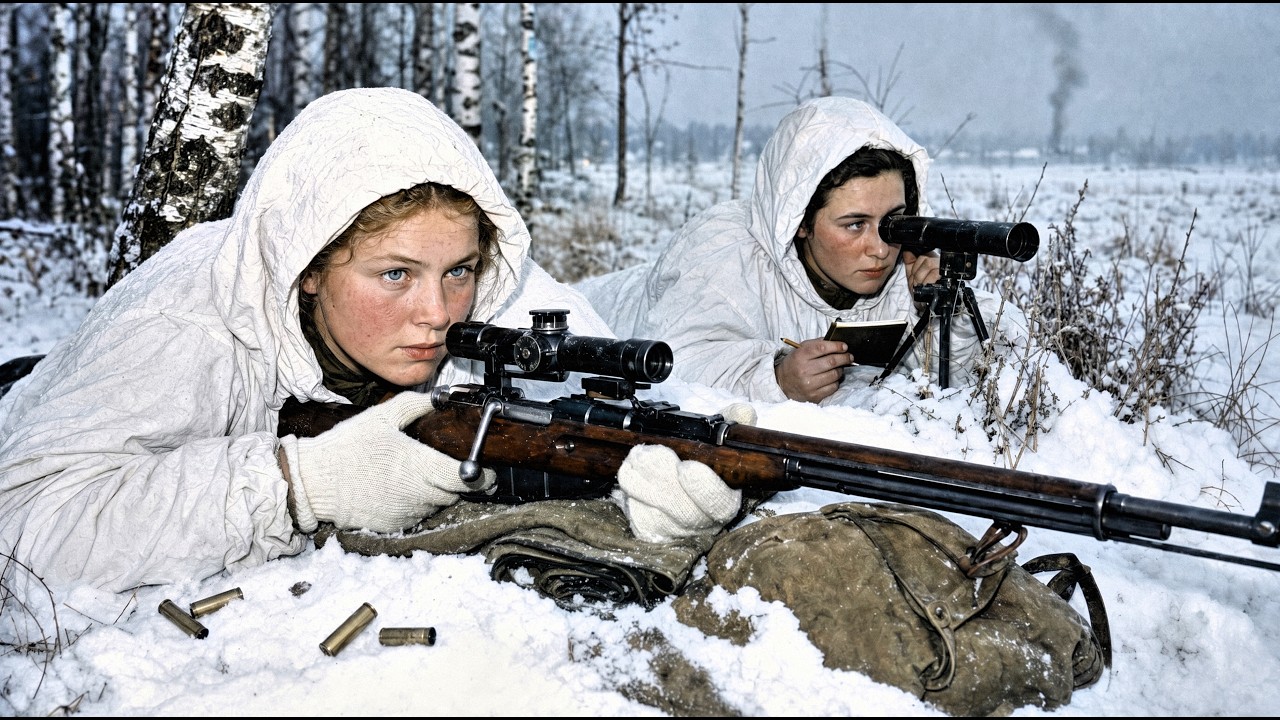
The crosshair drifted across a stretch of gray trees, then settled at 380 meters. A German officer in field gray had stepped out of the treeline to speak with a runner, his back turned to her at first. Then he turned. The crosshair rose from the top edge of his coat collar to the line below his chin, tilting slightly left.
Light. She had measured it earlier from the smoke rising off a farmhouse stove. Two clicks back, two clicks for windage, and a whispered adjustment for elevation in the cold air. The rifle would shoot slightly truer at this temperature than the warm-air tables predicted.
She knew this rifle. She knew the air. She exhaled. The sight settled.
She squeezed. He fell. The runner did not understand at first, looking around. The officer lay in the snow.
The runner bent down, straightened, moved forward, stepped back. He had not heard the shot because of the wind. The crack of a Mosin-Nagant carries far in cold air, but the wind pushed it sideways, and the runner did not know which way to look. She did not shoot the runner.
She watched him for ten seconds. Then she lowered her head behind the scope. She slid backward through the snow, dragging the rifle, keeping to the same shallow trough she had made coming in. She moved slowly.
In the training grounds she had learned that a slow body lives and a fast body dies. A line of birch trees lay behind her, a communication trench beyond that. She rolled into it, stood, and shook the snow off her cloth cover. This was East Prussia.
January 1945. Third Belorussian Front. The sniper was a girl from a village in Arkhangelsk. She was twenty years old, fair-haired and blue-eyed, above average height, and she could lie motionless in the snow for eight hours.
She had been a kindergarten teacher before she taught herself to kill men through glass. She kept a diary, which was strictly forbidden under Soviet military regulations, and she kept writing in it anyway. She would be dead within two weeks. Her name was Roza Shanina.
She was born on April 3, 1924, in a village called Yedma, in Arkhangelsk Province. Her father was a lumberjack, Yegor Mikhailovich Shanin, who had fought in the First World War and taken a knee wound that left him lame for the rest of his life. He was recovering from that wound in a Moscow hospital when he joined the Bolsheviks. In later years he worked as a party organizer on a collective farm.
Her mother was a cowherd named Anna Alexeevna. The couple had seven children of their own and adopted three orphans, raising all of them in a village at the edge of the Pinega River, where the school had four rooms, harvests came late, and winter arrived early. Five of the seven were boys: Mikhail, Fyodor, Sergei, Pavel, and Marat. Roza was the eldest sister; the youngest was Olya.
She was named after Rosa Luxemburg, the German communist revolutionary assassinated by the Freikorps in Berlin in 1919. Her father told her the name carried meaning and that she would have to live up to it. Her mother believed the name brought bad luck. Her premonition proved correct, though it would take twenty years to show it.
Olya attended the school in Yedma through the fourth grade, four rooms, four teachers, one stove. After fourth grade she moved to another school in the village of Bereznik, thirteen kilometers away. There were no buses. She walked those thirteen kilometers every morning and walked back every evening, through spring mud, summer dust, autumn rain, and bitter winter cold.
In a country where northern children routinely walked to school at thirty below, the walking strengthened her legs and made her patient. At fourteen she wanted to continue school, but there was no secondary school within walking distance. Her parents told her she had enough, that they needed her on the farm. She left anyway.
Carrying a small bundle of clothes on her back, she walked alone two hundred kilometers across the Pinega wilderness to the nearest railway station. The trip took about forty hours, by the estimate of a teacher who later confirmed her route. She was a fourteen-year-old girl. The Pinega wilderness in 1938 was not empty of people.
There were wolves, thieves, and, in spring and autumn, bears. She crossed it with what she had, then boarded the train. She rode to Arkhangelsk on the White Sea and lived with her older brother Fyodor, who was stationed there. She enrolled in secondary school and joined the Komsomol that same year.
She passed her upper forms and graduated in the spring of 1941, just as the country slid into war. Free secondary education in the Soviet Union had been suspended that summer to pay for rearmament; tuition was introduced and her allowance cut. On September 11, 1941, she took a job at kindergarten No. 2 in Arkhangelsk to make ends meet, teaching small children all day and into the evening.
Then the Germans came on June 22, 1941, with Operation Barbarossa, an attack along the entire western border of the Soviet Union from the Baltic to the Black Sea, 1,800 kilometers of front. Three million Axis soldiers drove east. By autumn the Luftwaffe was bombing Arkhangelsk, the only Soviet port able to receive Allied supply convoys in the north. She volunteered for air-raid watch on the roof of her kindergarten.
Children in the cellar, sirens screaming, the sky red from burning warehouses on the docks. She stood on the roof with a bucket of sand and an axe, waiting for incendiary bombs to fall. She was seventeen. In December 1941 a telegram arrived.
Her brother Mikhail had been killed defending Leningrad. He was nineteen. The siege had begun in September; he was holding part of the outer ring. The cause of death was recorded as combat, the location on the line outside the city.
He was the closest to her in age, and she once told a friend he was the kindest of them all. She went to the military enlistment office in Arkhangelsk and asked to join. They refused. Women were not yet eligible for the Red Army.
Age rules were under review. The commissariat sent her back to the kindergarten. She came back the next month. They sent her back.
She came back the month after that. In February 1942 the policy changed. Soviet women between sixteen and forty-five became eligible for conscription. Roza was about to turn eighteen.
She returned to the office. They told her there were no vacancies for women in her district. The local officer responsible for her file later admitted after the war that he had been trying to keep her out. He knew her father.
He thought she would be safer behind a chalkboard. He thought the war would be short. She kept coming back. Through the rest of 1942 she taught the children and waited.
She began spending her free hours at a shooting range in Arkhangelsk. She had never fired a rifle before. In the first weeks she squeezed the trigger like a kindergarten teacher, jerking the rifle and sending rounds wide. The instructor told her to stop jerking.
She stopped jerking. She began to squeeze. She noticed her body grew quiet when she lay behind the rifle. Somehow, nowhere else did it.
By the end of the year she was shooting men in the range’s silhouette targets. The instructor noticed. In the spring of 1943, two more of her brothers went to the front. They would not come back either.
She did not know that yet. She only knew the war was eating her family faster than she could keep up by waiting. On June 22, 1943, exactly two years after the Germans crossed the border, the Arkhangelsk commissariat finally gave in. She was accepted into the Vsevobuch program, a general military training course: 150 hours of marksmanship, tactical drills, and infantry basics taught alongside her civilian job.
She completed the hours on top of her kindergarten shifts. She completed them at night. At the end of the program she took the qualifying examination for sniper academy. Three male candidates and herself: shooting at 100 meters with iron sights standing, at 200 meters with iron sights prone, at a moving target at 300 meters, and at a head-and-shoulders silhouette at 400 meters.
She outshot all three men. The recruiting officer, the one who had told her women were not snipers, signed the form himself. He did not look pleased, but he signed it. She was ordered to the Central Women’s Sniper Training School at Podolsk, Moscow Province.
She boarded a train south in late June 1943. She was nineteen. The school sat outside Podolsk, a pine forest spread about thirty kilometers south of Moscow. It had been founded in May 1942 by order of the People’s Commissariat of Defense on the recommendation of the General Staff.
The first course ran three months. By the time Roza arrived it ran seven. By the time she graduated it was close to a year. Admission standards were strict.
Applicants had to be at least twenty, with exceptions made for promising candidates who had passed the Vsevobuch qualifying exam. They had to have completed at least seven grades of secondary school. They had to pass a four-day entrance examination. Physical fitness had to be high, and eyesight was checked again and again.
They had to demonstrate trigger discipline before being allowed near the sights. By war’s end in May 1945, the Central Women’s School had graduated just over a thousand snipers. By conservative Soviet statistics, those women accounted for at least 11,280 enemy kills along the Eastern Front. Another 2,484 Soviet women were trained as snipers through the Vsevobuch program alone outside the central school.
They were the largest and deadliest force of female snipers ever fielded by any army. The instructors were combat veterans. Some had fought on the Finnish border in 1939, some in Moscow in 1941, some at Stalingrad. They knew the work intimately.
The rifle was the Mosin-Nagant 1931/30, a five-shot internal magazine, bolt action, 28-inch barrel, with a bent bolt handle on sniper versions to clear the scope, firing the rimmed 7. 62×54mm round. The cartridge was older than the rifle, in service with the Imperial Russian Army since 1891 and still in service with the Russian Federation more than a century later—a powerful, reliable round, with 1,850 foot-pounds of muzzle energy and an effective sniper range of about 800 meters in skilled hands with proper optics and favorable conditions. The scope was a 40mm objective PE, 4x magnification, with quarter-minute windage and elevation adjustments, an elevation turret on top and a windage turret on the side.
The reticle was a fine post with horizontal marks for range estimation, mounted on a side rail screwed to the receiver. The scope mount sat high enough to leave the iron sights usable as backup if the scope was damaged, fogged, or knocked out of zero. The PE was a copy of a German Zeiss design from the late 1920s, refined by Soviet optical engineers through the 1930s. It was rugged, reliable, held its zero, even after drops, and did not fog if cared for.
At very long range it underperformed the German 4x Zeiss carried by some Wehrmacht snipers. But at 400 and 500 meters, where most Eastern Front sniping took place, it was enough to hit a man’s eye. A trained sniper could take a man’s head at 600 meters in clear weather, and the best of them his head at 800. The school drilled the women in eight disciplines until they became reflex.
First, ballistics: the path of the bullet through air. Drop at 200, 300, 400, 500, 600, 700, and 800 meters. Rotational drift at long range, the bullet curving slightly right with every second of flight. The effect of cold air on velocity, small but real.
The effect of altitude on air density, critical in the Caucasus and the Carpathians, less so on the flat Belorussian plains. The effects of barometric pressure. They plotted trajectories on graph paper and memorized the numbers. Roza was good with math; she had loved numbers in school.
Second, optics: mounting the scope, zeroing it at 100 meters and again at 300, adjusting windage and elevation in field conditions with cold hands, reading mirage through the reticle to judge wind speed. They learned to read wind by smoke rising from a stove, by the bending of grass, by leaves turned in a breeze, by snow blowing off a ridge. Wind was the great variable they could not control. They learned to live with it.
Third, camouflage and concealment: building ghillie suits from local vegetation, sewing strips of cloth onto an over jacket with a hood, weaving in grass, twigs, and leaves. Matching colors to the season—white suits and white rifle covers in winter, browns and grays in autumn, greens and yellows in summer. Avoiding skyline positions on hilltops and rooflines. Building a hide that did not look like a human shape, never round, never symmetrical, always uneven, always lower than a searching eye expected.
Choosing positions with a way out, not just a way in—a hide with a single entrance was a coffin if found. Fourth, range estimation by eye and by reticle. The stadia method: measure a known dimension against the horizontal marks and calculate range with simple trigonometry. They drilled on the height of a German helmet—25 centimeters—and the width of a German greatcoat at the shoulders—50 centimeters—and converting those into range.
Miss the range by 50 meters at 400 and the bullet will land 20 centimeters off target, which measures nothing; get it right and the bullet takes the throat. Fifth, target priority: officers first, then machine gunners, then radiomen and signalers, then forward artillery observers, and always the enemy sniper when one could be found. Riflemen last. Conscripts were ignored because the cost of a bullet exceeded the value of a conscript’s life to the German war effort.
They were told to choose the men whose deaths would unbalance a unit. They were told to make every cartridge cost more than it was worth. Sixth, trigger discipline: a two-stage pull. Start the first stage.
Break the second at the end of the exhale, lungs empty and no place left for the body to settle. The shot must surprise. Flinch and miss. Anticipate and miss.
The rifle should fire itself, as if by accident. They dry-fired on barrack floorboards for hours. Seventh, the double tap: two shots in rapid succession, bolt worked fast with the right hand on the bent straight handle. First shot at one target, second at a different target before either can move.
Soviet snipers were famous for it. Roza became one of their best. By the end of training she could put a second bullet into a second man within four seconds of the first, both shots inside her hand’s span of where she aimed. The double tap was the sniper’s specialty because it punished German rifle squads that usually sent one man to look and one to recover.
Kill the first, kill the second, and a third man learned to stay down. Eighth, pair work. Snipers operated in twos: an observer with binoculars, a shooter with the rifle. The observer read wind, range, and target priority.
The shooter fired. Pairs stayed silent for hours, sometimes whole days. They learned to move together, to trade roles, to carry water for each other. The observer mattered as much as the shooter.
A sniper without a partner would eventually fall into a trap he could not see alone. She trained for seven months. She passed the final exam with distinction, first in her class. The school offered her an instructor’s post.
The offer was tempting materially: regular pay, a bed, hot food, no more frontline. She turned it down. She had not come to Podolsk to teach men or women how to shoot; she had come to fight herself. She made two close friends in training.
Alexandra Yakimova, called Sasha, a sturdy girl from the Urals with a dry wit and a sniper’s calm. Kaleria Petrova, called Kalya, smaller and quicker, the best knife-thrower in the course. Roza called the three of them “the three vagrants,” the troika. She later wrote that they became her family in the war.
Only Kalya Petrova would come home. In early April 1944 she was deployed. She was assigned to the 184th Rifle Division on April 2, 1944, part of the Third Belorussian Front, formed only ten days earlier from the older Western Front. A separate women’s sniper platoon was organized within the division, and Roza was made its leader.
She was nineteen and had not fired a single shot in real combat. The front was dug in southeast of Vitebsk in northern Belorussia, under German occupation for nearly three years. The line had settled here during the winter of 1943 into the spring of 1944. Both sides had fortified and were waiting for the thaw.
Both knew Operation Bagration would come soon and that Vitebsk would be a hinge. She got her first kill on April 5, 1944, three days after joining the unit. The position was a narrow trench on the forward edge of a tree line. She crawled out an hour before dawn, dragging the rifle in its canvas case.
She built the hide from snow, brush, dead branches, and a rectangle of white cloth. She carried a thermos of tea and four cartridge pouches on her belt. She wore a watch. Her partner, Sasha Yakimova, lay eight meters to her right with binoculars.
They had been told of a German position on a treeline 370 meters across a plowed field. They were to wait. The German came at a bad time for him, mid-morning, the light flat across the field between them. He was a soldier, not an officer.
He stood in his forward trench to drink something hot, a metal cup in his right hand, the cup catching the thin April light. Sasha said, “450 meters. Light wind from the left. ” Roza saw him.
She adjusted elevation. She read the wind from the smoke of a Soviet field kitchen half a kilometer away. Light, left to right. Two clicks of windage.
Exhaled. The sight settled on the line where his neck met his collar. She squeezed. He fell.
The metal cup hit the ground and rolled. She stayed still for ten minutes. Then she crawled backward out of the hide. She entered the Soviet communication trench.
Her legs gave out. She slid down the trench wall and sat in the mud at the bottom. The other women of the platoon were there. They watched her face.
She said, “I killed a man. ” One of them, an older girl who had already killed three, said, “You got rid of a fascist. ” Roza did not answer. She sat in the mud, hands on the rifle, looking at the opposite trench wall.
Kill number one. She recorded nothing in her diary that day, because she had not yet begun the diary she would later keep. What we know of her first kill comes from a later eyewitness who wrote down the trench scene from memory, and from her own later writings in which she referred to that moment. She wrote months afterward that the first kill had been the hardest, and that after it the question of whether she could do this work had been answered.
Only one remained: how good would she get. The second was easier. The third easier than the second. By the end of the first week she had killed six.
Major Degtyarev commanded the 1138th Rifle Regiment, the regiment of the 184th Division her platoon supported. He counted her kills himself. Kills were not awarded easily in the Red Army. They had to be confirmed by a second observer with binoculars, by a retrieved body, or by a retrieved pay book.
Unconfirmed kills were not entered into the citation papers. Between April 6 and April 11, 1944, she killed thirteen German soldiers. The fighting centered around a village called Kozye Gory in Smolensk Province, the name meaning “Goat Hills” in Russian. The Soviet position came under continuous artillery and machine-gun fire those days.
She did her work prone in mud and broken snow, her sniper partner Sasha Yakimova alternating shots with her. She killed an officer at 320 meters. The officer had been moving along the German rear trench, bending, standing, bending again. The bullet took him standing, hit his chest, and turned him sideways against the trench wall.
He did not move afterward. She killed a machine gunner whose crew had a heavy Maxim in the ruins of a farmstead. The Maxim had been cutting down a Soviet rifle company for two days, ripping long bursts and smothering the advance every time it tried to leave its start line. She positioned herself at 400 meters in a hide behind a dense thicket of broken hawthorn.
She waited four hours. The gunner rose to change a belt and she took him in the head. Another crewman rose to bring the gun back into action, and she took him too, with the double tap as trained, the second shot following the first within three seconds. The crew abandoned the gun.
The Soviet rifle company left the start line. She killed a forward observer who had been directing artillery on Soviet positions for three hours. He worked from the tower of a wrecked church at 640 meters, a narrow horizontal slit he looked through with his binoculars and spoke coordinates into a field phone. She fired two shots through the slit within the time it took her to work the bolt twice.
Either shot was enough. The shelling stopped. She killed a mounted courier at 500 meters, a rider carrying orders across the German rear. She raised her sights high and led the horse as she had trained on the moving-target drills.
The rider fell from the saddle, but the horse kept running. She did not fire a second shot. The horse was not the enemy. She killed nine more in those same five days, infantrymen, a sergeant, one man with binoculars whose rank she could not fix.
She did not record their faces. She did not look at them through the scope after they fell. She moved to the next position and waited for the next. Major Degtyarev noted it all.
The citation was written on April 17, 1944: the Order of Glory, Third Class. The medal had been created by the Presidium of the Supreme Soviet on November 8, 1943, in the second year of the war. It was a soldier’s award, not an officer’s, worn on the black-and-orange ribbon of St. George, the same ribbon the Imperial Russian Army had used and which the Soviet authorities revived for its visual association with valor.
There were three classes: Third Class, for junior ranks, in silver; Second Class, higher, in silver with a gilt center; First Class, highest, in gold. A soldier with all three became a full Knight of the Order of Glory, an honor roughly equivalent to Hero of the Soviet Union. The citation stated she had killed thirteen enemy soldiers under artillery and machine-gun fire between April 6 and 11, that she had shown courage and precision in combat. She was named the first woman on the Third Belorussian Front to receive this medal.
She was nineteen. Her confirmed tally at the time of citation was seventeen. By the end of May it rose again. Two new kills in mid-May, at long range, somewhere east of Vitebsk.
One more in late May at such close range that she did not bother with windage: a German soldier shot at under 150 meters when he rose to relieve himself in a wood line. By early June she had reached twenty-two. On June 9, 1944, her photograph appeared on the front page of the Soviet army newspaper Unichtozhim Vraga—“Destroy the Enemy. ” The picture showed a young woman, fair-haired and blue-eyed, carrying a rifle on her right shoulder.
The caption gave her name. The headline read: “One cartridge, one fascist. ” The propaganda purpose was obvious. Political officers told her she had become a symbol.
Symbols, they said, must not be killed. They told her she would be pulled from the front lines. She did not want that. On June 22, 1944, exactly three years after Barbarossa, the Soviet armed forces began Operation Bagration.
Four fronts, 1. 7 million men, attacking across a 700-kilometer front. The objective was the destruction of Army Group Center. The plan was a strategic encirclement of the German position in Belorussia, coordinated with heavy Soviet tank exploitation behind the German lines.
Within six weeks the offensive would inflict more damage on the Wehrmacht than the Western Allies achieved in the entire Normandy campaign during the same period: 28 German divisions destroyed, 300,000 German soldiers killed or captured, and the Soviet line advanced west by 500 kilometers. The order reached her platoon that same day: withdraw the women snipers from frontline combat, reassign them to training and propaganda roles in the rear. The order was about preserving the symbol, not using it. She refused—not in writing, but by walking away from the rear and back to the front.
She left her training company and attached herself to a rifle battalion moving up into the offensive. She fought through the next three days alongside an infantry company in open ground between Vitebsk and Orsha, where Bagration crushed the German Third Panzer Army. She killed Germans in those three days. The exact number was not preserved because she was outside her own chain of command, and her kills were attributed to the rifle battalion she was with, where regimental bookkeeping was less precise.
She captured three Germans alive. She later wrote in a letter that they were strong men, not easy to surrender. She pointed a submachine gun at them and marched them to the Soviet lines. She was twenty, barely; her birthday had passed in April, spent in a hide.
She returned to her unit and was reprimanded. The political officer put her on the Komsomol watch list. She was told that if she repeated the offense, she would face a court-martial. The watch list was real.
A court-martial conviction would have meant a penal battalion or worse. She showed no concern, and she repeated the offense. The next breach was Vilnius. The Lithuanian capital had been under German occupation since June 24, 1941, when the Wehrmacht took it in the first thirty-six hours of Barbarossa.
Three years later the Third Belorussian Front was pushing west into Lithuania as part of the wider Bagration offensive. Vilnius lay on the road to East Prussia. The Germans fortified it heavily with elements of the Third Panzer Army that had survived the Vitebsk disaster. The Soviet plan was to encircle the city from north and south with a direct push from the east to hold the German garrison in place.
The battle began on July 7, 1944; advancing Soviet troops entered the city by July 8. Fighting ran through the streets, snipers working from rooftops, church towers, and the upper floors of wrecked apartment blocks. Streets were narrow, and rifle ranges were close by sniper standards—200 meters, sometimes 120, sometimes less, sometimes much less. She killed twelve men in Vilnius.
The fighting lasted six days. The city fell on July 13. She did some of her work from the fourth-floor window of a building near Cathedral Square. The window was partially broken; the room behind it had been burned.
She lay on the room’s floor with her rifle propped on a stack of schoolbooks pulled from what had been a teacher’s apartment. She fired through the gap in the masonry, low along the floorline so the muzzle flash would not be visible from the street. She killed a German officer crossing a courtyard at 180 meters. She killed a man at a window in the building opposite, 160 meters.
She killed a third man who climbed the same stairs she had used to reach the room, unaware of her presence. She heard his footsteps on the third-floor landing. She aimed the rifle at the door, waited. The door opened.
She fired into the center of his chest. He fell on the threshold. She never learned his rank, never checked his collar tabs. She left the room within the hour because the staircase had become exposed.
She continued from a sewer entrance on Voitu Street. She continued from a roof above the railway station, lying with the rifle propped on the parapet, the 4x scope holding a long span of street along which German reinforcements were moving up to shore up the southern garrison. She killed a sergeant organizing traffic at a railroad crossing. She killed two infantrymen who came out of cover to recover their sergeant.
She continued from a stone wall in a back garden on the western edge of the Old Town, where the Soviet line was pushing the last German pockets toward the river. She killed a soldier at 200 meters who came out of a doorway to throw a grenade. Her confirmed tally inside the city limits of Vilnius reached twelve in six days. After the city fell, her total captured stood at thirty-two.
Her diary for that period is lost. She had not yet begun her later journal, but she wrote to her pen pal, Bota Molchanov, a war correspondent based in Kiev. She told him she had captured three more Germans in Vilnius. She told him the Germans were tough.
She told him she was glad to be back in action. Bota Molchanov kept her letters and later her diaries for twenty years after the war. He published them in 1965. Without him, no record of her words would survive.
The front moved west through the rest of July, August, and September. By the end of August her confirmed total was forty-two. By mid-September it was higher. On September 16, 1944, she was awarded the Order of Glory, Second Class.
The citation recounted her actions during the summer offensive. She became the first woman on the Third Belorussian Front to hold both Third and Second Class. Two steps from a full knighthood. She would not reach Third Class—she had already exceeded it.
The front crossed the border into East Prussia in October 1944. East Prussia was Germany’s easternmost province, a wedge of farmland and small towns running east between Poland and Lithuania toward the Baltic Sea. Königsberg was the regional capital. The region held farms, forests of pine, cold lakes, brick-paved roads, and farmhouses with red tile roofs and gables painted black and white.
The towns carried German signs, German churchyards, German street markers in black-letter script. It was the first piece of German soil any Allied soldier set foot on. The Germans defended it with tenacity. Wehrmacht morale, fragile during the summer retreat through Belorussia, stiffened when they held their own ground.
Volksturm men—old men and boys conscripted in the war’s final months—fought alongside regular numbered divisions and Waffen-SS units. Civilians fled west in long columns of farm wagons and carts piled with household goods, pulled by horses impressed from Polish farms. Two years earlier the Red Army had advanced east through empty towns with abandoned dinners, overturned chairs, and frozen laundry on the lines. Soviet propaganda had made East Prussia a field of vengeance.
The writer Ilya Ehrenburg was publishing articles in the army newspaper Krasnaya Zvezda urging Red Army soldiers to remember Smolensk, Kiev, Minsk, the labor camps—and to take revenge on the German civilians ahead of them. The propaganda was crude. The behavior of some Red Army units on German soil that winter was so hard for later Soviet historians to write about that it went undiscussed in Russian press for decades. Roza Shanina did not write about propaganda.
She wrote about her work, her friends, the men she loved, the very few she did not. She wrote about the cold, about her boots when she had them, about being barefoot in the trench when she did not. She wrote about food, about Sasha and Kalya, about the Katyusha rocket crew positioned behind her position firing at odd hours and waking her up. She did not write about propaganda because propaganda was not the work.
The work was the rifle, the scope, and the wind. The first East Prussian town she fought in was Schloßberg, called Pillkallen by the Russians, Dobrovolsk today. The town changed hands several times through October and November. The Soviets took it; the Germans counterattacked and retook it; the Soviets retook it.
It was not finally held until January 16, 1945, the third day of the East Prussian offensive proper. She worked as a sniper around Schloßberg through October. The fighting was urban, the ranges short, and the tally rose. She began the surviving diary on October 6, 1944.
She carried three thick notebooks in her pack, with a waxed cloth cover. She wrote in pencil, sometimes ink, sometimes in the cramped hand of a soldier who had not sat at a desk in months. The notebooks were strictly forbidden under Soviet military regulations. Battle diaries were banned because they might be taken in action.
A captured diary could reveal positions, names, and methods. The penalty for keeping one ranged from reprimand to a penal battalion. She knew the rule. She wrote anyway.
She invented a code for the dead so that the diary, if taken, would not read as a kill list. She called the Germans she killed “the blacks” and the Germans she wounded “the reds. ” Dead Soviets she named sometimes, sometimes not. Wounded Soviets she named most often.
Germans she never named. The early diary is rich with practical detail: unit movements, the weather, the new boots she had received, the commander, Sasha, Kalya, the machine gunner she did not trust, the Katyusha crew behind her position, the political officer who scolded her for missing a military reception because she preferred to be in the line before sunset. She wrote about food, which was mostly bad, except when one of them captured a German farm trader and brought back sausage. She wrote about the other women, the way one of them snored at night, the boys in the artillery, the horses.
She wrote about a young man named Misha Panerin, killed in fighting that autumn, someone she loved, or thought she loved, or wanted to love. She wrote two lines about him and closed the subject. She wrote about another man, an artillery soldier named Nikolai, about whom she was not entirely sure. She wrote that she was twenty years old and had not a single close male friend left in the world.
She did not write about her brothers. She wrote about the work. On October 14 she lay in a hide built into the roots of a fallen oak. Germans were 370 meters away at the far edge of a plowed field.
She had been watching a German sniper who had shot two Soviet men in the same trench over the previous two days. She waited eleven hours. The sniper did not come. She withdrew at last light.
On October 15, in the same hide, she waited seven hours. Then he came. She saw the muzzle flash low along a tree line almost at ground level through the 4x scope. She fired two shots, two within three seconds, both into the flash.
She did not see the body. The flash stopped and did not return. She recorded “black” in her diary that night. She thought it was a sniper.
She thought it was the same sniper. She was almost certain. She did not write that certainty. October 17: two more soldiers, both from a hide 200 meters short of the Soviet line, both under 300 meters, both of them waking men who should have been crouching.
October 21: one more, a signalman carrying a reel of field phone between two German positions at 420 meters. He fell. The phone reel rolled into the snow. She watched the reel for a minute, then withdrew because the position would be red by then.
By the end of October her tally was forty. She wrote that the work was no longer what it had been the first time. She wrote that she could kill with cold blood now, that she had found meaning in this profession. If she had to start over, she wrote, she would go to the sniper school and ask to be put on the line.
She wrote it plainly. She did not flinch from what she wrote. She stopped writing as if someone might read it. She was awarded the Medal for Courage by the Komsomol central committee that same month for work near Schloßberg.
The Medal for Courage was separate from the Order of Glory, given for personal bravery in direct combat, and hers was one of the first such medals awarded to a Soviet sniper on the Belorussian fronts. She cut her hair. She wrote in her diary that her hair had grown badly. A girl in the next trench, a signaler named Tosya, cut it with scissors taken from a German house.
She wrote that Tosya was a good girl. She wrote that Tosya laughed at the haircut and made her look into a small mirror, also taken from a German house. She wrote that she liked the haircut. She killed three more “blacks” the next week.
Forty-three. Two more in early November. Forty-five. One more in mid-November at 300 meters, a soldier caught at a window.
Forty-six. Three more in late November, two of them with the double tap. Forty-nine. Two more in early December.
Fifty-one. On December 12, 1944, a German sniper put a bullet through her right shoulder. She had been moving along the forward edge of a wooded hill with her two sniper partners. The hill faced southwest.
The wind was wrong. The light was wrong. She insisted on the position because it gave her a view of a German command post she had been watching for three days. Her partners told her the position was exposed.
She argued. But they moved. She was the platoon leader. The platoon moved when she ordered it.
The bullet came from somewhere in the treeline behind the German line. She never saw the sniper. She felt the bullet before she heard it—the way a sniper always does at close range. A heavy blow to the right shoulder.
She fell. Her partners dragged her back across the snow on the cloth she used for concealment. They reached the battalion aid station in forty minutes. The bullet missed the bone.
It passed cleanly through soft tissue, an entry wound at the front of the shoulder and an exit at the back. A field surgeon cleaned, packed, and sewed both. She lost some blood but not the use of her arm. She was sent to the divisional hospital for ten days, where she did not rest well.
She wrote in her diary that the hospital ceiling was full of cracks and that she had counted them twice. She wrote that she wanted to get back to the front line, that the men in the next bed coughed a great deal, that the nurse was kind but tired. She returned to the front two weeks early. The surgeon was not pleased.
She did not care. On December 27, 1944, she was officially awarded the Medal for Courage at a regimental ceremony. The front was still grinding through East Prussia. The medal’s citation gave her the standing she had already earned in practice: she was informed she could now apply for frontline combat duty without additional special permission.
She wrote a letter to her mother that night, keeping it as short as possible. She did not mention the bullet in her shoulder. She did not mention that she was a sniper. She said the front was cold, that she had warm boots and some friends, that she missed her mother.
She signed it Roza. She killed three more in the last days of December. Fifty-four. One more in early January 1945.
Fifty-five. On January 13, 1945, the East Prussian offensive proper began with twenty minutes of preparatory fire from more than 5,000 Soviet guns and rocket launchers along the start line. The Third Belorussian Front, the First Baltic Front, and the Second Belorussian Front attacked simultaneously. The aim was to destroy the German Fourth Army and cut off Army Group North in the Courland Pocket.
Total Soviet strength committed was about 1. 7 million men, 6,500 tanks, 25,000 artillery pieces, and 3,000 aircraft. The German defenders numbered about 580,000. Her division crossed the start line at 0700.
Her diary for January is short. She was not writing for posterity; she was writing because she was used to it. On January 8 she had gone to see a member of the army military council and pressed him for permission to advance with the first wave of the offensive. He sent her to General Krylov, the army commander, who allowed it.
She wrote one word at the end of that entry. Finally. She killed three German soldiers on the first day of the offensive. The front broke through the outer German positions on a narrow sector, and the Germans fell back to a second line of fortifications and anti-tank ditches.
She killed one at 320 meters at a firing embrasure in a bunker. She killed the second at 450 meters running toward a communication trench. She killed the third at 210 meters on the edge of a wood line where he stopped to fix his rifle sling. Three German soldiers on January 13.
Fifty-eight. She killed one more on January 14 at 400 meters in flat snow country. Fifty-nine. The advance stalled on January 14.
She did not stop being at the front. She kept her rifle, her scope, and her partner. She did counter-sniper work along a forest edge on the 15th and again on the 16th, and saw no targets she could identify. The Germans had fallen further back than expected, holding houses inside a village called Ilmsdorf, further west than the maps in the briefing tent had shown.
The line was moving so fast her hides were becoming obsolete inside their own time. On January 16, 1945, she wrote in her diary that an unknown force was pulling her to the front. She wrote that she felt no fear. She wrote that she had agreed to go into direct combat.
That phrase was her own, not a quotation. She had heard infantry officers say it. When one of them asked her, she answered yes. On January 17 she wrote a letter to Bota Molchanov.
She wrote that she might be killed soon. She wrote that her battalion had lost 72 of its 78 men in recent fighting. That figure she wrote in her own hand. It was the battalion’s strength as it stood when she wrote it on January 20.
She wrote that the cold was unbearable, that the snow was too deep for her to crawl to a firing position, that her right shoulder, where the December bullet had passed through, was stiff and painful. She wrote that the rifle still shot true. On January 22 she wrote about Sasha Yakimova, wounded the previous day, and about Kalya Petrova, who had survived the last battle. She wrote about Tosya, the signaler who had cut her hair, still alive.
She wrote a small list of her friends’ names. Then she did not write in the diary for two days. Somewhere in that span, perhaps on the 23rd, she sat in a billet behind the front in a requisitioned German farmhouse, the stove lit, the windows still half-boarded against snipers, and wrote a short letter to her mother. It never arrived.
Only one line survives, remembered later by her sister Olya: Roza still sometimes thought that she had done what she had to do. That is the second reference. There would be no further reference. On January 24, the last surviving entry of her diary, she wrote that German fire had grown so heavy that Soviet troops, herself included, had taken shelter inside the steel hulls of self-propelled guns parked behind the attacking wave.
The guns were light, mobile, open-topped, but at least armored against shell splinters. She wrote that she could find no comfort now. She wrote that she felt useful to no one. The handwriting in the entry is steady.
The lines are short. The page is unsigned. On January 25 and 26 she fought in open ground south and east of Ilmsdorf. No diary entries exist for those two days.
Her last confirmed kill was on the 14th. Her total never passed fifty-nine. On January 27, 1945, the Soviet advance reached an estate called Richau, three kilometers southeast of Ilmsdorf. Ilmsdorf is today called Novobobruysk, a small settlement in Kaliningrad Province.
The Richau estate is today called Telmanovka. The geography matters because the battle records used place names that have changed twice since, once under the Soviets and once more later. The German counterattack came mid-morning. It was a strong push.
The Soviet line in front of the estate was held by a mixed force of artillery and infantry. A battery of self-propelled guns had been pushed forward in support. A young artillery officer, a senior lieutenant whose name is not given in the after-action report, was directing fire from an exposed forward observation point. The Germans hit the Soviet position with artillery.
The officer was badly wounded, bleeding heavily in the snow under the German barrage. Roza Shanina was near him with her rifle, doing counter-sniper work along the same forest edge. She crossed the open ground to reach him and covered him with her body. She was not trained as a medic and carried no equipment.
All she had was her body. She lay over him. A German shell landed, and a splinter tore through her abdomen and chest. Later reports differed on whether it was one shell splinter or a burst of automatic fire.
The medical records signed at the field hospital the next day record a shrapnel wound tearing the abdomen. Two Soviet soldiers found her afterward, still alive. She was clutching the rifle in her right hand—the same hand, the same shoulder, that a German bullet had gone through six weeks earlier. The officer beneath her was still alive too.
Both were carried through the snow to a battalion aid station and from there to a field hospital near the same estate, a converted barn with a stove, a few oil lamps, and a single field surgeon. She lived through the night. A nurse named Ekaterina Radkina sat with her in the early hours of January 28, holding her hand. Roza was conscious for parts of those hours and unconscious for others.
The wound was untreatable. No surgery could have saved her, in any hospital, in any army, anywhere on the Eastern Front in January 1945. At one moment of consciousness she spoke to the nurse and said she regretted she had not done more. She died sometime in the morning; the surgeon recorded the time as about 5:00 a.
m. The death certificate is dated January 28, 1945. The death notification was sent to her mother in Arkhangelsk and processed through divisional headquarters that day. The official notice read: “Please inform Shanina Anna Alexeevna, resident of Arkhangelsk, Leningrad Street 15, that her daughter, sniper Senior Sergeant Shanina Roza, who fought for the socialist fatherland, true to her military oath, showing heroism and honor, was wounded and died of her wounds on 28 January 1945.
” Her final rank was senior sergeant. Her final confirmed tally was fifty-nine, including twelve in Vilnius and twelve confirmed German snipers among the dead. She served at the front, including training, for one year and seven months. Her actual combat time, from her first kill on April 5, 1944, to her mortal wounding on January 27, 1945, was nine months and twenty-two days.
She was twenty years old. She was buried under a pear tree on the bank of the Alle River. The Alle is today called the Lava, and it flows through what is now Kaliningrad Province in the Russian Federation. The pear tree’s branches overhung the riverbank.
A wooden post and a Soviet star were placed on her grave. Other soldiers killed the same week were buried near her. Two years later, in the late 1940s, Soviet authorities moved the dead from that stretch of river into a single memorial mass grave at the settlement of Znamensk in Kaliningrad Province, formerly the German town of Wehlau. Nine hundred fifty-nine Soviet soldiers were gathered there from their scattered original burial sites.
Roza Shanina was moved with them. Inside the memorial mass grave, she has her own grave. The headstone carries her name, her rank, and the date of her burial. The pear tree was lost in time.
The regiment kept her rifle for a few weeks, then reissued it. The Mosin-Nagant 1931/30 was standard issue; there were tens of thousands in service. The serial number of her rifle is not preserved in surviving records. The 4x PE scope, stamped above the receiver, went with the rifle.
It passed to someone else. Perhaps it killed more men after her death. The rifle’s mechanism does not know the name of the hand that holds it. The war correspondent Bota Molchanov carried her diaries, the three thick notebooks, from the front.
He was her friend and pen pal through the autumn of 1944 and the winter after. She wrote to him almost weekly in that period. He took the notebooks with him to Kiev after the war, on his way to demobilization, and kept them in a drawer in his apartment for twenty years. The Soviet press did not publish much about Roza Shanina in the late 1940s or 1950s.
The Soviet Union had millions of war dead; she was one of many. Her countrymen Vasily Zaitsev at Stalingrad, 242 confirmed kills, and Lyudmila Pavlichenko at Odessa and Sevastopol, 309 confirmed kills, received more press because their totals were higher, their stories had been told earlier, and they had survived to tell them. Roza Shanina, with fifty-nine, was outnumbered. In the autumn of 1964, twenty years after she was buried under the pear tree, Bota Molchanov opened the drawer in his Kiev apartment, took out the three notebooks, and brought them to the editors of a Soviet magazine called Yunost—“Youth.
” The magazine published a series of excerpts. In 1965 the newspaper Severny Komsomolets, “Northern Komsomol,” published in Arkhangelsk, issued a public appeal for memories of her. It asked anyone who had known Roza Shanina to write in. Letters flooded in: from the kindergarten where she had taught, from the shooting range in Arkhangelsk where she had taught herself to shoot, from her Vsevobuch instructors, from the Podolsk school, from Kaleria Petrova, the sole survivor of the three vagrants, from Tosya the signaler who had cut her hair, from a man who had been a child in the kindergarten in the autumn of 1941 and remembered the tall girl on the roof.
The letters were collected into a book. The diary was made into a separate book, titled Diary of a Sniper, reprinted many times in Russian over the following half century, and finally translated into English in 2020. Streets in Arkhangelsk were named for her. The village of Yedma opened a small museum to her in the school where she finished fourth grade; the local school placed a memorial plaque on the “war room” where she had sat as a child.
A regional women’s sports tournament was named for her. The combined tally of 11,280 kills credited to Soviet women snipers during the war remains the largest documented body count of women in combat in the history of any army. Roza Shanina ranks third on that list with fifty-nine. Lyudmila Pavlichenko leads with 309.
Nina Petrova, who killed 122 before dying in a traffic accident in Czechoslovakia in May 1945, ranks second by some counts. Aliye Moldagulova, who killed about thirty before her death in battle in 1944, is named alongside Roza in the small group of women snipers whose stories survived the late-1940s censorship and resurfaced in Yunost in the mid-1960s. Roza’s diary survived because it broke a Soviet military law and accepted the risk of a court-martial to record what she saw, what she did, and what she felt about it. The diary survives because she wrote the morning after her first kill that she did not know how she would do it again—and then did it fifty-eight more times.
The diary survives because in October 1944 she sat in a trench in East Prussia and wrote in cold ink on cheap paper that she had stopped being afraid, that she could now kill men in cold blood—men she had never met, never spoken to, never seen at close range, men who were only shapes through a 4x scope at 370 meters—that this was her work, that she would do it again if asked, that she had found meaning in it. She also wrote near the end that she could find no comfort. Both things were true at the same time. The diary holds both.
It does not try to reconcile them. The diary records only one small detail at the end. She told the nurse in the field hospital at Richau, on the morning of January 28, that she regretted having done too little. That sentence is unexpected from a woman with fifty-nine confirmed kills, a Soviet medal for personal courage, and a front-page headline reading “One cartridge, one fascist.
” It is entirely expected from a woman who measured herself against a list on which three brothers had already been killed at the front and a war that would not end in time. She did not mean she had killed too few men. She meant something else, and that meaning is in the diary too, not stated outright but circled around: the boots, the stoves, the friends, the weather, the Katyusha crew, the haircut Tosya gave her in the trench at Schloßberg. The diary writes of a man named Misha Panerin, dead, and another named Nikolai, still alive, and the self-propelled gun crew that sheltered her when the shells came too close.
It writes of the rifle shooting true after her December wound. It writes of the terrible cold. It never once writes of her brothers. Their absence from those pages is, ultimately, the most prominent line in them.
On the morning of January 27, 1945, as she crossed the open ground at the Richau estate to cover the wounded artillery officer with her body, the count stood at fifty-nine. It did not advance. It stopped where she stopped. She lay in the snow, prone, elbows locked.
The Mosin-Nagant 1931/30 rested on a folded cloth. The 4x scope sat above the receiver, a cartridge in the chamber, 7. 62×54mm. She exhaled.
The sight settled. She pressed. She was a kindergarten teacher. She was a Komsomol member.
She was a daughter, a sister, a friend, a sniper, a platoon leader. She was the woman who walked two hundred kilometers through the Pinega wilderness at fourteen because her village school had run out of grades. She was the woman who outshot three men to qualify for Podolsk. She was the woman who broke orders twice and challenged them to court-martial her.
She was the woman who came back to the front two weeks early after a German sniper put a bullet through her right shoulder. She was many things. When the Soviet archives were finally opened, her name appeared in the column of senior sergeants killed in the East Prussian offensive—thousands of names in that column, hers one of them, the column making no distinction between snipers, riflemen, signalers, tank drivers, engineers, or medics, listing simply the dead. Her diary survived.
The diary makes the distinction. It is all we have of her, and it is enough. She was twenty years old, and her name was Roza Shanina.
