In August 1944, a man in British battle dress walked slowly around a burnt-out Sherman tank standing in a wheat field south of Caen. He carried a notebook and a tape measure. He was not a soldier in the way the men who had died inside that tank were soldiers. Before the war he had been an academic, one of the physicists, zoologists, and statisticians pulled from universities and put into uniform.
Now his job was to climb over incinerated armored vehicles in French fields and record what he found. He measured the hole in the hull. He noted its diameter, its angle of entry, its height above the ground, and the compass bearing from which the shot had come. He recorded what had been penetrated on the way in and what the fragments had struck on the way through.
He noted whether the tank had burned and, where he could establish it, where the fire had started. He had done this to dozens of tanks, and by the end of the campaign he and the men working alongside him would do it to hundreds. The conclusion accumulating in those notebooks contradicted what every tank crewman in the Allied armies believed about the machine he climbed into every morning. Ask any of them why the Sherman burned, and you received the same confident answer in every unit on both sides of the Atlantic.
It burned because it ran on gasoline. The Germans used diesel. Diesel did not catch fire. They had been sent to war in a petrol tank that went up like a cigarette lighter, and everybody knew the nickname that went with it.
That answer was wrong in almost every particular. The claim about German tanks was the exact opposite of the truth. The Panzer IV, the Panther, and the Tiger all ran on Maybach petrol engines. The German medium and heavy tanks of the Western Front were petrol vehicles exactly like the Sherman, and they burned.
British operational research teams examining knocked-out German armor in Normandy found Panthers burning at rates broadly comparable to Shermans, for the same reason: the Panther also carried much of its ammunition in the sponsons along the hull sides, and a hit there set it off just as reliably. The decisive evidence came from inside the American program itself. The United States built a diesel Sherman, the M4A2, powered by a pair of General Motors two-stroke diesels. Thousands were made.
They went to the Marine Corps in the Pacific and in large numbers to the Soviet Union under Lend-Lease. They burned at the same rate as the gasoline versions. The Marine Corps ran diesel Shermans almost exclusively, making the Pacific a full theater of American armor operating on the fuel supposed to be safe. Marine Shermans burned when Japanese 47mm guns hit them in the flank at short range on Peleliu, and they burned when satchel charges were placed against the hull.
When they burned, the fire started in the ammunition racks. The fuel was never the variable. The problem was 90 rounds of artillery ammunition. A Sherman with the 75mm gun carried around 90 complete rounds, each one a projectile seated in a brass case packed with nitrocellulose propellant.
That propellant was what killed tank crews, not the shell that came through the wall. A hole and some fragments might kill one or two men in a five-man crew. What killed the whole crew was what happened next. When an armor-piercing shot came through the plate, it brought with it a spray of white-hot spall traveling in a cone into the fighting compartment.
If any part of that cone reached a propellant charge, the charge ignited and burned at a temperature that turned the interior into a furnace in under a second, then set off every other charge within reach. The rounds sat in racks in the sponsons, the boxed spaces on either side of the hull above the tracks, at roughly chest height along both sides of the vehicle. That was exactly where an anti-tank round arriving from the flank was going to end up. Nobody had been stupid.
In 1941, the sponsons were the right answer to the question the designers were asked: where do you put the ammunition so the loader can serve the gun at a rate that keeps the tank alive in a gunfight? The engineering was a trade, and at the time nobody had the data to price the other side of it. The men with the clipboards were doing a discipline called operational research. The idea behind it was unglamorous: a war generates enormous quantities of physical evidence, and if you collect that evidence systematically rather than relying on the impressions of the men who were there, you frequently discover the impressions are wrong.
By the Normandy campaign, 21st Army Group had an operational research section staffed with scientists pulled out of universities. One of its senior figures was Basil Schonland, a South African physicist known before the war for his work on lightning. Among its analysts was Michael Swann, a young zoologist who would end his career as principal of a university and chairman of the BBC. Their work meant walking up to a burnt-out vehicle in a hot field days after it burned.
It meant opening the hatches and frequently finding what was left of the crew still inside, and doing the measurements anyway because the position of the remains was itself evidence. They did it hundreds of times. And out of that came a body of data that answered a question no crewman was in a position to answer: not did it burn, but where did the fire start? A burnt tank was not a blank.
Fire leaves a direction. Paint scorches in a gradient, heaviest at the source and fading outward, and that gradient survives on a steel hull long after everything organic is gone. Aluminium fittings melt at one temperature and steel deforms at another. A fuel fire in the engine bay left the rear compartment gutted and the fighting compartment comparatively intact.
An ammunition fire did the reverse. If it went off all at once, it lifted the turret off its ring. A Sherman standing in a field with its turret sitting crooked was telling you exactly what killed it before you climbed on it. The finding was consistent and decisive.
In the great majority of cases where a penetrated tank burned, the fire originated in the ammunition, something in the region of six in ten fires tracing back to the propellant charges. Fuel accounted for a small minority, around one in seven. And burning was what killed crews. A Sherman that was penetrated and did not burn was for the men inside it a survivable event: somebody was probably hit, the tank was probably a write-off, but four men out of five got out through the hatches and were back in another tank within days.
A Sherman that was penetrated and burned was catastrophic. Across the campaign in Northwest Europe, American studies came out at roughly one crewman killed for every Sherman knocked out, with one or two more wounded. That average was made of two completely different populations: the tanks that burned and the tanks that did not. The conclusion the notebooks pointed to by late summer 1944 was this.
You cannot stop the tank being hit. You can decide what happens in the four seconds afterward. Stop trying to make the tank invulnerable. Make it survivable.
The American Ordnance Department had already tried to fix the problem twice, and both attempts had failed. The first fix was appliqué armor. From 1943, Shermans appeared with roughly one-inch plates welded on the hull sides over the sponson racks. Against a German 75mm long gun or an 88 at any sensible combat distance, the extra inch made no difference; the round came through both plates without materially slowing down.
And the plates advertised the ammunition. A German gunner now had two rectangles welded onto the side of the hull telling him precisely where the racks were. There are accounts of crews grinding the plates off for exactly that reason. The second fix, armored ammunition boxes enclosing the racks, helped but did not solve anything, because a round that came through the hull side would come through the box as well.
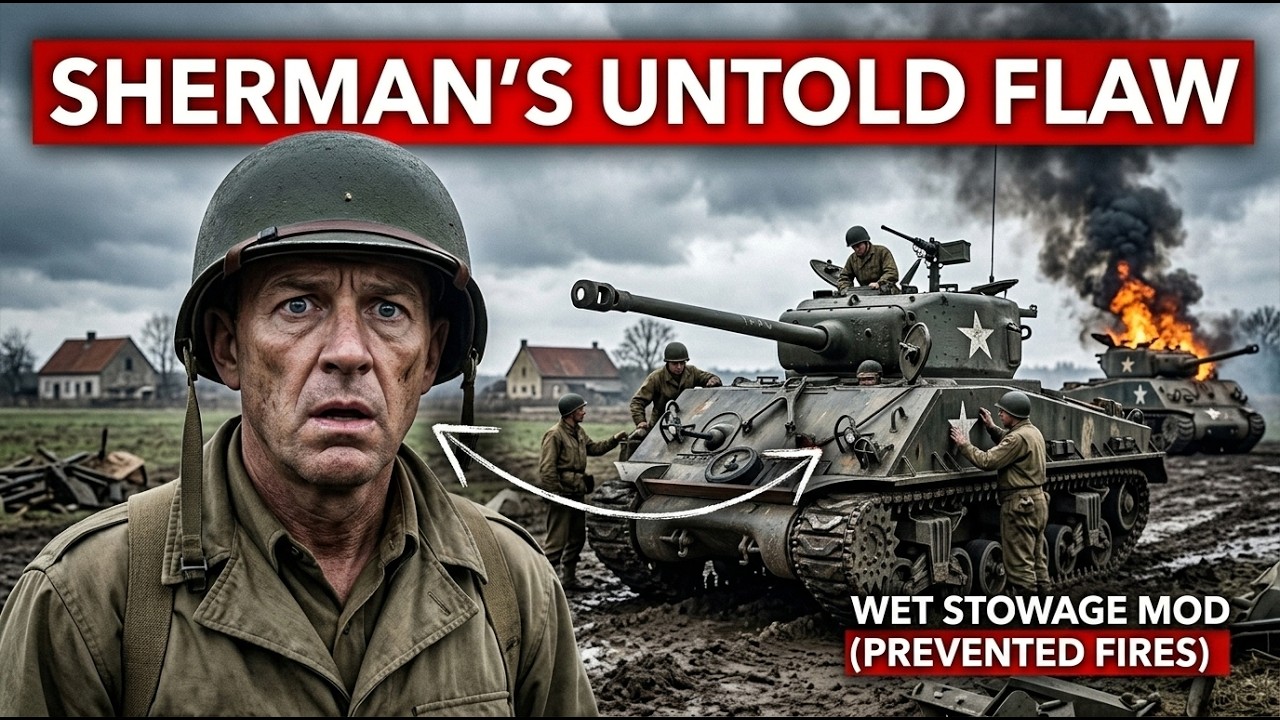
The third fix asked whether the ammunition had to be in the sponsons at all. It was called wet stowage, and it did two things at once. First, it moved the ammunition. The racks came out of the sponsons entirely and went down onto the floor of the hull between the sponsons, below the turret basket, the lowest and most central volume in the vehicle.
That position was protected by the tracks, the suspension, the road wheels, the sponson structure itself, and the geometry of the tank. A flank shot that would have gone straight through a sponson rack at chest height now had to get through several feet of tank first. Second, the relocated racks were enclosed in jacketed containers filled with a liquid, water with ethylene glycol as antifreeze and a corrosion inhibitor, around 30 gallons of it. The intent was that if a rack was breached, the liquid would flood over the propellant, absorb heat, and prevent one charge that had started to burn from setting off its neighbors.
The tanks were identifiable by their designations: the M4A1(76)W or M4A3(76)W. The W stood for wet. The first came off the production lines in January 1944 and began appearing in Europe from the Normandy fighting onward. While doing this, Ordnance fixed something else that mattered enormously to men trying to get out of a burning vehicle.
The hull was redesigned with a single-piece sloped glacis and critically larger hatches for the driver and bow gunner. The old small hatches were survivable in the sense that a man could theoretically get through one. The new ones were survivable in the sense that a large man in winter clothing with a shattered arm could get through one while the compartment behind him was on fire. And a loader’s hatch was cut into the turret roof.
On the original turret there had been no loader’s hatch. The loader stood on the left of the gun and had to get around the breech in the dark and smoke, reaching the commander’s hatch behind two men who were already using it. Crews complained loudly and repeatedly, and from late 1943 an oval loader’s hatch was added. The American medium tank had quietly gone from a vehicle with two usable exits for five men to a vehicle with four.
Here are the numbers. A dry-stowage Sherman that was penetrated burned somewhere in the range of six to eight times out of ten. A wet-stowage Sherman that was penetrated burned roughly one to one and a half times out of ten. The United States built around 49,000 Shermans, and American armored divisions lost thousands of them in the last year of the war.
A change in burn rate of that magnitude applied across that population is measured in thousands of men who went home. The modification was threaded into existing production lines at different companies in different states without stopping output. And then it arrived at the front, and nobody explained it to anybody. Tanks arrived from the replacement depot.
Some had the new 76mm gun, which men noticed because a bigger gun is visible. The stowage arrangement was different, but nobody arrived with the tanks to say this vehicle is roughly six times less likely to burn and here is why. There was no campaign, no notice pinned up in every tank park. It went out as an engineering revision through supply channels.
Three consequences followed. The first is that the false explanation survived the war intact. Crews went on believing it was the gasoline because nothing had ever contradicted it and because it was a satisfying story. They came home believing it and told their children.
In 1998, Belton Cooper, a retired officer who had served as an ordnance liaison officer with the Third Armored Division, published a memoir called Death Traps. He had personally seen more burnt Shermans than almost any American alive. The book argued with total sincerity the crews’ version of events. He was there.
He was wrong about the mechanism, and he was wrong because in four years nobody had ever sat him down and shown him the operational research. The wrong answer became the historical record. The second consequence cost lives at the time. A wet-stowage Sherman carried fewer rounds than a dry one.
Crews who preferred not to run out of ammunition made up the difference by carrying extra rounds loose on the turret floor or stacked in the sponsons where the old racks used to be. Every one of those loose rounds was outside the protection. A crew that had loaded a dozen extra shells for a big attack had, without knowing it, converted their protected tank back into a 1943 tank. Nobody had told them the racks were the point.
The third consequence is visible in every photograph from the winter of 1944. Crews piled sandbags on the front of their tanks, then logs, then spare track links welded on in slabs, then concrete poured into timber forms. Whole divisions did it. It accomplished very little and wrecked suspensions and final drives on a vehicle already at its weight limit.
Patton eventually prohibited sandbagging in Third Army. Men whose lives had just been saved by a change to a box under their feet spent their nights piling sand onto the front of the tank because nobody had told them where the danger actually was, while quietly undoing the change by stacking extra shells on the floor. Germany had the same problem and never solved it. The Panther carried its ammunition in the sponsons for precisely the reasons the Sherman originally did.
Its frontal armor was superb and its gun was better than anything the Americans fielded in numbers, and none of that helped when a shot came through the hull side and arrived in the ammunition. The Tiger stowed the same way with the same result. Nobody in Germany moved the racks to the floor. The German answer to survivability was more armor on the front, a superb answer to the tank you are shooting at across a field and no answer at all to the anti-tank gun in the hedge to your left.
The Americans were slow about guns, fast about survivability. The Germans were fast about guns and never asked the survivability question at all. Wet stowage is named for the water. The letter in the designation is a W.
But look again at what the modification actually consisted of. The racks came down out of the sponsons, out of the exact volume that flank hits pass through, and onto the floor behind the tracks, behind the suspension, under the turret basket, in the single most protected space in the vehicle. The strong reading, supported by the geometry, is that the relocation did the majority of the work. The water reduced the consequences of a rack being breached.
The relocation reduced how often a rack was breached at all. A fire that never starts does not need putting out. The single most effective life-saving modification in the American Armored Force was at its core a decision about where in a box to put another smaller box. There is no drama in that.
There is no photograph of it. It has no muzzle velocity and no armor thickness, and it does not appear in any comparison table of the tanks of the Second World War. And it saved more American tank crewmen than the 76mm gun, the Jumbo, the Easy Eight, and every field modification of the war combined. That is precisely why nobody was told.
Every other improvement in war announces itself. A better gun announces itself the first time you kill something you could not kill last week. Thicker armor announces itself the first time you take a hit and drive on. Survivability does not work like that.
The product of wet stowage is a fire that did not start. You cannot feel that. The crew of a wet-stowage Sherman that was penetrated in the Ardennes and did not burn got out, swore, walked back, drew a new tank, and never had a single reason to think anything unusual had occurred. From inside the tank, it was just a day when they were lucky.
The Sherman earned its reputation in 1943 and the first half of 1944 from the tanks that burned. It never earned it back from the tanks that did not, because nothing happened in those, and nothing is not a story. The men with the clipboards went home. Schonland went back to physics.
Swann went back to biology and ended up running a university and then the BBC. Belton Cooper, who spent his war among the wreckage and came away with the wrong cause, told the story he had been left with and told it honestly. He was never given the answer. And the crews who lived, the loaders and drivers and bow gunners who got out through the new large hatches of tanks that had failed to catch fire, went home believing to the end of their lives that they had survived a death trap by luck.
Some of them had. A great many of them had survived it because somebody they never met, working from data collected by somebody else they never met in a field in Normandy with a tape measure and a notebook, had worked out that the enemy was not the fuel.
