In the summer of 1462, Sultan Mehmed II, the conqueror of Constantinople, led an Ottoman army of roughly ninety thousand men across the cold waters of the Danube. Their target was Targoviste, the capital of Wallachia. They never reached it. Long before the city’s towers came into view, a smell rolled down from the hills, the sweet, heavy stench of meat left too long in the sun.
Then the sky darkened, not with clouds but with thousands of crows wheeling in slow black spirals. When the vanguard crested the final ridge, they found a valley turned into a forest of corpses. Twenty thousand human beings hung from thick wooden poles set in neat military rows that ran for miles. Men, women, soldiers, mothers with infants impaled on the same shaft beneath them.
This was the calling card of Vlad III. The blunt, grease-slicked stakes were designed not to kill quickly but to slide through the body’s organs, keeping the victim alive for days. Mehmed, the man who had broken the walls of an empire that had stood for a thousand years, looked at that valley, turned his horse around, and ordered the retreat. An entire war ended without a single arrow fired.
The stake had won. Public execution inside the city walls wore a different costume. It was a holiday. Bakers carried trays of bread through the crowd.
Fathers hoisted children onto their shoulders. These people came because something in their world had been broken by a crime, and they needed to see the world put back together. The state had been wounded, and the criminal would be unmade in daylight so the wound could close. For the very worst offenders, the state reached for the breaking wheel.
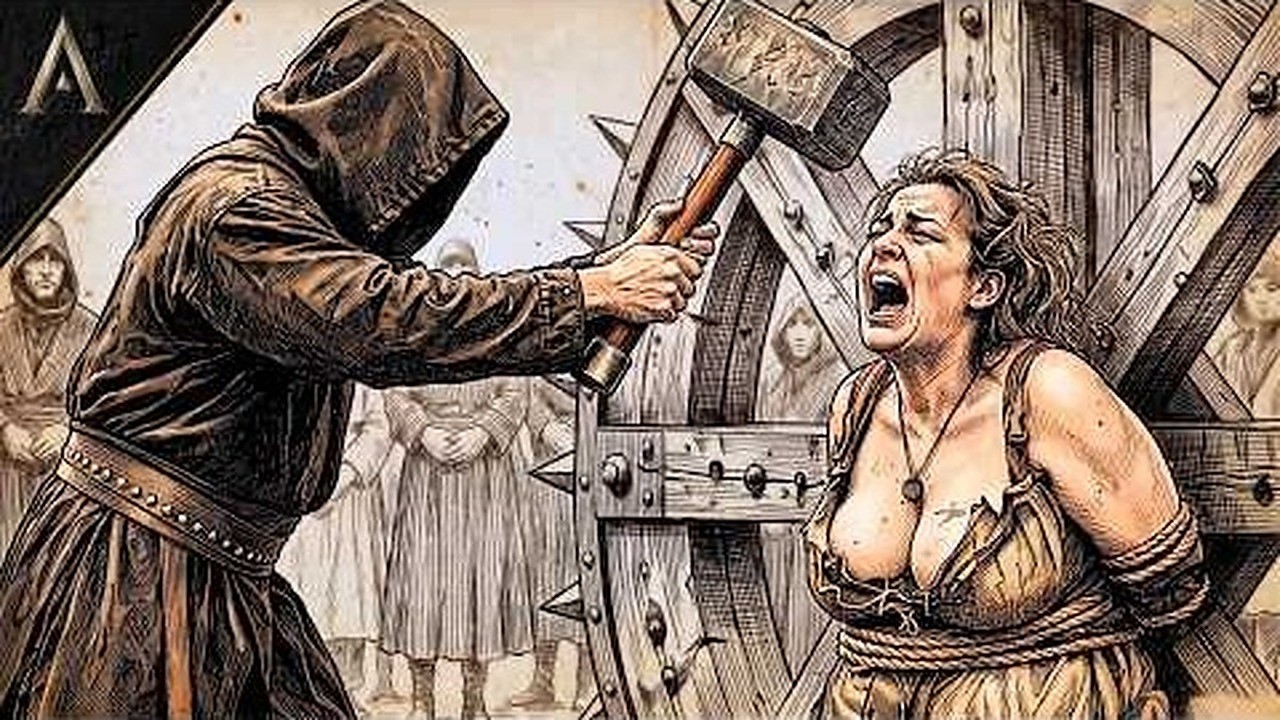
The executioner stretched the condemned across the boards, slid wooden wedges under each major joint, and brought an iron bar down into the gap below the shin. He worked methodically, breaking the long bones into jagged shards. Skill mattered. If the prisoner died too quickly, it was considered a professional failure.
The executioner then threaded the rubbery limbs in and out of the spokes of a wagon wheel, raised it on a tall post, and turned the prisoner to face the open sky. Vultures came almost immediately, beginning with the soft tissues. In 1589, a parish priest in southern Germany recorded watching a man survive on the wheel for nine days, calling for water until his throat tore open and only a hiss came through. The executioner was not a hooded brute but a craftsman.
Master Franz Schmidt of Nuremberg, who held the office from 1573 until 1617, kept a precise diary of his work. By the end of his life he had executed nearly four hundred people, and his pages read more like a surgeon’s notes than a killer’s confession. He knew which artery to spare so the show would last. He lived in a separate house on the edge of town because no respectable citizen would sit at his table, yet the same citizens trusted his hands to hold their moral universe in place every market day.
Some bodies were broken. Others were peeled. In 1571, on the island of Cyprus, the Venetian commander Marcantonio Bragadin had defended the city of Famagusta for almost a year against an Ottoman force that outnumbered his garrison many times over. When the city fell, the Ottoman general Lala Mustafa Pasha offered honorable surrender and safe passage, and the documents were signed.
Then he changed his mind. He ordered Bragadin’s nose and ears cut off, and the mutilated commander was thrown into a stone cell for two weeks. The executioner then tied him to a marble column and began to flay him, working a short curved blade from the soles of the feet upward. A shallow cut, only deep enough to separate the skin from the red muscle beneath.
Cut too deep and the prisoner would bleed out and waste the ceremony. The dense network of nerve endings that lets a person feel a breeze sits almost entirely inside the skin. When the skin is rolled away, those nerves are exposed, raw to the open air. Bragadin was awake the whole time, watching the skin slide off his calves, then his belly, then his back.
The body without skin cannot hold its temperature, and even in the Cypriot heat a flayed human enters hypothermia within minutes. Bragadin held on until the knife reached his waist. Then his heart stopped. The Ottomans took the entire skin, stuffed it with straw until it held the shape of a man, dressed it in his old uniform, and paraded it through the streets on the back of a cow.
Later they raised it to the top of a war galley’s mainmast as the ship sailed home. The kings of England were paying attention. The English crown developed its own signature, a sequence so specific it had its own name in the law books: hanging, drawing, and quartering, reserved above all for treason. Treason was understood not as an ordinary offense but as a tumor growing inside the body of the kingdom, and the surgery had to be done in public so every other cell would behave.
On August 23, 1305, the Scottish knight William Wallace was brought into London in chains, stripped, tied to a wooden hurdle, and dragged by horses through the streets to the gallows at Smithfield. Cobblestones ripped the flesh off his back. The noose was placed around his neck, and he was lifted slowly, not to break his spine but to slowly close his throat. Just before he lost consciousness, the executioner cut the rope.
Wallace crashed to the dirt, gasping. Fully awake again, the executioner cut off his genitals and tossed them into a brazier of coals. Then he opened the abdominal cavity and began to pull out the small intestine, hand over hand, feeding each loop into the fire. Only after that did he reach up under the ribs for the lungs and heart, then the heavy axe fell.
The head was dipped in tar and driven onto an iron spike above London Bridge, where every traveler crossing the Thames had to walk under it. For those who killed kings, the state reserved something even more elaborate. In 1584, a young man named Balthasar Gerard fired a pistol into the chest of William the Silent, Prince of Orange. The Dutch authorities wanted to take him apart in a sequence designed to undo his existence one organ at a time.
They hung him from the ceiling by his wrists with a three-hundred-pound stone block tied to his big toes, dislocating his shoulders and pulling his spine apart. Then they laced heavy leather sleeves over his lower legs and poured boiling animal fat over them, cooking the muscle inside. The next morning, his right hand was pressed against a red-hot iron rod until it was gone. Then came the pincers.
Two assistants drew long iron tongs from the coals, clamped them onto a section of his chest, twisted, and pulled. They did this six times across his arms, thighs, and torso, opening windows down to his ribs without puncturing the lung underneath. He was kept conscious through all of it. At the end, the executioner cut his chest open, lifted out the still-beating heart, and slapped Gerard across the face with it before he died.
The English crown ran its own experiments with heat. In 1531, King Henry VIII faced a problem that frightened him more than any battlefield. A cook named Richard Roose was accused of slipping poison into a pot of porridge intended for the Bishop of Rochester. Poison ignored guards, stone walls, and the divine right of kings.
Henry pushed through a special act of Parliament elevating poisoning to treason with one mandatory sentence: death by boiling. Roose was stripped naked, bound, and lowered into a massive iron cauldron at Smithfield. The executioners did not drop him in. They lowered him to the ankles, lifted him out, lowered him to the knees, lifted him out.
They cooked him in stages, like meat being carefully prepared. The flesh sloughed off the bone in long ribbons. He drowned in boiling water while pieces of his body drifted around him. Cruelty was a language, and everyone in the kingdom was fluent.
The square was a school, and the executioner was the teacher. The lesson, repeated in different translations week after week, was obedience. The state used the absolute physical limits of the human animal to measure its own power. They engineered an entire architecture of pain.
The platform was always raised high, forcing every spectator to look up. The steps up to the block were designed to break a person before the executioner ever touched them. If a prisoner fainted, a bucket of cold water hit the face and the procedure resumed. The performance had to be completed exactly as written in the sentence.
The condemned was required to feel every weight of the crown’s justice with their eyes open. But public terror had one weakness, and the smartest tyrants knew it. It was public. Sometimes a victim refused to perform.
A man stood on the wheel with broken legs and would not scream. A woman stepped up to the cauldron and simply prayed until the boiling closed her throat. When that happened, the entire calculation reversed. The crowd did not see a criminal being unmade.
They saw a saint being born, and a martyr is a torch handed forward to the next generation. The truly cold architects of power understood this danger. The deepest way to destroy a human being was not to take them apart in front of cheering crowds but to take them somewhere no one would ever see them again and erase them entirely in the dark. The oubliette, from the old French word for forgetting, was a shaft cut into the earth.
The crown was not interested in punishing you. It was interested in deleting you from the record of the living. In the early 1500s, the O’Carroll clan ordered a hidden shaft cut into the floor of Leap Castle in the Irish Midlands. The drop was eight feet straight down, and the floor at the bottom was studded with sharpened wooden stakes.
When workmen finally pried open the chamber centuries later, they hauled away cartload after cartload of human bones. The human brain is not designed to function in a vacuum. Within roughly two days, the prisoner starts to hear things that are not there. Paranoia comes next, total and fast.
You begin to speak aloud just to confirm you still exist because your own voice becomes the only evidence you have left. The body begins to chew its own muscle for fuel. You wither in the dark slowly, with no one ever coming to remove the dead. In the Italian city of Pisa in 1289, Count Ugolino della Gherardesca was locked inside a stone tower with his two grown sons and two grandsons.
Five members of one bloodline behind one door. The Archbishop Ruggieri ordered that door nailed shut from the outside, and the key was thrown into the Arno River. The body takes a long time to die from hunger. The mind takes only seconds.
For three days, the worst of it was the cramping in the gut. By the fourth day, the cell began to smell of acetone, the chemical signature of a human being burning their own fat for survival. Ugolino watched his children fade in front of him. His son Gaddo finally crumpled to the floor and asked his father why he would not help.
Ugolino had no help to give. His sons, with what little voice they had left, begged him to feed on their bodies after they died. Ugolino lost his sight on day six and crawled in slow circles calling each of their names into the dark. He died on the eighth day.
The same erasure was waiting for the highest born. In December 1610, the Hungarian noblewoman Elizabeth Bathory was arrested after years of rumored killings of young women in her care. The accusations ran into the hundreds, but Bathory was too high in rank for a public axe. Instead, masons bricked up her windows and doorways at Csejte Castle, leaving a single narrow opening just wide enough to slide a plate of food through.
The woman who once ruled an entire estate paced inside a stone box for almost four years. They took her mirrors first, then every servant and every voice that was not her own. She lost the ability to tell winter from summer. The stone shell that had been her bedroom became her tomb.
They found her body in August of 1614. Darkness was one method. Sleeplessness was another. The inquisitors of Spain and Italy built an entire science around stealing rest from the human body.
Their favorite tool was called the heretic’s fork, a leather collar with an iron rod fitted with two sharp prongs. It froze the head in place. The moment the prisoner’s head nodded forward in sleep, the weight of the skull drove the prongs into the meat of the throat. A human being cannot survive long without sleep.
After roughly seventy-two hours, the brain begins to fail. The prisoner sees things that are not there. The inquisitors stood nearby, rested and well-dressed, asking the same questions over and over. After enough hours, the prisoner would confess to anything at all, inventing crimes from thin air just for permission to close their eyes for one hour.
Sometimes, against all odds, the mind held. The old common law of England had a strange door built into it. Before any subject of the Crown could be put on trial, they had to enter a plea. If the accused refused to speak, the trial could not legally begin.
No trial meant no conviction, and the Crown could not seize the family’s land. So the law devised an answer: peine forte et dure, hard and forceful punishment. On March 25, 1586, in York, a woman named Margaret Clitherow stood accused of hiding Catholic priests. She would not enter a plea, knowing that any plea would end with her property seized and her children left destitute.
The court sentenced her to the press. They laid her flat on her back, tied her wrists and ankles to iron rings, placed a sharp stone under the small of her back, and laid a heavy oak door across her chest. Then they began to load the weights, one iron weight at a time. Her ribs flexed inward, then began to snap.
The stone ground upward into her spine. By the end, roughly eight hundred pounds of iron sat on top of her. The jagged ends of her own bones punctured her lungs from the inside. She drowned in her own blood.
She never spoke a single word in court. The state used pure physics to permanently rewrite the wiring of a man’s body and mind. In 1513, the political philosopher Niccolò Machiavelli was arrested in Florence on suspicion of plotting against the Medici. They introduced him to the rope, the strappado.
His arms were bound behind his back, and a rope ran up to a pulley in the ceiling. The executioner pulled until Machiavelli’s feet left the floor, hanging the entire weight of his body from two shoulders rotated backward into impossible angles. The rotator cuff tore. Then came the drop.
The executioner released the rope, and just before the feet touched the ground, pulled it tight again. The energy of the fall transferred in one violent jolt into both shoulder joints. Machiavelli endured six separate drops. He never gave the Medici a single name.
They eventually let him go, but his shoulders were finished forever. He spent the rest of his life with arms that ached in every cold morning, writing his political masterpieces with a hand that trembled across the page. The Judas Cradle was a favorite device on the Italian Peninsula throughout the sixteenth century. The seat of the stool was a sharp wooden pyramid capped with a polished brass point.
The executioner lowered the prisoner onto the point, not in a drop, but an inch at a time. The prisoner’s own body weight forced the wedge upward into the body’s interior. The moment the prisoner began to lose consciousness, the executioner pulled the rope tight, lifting the body an inch off the wedge, offering water, allowing the ordeal to be drawn out across three full days. If the wedge itself did not kill the prisoner, the infection that followed almost always did.
The common thread running through every method was this: the state took something the human body fundamentally needs in order to live and turned that very need into the weapon. The need for light became the weapon at the bottom of the oubliette. The need for sleep became the weapon hanging from a leather collar. The need to protect your children’s future became the weapon stacked on top of a wooden door.
The hidden tortures were engineered to isolate the prisoner and erase the witnesses, making every scream completely private. Without an audience, no martyr can be born. There is only a person alone in the dark, sliding quietly into a madness that no one will ever record. But there was one final tier of medieval justice, reserved for the absolute enemies of the crown and the church.
The executioners in this tier put down the hammer and picked up surgical saws and carefully calibrated flames. They industrialized the production of human suffering. The saw survived for more than a thousand years. Two executioners, one long iron crosscut saw.
The condemned was stripped, hoisted upside down by the ankles, and tied to two wooden posts with the legs forced into a wide V. The inversion was the entire secret. The heart, no longer fighting gravity, poured blood into the head. The over-oxygenated brain could not fall into shock.
It was held in a state of brutal awareness while the rest of the body was destroyed. The executioners placed the saw at the base of the groin and began to draw it back and forth in long, even strokes. The blade reached the pelvic bone, the densest bone in the human skeleton, and the work became physical labor. The saw breached the bladder and tore open the intestines.
The prisoner was still awake, still feeling it, until enough blood finally left the body to overcome the forced consciousness. Sometimes the state wanted theater, a precise reversal of the crime itself written in the body of the criminal. In Transylvania in 1514, a peasant named György Dózsa rose up at the head of an enormous uprising against the Hungarian nobility. He took castles and began to call himself king.
The nobles eventually broke his army, and Dózsa was captured. The warlord John Zápolya decided that an execution by sword would be a waste. The blacksmiths forged a heavy iron throne, a crown, and a scepter. The regalia was heated until it glowed cherry red, and Dózsa was forced onto the throne.
The fat under his skin liquefied and ran down between the iron bars. The executioner placed the burning crown on his head and forced the red-hot scepter into his right hand. Then Dózsa’s own senior commanders, starved for a week, were dragged into the courtyard and ordered to eat their king. They tore strips of roasted meat from his ribs with their bare hands and swallowed.
Dózsa watched his closest followers consume his body while he was still breathing, and he died on the iron chair he had wanted so badly. Fire was always the problem child of the executioner’s catalog, wild and unpredictable. The state wanted fire that obeyed orders. On March 18, 1314, in Paris, Jacques de Molay, the last grand master of the Knights Templar, knelt in chains.
King Philip IV of France owed the Templar order a fortune so vast he had no realistic way to repay it. He had accused the entire order of heresy. De Molay had spent seven years in a stone cell, and under torture he had signed a confession. Now he had taken it back in public, naming the king and the pope as liars.
The executioners built the pyre on an island in the River Seine using green wood and charcoal, which smolder rather than flash into roaring flame. The heat came up slowly. The soles of his feet cooked first. Because the wood was green, he could still breathe and could watch his own legs slowly turn black.
The blood inside his veins boiled and burst beneath the skin. He burned there for hours, fully awake. They say he cursed the king and the pope through the smoke, naming them by name and calling them to meet him before the throne of God within the year. Both of them were dead within twelve months.
In 1447, the Duke of Exeter introduced a new device into the dungeons of the Tower of London. It was little more than a winch laid on its side, with two rollers, toothed gears, and a long wooden lever. The English called it the rack. The prisoner was stripped, laid flat, and tied to the rollers by the wrists and ankles.
The executioner pulled the lever. The tension climbed. The cartilage in the knees began to tear. The shoulders ground against their sockets.
The executioner stopped, asked his question, and pulled again. Both shoulders dislocated at once. The hips wrenched out of their sockets. The vertebrae of the spine pulled apart.
The executioner locked the gears and left the prisoner there for hours, sometimes overnight. When the guards released the ropes, the limbs did not snap back. Many prisoners never walked again. The state had used pure mathematics, force applied across distance, tension overcoming resistance.
The Spanish engineers built a device to attack the spine itself, the garrote vil. A solid wooden chair bolted to a post, an iron collar mounted at neck height, and a long iron screw. The prisoner was seated, the collar closed around the throat, and the executioner turned the brass handle. The metal pressed inward on the windpipe.
The eyes bulged. The jugular veins were crushed. But the real target was the two highest vertebrae of the cervical spine. The instant those bones broke, the spinal cord was pinched, and the heart stopped.
There was no spray of blood, no swing of an axe. The executioner simply turned a screw, treating the human body the way a mechanic treats a stuck engine. The highest peak of biomechanical destruction in the medieval world may belong to myth, blurring into anatomy. In 867, the Viking warlord Ivar the Boneless took the city of York and hunted down King Ælla of Northumbria.
Years earlier, Ælla had captured Ivar’s father, the legendary Ragnar Lothbrok, and thrown him into a pit of vipers. Ivar demanded the blood eagle. Modern historians still argue over whether this ritual was ever truly performed, but the anatomical mechanics are precise enough to be chilling either way. Ælla was thrown face down and lashed to stakes.
The executioner cut deep incisions down both sides of the spine, pulling the muscle aside to expose the ribs. Then, with a chisel and mallet, he separated each rib from the spine without puncturing the lungs beneath. When every rib was freed, he pulled outward, cracking the rib cage open into the shape of a pair of bloody wings. Ælla was still alive, his lungs exposed to the cold air.
The executioner reached in, lifted the lungs out, and draped them over the broken ribs, where they continued to expand and contract, filling and emptying like wet wings beating slowly in the cold. The shock collapsed the heart within minutes. Ivar had not just killed an enemy king. He had carved a message into anatomy itself.
None of this was random. None of it was the work of brutes who simply liked blood. Every device, every ritual, every carefully timed second of consciousness was a precise calculation. The state needed a measurable amount of fear to control a measurable amount of population.
The executioner was an applied scientist, calibrating rope, flame, and iron the way a clockmaker calibrates a movement, hunting for the exact ratio that would extract the maximum number of waking seconds from a dying man. The shape of the skull that holds your brain is identical to the shape of the skull that held the brain of the master executioner of Nuremberg. The genetic code is the same. The capacity that built the rack and lit the green wood and forged the iron crown is not buried in the past.
It is sitting quietly, dormant, inside the operating system of every single one of us, sleeping under a thin crust of laws, contracts, courts, and cameras. When the lights go out, when the institutions crack, when one set of human beings is allowed to do whatever it wants to another with no one watching and no one stopping them, the old machinery wakes back up. Civilization, every version of it that has ever existed, is a temporary truce.
