It must have been a sound the construction crew had never expected to hear. In the fall of 2005, they were digging a simple wastewater pit for a university campus expansion on a quiet stretch of Stockton, California. But a few feet beneath the soil, their machine struck something that was never supposed to surface again. Human bones.
Before the day was finished, investigators realized this was no isolated body. The digging stopped. The site was cordoned off. And in the weeks that followed, officials would estimate that as many as thirty people lay buried beneath that ground without headstones, without names, without a single record to say who they had been.
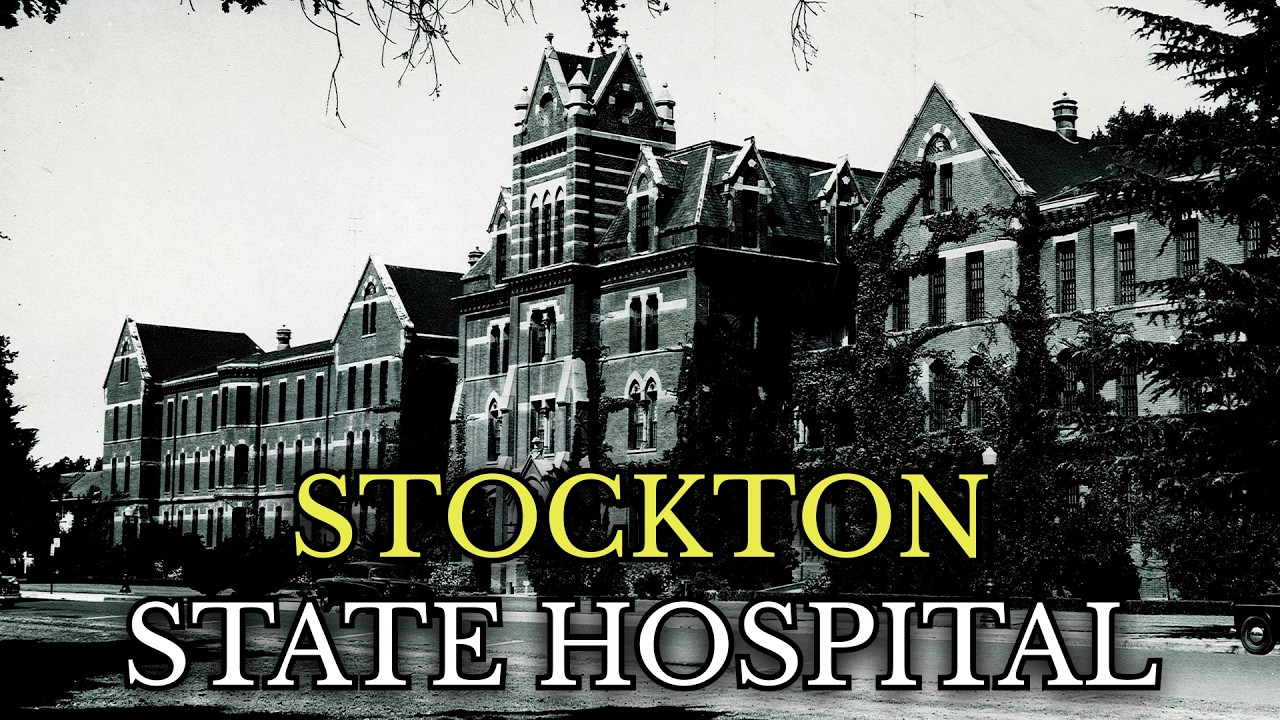
They had been patients. Forgotten patients of California’s very first insane asylum, a hospital that once stood on this same soil and had been closed for nearly a decade. For much of its history, that hospital had not treated the people inside its walls as though their comfort or their dignity mattered. Patients labeled as dangerous were kept in basement dungeons.
At meal times, staff handed out spoons and nothing else, terrified that a fork or a knife might become a weapon. That single rule outlived generations of superintendents, still enforced in a dining hall with no heat at all until 1950. This is the story of Stockton State Hospital. A place built to bring order to the chaos of the gold rush.
A place that could not even keep track of its own dead. To understand how that hospital came to exist at all, you have to go back to the very beginning of California itself, to a territory transformed almost overnight by the discovery of gold. In January of 1848, gold was found in the foothills of the Sierra Nevada. And within months, the world came rushing in.
Men left farms in the east, ships in New England harbors, villages in China, mining towns in Mexico and Chile, and entire lives behind in Europe, all chasing the same impossible promise. By the end of 1849, California’s population had exploded from a few thousand to well over 100,000 people, most of them strangers to the land and to each other. Fortunes were won in a season and lost in a single night of cards. Whole communities sprang up around a riverbed, then vanished just as fast once the gold ran dry.
It was a world built on hope, and hope does not curdle quietly. Men who had crossed oceans and continents on nothing but the promise of striking it rich watched that promise collapse in front of them. They lost claims, savings, and family they would never see again. Loneliness settled into mining camps that had no churches, no doctors, and no one who knew a man’s name before he arrived.
Alcohol was cheap and everywhere. Violence was common. And for a portion of these men and women, the strain of it all became too much for the mind to carry. Some grew delusional.
Some grew violent. Some simply stopped functioning, wandering camps and streets in a state no one around them knew how to name, let alone treat. California in those years had almost nothing in place to care for them. The territory that became a state on September 9th, 1850, was still assembling its most basic institutions: courts, roads, schools.
Mental illness was left to fend for itself. Families with money might send a troubled relative back east or quietly confine them at home. Everyone else ended up in county jails, poor houses, or simply on the street because there was nowhere else for them to go. Jails in particular became unofficial asylums, holding people who had committed no crime except the crime of falling apart in public.
By 1851, lawmakers in the new state legislature could no longer ignore the problem. The scale of it had become impossible to overlook. A state built almost entirely of transplants, most without family nearby to care for them if they broke down, and no public institution equipped to hold, let alone treat, the mentally ill. So the legislature authorized the creation of what would become California’s first public hospital dedicated to the insane, to be built in the young river town of Stockton.
A fitting choice, since Stockton itself functioned as a gateway to the southern mines, a place where the human cost of the gold rush regularly passed through on its way to somewhere else. The land for the new hospital came from one of the men most responsible for Stockton’s very existence. Captain Charles Maria Weber, the town’s founder, donated 100 acres for the project, a substantial gift that placed the asylum on the eastern edge of a city still finding its shape. Weber had built his fortune and his name as Stockton’s founder, supplying and provisioning the very miners whose broken dreams would eventually fill the hospital he helped bring into being.
Now some of that same wreckage would be housed on land bearing his gift. Construction began that same year, and what emerged first was not yet the grand institution the state would later boast about. It opened modestly as Stockton General Hospital, tasked with caring for the state’s sick and its mentally ill under one roof. It would take only a couple of years before the mission narrowed and the name changed to match it.
But the earliest incarnation of the hospital was born out of pure necessity, a stop-gap solution for a state that had no time to plan carefully. California did not build this hospital because it had a vision of enlightened care. It built the hospital because it had run out of anywhere else to put the people the gold rush had broken. That distinction, born in urgency rather than ideals, would shape almost everything that followed within its walls.
In its earliest years, the hospital surprised almost everyone who expected the worst. On May 17th, 1853, Stockton General Hospital was formally renamed the Insane Asylum of the State of California, a change that made its true purpose unmistakable. The buildings themselves were modest by later standards, simple wards built quickly and cheaply to meet an urgent need with little of the architectural grandeur that would define the institution decades later. But inside those plain walls, the physicians who ran the asylum in its first years followed a philosophy that would feel startlingly familiar to modern eyes.
It was called moral treatment, and it stood in sharp contrast to the popular image of the nineteenth-century asylum as a place of chains and cruelty. The doctors who embraced moral treatment believed that people suffering from mental illness were not beyond help. They believed structure, kindness, useful work, clean surroundings, and a calm environment could do more for a troubled mind than restraint or punishment ever could. The goal was never to warehouse patients.
It was to stabilize them and return them to their families and their lives as quickly as possible. The numbers from those early years back up the philosophy in a way that is almost hard to believe. Of the more than 2,000 patients admitted to the asylum between 1852 and 1862, nearly 40 percent were discharged within six months. Some of that can be explained by the nature of the patients themselves.
A significant share involved men whose breakdowns were tied to heavy drinking rather than a persistent mental illness, and those cases often resolved once the alcohol left their system and a period of forced sobriety took hold. But the discharge numbers also reflected something more deliberate. Physicians who genuinely believed recovery was possible and who built their treatment around that belief instead of around permanent confinement. For a hospital built out of desperation, this was no small achievement.
It suggested that Stockton might have become something genuinely humane, a place that treated its patients as people capable of healing rather than as problems to be contained. But the asylum’s leadership in these years was anything but stable. And nothing captures the volatility of the institution’s early culture quite like what happened in April of 1856. By that point, Dr.
Samuel Langden had become the asylum’s second superintendent, the man responsible for overseeing every aspect of patient care and hospital operations. Beneath him worked Dr. William Ryer, his assistant physician, a man who shared responsibility for the wards but answered to Langden’s authority. Precisely what drove the two men into open conflict has been lost to time, buried under a century and a half of incomplete records.
But whatever the cause, the dispute between them escalated far beyond a professional disagreement. The two physicians settled their conflict the way gentlemen of the era sometimes did when words failed them. They fought a duel. It was an almost unbelievable turn for two doctors sworn to heal the sick.
Yet it happened. And it happened with real consequences. When the shooting was over, Langden had taken a bullet to the knee, an injury serious enough to end his tenure as superintendent. He was eventually replaced, his medical career at the asylum finished not by a failure of treatment, but by a bullet fired in anger by his own subordinate.
The incident says something uncomfortable about the institution behind the philosophy. Moral treatment, for all its genuine promise, was only as steady as the men enforcing it. And those men were not immune to the same passions, grievances, and violent impulses that could consume anyone else. An asylum meant to bring calm to disordered minds had a leadership structure that could collapse into gunfire over a dispute no one bothered to record for posterity.
Stockton would go on to see a long line of superintendents after Langden, some more capable than others, each one inheriting a growing hospital and a growing burden. The early promise of moral treatment did not disappear overnight. But the duel of 1856 stands as an early crack in the institution’s foundation, a reminder that the asylum’s ideals and its reality would not always match, and that the widening gap between the two would only grow more dangerous as the hospital swelled far beyond what its founders had ever imagined. California’s population kept climbing through the 1850s and 1860s, and with it climbed the number of people the state deemed unfit to live outside an institution’s walls.
The modest wards built in the asylum’s earliest years, designed for a much smaller population, quickly became too small to hold the people arriving at its gates. Nowhere was that strain felt more acutely than in the wards built to house women. Work on a proper female building began in 1865, and almost immediately the project revealed just how difficult it was to build anything quickly inside a state institution running on a limited budget. The south wing was the first piece to take shape, finished in 1867.
The center and north wings would take far longer. The center wing did not open until 1868, and the north wing was not completed until 1874, nearly a decade after construction on the entire project had begun. When the building was finally finished in full, the total cost had reached $249,500, an enormous sum for a young state still finding its financial footing. And the completed structure could comfortably house 325 patients.
Comfortably, however, was the operative word. And comfort rarely lasted long inside Stockton’s walls. Even as new wings opened, the pace of admissions outstripped the pace of construction. While the female building crawled toward completion, one wing at a time, conditions inside the hospital’s existing wards, particularly on the men’s side, grew worse by the year.
Overcrowding became more than an inconvenience. It became a defining feature of daily life inside the asylum. With too many patients and not enough rooms to hold them, staff began placing chairs and beds directly in the hallways, turning passageways meant for movement into makeshift living quarters. Patients considered difficult to manage were often strapped into these hallway chairs for hours at a stretch, restrained not in a private room but in a corridor, left to sit in semidarkness.
The building itself contributed to the gloom. Despite its scale, the entire structure contained only two chimneys, and heat and light were concentrated in a handful of spaces. Marble fireplaces warmed the visiting rooms, the staff sick room, and select wards, while other corners of the building sat cold and dim for hours on end. A patient restrained in a hallway chair was left in the shadows, both figuratively and otherwise.
The pressure on the men’s wards became so severe that the hospital could not afford to wait for a proper brick building to be designed and funded. In 1869, administrators authorized a stop-gap solution, a row of wooden structures thrown together and known collectively as the cottage ward. These buildings were never meant to be a long-term answer. They were plain, hastily constructed, and clearly temporary in both design and spirit.
Yet they ended up housing 160 men for years, far longer than anyone likely intended when the first boards went up. The cottage ward captures the pattern that would define Stockton for decades to come. A crisis of overcrowding would emerge. A quick, cheap fix would be built to relieve the immediate pressure.
And that supposedly temporary fix would remain in use for years because a permanent solution was slower, more expensive, and less urgent to the people controlling the state’s purse strings. Patients paid the price for that gap between urgency and permanence, living in wooden cottages never designed to last or strapped into chairs in unheated hallways, while officials debated budgets and architectural plans. By the mid-1870s, with the female building finally complete and the cottage ward still standing far past its intended lifespan, Stockton had become something its founders likely never envisioned. Not a single asylum, but a patchwork of buildings assembled piece by piece under pressure.
Each addition arriving a step behind the need that demanded it. The hospital was growing, but it was growing the way a wound grows when it is never properly closed, expanding outward under strain rather than healing from within. And on the men’s side of the grounds, a very different kind of building was about to rise, one that would come to define Stockton’s darkest reputation more than any other structure on the property. That building rose on Grant Street between Acacia and Flora, and it opened in 1884.
Officially, it was the men’s building, the second structure raised specifically to house male patients. Unofficially, everyone who worked there or lived inside it called it the Bricks. It was built to hold 387 patients, a number that made it the largest single ward on the entire property. And it was here that the gap between the hospital’s founding ideals and its daily reality became impossible to ignore.
In its basement, the Bricks contained a set of rooms that staff at the time referred to as dungeons. Patients considered the most severely disturbed men, the era’s staff labeled them maniacs, were confined below ground, away from daylight, away from the wards where quieter patients moved with at least some freedom. The basement rooms offered little beyond four walls and a door. There was no pretense here of moral treatment, no talk of structure or kindness restoring a troubled mind.
This was containment built on the assumption that some patients were too dangerous to be treated as anything other than a threat to be locked away. That same assumption shaped one of the strangest and longest-lasting rules in the hospital’s history. At meal times, patients in the Bricks were issued only a spoon, no fork or knife. Staff feared that a fork’s tines or a knife’s edge could become a weapon in the wrong hands, turned against an attendant or another patient in a moment of violence.
It was a safety measure born of genuine concern. But it also reduced every meal to an exercise in survival, not dignity. An entire population of grown adults eating whatever was placed in front of them with a single blunt utensil, day after day, year after year. And this was not a policy adopted briefly and abandoned once cooler heads reconsidered.
The spoon-only rule persisted for decades, written into the rhythm of institutional life long after the men who first imposed it had died or moved on. The physical conditions inside the dining hall matched the bleakness of the rule itself. For all the money the state had poured into brick and mortar, into towers and wings and marble fireplaces elsewhere on the grounds, the dining room in the Bricks had no heating system at all. Patients sat down to eat in a room that offered no defense against California’s cold winter mornings, shivering through meals in a building meant to shelter them.
This was not a temporary hardship endured during a single harsh season while repairs were arranged. It continued for generation after generation of patients, a basic comfort withheld not by accident but by institutional neglect, until 1950, when heat finally reached the room. By then, patients had been eating cold meals in a cold hall, spoon in hand, for sixty-six years. Recreation arrived only after an extraordinarily long wait.
It was not until around 1954 that the hospital established its first dedicated club room inside the Bricks, giving patients something resembling a communal space for leisure rather than confinement. For seventy years, the building’s primary purposes had been housing, feeding, and containing. Only in its final active decade did anyone formally carve out space for patients to gather and pass the time as people, not as cases to be managed. Structurally, the Bricks carried a certain grandeur, even amid its grim reputation.
The building originally rose with three steeples along its roofline, a detail that gave it almost the silhouette of a church, not an asylum ward, an odd visual contradiction for a place built around dungeons and spoons. That architectural detail would not survive the building’s history intact. And the story of what happened to those steeples belongs to a darker chapter still to come. It was proof that Stockton’s founding language of moral treatment, of structure and kindness restoring the mind, had not traveled evenly across every ward in every decade.
In some corners of the institution, patients were still cared for with genuine effort. In others, particularly here, behind brick walls on Grant Street, the hospital had settled into something closer to warehousing, a system built around managing risk rather than nurturing recovery. And as conditions like these persisted year after year, largely hidden from the public eye, it would eventually take an outsider willing to walk through the front doors as a patient, not a visitor, to expose exactly what daily life inside Stockton had become. That outsider arrived in April of 1888, and he came with a plan few reporters before him would have dared to attempt.
His name was Frank A. Peltrit, and he worked as an investigative reporter for the San Francisco Examiner, a newspaper that had built its reputation on precisely this kind of daring, immersive journalism. Peltrit’s assignment was as simple as it was extraordinary. He would fake his own insanity, submit to whatever process the state used to commit a person against their will, and get himself admitted into the very institution this story has already described in such unflattering detail.
Then he would live, eat, and sleep as a patient, watching everything until he could find a way back out to tell the public what he had seen. The plan required real nerve. Committing oneself to a nineteenth-century asylum was not a stunt with an easy exit. Once inside, a patient’s word carried little weight, and the very act of insisting you were sane could easily be dismissed as exactly the kind of delusion the hospital existed to treat.
Peltrit understood the risk, and he took it anyway. He was admitted, and for several weeks he lived inside Stockton State Hospital as one of its patients, observing the wards, the staff, the routines, and the other men around him from the inside rather than through the sanitized version. His release, when it finally came, was arranged by a colleague working the story from outside the walls, someone who could vouch for him and secure his exit once enough had been seen and enough time had passed. What Peltrit published afterwards surprised many readers.
And in some ways, it still surprises people examining the hospital’s history today. Given everything happening inside institutions like Stockton at the time, readers might have expected a searing exposure of cruelty and horror. Instead, Peltrit’s account was on the whole favorable. He wrote that his weeks inside had been better than he expected going in, a striking admission from a man who had entered with every incentive to find and report the worst.
He did not describe a house of chains and screaming. He described a functioning institution doing its best within real constraints. That did not mean Peltrit found nothing worth criticizing. His recommendations pointed to specific practical gaps in the hospital’s operation.
He believed the asylum needed workshops, some structured form of labor or purposeful activity to occupy the hundreds of patients who otherwise had little to do with their days beyond sitting in wards. He noted the dining hall menu needed more variation, an early, almost mundane echo of the same institution that was handing out spoons alone at mealtime and no heat to eat by. He called for more physicians on staff, recognizing that the ratio of doctors to patients left little room for the kind of individualized attention moral treatment had originally promised. And he pushed for closer supervision and better training of the attendants who spent the most hours with patients, the men and women whose daily conduct determined what life inside Stockton actually felt like.
Peltrit’s report matters not because it revealed some hidden atrocity, but because of what it reveals by omission. Here was a trained journalist who lived inside the institution specifically to find its failures. And what he found was a hospital that was flawed, understaffed, monotonous, and in need of reform, rather than one defined by overt brutality. It suggests that the darkest parts of Stockton’s history had become so normalized by 1888 that even a determined undercover reporter did not single them out as scandal.
They were simply how the hospital operated, unremarkable enough to escape a headline. And that quiet normalization would prove far more dangerous in the decades still to come, as the state began reaching for solutions to overcrowding that went well beyond spoons and cold dining halls. By the early twentieth century, California had settled on a new kind of answer to the problem that had haunted Stockton since its founding: the relentless, never-ending overcrowding of its wards. It was not an answer rooted in more buildings or more staff or more funding.
It was rooted in the belief, embraced by lawmakers and physicians across the country during this era, that mental illness and so-called feeble-mindedness could be bred out of the population entirely if the state prevented certain people from having children. In 1909, California passed a sterilization law, becoming the third state in the nation to give its institutions this authority. The law empowered superintendents at state hospitals to authorize the sterilization of patients under their care, framed by its supporters not as punishment but as a benefit both to the state and to the patients themselves. At the time the law took effect, California operated five state hospitals for the mentally ill alongside a separate home for patients classified as feeble-minded.
Every one of those hospitals gained the power to sterilize the people inside its walls, largely at the discretion of a single administrator. What followed was staggering in scale. By 1921, California alone accounted for roughly 80 percent of all sterilizations performed in the entire United States, a statistic that placed the state at the very center of the nation’s eugenics movement. And among California’s own institutions, Stockton did not merely participate.
It led. Stockton accounted for nearly half of every sterilization performed statewide. By some estimates from the 1920s, Stockton alone was responsible for more than 40 percent of all sterilizations carried out in California up to that point, an extraordinary concentration of authority resting in the hands of whichever superintendent happened to be running the hospital at the time. The scale of the institution made this possible.
Between 1910 and 1955, the total population held across California’s mental hospitals grew more than fivefold, climbing from roughly 6,800 patients to over 36,000. By 1940, the state’s mental hospitals alone housed nearly 23,000 people. And hospitals like Stockton performed thousands more sterilization procedures than the separate institutions built specifically for the feeble-minded. More than 60 percent of all sterilizations carried out in California before 1950 took place at just three institutions, and Stockton was chief among them.
The language used to justify this campaign reveals as much as the numbers themselves. Surviving records from Stockton superintendents include recommendations written in the flat procedural tone of routine paperwork rather than the weight the decision actually carried. One superintendent explained his reasoning in a single clinical sentence, noting that a patient’s condition may have been inherited and might be transmitted to future generations, and recommending on that basis that the sterilization proceed. Once such reasoning became normalized within the department, sterilization stopped being treated as an extraordinary intervention and became something closer to routine therapy, a box to check on a patient’s path through the institution.
The population subjected to this policy extended well beyond adults formally diagnosed with severe mental illness. Some of the young boys sent to Stockton had committed nothing more than petty theft or other minor offenses, never formally classified as mentally deficient at all. Yet they remained subject to the very same sterilization regulations as every other patient on the grounds. Age and the actual severity of a person’s condition offered little protection once a patient’s file crossed the superintendent’s desk.
It would take the better part of a century for the state to reckon publicly with what had happened inside institutions like Stockton. In 2003, Governor Gray Davis issued a formal apology on behalf of California, acknowledging the sterilization program as what he called a sad and regrettable chapter in the state’s history, a rare moment of an official name attached to decades of anonymous case files and clinical recommendations. Decades later still, the state moved beyond words alone, establishing a compensation program for survivors of forced or involuntary sterilization. Most of the people it might have helped were already in their eighties or older, and many, including patients once held at Stockton, had died long before any apology reached them.
The eugenics era did not announce itself to the public the way a fire or a scandal might. It moved through routine channels, buried in superintendent letters and department paperwork, treated by the very people carrying it out as a legitimate medical solution rather than a violation. That bureaucratic normalization is more chilling than outright cruelty would have been, because it reveals how thoroughly an entire system of trusted physicians and state officials had convinced themselves they were doing good. And even as this policy reshaped who Stockton’s patients could become and whose families would never exist, the hospital’s wards kept filling with a remarkably wide range of human lives.
Some destined for obscurity, and a surprising few who would go on to leave their names in the history books. Across more than a century of operation, thousands upon thousands of people passed through Stockton’s gates. The vast majority of them are lost to history entirely, their names surviving only in ledgers and case files that few researchers will ever open. But a handful of documented lives offer a window into just how wide a net the hospital cast, drawing in socialites and artists, athletes and decorated soldiers alongside the anonymous many.
One of the earliest was Sarah Althea Hill, a San Francisco socialite whose name had once filled California newspapers for entirely different reasons. In the 1880s, Hill became a central figure in one of the most sensational legal battles of the era, a bitter, drawn-out dispute over whether she had secretly married a powerful and wealthy senator, a case that grew steadily more volatile and violent as the years passed. In the years that followed, Hill’s mental health deteriorated, and by the time she died in 1937, she had spent decades as a patient at Stockton, carrying a diagnosis of schizophrenia. The woman once known across the state for her courtroom drama lived out the greater part of her life largely forgotten.
Decades later, the hospital’s wards held a very different kind of figure, one whose name would eventually become known not for scandal but for art. Martín Ramírez, a Mexican-born man diagnosed with schizophrenia, spent years institutionalized in California’s state hospital system. And it was during this period of his life that he began producing an extraordinary body of drawings, intricate, obsessive works built from trains, tunnels, animals, and religious imagery, created with whatever materials he could find inside the institution. For years, his work was treated as little more than a curiosity of his condition.
It would take decades after his death in 1963 for the art world to recognize Ramírez as one of the most significant self-taught artists of the twentieth century, his drawings eventually finding their way into major museum collections and exhibitions, including a showing at the Library of Congress. His story stands as one of the era’s strangest ironies. A man confined by a system built to manage and contain who nonetheless produced work that would outlast the institution itself. Athletic fame found its way into Stockton’s records as well.
Ad Wolgast, once celebrated across the country as a lightweight boxing champion, had built his career on speed and relentless aggression inside the ring during the early 1900s. But the same sport that made him famous took a severe toll on his body and mind. And in the years following his career, Wolgast’s mental health declined sharply. He spent his final years institutionalized, eventually dying in 1955, his story a lasting reminder of the long-term cost a sport like his could exact on the athletes it discarded once their usefulness in the ring had ended.
Not every notable name connected to Stockton belonged to a patient. Buried within the hospital’s own cemetery, at least for a time, was William Troy, a recipient of the Medal of Honor, the nation’s highest award for battlefield valor. His presence in the hospital’s burial ground is a reminder that the line between soldier and patient, between decorated hero and institutionalized man, was thinner than most people would assume, and that Stockton’s grounds held distinguished lives alongside forgotten ones, often with little to distinguish between the two in the hospital’s own records. And on the far darker end of that same spectrum stood a man who would grow into one of the country’s most notorious criminals.
Carroll Cole, later convicted as a serial killer responsible for a string of murders across multiple states, spent time institutionalized at Stockton at some point before the crimes that would eventually define his name. Though the exact circumstances and timing of that stay are not well documented, whatever role his time at the hospital played in the trajectory of his later life remains a matter of speculation rather than documented fact. But his presence in Stockton’s history underscores just how varied, and at times how disturbing, the population moving through the hospital’s wards over the decades truly was. Taken together, these few documented lives illustrate something the hospital’s official records could never fully capture on their own.
Stockton was never simply a warehouse for the anonymous poor and the chronically ill, though it held plenty of both. It was a cross-section of California itself, drawing in fame and obscurity alike. Long before a very different kind of crisis, one made of fire and smoke, would tear through the very building where so many of these lives, and thousands of others besides, had been confined. By the late 1930s, the Bricks had stood on Grant Street for more than half a century.
Its dungeons, its spoon-only dining hall, and its three distinctive steeples all familiar fixtures of the hospital grounds. On November 30th, 1938, that familiarity was shattered in a single afternoon. A patient inside the building set fire to a pile of oily rags stored in a closet, and the flames that followed moved with a speed the aging wooden fixtures and decades-old construction could do little to slow. The fire tore through ward 6 with brutal efficiency, consuming the ward itself and climbing upward into the steeple that rose directly above it, the same steeple that had given the building its almost church-like silhouette.
As smoke filled the corridors and flames spread along the upper floors, the chaos created an opening that the building’s usual routines and locked doors would never have allowed. In the confusion, a number of patients managed to escape the building entirely, slipping past staff who were suddenly consumed with fighting the blaze rather than maintaining the rigid control that normally defined life inside the Bricks. No official record credits the fire with sparking any lasting reform. And in the years that followed, the hospital simply patched what could be patched and moved forward the way institutions under financial strain so often do.
The two remaining steeples were eventually removed altogether due to structural weakness and leakage, leaving the building with a flatter, more utilitarian profile that bore little resemblance to its original, almost cathedral-like silhouette. The fire of 1938 did not mark the end of the Bricks. Not immediately. The building lingered on for another two decades, still housing patients, still operating under the same basic structure that had defined it since 1884.
But it marked a turning point of a different kind. A visible, undeniable sign that the building itself, not just its outdated policies, had begun to fail. Wood and plaster that had stood for half a century were now compromised. A structure originally built to project permanence and institutional authority had been reduced to scorched brick and hastily repaired wards.
The slower fall that followed unfolded not through a single dramatic event, but through a long, deliberate process of managed decline. Administrative functions once concentrated inside the Bricks alongside patient wards began shifting elsewhere on the property as the hospital modernized. In 1953, a new administration building opened, drawing most of the remaining offices out of the aging structure and into a facility better suited to the institution’s growing bureaucratic needs. The Bricks held on a little longer, as a professional building was completed in 1962, finally absorbing the last offices that had lingered within its walls.
By then, the building’s days as a functioning part of the hospital were numbered. Deactivation began in February of 1958 and continued in stages until August of that same year. Patients and staff relocated to newer facilities across the grounds while the old brick structure sat increasingly empty. Full demolition followed years later, completed in 1964, and the scale of what came down was staggering in its own right.
Crews removed an estimated 3,250,000 bricks from the site. Each one a fragment of a building that had, for eight decades, held some of the hospital’s most vulnerable and most harshly treated patients. What replaced the Bricks was mostly empty ground and newer construction elsewhere on the property. The physical evidence of the dungeons and the spoon-only dining hall erased more thoroughly than the policies themselves had ever been reformed.
The building that had done the most to define Stockton’s darkest reputation vanished from the landscape almost entirely, leaving behind only a citation in institutional histories. The hospital did not collapse alongside the Bricks. It carried on, reorganized and renamed more than once in the decades that followed, as California itself began rethinking what institutional psychiatric care was supposed to look like. But the demolition of 1964 marked something real.
The physical end of the building most responsible for the darkest chapter in Stockton’s long history, even as the hospital as a whole still had years of decline, restructuring, and eventual closure ahead of it. The years that followed brought no dramatic scandal, no fire, no single event that historians could point to as the beginning of the end. Instead, Stockton’s final decades unfolded through something quieter and, in its own way, just as corrosive: a slow tangle of bureaucratic reorganization that gradually stripped the institution of its identity, its independence, and eventually its purpose. In 1973, the state of California attempted a sweeping consolidation of its health system, folding the state’s physical and mental health programs together under a single new umbrella called the Department of Health.
On paper, the change promised efficiency, a more streamlined administration overseeing every corner of public health across the state. In practice, the consolidation proved to be a poor fit for institutions like Stockton, whose patients required specialized long-term psychiatric attention rather than the kind of general medical oversight the new department was built to provide. Mental health needs, complex and resource-intensive under the best of circumstances, found themselves competing for attention and funding within a much larger, more generalized bureaucracy that was not designed with their particular demands in mind. The state recognized its mistake within just a few years.
In 1978, officials broke the Department of Health back apart, splitting its responsibilities into several smaller, more specialized departments. Stockton was placed under the newly formed Department of Developmental Services, a shift that quietly signaled a change in how the state now understood and categorized the population the hospital served. That shift became explicit eight years later. In 1986, the institution that had opened its doors in the 1850s as the Insane Asylum of California was renamed once again, this time becoming the Stockton Developmental Center.
The word asylum had by then fallen out of use entirely, replaced by language meant to reflect a more modern, more clinical understanding of the people still living within its walls. The renaming was not merely cosmetic. It reflected a broader national shift in how developmental disabilities and mental illness were being separated from one another, even as Stockton’s own grounds still carried the physical and administrative residue of a century spent treating them as largely the same problem. Under its new name, the center continued operating for another decade.
A fraction of the span it had already endured, but a decade nonetheless, filled with patients, staff, routines, and the accumulated weight of everything that had come before. Yet by the 1990s, the broader currents reshaping American mental health care, deinstitutionalization, a shift towards smaller community-based housing, and a growing recognition that large centralized institutions like Stockton often did more harm than good, had become impossible to ignore. California began winding down its system of massive developmental centers in favor of dispersed community-based care. The final blow came through a piece of litigation rather than a single administrative decision.
The Coffelt settlement agreement, a legal resolution addressing the state’s obligations to residents of its developmental centers, set in motion the downsizing that would ultimately close Stockton for good. Over the course of the fiscal year spanning 1995 to 1996, the center wound down its operations entirely, discharging or transferring its remaining residents and closing its doors after roughly a century and a half of continuous operation. There was no ceremony fitting the scale of what had ended. A hospital that had opened during the chaos of the gold rush, survived a superintendent’s duel, built dungeons and steeples, sterilized thousands under the banner of science, burned in 1938, and renamed itself twice over, closed its doors within the routine language of a settlement agreement and a fiscal year.
The grounds that had once held so many lives, famous and forgotten alike, fell silent. But silence, it would turn out, was not the same as emptiness. And the ground itself still held secrets the closing of an administrative office could never erase. The first sign of what lay beneath the old hospital grounds surfaced in 1990, years before the closure was even finalized.
During work on another part of the former hospital property, crews uncovered human remains belonging to former patients. A discovery muted enough that it drew little lasting public attention at the time. The state arranged for cremation. In 1990, the state purchased plots at the Stockton Rural Cemetery specifically to hold these unidentified remains.
A small, practical solution to a problem that at the time seemed contained. Fifteen years later, in the fall of 2005, construction crews returned to another section of the same property, by then partly transformed into the Stockton campus of California State University, Stanislaus. They were digging a wastewater pit, a mundane piece of campus infrastructure work with no connection to the hospital’s long history. Their equipment struck bone almost immediately upon breaking ground.
And what followed was not a single burial, but a cluster of unmarked graves, unrecorded and forgotten, beneath decades of soil and construction. As word spread and researchers began examining the site more closely, officials estimated that the remains of as many as thirty former patients lay in that single location. Individuals who had died within the hospital’s walls and been buried with no headstones and seemingly little ceremony in ground that had since been paved over. Local historians and gravesite researchers who had spent years studying Stockton’s burial practices were not entirely surprised.
One researcher who had spent more than a decade examining cemeteries and burial sites across the region arrived at the excavation site within a day of the discovery, arguing that the ground itself should be treated as a cemetery until every remain had been properly removed and accounted for, regardless of how the university or the state chose to classify the property today. The scale of what those researchers believed might still lie beneath the campus was staggering. According to estimates drawn from historical hospital records and advocacy groups devoted to tracking these burials, as many as 4,200 patients who died at Stockton over its long history may have been interred in unmarked or mass graves scattered across the property, their individual records lost, discarded, or never created with any expectation that future generations would need them. For an institution that had operated continuously for roughly a century and a half, admitting and losing patients by the thousands across generations of overcrowding, underfunding, and shifting bureaucratic priorities, it was an entirely plausible number.
Today, the identifiable remains connected to Stockton’s long history rest primarily in two places. At Park View Cemetery in the nearby town of Manteca, two mass plots hold the cremated remains of 2,284 people who died at Stockton. And at Stockton Rural Cemetery, not far from the old hospital grounds, two additional unidentified plots remain, their exact contents unknown even to the cemetery staff who maintain the grounds around them. A simple granite marker standing in for names that no one alive can any longer recover.
What makes the story of Stockton’s burial ground so unsettling is not just the scale of the numbers, though the numbers alone are difficult to absorb. It is the flat, almost bureaucratic manner in which thousands of human beings were reduced to an administrative afterthought, buried without the basic dignity of a record, then built over by an institution with no memory of what lay beneath its own foundations. The hospital that could not always heat its dining hall, that issued only spoons for fear of violence, could not even reliably remember where it had laid its own dead to rest. And as California State University, Stanislaus continued expanding across the old hospital’s footprint in the years that followed, the campus inherited not just brick buildings and open lawns, but a responsibility, largely unspoken, to the thousands of former patients whose final resting places the state itself had allowed to disappear.
Today, the old hospital carries an official designation few students walking to class likely notice. It stands as California Historical Landmark number 1, a small bronze marker’s worth of recognition for an institution that once held thousands of lives across nearly a century and a half. Several of the surviving hospital buildings still stand on the property, repurposed now for lecture halls and offices. Their brick exteriors preserved even as their original purpose has been almost entirely forgotten by the people who pass through their doors each day.
That is the strange inheritance Stockton left behind. A university campus built quite literally on top of an asylum, its lawns and parking lots resting above ground that may still hold thousands of the institution’s forgotten dead. Students attend classes without knowing they are walking the same paths where patients once shivered through meals with nothing but a spoon, where superintendents once weighed a person’s fitness to become a parent as casually as they might approve a budget request, where a fire once sent men fleeing into the night from a building now reduced to a number of bricks. Stockton’s story is not one of villains and monsters, though it holds villainy enough within it.
It is a story of an institution that began with genuine intentions, drifted slowly into neglect and cruelty, and ultimately left the state to reckon, imperfectly and far too late, with what had been done in its name. The ground remembers even when the records do not. And perhaps the truest tribute this hospital’s forgotten patients can still receive is this: that their story continues to be told, long after the institution that held them has gone.
