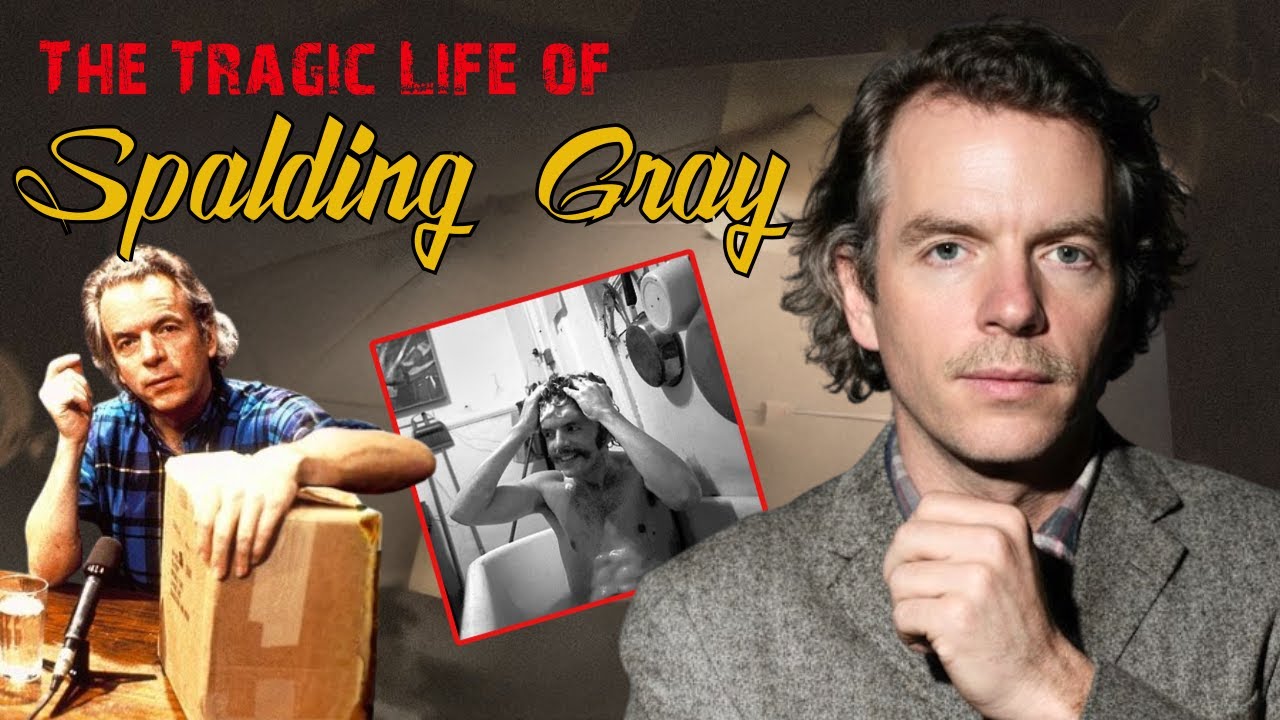
On a windy April afternoon, the stage had shrunk to the size of a wooden desk and a glass of water. From that confined space, Spalding Gray began telling his own story, turning his fears, obsessions, and the smallest details of his life into captivating art. The audience laughed at his awkwardness, then fell silent as they realized he was illuminating the deepest corners of their own souls. But the winds of that afternoon blew over a shattered spirit.
Since the accident, the brain that once wove so many stories had become a prison without exit, a place where his own narrative echoed back as distorted torment. The artist who spent his life exposing uncomfortable truths was now imprisoned by a silent and brutal one. The author of his own life story found its final chapter torn away by a cruel twist of fate, leaving blank pages stained with pain. A story that could no longer be continued, only ended.
To understand Spalding Gray, you must understand the world he was born into. A world of manicured lawns, quiet despair, and unspoken truths. He was a product of postwar America, specifically the white Anglo-Saxon Protestant milieu of Bington, Rhode Island. Born in 1941, he grew up in the seemingly calm 1950s, the era of Eisenhower prosperity and traditional family ideals.
On the surface, it was a world of order, propriety, and emotional repression. Feelings, especially complex and troubled ones, were things to be managed and controlled, preferably kept behind closed doors. The Gray household was the perfect embodiment of this ethos. His father was a factory treasurer, a practical and sober man, the solid pillar of New England tradition.
His mother, a housewife, was a more complex figure, a woman whose inner turmoil simmered beneath the placid surface of family life. It was this American landscape that the Beat writers like Jack Kerouac rebelled against, a culture of conformity they considered spiritually dead. For a sensitive and observant boy like Spalding, this environment was both a comfort and a gilded cage. He absorbed a culture where what you didn’t say was often more important than what you did.
The pressure to conform, to be a good boy, was immense. Yet, beneath this calm veneer, a sea of anxiety boiled. The Cold War was at its peak; the threat of nuclear annihilation was a constant hum in the background of daily life. A generation of young people began to question the values their fathers had fought a world war to preserve.
The civil rights movement was gaining momentum, and the folk music revival was giving voice to a new kind of social consciousness. By the time Spalding entered college in the early 1960s, the first tremors of the counterculture earthquake were beginning to show. This clash between the repressed world of his upbringing and the explosive openness of the 1960s would become the central tension of his life and art. He was a man with a 1950s mindset trapped in a 1960s world, and the friction between these two poles would generate the creative spark that defined his career.
The most important ghost in Spalding Gray’s story was his mother, Elizabeth. She was a woman struggling with deep depression and what was then vaguely and shamefully understood as nervous problems. In the suffocating propriety of 1950s suburbia, there was no acceptable language for her suffering, no community support, and no recognition that her condition was medical rather than a moral or personal failure. She was expected to be the cheerful, capable mother of the ideal family, and her inability to fulfill this role filled her with a shame that intensified her illness.
In a desperate search for a framework to understand her unraveling mind, she turned to Christian Science. This faith, founded by Mary Baker Eddy, posits that illness and suffering are essentially illusions of the material world, errors of thought that can be overcome through prayer and spiritual understanding. For Elizabeth, it was a tragic paradox: a belief system that promised healing by insisting her immense pain was not real. For young Spalding, his mother’s decline was a terrifying and confusing ordeal unfolding in hushed tones and conversations behind closed doors.
He watched the vibrant, intelligent woman he knew slowly fade, consumed by an invisible force no one in the family dared to name. He would later recall moments of strange behavior, deep inexplicable sadness followed by periods of frantic, almost manic energy. He was witnessing the brutal cycles of what was likely undiagnosed bipolar disorder, but without any context to understand it. All he knew was that his mother was disappearing.
The family’s reaction was to tighten the silence, to pretend nothing was happening, to maintain appearances at any cost. This silence, this collective denial, was perhaps as damaging as the illness itself. It taught him that the most frightening things in the world are the ones we are forbidden to speak about. In 1967, at the age of 52, Elizabeth Gray drove the family car into the garage, closed the door, and turned on the engine.
She left no note. Her suicide was the foundational trauma of Spalding’s life, the bomb that never went off at the center of his emotional world. It shattered the mask the family had carefully constructed, leaving behind a legacy of guilt, confusion, and a chilling, unrelenting fear. It instilled in Spalding a profound sense of inherited madness, a cold terror that he was genetically destined to follow the same dark path.
He became convinced he carried her tainted blood, a fear that became a central theme of his work. He would later say his entire career could be seen as a reaction to his mother’s final silence, a desperate, lifelong attempt to speak the unspeakable, to name the demon that consumed her, hoping that naming it would strip it of its power over him. After graduating from Emerson College with a degree in theater arts, Spalding fled the stifling traditions of New England for the liberating anonymity of New York City. In the late 1960s, he was drawn not to Broadway, but to the radical off-off-Broadway scene emerging downtown.
It was a world of converted warehouses in SoHo, black box theaters in the East Village, and experimental art collectives intent on dismantling the traditions of text-based theater. It was a scene fueled by the political ferment of the era, Vietnam, the sexual revolution, and a desire to create new forms of performance reflecting a fractured world. Here, he found his tribe. In 1975, he co-founded The Wooster Group with his then-partner, the brilliant director Elizabeth LeCompte.
From their base at The Performing Garage on Wooster Street, the group quickly became a leading force in the American avant-garde. Their work was intense, challenging, and often deliberately disorienting. Their method involved taking classic American texts, like Thornton Wilder’s Our Town and Arthur Miller’s The Crucible, deconstructing them, and reassembling the pieces into provocative multimedia collages. They incorporated video, distorted sound, and a performance style marked by emotional detachment.
The goal was not to tell a linear story, but to interrogate the text itself. For years, Spalding was a key performer in this machine, praised for his stage presence, but he was growing restless. He felt a deep disconnect between the conceptual, intellectually cool nature of the work and his growing need for direct, personal, emotional expression. He was tired of interpreting other people’s words, and his head was full of his own story.
The Wooster Group’s aesthetic was about deconstructing the self; Spalding was obsessed with constructing his. The moment of revelation came from a simple suggestion. A friend, listening to his endless stories, proposed he simply sit and tell them to an audience. It was a ridiculously simple idea, yet radically freeing.
He arranged a performance at The Performing Garage. He brought a simple wooden desk and chair, placed a microphone, a glass of water, and a spiral notebook on the desk, and began to talk. He spoke about his childhood, his fears, his embarrassing sexual experiences, and his family’s ghosts. He wasn’t acting; he was testifying.
His early monologues, like Sex and Death to the Age 14, were performed for small, intimate audiences of artists and critics. But something extraordinary began to happen. Audiences were completely captivated. In an age of theatrical artifice, the simple, vulnerable act of a man sitting at a desk and telling his story with unflinching honesty was a revelation.
He had found his voice in the unadorned, neurotic, deeply funny character of Spalding Gray. He was pioneering a new form of theater, blurring the lines between art and life, confession and performance. He had found a way to transform the silence of his hometown into a symphony of words. By the early 1980s, Spalding Gray had carved out a unique niche for himself in the American theater scene.
He was no longer just a cog in the Wooster Group machine, but the sole owner of his unique art form. From behind his simple wooden desk, he had become a kind of public philosopher of the personal. Audiences, weary of the intellectual coolness of postmodern performance, were drawn to the radical vulnerability of his work. He voiced the unspoken, turning the ordinary humiliations and private fears of his New England upbringing into hilarious and captivating theater.
He had found his voice, his style, and his audience, but he remained a cult figure, a secret passed among the downtown cognoscenti. The moment that catapulted him from the confines of The Performing Garage to international recognition came from the most unexpected source: a small role in a serious Hollywood film about one of the darkest chapters of the twentieth century. In 1983, through a series of lucky connections, Gray was cast as the assistant to the American ambassador in Roland Joffé’s harrowing historical drama, The Killing Fields. The film told the true story of Cambodian journalist Dith Pran and his American New York Times colleague Sydney Schanberg during the brutal rule of the Khmer Rouge.
The production was a massive undertaking, filmed primarily in Thailand. For Spalding Gray, the man known for his meticulously ordered inner space, the sudden plunge into a reality filled with mass graves and historical trauma was a profoundly disorienting and creatively fertile experience. He found himself surrounded by the ghosts of genocide. He spoke with survivors, visited refugee camps, and absorbed the horrifying history of the Khmer Rouge’s radical agrarian revolution, which led to the deaths of nearly two million people.
On the other hand, he was a minor player in the absurd circus of a big-budget film production. He was obsessed with his one pivotal scene, worried about his per diem, and consumed with getting the perfect haircut for his small role. This stark contrast between his minute, neurotic concerns and the enormity of historical horror became the raw material for his next, most famous monologue, Swimming to Cambodia. Premiering at The Performing Garage in November 1984, it was his masterpiece.
Performed over two consecutive nights, each part lasting about two hours, it was a masterful tapestry woven from three distinct threads. The first was a hilarious, behind-the-scenes parody of making The Killing Fields. He detailed this awkward interactions with the film’s stars, Sam Waterston and Dr. Haing S.
Ngor, the Cambodian doctor and genocide survivor who would win an Oscar, and his pathetic attempts to feel important on set. The second thread was his personal, almost spiritual quest for a perfect moment. Traumatized by the stories of Cambodia, he became obsessed with taking long swims off the coast of Thailand. He described the beauty and terror of the sea, the feeling of being an insignificant speck in a vast, indifferent universe.
His search for a moment of perfect oceanic bliss was a poignant expression of a universal human longing for peace. The third and most powerful thread was the unforgettable, horrific history of the Cambodian genocide. Gray did not present himself as an expert. Instead, he acted as a conduit, a horrified witness.
He relayed the stories told to him by survivors, narrating the Khmer Rouge’s brutal methods with a quiet, devastating simplicity. He spoke of the evacuation of Phnom Penh, the separation of families, the torture, the starvation. The genius of the monologue lay in how he braided these disparate threads together seamlessly. He showed how they were inextricably linked, connecting his personal existential anxiety to the vast, impersonal horrors of history, suggesting that the chaos of the world might be a larger, more terrifying reflection of the chaos within us.
Swimming to Cambodia was a critical and commercial triumph. It won an Obie Award, the highest honor in off-Broadway theater, and transferred to larger venues where it sold out. Critics hailed it as a landmark piece of performance art. Frank Rich of the New York Times called him a poet of psychopathology.
In 1987, the monologue was adapted into a film directed by Jonathan Demme. Demme wisely focused intensely on Gray behind his desk, using simple sound design and Laurie Anderson’s evocative music to enhance the power of the words. The film brought Gray’s unique style to a vast global audience, cementing his place as one of the most original voices in American culture. No longer a downtown secret, he had become a star.
Fame brought a new set of fears, and therefore new material. His next major work, Monster in a Box (1991), hilariously detailed his struggles to complete his first and only novel, an autobiographical work about his experiences during Swimming to Cambodia. The “monster” was the massive 1,800-page manuscript that sat in a box in his apartment, a physical manifestation of his inability to contain his life within the traditional narrative structure of a book. The monologue was a brilliant, painfully funny meditation on procrastination, the fear of success, and the paralyzing nature of creative ambition.
He was now terrified by the success he had craved, fearing he would be exposed as a fraud. He followed this with Gray’s Anatomy (1993), a monologue that shifted focus from professional anxiety to a more primal fear: the decay of the body. It recounted his frantic journey through the labyrinths of traditional and alternative medicine after he was diagnosed with a rare eye condition. A small piece of scar tissue was growing over the retina of his left eye, distorting his vision.
For a man whose art depended entirely on observation, the threat to his sight was a threat to his very existence. His terror of the surgeon’s knife sent him on a wild global quest for a cure. He consulted Native American sweat lodge leaders, Christian Science practitioners who tried to convince him the condition was an illusion, and a Filipino psychic surgeon who claimed to operate with his bare hands. Again, he transformed his private terror into universal comedy, exploring our collective fear of death.
Through it all, he was asking a fundamental question: in the face of our inevitable physical decline, where do we place our faith? On the surface, Spalding Gray seemed to have found the ultimate trick: how to tame his demons by displaying them publicly, how to control his anxiety by making it his life’s work. It seemed like a perfect, sustainable system. He had created a feedback loop where his life produced material for his art, and his art gave his life meaning and control.
But the system was far more fragile than anyone realized. The man sitting behind the desk, appearing in complete control of his own narrative, was wrestling with forces far older and deeper than an unfinished manuscript or an eye problem. With the international success of Swimming to Cambodia, the persona of Spalding Gray was cemented in the public imagination. The world saw a solitary man, seemingly in complete control of the stories he chose to tell.
But the performance, built so overtly on a real life, was never a purely solo act. To understand the man behind the monologue, one must look beyond the desk to the intricate, charged personal relationships that fueled the work. His twenty-year partnership with Elizabeth LeCompte was the cornerstone of his early creative life. Theirs was a complete blending of the personal and professional, a dynamic that was both explosively creative and emotionally exhausting.
There were no boundaries between the work and their shared existence. Their arguments became material for the work, their psychological battles fed the deconstructed texts they were performing. But for Spalding, the relationship eventually became unbearable. While LeCompte’s artistic project aimed at deconstruction and depersonalization, his own drive was the opposite.
When he left to seriously pursue his solo monologues, it was a declaration of personal independence. He needed to be the sole author of his own story. After LeCompte, he began a long-term partnership with Renée Shafransky, an artist and writer who became his partner and, to a large extent, the subject of his work. Their relationship coincided with his rise to fame.
Shafransky assisted in producing and editing several of his monologue films, including Monster in a Box. In turn, he documented their life together in his shows, particularly in It’s a Slippery Slope. He revealed their private life on stage: their travels, their arguments, his reluctance to commit to marriage. To be in a relationship with Spalding Gray meant accepting that your life together was potential material, and that the most intimate moments could be shaped and presented to a paying audience.
In a poignant essay published after his death, Shafransky described the experience of being a character in Spalding’s ongoing story, over which she had no editorial control. She wrote that he believed in a hierarchy of truth where the real story is the one the artist tells. He took from life what he needed. He was the hero of all his stories.
It was, she noted, like being an animal in a cage with a friendly lion that might suddenly turn. His need to turn every experience into a story often blurred the line between living his life and performing it. Throughout these relationships, his deepest fears remained rooted in his family history. The specter of his mother haunted him constantly.
He was terrified of what he called “bad blood,” a latent genetic predisposition to the mental illness that had taken her life. This terror manifested in a lifelong struggle with depression, which he often personified as his shadow. He tried everything to escape it: years of Freudian analysis, EST training, Eastern philosophy, and, of course, the talking cure he practiced on himself on stage. The monologues were a form of public self-therapy, a heroic attempt to map the geography of his mind, pinpoint the source of the darkness, and contain it through the power of expression.
In the mid-1990s, a significant shift occurred. He met Kathy Russo, and they married, his first marriage, at age 52. He became a father to two boys, Forrest and Theo, and a stepfather. This immersion in family life both terrified and transformed him.
Parenthood grounded him in a new and profound way, forcing him to confront his fears of responsibility and the possibility of passing on “bad blood. ” He chronicled this dramatic change in what would become one of his most personal monologues, It’s a Slippery Slope (1996). The central metaphor was his decision to learn to snowboard late in life, a clumsy, joyful, and terrifying pursuit that mirrored his plunge into marriage and fatherhood. For a while, it seemed he had finally found a kind of peace, a version of the perfect moment he had chased on the beaches of Thailand.
He settled with his family in Sag Harbor, a quiet village on Long Island, far from the bohemian downtown scene where he had made his name. He had a family, a house with a garden, and a measure of stability he had spent his whole life both craving and resisting. The monologues became less about the isolated ego and more about the self in relation to others. He seemed, for a moment, to have built a life solid enough to keep the shadows at bay.
But the narrative of a life is not written by the person who lives it alone. No fortress of words, however beautifully constructed, can protect against the cruel, random physicality of the world. One catastrophic moment on a country road would prove that the most terrifying stories are those that strike with no metaphor, those that shatter the storyteller himself. In early summer 2001, he and his wife traveled to Ireland to celebrate his sixtieth birthday.
On a sunny June afternoon, they were driving on a narrow, winding country road, a picture-perfect image of tranquility. Then, in a moment of inexplicable, random violence, another car swerved into their path. The head-on collision was devastating. Kathy suffered serious injuries, but Spalding’s were catastrophic.
He suffered a severe fracture of his right hip, leaving him in chronic, debilitating pain for the rest of his life. More critically, he sustained a depressed skull fracture on the right side of his head. A piece of his skull pushed inward, bruising and permanently damaging his brain. The injury was to his right frontal lobe, the part of the brain that controls personality, emotional regulation, impulse control, and the ability to plan and understand the world.
The man who returned from Ireland was not the same man who had left. The physical changes were stark, but the psychological and neurological damage was far deeper and more terrifying. His lively, active mind, the tool of his art, had been shattered. He fell into a deep, intractable depression, a darkness far more suffocating than the familiar shadow he had so eloquently chronicled.
This was not a poetic sadness he could craft into a monologue. It was an overwhelming biological fact, an inescapable chemical and structural prison. His friends and family watched in horror as the man they knew began to fade. He became incapable of finding joy or pleasure in anything.
He was obsessed, trapped in a neural loop, reliving the accident over and over in his mind. The intricate machinery that enabled him to transform pain into art had been demolished. He heroically attempted to do the only thing he knew how to do: turn the experience into a story. He began work on a new monologue tentatively titled Blackspot, intending to make it a story about the accident and his recovery.
But the words wouldn’t come. His ability to create a narrative had deserted him. The frontal lobe injury had stolen his ability to abstract, to find the ironic or philosophical distance from his own suffering. For a man whose identity was built entirely on talking as a way to transcend his problems, this was the ultimate horror.
There was nothing funny about it, nothing inspiring. There was only the abyss. He sought help with desperate urgency, trying a staggering array of antidepressants and mood stabilizers, but the drugs seemed to do little. He underwent multiple rounds of electroconvulsive therapy, which brought only fleeting, if any, relief.
Nothing worked. In the two and a half years between the accident and his death, Spalding’s life became a painful cycle of despair and false hope. He made several suicide attempts, each one a more desperate cry from a mind in unremitting agony. The fear that had haunted him his entire life, that he would end up like his mother, was no longer a vague premonition but a daily reality consuming him.
He spoke openly and chillingly about his desire to die, telling friends and family he felt like an unbearable burden. On January 10, 2004, a Saturday, he took his two young sons to see a movie in Manhattan. The film was Tim Burton’s Big Fish, a poignant, fantastical tale about a dying father who spun embellished, mythological stories about his life. After the film, he had a brief, final conversation with his stepdaughter, Marisa.
He then went to the South Ferry terminal and bought a ticket for the Staten Island Ferry. He was reported missing that night. For nearly two agonizing months, his family and friends lived in torment, holding onto the faintest hopes. The city was papered with missing-person posters bearing his familiar, worried face.
Finally, on March 7, 2004, his body was identified after being pulled from the East River near Greenpoint, Brooklyn. The medical examiner ruled his death a suicide by drowning. The man of a million words had been swallowed by a final, terrible silence. The man who lived by words was consumed by a pain for which he had found no words.
The story had ended. However, the end of a life is often the beginning of a legacy. His tragic death left behind a body of work that had to be re-examined in the light of its ending, forcing a series of profound questions about the nature of truth in art and the devastating reality of mental illness and traumatic brain injury. The most significant of these questions was about truth.
Was Gray a journalist of the self, reporting factually from the front lines of his life? Or was he a masterful writer of fiction, whose greatest creation was the neurotic, articulate persona named Spalding Gray? He himself offered a useful, if ambiguous, term for his method: poetic reportage. The phrase acknowledges the artistic shaping inherent in turning lived experience into performance.
He did not work from a literal record of his life. He relied on memory, a process inherently personal and fallible. He wrote outlines and key phrases in his spiral notebooks, but the performances themselves were largely improvised, re-crafted each night. Detailing could change, timelines compressed, conversations polished for maximum effect.
Many critics and audience members, captivated by his seemingly artless sincerity, took him as a literal transmitter of truth. This assumption sometimes led to complications and hurt feelings, especially for those who found themselves as characters in his public narratives. As Renée Shafransky noted, he took what he needed from life, and he was always the hero of his own stories. The truth of his work was emotional, not documentary.
The feelings were real even if the specific events were filtered through the lens of performance. A second, more tragic debate emerged in the wake of his death, centered on his desperate medical journey. In the aftermath of the car accident, he became obsessed with the physical source of his suffering. He believed with unshakable conviction that his depressed skull fracture was the sole cause of his torment.
He desperately wanted a surgeon to perform a craniotomy to lift the bone, convinced this physical intervention would magically restore him. Most of his doctors strongly advised against such a high-risk operation, believing his condition was far more complex, a devastating combination of diffuse neurological damage, psychological trauma, and a possible genetic predisposition to depression. They saw his desire for surgery as a form of magical thinking. Yet, in his desperate search, he did find one surgeon willing to consider the operation, creating a painful ethical dilemma and division within his family.
The surgery never happened, and the question of whether it would have helped remains a source of unresolved pain. Spalding Gray’s ultimate legacy is twofold. First, he is a pivotal figure in the history of modern theater and performance art. He took the deeply personal and made it universal, proving that a single voice, a desk, and a glass of water could be as theatrically compelling as a million-dollar production.
He dismantled the fourth wall not with a trick, but with radical honesty. He opened the door for a new generation of storytellers working in the fertile ground between comedy, confession, and theater. The entire genre of modern autobiographical storytelling owes a great debt to the model he created. He legitimized the personal narrative as a valid and powerful form of public art, showing that our small, seemingly insignificant lives are worthy of the spotlight.
Second, his life, and perhaps his death even more powerfully, cast a long shadow over public discussions of mental health and traumatic brain injury. He was a man who seemed to possess the perfect intellectual defense against depression. His suicide was a devastating reminder that severe depressive disorder is not a failure of character or a lack of willpower. It can be a biological condition, a real and fatal illness.
His story became a tragic case study in the destructive effects of brain injury, demonstrating with horrifying clarity how a physical blow can completely and irrevocably alter a person’s character and ability to hope. He spent his life trying to understand the ghost of his mother’s suicide, only to become a ghost himself. He remains important because his work endures as a timeless, hilarious, and heartbreaking map of the modern psyche. And his death remains a profound, tragic lesson in the limits of storytelling itself.
In the end, Spalding Gray’s life was a testament to the power of narrative and its ultimate failure. He believed, or at least desperately needed to believe, that if he could find the right words, he could control the chaos of his experience. For many years, this belief system served him well. It made him a star and, in many ways, kept him alive.
He built a fortress of language around himself, and from within its walls, he courageously confronted his fears. But the car accident in Ireland was a force of brute reality that language could not tame. It was not a metaphor. It was a physical event that shattered the very tool he used to understand the world.
The storyteller had lost the thread of the story. The final image of him on the Staten Island Ferry is almost unbearably poetic. There he was, suspended between two shores on cold, dark water that had always been a recurring theme in his work, a symbol of the unconscious, of chaos, of the great unknown. He had spent his life swimming in those psychological waters, seeking his neural pathways before a paying audience.
But in the end, the current was too strong. The man who talked his way through life finally chose the ultimate act of silence. His story offers no easy answers or comfortable lessons. Instead, it leaves us with a profound sense of loss for a unique and luminous voice, reminding us that our lives are a fragile, ongoing negotiation between the stories we tell ourselves and the unwritten, often brutal reality we must face.
Spalding Gray’s tragedy was that he faced, for the first time in his life, a pain for which he could find no words, a final, terrifying monster he could not contain within any story.
