Boston, 2025. The rain drummed steadily against the windows of the Harvard Divinity School archive as Dr. Rebecca Collins carefully examined a collection of historical church photographs. The images had recently been donated by the Diocese of Massachusetts as part of a research project on early twentieth-century religious architecture in New England.
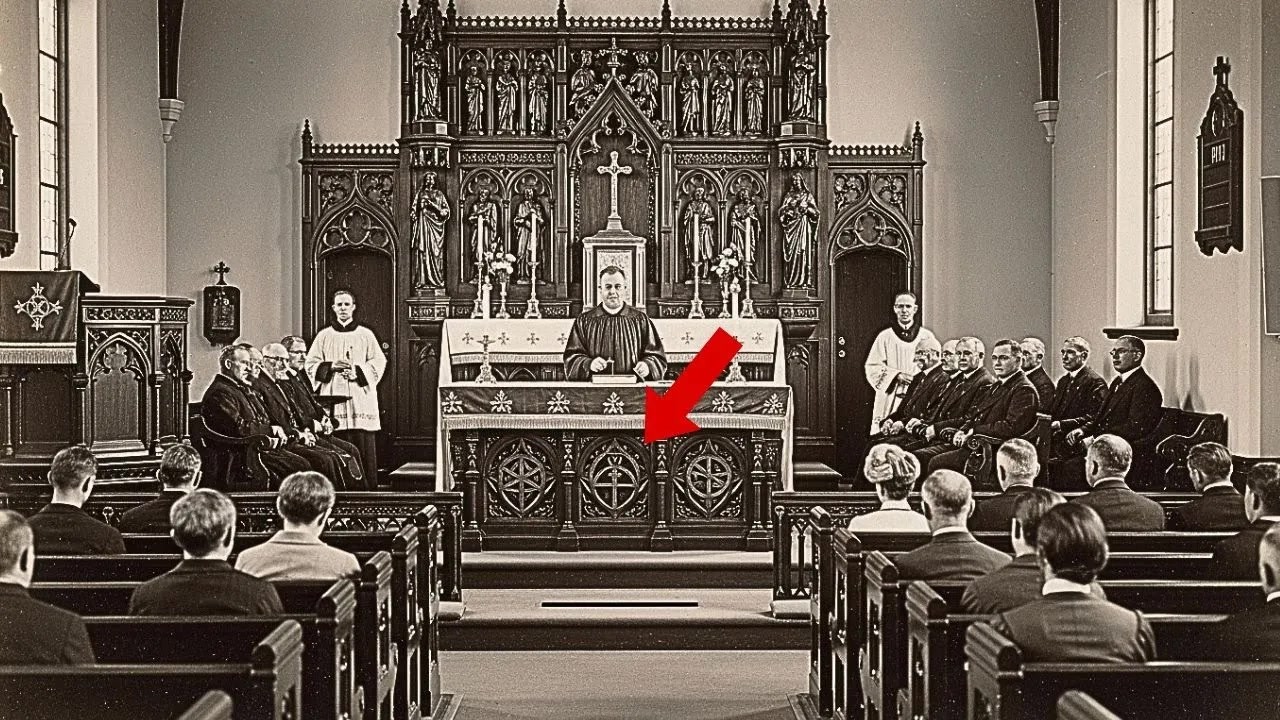
Most were unremarkable: stiff portraits of parishioners, documentation of church restorations, ceremonial occasions preserved for posterity. But one photograph caught Rebecca’s attention. A formal portrait from 1908 showing St. Michael’s Episcopal Church in Brookline celebrating its fiftieth anniversary.
The image revealed the church’s ornate interior with congregants gathered in their Sunday finery. At the heart of the photograph stood the precisely carved altar, and behind it, the Reverend Thomas Aldritch, the church’s rector, surrounded by members of the church council. The quality of the image was exceptional for its era, capturing fine details throughout the church. Something about the altar stirred Rebecca’s trained eye.
While the rest of the church featured the usual Gothic architectural elements of the period, the altar contained unfamiliar engravings partially covered by ceremonial fabrics. Using a digital magnifier on her tablet, she zoomed in on that portion of the photograph. “Dr. Winters,” she called to her colleague, a religious historian specializing in ecclesiastical artifacts, “can you take a look at these carvings?
They don’t match the period or the denominational style. ” Dr. James Winters studied the enlarged image, his expression gradually shifting from professional interest to concern. “Those aren’t Episcopal symbols,” he said quietly.
“Or even Christian. This is a modified version of the Eye of Providence, but with symbols I associate with Hermetic or occult traditions. And these side panels contain elements of ritual magic engravings. ” “On an Episcopal church altar from 1908?
” Rebecca asked in disbelief. “Which is exactly why it’s unusual,” Winters replied. “But more worrying, look how the altar appears to contain a hidden compartment. Do you see this seam?
It’s not decorative. It’s functional. ” Rebecca felt a chill despite the archive’s precise climate control. What had begun as routine architectural research had suddenly revealed something far more interesting and possibly far more disturbing.
What was an altar bearing occult symbols and hidden compartments doing inside a traditional Episcopal church in 1908? And what might be hidden inside it? “We need to find out if St. Michael’s is still standing,” she said, reaching for her laptop.
“And whether that altar is still there. ”
The next morning, Rebecca and James stood before St. Michael’s Episcopal Church in Brookline. Its Gothic stone facade had changed little since the 1908 photograph.
The rain had stopped, leaving the autumn air fresh and bright as they climbed the worn stone steps. “The church underwent major renovations in the sixties,” James explained as they approached the entrance. “But according to diocesan records, many original architectural elements were preserved or carefully restored. ” The heavy wooden doors opened to reveal a warm interior bathed in sunlight.
Rebecca oriented herself using the historical photograph, her eyes drawn to the front of the sanctuary where the altar should stand. She caught her breath. The altar was completely different—a simple modern marble table lacking any of the ornate wooden carvings from the 1908 image. “Can I help you?
” The voice belonged to a middle-aged woman emerging from a side door. Her clerical collar identified her as the church’s current pastor. “I’m Dr. Rebecca Collins from Harvard Divinity School, and this is my colleague Dr.
James Winters. We’re conducting research on historical church architecture, and we have some questions about the original altar that once stood here. ” The Reverend Sarah Mitchell smiled warmly. “You’re in luck.
I have a particular interest in St. Michael’s history. The original altar was removed during the sixties renovations, but it’s preserved in our church basement museum. Would you like to see it?
” She led them down a narrow staircase and unlocked a heavy door, revealing a small museum of artifacts from the church’s 167-year history. Against the far wall stood the altar from the photograph—smaller than it appeared in the image, but unmistakable with its ornate carvings and distinctive design. “It was quite controversial when they replaced it,” Mitchell explained. “Some of the older parishioners were deeply attached to it, despite its unusual design elements that weren’t typical of the Episcopal tradition.
” Rebecca and James exchanged glances and approached the altar cautiously. Up close, the symbols diverged even more clearly from traditional Christian iconography—subtle modifications of traditional symbols that significantly altered their meaning. “Do you know anything about the Reverend Thomas Aldritch, who led the church in 1908? ” Rebecca asked casually.
“Only that he served here for nearly thirty years before his sudden departure in 1911. There was some kind of controversy, though the church records are frustratingly vague. Local historical rumors suggest he developed unconventional theological interests that concerned the diocese. ” As Mitchell was called away to parish business, Rebecca and James examined the altar carefully.
The seam visible in the photograph was indeed present—a thin line indicating a hidden compartment built into the altar’s structure. “We need permission to examine this more closely,” James whispered. “If there really is a hidden compartment, we can’t simply start prying at a historical church artifact. ” Rebecca nodded, already drafting her request to the church council.
Whatever secrets this altar held had remained hidden for over a century. A few more days of following proper protocols wouldn’t hurt. She had no idea that the contents of that compartment would profoundly challenge her understanding of early twentieth-century religious life in the respectable town of Brookline, Massachusetts. Three days later, Rebecca and James returned to St.
Michael’s with official authorization to examine the altar. They were accompanied by Dr. Helena Martinez, an artifact conservation specialist, to ensure no damage came to the historical piece during examination. “The church council was surprisingly enthusiastic about our research,” Rebecca said as they set up their equipment in the basement museum.
“Apparently, there have been long-standing questions about this altar among church historians. ” “Respect for history has its limits,” Mitchell replied, joining them for the examination. “We’ve always known there was something unusual about this piece, but we lacked the expertise to investigate properly. ” Dr.
Martinez conducted an initial non-invasive examination using a specialized scanner. “There’s definitely a void behind this panel,” she confirmed. “Based on these readings, I believe the opening mechanism is activated by pressing these two specific decorative elements simultaneously. ” Following her direction, James pressed gently on the two carved rosettes she indicated.
After a moment of resistance, they heard a soft click, and a previously invisible seam widened slightly. Martinez carefully inserted conservation tools to expand the gap without causing damage. The panel slid open to reveal a hidden compartment approximately twelve inches long and eight inches deep. Inside were several carefully wrapped bundles tied with deteriorated silk and protected by wax seals.
“This is exceptional,” Martinez murmured, photographing everything before removal. “These items were specifically prepared for long-term concealment. ” Following conservation protocols, they carefully transferred the bundles to an examination table. The first bundle contained a leather-bound journal bearing Reverend Aldritch’s name on its cover, its pages filled with dense, precise handwriting.
The second bundle revealed something stranger: a collection of magical texts including a worn copy of the Book of Abramelin, a fifteenth-century work of ceremonial magic, along with several encrypted manuscripts. These were not the commercial spiritualist texts popular in the region’s occult revival, but serious esoteric works that would have caused deep controversy in an Episcopal church context. The third bundle contained the most troubling items: ritual implements including a silver ceremonial knife with engravings, a small chalice, and vials of dried substances labeled in the same handwriting as the journal. “This is not what I expected to find in an Episcopal church altar,” Mitchell said, visibly disturbed.
Rebecca had already begun examining the journal, her expression growing more troubled as she read. “Oh. According to these entries, Reverend Aldritch was leading two congregations: his public Episcopal parish, and a private esoteric group that met secretly in the church after hours. He refers to them as the Inner Covenant.
” James examined one of the encrypted manuscripts carefully. “This appears to be a modified Trithemius cipher. Decoding it will take time, but some recurring symbols suggest it contains ritual instructions. But why would he hide these things inside the altar itself?
” Mitchell asked. Rebecca turned to a later entry in the journal. “According to this, Aldritch believed the altar stood at a specific convergence point of terrestrial energies. He designed it not just to conceal these items, but to amplify certain energies through their placement within it.
” She looked at her colleagues. “He was using the altar itself as an active component in whatever rituals he was performing here. ” The implication settled heavily on the room. A respected Episcopal priest had integrated occult symbols and a hidden compartment for ritual implements directly into the most sacred part of his church, conducting secret ceremonies for years without detection by church authorities or his conventional congregation.
Whatever had happened at St. Michael’s in the early twentieth century was far stranger than a simple architectural curiosity. Back at her university office, Rebecca carefully transcribed Reverend Aldritch’s journal, its fragile pages requiring delicate handling despite their relatively good preservation within the altar. The narrative that emerged was both fascinating and unsettling: a traditional clergyman’s spiritual journey toward increasingly esoteric practices.
The early entries from 1899 showed Aldritch as an educated but conventional Episcopal priest. His turn toward alternative spirituality began after a personal tragedy. April 16, 1900. “Emily’s death has left a void that no conventional faith seems able to fill.
The church’s comforting words about God’s will ring hollow with my four-year-old daughter lying in the earth. There must be more direct means of understanding the divine plan, and perhaps even of communicating across the veil that separates us. ” Through subsequent entries, Aldritch documented his exploration of increasingly obscure esoteric traditions. By 1904, he had formed his Inner Covenant with seven like-minded parishioners.
November 8, 1904. “Our circle now numbers eight seekers, each committed to the higher work. Mrs. Westerly, Dr.
Hammond, Professor Burke, Miss Calloway, Mr. and Mrs. Thornton, Mr. Pierce, and myself.
All outwardly respectable members of the parish, all inwardly seeking truths beyond conventional religion. We meet monthly under the guise of a parish committee, but our real work begins after the church empties. ” The most disturbing entries concerned Aldritch’s plans for the 1906 church renovation, when the original altar was scheduled for replacement. March 3, 1906.
“The opportunity I have long awaited has arrived. The church committee has approved funding for a new altar, leaving the design nominally to my discretion as rector. They will not recognize the symbols I have incorporated. Subtle modifications that transform Christian iconography into keys for our work.
More remarkably, the carpenter has agreed, for substantial additional sums from my own funds, to incorporate a secret compartment to my specifications. The altar will stand precisely at the convergence point I have determined through careful measurement. ” Rebecca paused, struck by the calculated deception. Aldritch had deliberately exploited his trusted position to plant occult elements in the church’s most sacred furniture, funded by his congregation for work whose true purpose they would have found horrifying.
The entries following the altar’s installation described an escalation in ritual activity. October 31, 1907. “Tonight’s ritual surpassed all previous attempts. With the elements properly placed within the altar for a full lunar cycle, the veil thinned exactly as the ancient texts promised.
The manifestation was brief but unmistakable. Hammond’s doubts were finally silenced. Mrs. Thornton wept at what it meant.
What we touched cannot be reconciled with Episcopal doctrine, yet it feels more authentically divine than anything in the seminary teachings. ” The most troubling entries were the final ones from early 1911, where Aldritch’s writing became increasingly disturbed. February 14, 1911. “The entity we have contacted is not what we initially believed.
Certain inconsistencies in its communications have become apparent. Pierce noticed it first—subtle contradictions, gaps in knowledge where absolute knowledge should exist. I fear we may have opened a door to something neither divine nor good. Mrs.
Westerly has withdrawn from our covenant after her troubling experience last week. I cannot blame her. ” The journal ended abruptly with an entry dated March 22, 1911. “They are coming to take me tomorrow.
Bishop Harrington has summoned me to answer for grave irregularities in my priestly service. Someone has spoken. I have sealed our materials within the altar one final time. They may remove me from St.
Michael’s, but the work we began continues through the vessel we consecrated. It will remain active long after my departure, awaiting those who know how to access its power. ”
Rebecca sat back, absorbing the implications. According to diocesan records, Reverend Aldritch resigned his position in April 1911, ostensibly for health reasons, and moved to Europe.
There was no record of his ever returning to the United States. Whatever had happened at St. Michael’s between 1906 and 1911 had been deliberately concealed by both Aldritch and church authorities, who likely wished to avoid scandal. But according to Aldritch’s final entry, he believed their work had created something that would remain active within the church itself—something that seemed to center on or be contained by the altar that had sat untouched in the church basement for decades.
Rebecca and James spent the following week researching the members of Aldritch’s Inner Covenant. As prominent church members in early twentieth-century Brookline, most had left sufficient historical traces to construct their biographies. “They were all respected community figures,” James noted as they compiled their findings. “Dr.
William Hammond was chief of medicine at Brookline Hospital. Elizabeth Westerly was a prominent society widow who funded numerous charities. Thomas and Margaret Thornton owned one of Boston’s largest department stores. These weren’t fringe occult dabblers—they were pillars of the community.
” Rebecca was tracing Professor Arthur Burke, a physics instructor at MIT. “Burke is particularly interesting. His early research papers dealt with conventional electrical phenomena, but after 1907, his work shifted dramatically toward theories about etheric energies and vibrational resonance between material and immaterial planes. His academic career effectively ended in 1910 when MIT declined to renew his contract.
” The more troubling pattern emerged when they investigated what happened to the group after Aldritch’s departure. Dr. Hammond committed suicide in July 1911, leaving a cryptic note about unbearable knowledge. Elizabeth Westerly suddenly sold her Brookline mansion in April 1911 and moved to Arizona, where she lived in seclusion until her death in 1932.
The Thorntons divorced in late 1911, a scandalous decision in that era, with Margaret entering a sanitarium for what records euphemistically called nervous exhaustion. “Something shocking happened to this group,” James observed. “Their lives collectively collapsed in the months following Aldritch’s removal from St. Michael’s.
” Only two covenant members escaped obvious tragedy. Sophia Calloway, an unmarried schoolteacher, continued teaching in Brookline until her retirement in 1931. Her former students described her as intensely private and haunted by something. Harold Pierce fared perhaps best, moving to New York and establishing an antiquarian bookstore specializing in occult texts that still operated under family management.
Most interesting was what Rebecca discovered in Pierce’s personal papers, accessed through his granddaughter who now ran the store. A diary entry from 1935 during a visit to Boston read: “I stood outside St. Michael’s today but could not force myself to enter. The altar is still within those walls, though likely forgotten or repurposed by now.
Better that it remain forgotten. What we awakened there must never be disturbed again. I alone seem to have survived the worst consequences of our folly, perhaps because I was the first to recognize what truly responded to our calls. Not divine, not good, but ancient and patient, and I still sometimes feel its attention turning toward me across the years, like a predator that has tasted blood and waits only for opportunity.
” Rebecca shared Pierce’s notes with James, who had been working on translating the encrypted manuscript found in the altar. “This aligns with what I’m finding in the ritual texts,” he said grimly. “Aldritch believed they were communicating with angelic entities, but the ritual framework he designed was fundamentally flawed. The protective elements were insufficient for the forces he was summoning.
” “Are you suggesting they actually contacted something? ” Rebecca asked skeptically. James chose his words carefully. “I’m suggesting that Aldritch and his group believed they established contact with a non-human entity.
Whether it was objectively real or a shared psychological phenomenon, most of them were clearly traumatized. And Aldritch seemed to believe that whatever they experienced remained connected to the altar itself in some way. ” Their research had shifted from historical curiosity to something more unsettling. A respectable church rector had transformed his altar into an occult instrument, conducted secret rituals with prominent community members, and possibly experienced something disturbing enough to shatter his group and be deliberately concealed by church authorities.
And the altar at the center of it all still sat in the basement of St. Michael’s, recently opened after more than a century of isolation. Rebecca arranged interviews with several elderly St. Michael’s parishioners, hoping they might have inherited stories about Reverend Aldritch or the altar’s removal in the sixties.
Most knew only vague details, but one woman in her nineties, Martha Kincaid, whose grandmother had attended the church during Aldritch’s tenure, provided intriguing family accounts. “My grandmother never spoke directly about Reverend Aldritch,” Martha explained as Rebecca recorded their conversation in a church meeting room. “But she warned us children never to stay in the church alone. She said the altar watches when no one is looking.
” “The altar watches? ” Rebecca asked, trying to maintain a neutral tone. Martha nodded. “I assumed it was childish imagination.
But my grandmother was actually a practical woman, not given to superstition. She mentioned once that after Reverend Aldritch left, a small group of parishioners took turns staying in the church at night. When I asked why, she said they were keeping watch, though she never said against what. ” This corroborated something James had found in the church’s financial records: mysterious payments from 1911 until 1962 to a special maintenance committee that met monthly, though its activities were never specified in church meeting minutes.
“When they removed the altar in 1963, my grandmother was still alive in her eighties,” Martha continued. “I remember her enormous relief when she said, ‘Thank God that’s over. The watch can end now. ’ When I asked what she meant, she simply said, ‘Some burdens pass from generation to generation until they are properly buried.
’” After interviewing other parishioners, Rebecca pieced together an astonishing story. After Aldritch’s departure, a group of church members—perhaps those who knew the truth of what had happened—established a tradition of maintaining continuous vigilance over the altar. As the original members aged or died, they recruited younger replacements, without fully explaining the purpose but emphasizing the absolute necessity of the watch. This tradition continued quietly for over fifty years until the church renovations of the sixties provided an opportunity to remove the altar from its original position.
Even then, they insisted it remain within church property rather than being sold or destroyed, suggesting either continued caution or perhaps an inability to dispose of it due to perceived consequences. When Rebecca shared these findings with James, he made another connection. “The church basement was renovated and consecrated in an unusual ceremony in 1963, according to these records. Bishop Gardner personally consecrated the storage room where the altar was placed—a remarkable level of attention for what was ostensibly just a space for old furniture.
” “They were containing it,” Rebecca said slowly. “Whatever Aldritch and his group believed they contacted, the church knew about it somehow and took precautions for decades. ” Most revealing was what Mitchell discovered in the personal papers of the priest who oversaw the altar’s removal in 1963, the Reverend William Stanton. In a private letter to the bishop, he wrote: “The transfer was completed yesterday as planned.
The faithful watchers have finally been released from their burden after 52 years of vigilance. While I remain skeptical about the necessity of these precautions, I respect the conviction with which they maintained their watch for over half a century. The altar is now doubly secured, removed from its activation point, and held within consecrated and reinforced walls according to Gardner’s specifications. The original watcher, Mrs.
Eleanor Jenkins, née Calloway, aged 82, wept with relief, repeating that her mother’s promise had finally been fulfilled. ” This reference to Eleanor Jenkins, née Calloway, immediately caught Rebecca’s attention. Sophia Calloway had been one of Aldritch’s Inner Covenant members. This suggested her daughter had become one of the watchers who guarded the altar for decades.
“Which raises the question,” James said quietly, “of what exactly they were watching. And whether removing the items from the altar compartment after all this time might trigger consequences they sought to prevent. ” Rebecca felt a chill as she considered the implications. What had begun as historical research had uncovered a secret passed down through generations, involving ritualized watching over an altar deliberately modified for occult purposes.
And they might have disrupted containment measures carefully maintained for over five decades. The first indication that something unusual was happening came from a phone call Mitchell made to Rebecca early one morning. “There have been incidents at the church since we opened the altar,” she explained, her usually calm voice strained. “At first, just minor disturbances.
Objects moving between evening closing and morning opening, unusual cold spots in the basement. But last night, our janitor quit after reporting seeing a figure standing beside the altar while he was alone in the building. ” Rebecca and James returned to St. Michael’s that evening, finding Mitchell visibly exhausted.
“I stayed the night here,” she admitted. “I thought having a clergy presence might help. Around three in the morning, I heard what sounded like chanting coming from the basement. When I checked, there was no one there, but the room was freezing.
The hidden compartment in the altar was open again, though I know we closed it. ” James examined the altar while Rebecca reviewed security camera footage. The church’s modern system showed distinct anomalies: unexplained light phenomena near the altar, momentary distortion, and most disturbingly, a dark figure that appeared briefly at 3:17 AM with no obvious source. “This is exactly what Eleanor Jenkins and her watchers feared,” Rebecca said quietly.
“Aldritch wrote that they had created a vessel that would remain active. By removing the contents and breaking the seals after all this time, we may have disrupted whatever equilibrium they had established. ” “You’re not suggesting this is genuinely supernatural? ” Mitchell asked, her theological training visibly conflicting with the evidence before her.
James chose his words carefully. “I’m suggesting that Aldritch and his group performed rituals they believed established contact with something beyond their understanding. Whether that was objective reality or a shared psychological phenomenon, they took extensive measures to contain it. Those measures have now been disrupted.
” As they spoke, Dr. Martinez called with troubling news from the conservation laboratory where the altar’s contents were being studied. “We’re experiencing equipment failures and unusual phenomena. Temperature fluctuations, batteries draining, and most concerning, the journal appears to be changing.
” “Changing how? ” Rebecca asked. “Some passages have faded while others have become more distinct since yesterday. And there’s writing appearing in the margins that wasn’t visible during our initial examination—in handwriting different from Aldritch’s.
” Rebecca and James rushed to the conservation laboratory, where Martinez showed them the journal under specialized lighting. As she had reported, some passages had faded while others appeared darker, creating a new pattern of emphasis in the text. Most troubling were the marginal notes now visible—cramped, spidery handwriting that had not appeared in their initial examination. The marginal text repeated variations of a single phrase: “The door remains open.
I remain. I wait. I watch. I hunger.
” “This is chemically impossible,” Martinez stated flatly. “These changes cannot be explained by any known conservation phenomenon. ” As they examined the journal, the laboratory lights flickered briefly. When they steadied, a new line had appeared on the final page in the same spidery handwriting: “You remembered me.
I remember you. ” The three researchers stared at the impossible text. Whatever Reverend Aldritch and his Inner Covenant had begun in 1908 had not ended with their dissolution. Something remained connected to the materials sealed within the altar.
Something that was now manifesting in increasingly disturbing ways. “We need to understand exactly what Aldritch’s group did,” Rebecca said firmly, setting aside her scientific skepticism in the face of the inexplicable evidence before them. “And more importantly, how the original watchers contained it afterward. Whatever is happening is escalating.
” As they left the laboratory, none of them noticed the hallway security camera tracking their movements, though no one was monitoring the system. In the empty church basement, the hidden section of the altar slowly closed itself, the wood creaking in the silence of the abandoned building. James worked through the night decoding the manuscript, finally calling Rebecca at dawn. “I’ve deciphered enough to understand what Aldritch was trying to do,” he explained, his voice heavy with exhaustion and concern.
“It’s a modified Enochian ritual system designed to open what he called a permanent aperture between spheres of existence. ” “What does that mean exactly? ” Rebecca asked. “It means Aldritch wasn’t just trying to temporarily communicate with whatever he believed existed beyond our reality.
He was attempting to create a permanent connection—a door that wouldn’t close. The altar wasn’t just a hiding place; it was the door itself, built at what he calculated as a convergence point of what he called terrestrial currents. ” Rebecca tried to absorb this. “Did he succeed?
” “Partially. According to his journal and this ritual text, something responded to their work, but it wasn’t what they expected. Pierce appears to have been the first to realize that the entity they contacted had been pretending to be benevolent while actually being something else entirely. ” James explained that the ritual materials had been placed within the altar not just for concealment but as components of an ongoing operation—like an occult machine designed to maintain the connection Aldritch had established.
When church authorities isolated him in 1911, he had sealed everything in place, believing the connection would remain active. “The watching tradition makes sense now,” Rebecca realized. “After Aldritch left, those who knew what happened—perhaps including Sophia Calloway, who had broken from the group—established the watch to ensure nothing came through that door he had opened. ” “When they finally moved the altar in the sixties, they believed they had neutralized it by removing it from its convergence point.
But they didn’t destroy it,” James noted. “Which suggests they either couldn’t or feared the consequences of attempting it. ” The implications were disturbing. For over fifty years, a rotating group of parishioners had maintained a vigil over an altar they believed contained some kind of dangerous connection to something outside ordinary reality.
Then, for another sixty years, the altar had sat dormant in the basement. The threat seemed neutralized by its removal—until they opened the compartment and removed the ritual items, potentially reactivating whatever connection Aldritch had established. As if confirming their fears, Mitchell called with alarming news. “The manifestations are intensifying.
Last night, three separate witnesses reported seeing a figure in the church. Not a shadow this time, but what they described as a man in early twentieth-century clerical attire. And the temperature drops are affecting the entire building now, not just the basement. ” “Did they identify the figure?
” Rebecca asked, though she suspected the answer. “One of our oldest parishioners recognized him from a historical photograph. She says it was the Reverend Thomas Aldritch. ” The pieces were coming together with disturbing clarity.
Aldritch had created his permanent aperture more effectively than he perhaps realized himself. Something had remained connected to the altar for over a century, held back by the watchers and then by the relocation. By opening the hidden compartment and removing its contents, they may have weakened the barriers maintained for generations. “We need to restore the original containment,” Rebecca decided.
“Return everything to the altar exactly as we found it, reseal it, and consult with religious authorities about more permanent solutions. ” “There’s a problem with that approach,” James said flatly. “According to the encrypted text, the original binding required eight participants arranged in a precise geometric configuration around the altar—Aldritch’s Inner Covenant. We have the materials and the location, but we lack the human element that made the binding effective.
” Rebecca pondered this challenge as reports of disturbing phenomena continued to accumulate from St. Michael’s. Whatever had been awakened was growing stronger, appearing more frequently, and showing signs of intelligence and intent. They needed to act quickly before the situation escalated beyond their ability to contain.
Rebecca spent hours researching how the original watchers had handled the situation after Aldritch’s departure. The breakthrough came from the personal papers of Eleanor Jenkins, donated by her family to the Brookline Historical Society after her death in 1970. “They didn’t try to close Aldritch’s door completely,” Rebecca explained to James and Mitchell as they gathered in the church office. “They knew they couldn’t recreate his original ritual.
Instead, they established a containment protocol based on regular consecration and vigilance. ” Eleanor’s papers revealed that her mother, Sophia Calloway, had broken from Aldritch’s covenant after realizing the true nature of what they had contacted. Unable to convince the others immediately, she had secretly consulted a Jesuit priest experienced in theology and esoteric matters, Father Doherty of Boston College. After Aldritch’s removal, Sophia and Father Doherty developed a hybrid containment approach combining elements of Catholic protective ritual, Episcopal consecration rites, and modified versions of the same Hermetic principles Aldritch had exploited, but reversed for containment rather than communication.
Crucially, they discovered they could not permanently close the connection without risking violent and dangerous backlash. Instead, they established a system of regular practices that kept the entity dormant as long as the rituals were maintained and the altar remained under watch. “This is why they insisted on keeping the altar on church grounds even after removing it from the sanctuary,” James realized. “The containment depended partly on it remaining within consecrated space.
” Eleanor’s papers included the specific ritual procedures the watchers had performed monthly for decades: prayers, anointings, and ceremonial actions designed to maintain the barriers between worlds. When the altar was moved in 1963, Bishop Gardner appeared to have incorporated permanent protective elements into the basement room’s construction: consecrated objects sealed within the walls, specific geometric arrangements, and blessing rituals performed during the renovation. “We have everything we need,” Rebecca said. “The original containment procedures, the altar in its consecrated space, and even an advantage they lacked.
We’ve removed the ritual objects that served as the primary conduit. If we return them properly and reactivate the watching protocols, we should be able to restore the dormant state. ” “There’s a missing element,” Mitchell pointed out. “The original watchers were all connected to people who knew the truth.
Family members of those involved maintained their vigilance out of personal commitment. We’re outsiders to this situation. ” Rebecca had considered this. “Eleanor’s papers addressed that too.
The connection works both ways. Once you interact with the phenomenon, you become part of its awareness. We’ve all experienced those manifestations. We’ve all handled those materials.
As she said, once it knows you, you’re bound to it and it to you. ” “We’re already bound,” Mitchell acknowledged. “Which actually gives us the qualification to perform the containment. ”
That evening, they prepared the church basement according to Eleanor’s specifications.
The altar items were carefully returned to their compartment in the exact order documented during their initial examination. Mitchell, drawing on her Episcopal authority, performed the consecration rituals while Rebecca and James completed the geometric arrangements of symbolic objects around the altar. As they worked, the manifestations intensified: temperature drops, electrical disturbances, and brief glimpses of a figure moving at the edge of their vision. The feeling of being watched was palpable, creating an atmosphere of mounting tension as they completed the preparations.
The final step required the three of them to recite the containment invocation. Preserved in Eleanor’s papers, it was an odd blend of Latin ritual, Episcopal prayer, and occult formula that acknowledged the entity’s existence while firmly binding its influence. As they spoke the final words, the basement plunged into complete darkness for several seconds. When the emergency lights activated, they found the altar’s hidden compartment had sealed itself.
The seam was now nearly invisible, just as it had been before their investigation began. The immediate sense of presence that had filled the room diminished, though it did not entirely disappear. Something remained, but it seemed contained, restrained, returned to the dormant state that had persisted for decades before their intervention. “It worked,” James said quietly.
“But this is a maintenance protocol, not a permanent solution. Like our predecessors, we’ve achieved containment rather than expulsion, which means the tradition of watching must continue. ” “Ah,” Mitchell realized, the weight of this new responsibility evident in her expression. “As Eleanor said, some burdens pass from generation to generation.
” Rebecca nodded, understanding now why the original watchers had maintained their vigil for so long, and why they had so carefully recruited replacements as they aged. What Aldritch had begun could not simply be ended—only managed by those who understood the necessity of their work. They had restored the balance, but in doing so, they had themselves become links in a chain of responsibility that would now have to continue into the future. A year later, Rebecca returned to St.
Michael’s for the monthly ceremony. The basement room had been redesigned as a meditation chapel, providing legitimate reason for regular ceremonial activity around the altar without revealing its true purpose to the rest of the congregation. Mitchell greeted her at the door. “How are the new historical articles being received?
” she asked as they walked through the quiet church. “Better than I expected,” Rebecca replied. “The heavily edited version of events has been accepted as an interesting case study in early twentieth-century religious experimentation. No one questions why we redacted certain details or why we focused on Aldritch’s unconventional theology rather than the full truth.
” James was waiting for them in the basement chapel, where soft lighting and tasteful religious symbols now concealed the room’s true function. The altar stood against the wall, appearing to casual observers as merely a historic church artifact preserved for its artistic value. “Any manifestations since last month? ” Rebecca asked as they prepared the space.
“Minor temperature fluctuations, nothing more,” James answered. “The containment is holding, though I still feel tense when I’m alone here. ” The monthly ritual had been simplified from Eleanor Jenkins’s original procedures, but it maintained the essential elements: renewal of consecration, acknowledgment of the boundary, and recognition of the guardian’s commitment. As the three completed the ceremony, Rebecca felt the now-familiar sensation of the entity’s awareness receding slightly, returning to its dormant state for another month.
“We should discuss succession plans,” Mitchell said as they concluded. “None of us are getting younger, and like the original watchers, we need to ensure continuity. ” Rebecca nodded, aware of the weight of this responsibility.
