The locomotive was called Hero, and it weighed six tons. From where Sylvester Marsh stood at the summit of Mount Washington, he could watch it climb toward him on a grade so steep that the track disappeared beneath the front of the engine. The slope was 37 percent, steeper than most staircases. Yet the engine did not slide back down the mountain, because it was not riding on friction alone.
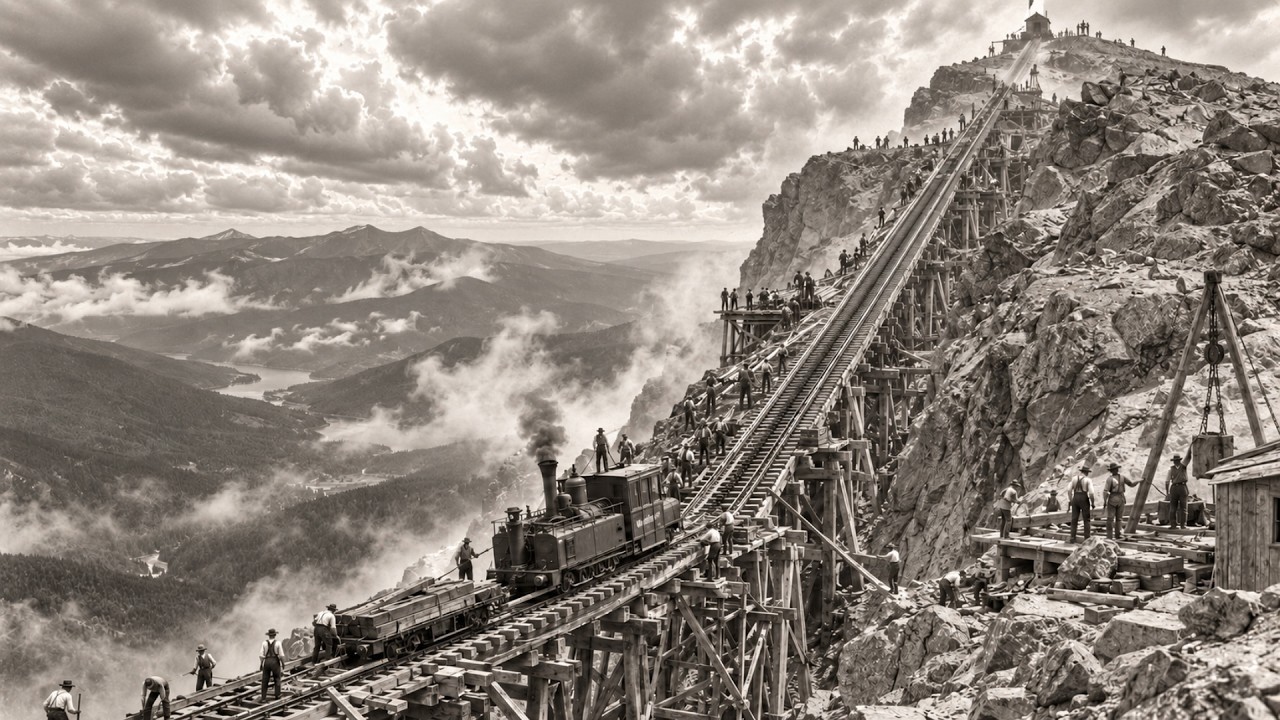
Beneath the locomotive, a steel cog wheel meshed into a third rail of iron teeth laid between the running rails. The cog drove the engine forward one tooth at a time, and gravity could not pull it back because the cog held. What Marsh had built was the world’s first mountain-climbing cog railway, and it had taken him eleven years and the labor of several hundred men to reach this moment. Most people who know the Mount Washington Cog Railway know it as a tourist attraction, the oldest such railway in the world, still running steam excursions up the same track completed in 1869.
What most people do not know is what it took to put that track there. Not the engineering, which was novel enough to attract attention from every railroad publication in the United States, but the physical work: the men who drove iron into granite on a mountainside that could generate a windstorm capable of destroying a wooden building in twenty minutes, the men who built a wooden trestle on a 40 percent grade so far above the valley floor that the structure creaked and swayed in winds that never entirely stopped, the men who were paid by the day to stand on a scaffold in conditions the mountain made clear, repeatedly and without apology, it did not intend to tolerate. Mount Washington stands 6,288 feet above sea level, not an exceptional elevation by Western standards. The summit of the South Kaibab trail head in the Grand Canyon sits higher.
What makes Mount Washington exceptional is not its height but its weather. The mountain sits at the convergence of three major storm tracks in the northeastern United States. The jet stream passes directly over its summit in winter and approaches from irregular angles throughout the year. Cold air from the north collides with moisture from the Atlantic and the Gulf of Mexico over this specific peak with a regularity that meteorologists have spent 150 years trying to fully explain.
The result is a summit that recorded the highest wind speed of any surface weather station in the world for most of the twentieth century. On April 12, 1934, a weather observer at the Mount Washington Observatory recorded a wind gust of 231 miles per hour. That record stood for seventy-six years. The summit is above tree line for the top 1,200 feet of its height, and the terrain above the trees is exposed granite, loose talus, and the remnants of a glacially scoured landscape that offers no windbreak of any kind.
The summit can receive snowfall in every month of the year. Visibility drops to zero in minutes when cloud moves in from the west. In winter, the combination of wind and ice produces rime accumulations on structures that must be physically broken off with tools to prevent them from collapsing under their own weight. Sylvester Marsh understood this better than most people in 1852, because the mountain nearly killed him that year.
He was caught in a sudden storm while descending and survived by digging into a hollow in the rock and waiting until the weather broke. After that experience, he spent the following months considering a question that struck most people who heard it as self-evidently absurd: was it possible to build a railway to the summit? The practical arguments against it were numerous and obvious. The grade was too steep for any conventional locomotive.
The weather would destroy conventional infrastructure. The cost would be enormous and the financial case uncertain. When Marsh petitioned the New Hampshire State Legislature in 1858 for a charter to build the railway, the committee that reviewed his proposal described the project as impractical, grandiose, and unnecessary. A member of the committee reportedly told Marsh he might as well apply for a charter to build a railway to the moon.
Marsh took this as neither discouragement nor insult. He took it as a starting point. The charter was eventually granted in 1858, and Marsh spent the next eight years solving the engineering problem, raising the capital, and assembling the right people. The man who solved the mechanical problem at the center of the project was Herrick Aiken, a machinist from Franklin, New Hampshire, who designed the locomotive and the rack rail system that made it possible.
The locomotive used a cog wheel driven by the engine’s pistons, which engaged a center rail of iron teeth laid between the two conventional running rails. On a level grade, a standard locomotive is held in place by friction between steel wheel and steel rail. On a 40 percent grade, that friction is insufficient. The cog railway removed friction from the equation entirely.
The cog meshed into the rack, and the rack held the engine to the mountain regardless of grade. What Aiken designed had never been built before in the United States. The theoretical basis existed in European mountain railway proposals, none of which had been completed at the scale and gradient Marsh was proposing. Aiken built a prototype in a Franklin workshop and tested it on a scale model before a single piece of track was laid on the mountain.
The prototype worked. In 1866, construction began. The men who built the Cog Railway were recruited from a labor pool well established in New England by then: Irish immigrants who had come through Boston and Portland in the 1840s and 1850s, drawn first by the famine and then by the construction contracts the expanding American railroad network had made available. They had built the Boston and Maine.
They had graded the Boston and Albany. They had done the blasting and heavy cut work on dozens of New England rail lines before anyone asked them to climb above tree line on a mountain where the wind could knock a man from his feet and the temperature could drop thirty degrees in an hour. The wages on the Cog Railway construction were consistent with what New England railroad construction paid in the late 1860s: approximately $1. 25 to $1.
75 a day for common labor, rising to $2. 50 for skilled work involving drilling or powder handling. In today’s money, that is roughly $25 to $50 for a ten-hour day in conditions no other project in the region replicated. No other railroad in New England was being built above tree line.
No other job site in New England was subjected to weather that could halt work for days at a time without warning, bury the construction front under three feet of snow in May, or generate ice accumulations overnight that sealed the drilling equipment to the rock face and required an hour of prying before work could begin. The workers camped at the base of the mountain during the construction season, in a base camp established near what is now the Cog Railway’s bottom station. Work crews ascended each morning on foot, or on the partially completed track as construction progressed upward. As the railway climbed above the halfway point and the grades became extreme, the approach to the work site each morning became its own labor.
A man carrying tools up a 40 percent slope at 5,000 feet of elevation, into a wind that averaged 35 miles per hour at the upper elevations even on calm days, arrived at the workface already depleted. There was no shelter at the upper work sites in the early construction seasons. The men worked in the open on the exposed granite shoulder of the mountain, in wind, in cloud that moved in without warning and reduced visibility to the length of a man’s outstretched arm, in rain that above 4,000 feet was frequently cold enough to turn to sleet and snow. The construction season was restricted by the mountain’s weather to approximately five months, from late May through early October, and within those five months there were weeks when the summit was entirely inaccessible.
Marsh kept no record of how many men were injured during construction. The accident ledgers that would have contained this information do not survive in any archive. What survives are the payroll records, the engineering correspondence, and a handful of newspaper accounts from the Concord and Boston papers that covered the project’s progress with a combination of genuine curiosity and barely concealed skepticism. The papers noted when track laying reached notable elevations.
They did not note what it cost to get there. The specific problem that produced the most difficult construction work on the entire railway was a section called Jacob’s Ladder. It is the steepest section of the Cog Railway, a quarter mile of track on the upper mountain that climbs at a sustained grade of 37. 41 percent.
That number represents something specific: for every 100 horizontal feet of track, the track rises 37. 41 vertical feet. The angle of ascent is approximately 20. 5 degrees from horizontal.
Imagine a staircase in which every step is nearly as tall as it is deep. That is Jacob’s Ladder. The original construction required a wooden trestle, a structure of timber bents built up from the mountain surface to carry the track at the correct grade over terrain too steep and irregular to grade directly. Trestle construction is common in mountain railroading.
What was not common was building a trestle on a grade of 37 percent in weather that destroyed timber structures in months, on a mountain where the construction crew could not bring heavy equipment to the site because the heavy equipment was what they were trying to build the railway to carry. Every piece of timber used in the Jacob’s Ladder trestle was carried to the site by the men who built it. Lumber was transported to the base of the mountain by wagon from the nearest mill town, then moved upward by hand along the partially completed track, by rope relay on the steepest sections, or on the shoulders of the construction crew. An eight-foot timber framing member weighs between forty and eighty pounds, depending on species and moisture content.
The Jacob’s Ladder trestle in its original form contained hundreds of such members, and each one was cut, fitted, and spiked into place by hand on a grade steep enough that a man releasing his grip on a timber would watch it slide fifty feet before catching on another piece of framing. The foreman of the Jacob’s Ladder construction crew does not appear with regularity in the surviving records. The engineering correspondence from this period names Marsh and Aiken and the surveyors. The names of the construction foremen appear occasionally in passing.
The names of the men in the crews appear almost never. What the records describe, in the dry language of construction accounting, is the volume of material moved and the time it took. The Jacob’s Ladder trestle was completed in the 1868 construction season, the third year of the project. The accounting entries for that season show a sustained period of intensive labor at the upper mountain work sites.
The material costs for timber and iron spikes are recorded precisely. The human costs are not recorded at all. To understand the physical reality of building the Jacob’s Ladder trestle, you have to understand the mountain in late summer. The construction season’s most productive weeks were July and August, when the weather was most consistently workable.
Most consistently is a relative term on Mount Washington. The summit records measurable precipitation on more than 200 days in any given year. In July and August, the mountain receives fog or cloud on the majority of days. Clear days are the exception.
The crew working on the Jacob’s Ladder trestle in August was working at approximately 5,000 feet of elevation on a 37 percent slope in conditions that alternated between workable and dangerous with a frequency no fixed schedule could anticipate. A morning might begin clear and cold, with the summit visible above and the valley floor visible below. By ten o’clock, cloud could move in from the west and reduce visibility to twenty feet. The wind could pick up from a steady fifteen miles per hour to gusts over fifty in the space of an hour.
Lightning on the exposed upper mountain was not a seasonal risk. It was a daily one throughout the summer months. A man standing on the framing of a wooden trestle in a lightning storm at 5,000 feet was not in a position to descend quickly. The trestle was accessed from below on the unfinished track grade.
Descent required climbing down the structure itself, which on a 37 percent grade in wind and rain was a controlled fall as much as a climb. The workers solved this the way construction workers on mountain projects have always solved the problem of unavoidable risk: they read the sky. The men who had been on the mountain longest developed a sense for the weather that the men from the valley towns could not replicate in their first season. When a particular kind of cloud built over the western shoulder of the mountain in the early morning, the experienced men recognized it.
They worked faster. They moved their tools to positions from which they could be recovered quickly. And when the experienced man said it was time to get down, everyone got down, because the experienced man had been there when someone did not get down in time. This knowledge was not written anywhere.
It passed from the man who had it to the men working beside him, day by day, season by season, through the three years it took to build the railway from base to summit. It was the same transfer of knowledge that happened on every dangerous construction project of this era: not from a manual, not from a training program, but from the hands and eyes of someone who had already made the mistakes and survived them. The blasting work on the upper mountain sections presented a problem the lower sections did not have. Below tree line, workers could use the surrounding forest as a reference for wind speed and direction when assessing blast safety.
The sound of a burning fuse could be heard at a reasonable distance, and the trees provided some shelter during the wait for detonation. Above tree line there was no shelter, and the wind made the sound of a burning fuse inaudible at twenty feet. The powder man on the upper mountain sections used a visual system instead of an auditory one. He positioned himself at a specific distance from the drill hole and watched the fuse burn rather than listening for it.
When the fuse reached a certain point, he moved. The blast followed. This is not a procedure that appears in any powder-handling manual from the 1860s, because powder-handling manuals of the 1860s were written for miners working underground, where conditions were controlled enough to allow for standardized procedure. The upper mountain of Mount Washington was not controlled.
It was in constant motion. The procedures that worked were the ones the men invented on the spot and passed to each other as reliable because they had used them and survived. The powder gang on the Cog Railway construction worked in teams of three: one man drilled, one man loaded, one man cleared the area and held the detonation count. In the wind conditions that prevailed above tree line, holding a count required one man doing nothing but watching.
On a project paid by the day, a man standing still watching was a man his employer might consider unnecessary. The records do not say whether the powder gang was ever pressured to reduce its safety margin. The records say only that the work was completed. The drilling itself on the upper sections was a different problem from drilling in a protected valley cut.
A two-man team on a granite cliff below tree line could work in relative stillness. On the exposed upper mountain, the wind leaned against them. It was not always violent, but it was almost always present. A man holding a steel drill against a rock face at 5,000 feet was bracing against a force that changed direction without warning.
The man swinging the hammer adjusted his arc to account for the wind, then adjusted it again when the wind shifted. The drill had to stay true through both swings. A drift of a few degrees in the hole’s angle changed the fracture pattern in the blast. A changed fracture pattern meant additional drilling rounds to correct the face before the track bed could be established.
The experienced drilling teams adapted. They worked in two-hour rotations, the holder and the swinger trading positions regularly, because the physical strain of holding the drill against wind-driven vibration was different from the strain of swinging the hammer. A man who held the drill for four hours straight lost the fine muscle control in his forearms that kept the bit on line. Two hours and switch: that was the rhythm.
They had worked out from experience on the mountain that two hours was approximately the limit of precise control in the upper conditions. No foreman wrote it down as a rule. The men simply knew it, because it was how work got done without the holes drifting. The railway reached the summit on July 3, 1869.
Marsh organized a formal inaugural excursion for August of that year. P. T. Barnum, who attended the inaugural, was reported to have called it the second greatest show on Earth.
Barnum understood spectacle, and the Cog Railway was genuinely spectacular. A locomotive climbing a 40 percent grade through cloud to a summit where the wind might remove your hat before you had finished putting it on was not something that had existed anywhere in the world before Marsh built it. The railway carried its first full season of passengers in 1870. By then, the workers who had built it had dispersed, back to the valley towns and the railroad construction contracts that continued moving across New England and west.
Some had been on the mountain for all three construction seasons. They carried with them, when they left, the particular knowledge of what it felt like to drive a steel drill into granite at 5,000 feet with the wind pressing against the back of your neck and the valley floor so far below that the farms looked like patches of cloth on the ground. That knowledge was worth nothing in a labor market that paid by the day and asked no questions about what a man had done before. The payroll ledgers entered them as laborers when they arrived and stopped entering them when they left.
The mountain kept no record at all. The wooden Jacob’s Ladder trestle was replaced in 1887 with a steel-and-timber structure capable of carrying heavier locomotives. The replacement required a construction crew to dismantle the original trestle while the railway continued operating, removing timbers from the structure from the top down while track remained in service below them. The men who did that work were not the men who had built the original.
Nineteen years had passed. The men who had built Jacob’s Ladder in 1868 were in their forties and fifties by 1887, and their names do not appear in the replacement construction records. The steel structure was itself replaced incrementally over the following decades as the railway upgraded its equipment and its carrying capacity. The current Jacob’s Ladder structure is a steel trestle rebuilt to modern engineering standards, carrying diesel locomotives on the same 40 percent slope that the Irish laborers of 1868 carried timber up by hand.
The mountain’s weather record continued to accumulate. The 1934 wind observation of 231 miles per hour occurred during a storm that would have halted construction operations entirely for at least three days. There have been many such storms. The mountain has never stopped producing them.
Sylvester Marsh died in 1884. He had lost control of the railway years earlier to the investors who financed it, who operated it as a commercial venture for the following century. He died comfortable in Concord, New Hampshire, having seen his project go from legislative mockery to one of the most recognizable tourist attractions in the northeastern United States. His obituary in the Concord Monitor described him as a visionary entrepreneur and the father of mountain railways in America.
His name is on a plaque at the base station. There are no plaques for the construction crews. There is no marker at Jacob’s Ladder for the men who carried timber up a 40 percent grade in August wind to build the trestle that the structure’s current steel version replaces. There is no monument to the powder gang that worked out, by necessity and survival, a visual fuse system for detonating charges in wind too loud to hear a burning fuse.
The railway is the monument. It has been running continuously, with interruptions only for major maintenance, since 1869: more than 150 years of operation on a track that was hand-built by day laborers on a mountain the New Hampshire legislature thought was unreachable. The engineering solution—the cog wheel, the rack rail, the toothed center rail—is what all the histories of the railway discuss, and it deserves discussion. It was a genuine invention built from American materials by American machinists, solving a problem European railway engineers had theorized about without solving.
Herrick Aiken’s locomotive design was examined by railroad engineers from Boston to London. The mechanism is elegant. But the mechanism did not put itself on the mountain. Someone drilled the anchor holes for the rack rail on a 40 percent grade in fifty-mile-per-hour wind.
Someone carried the iron teeth of that rack rail up from the valley on a route that did not exist yet, because building the route was the work. Someone stood on the Jacob’s Ladder trestle framing in August cloud and set the steel rail in place by eye and by feel. The cog wheel held the locomotive to the mountain. The men held the cog wheel to the mountain first.
If you ride the Cog Railway today, the train slows as it approaches Jacob’s Ladder. The grade pushes the front of the locomotive upward so steeply that passengers in the forward cars feel themselves tipping backward in their seats. The conductor announces the gradient. Passengers take photographs of the slope disappearing beneath them.
Below the tracks, if you look closely at the granite outcroppings on either side of the trestle, you can still find the drill marks where the construction crews set anchors into the rock in 1868. They are shallow depressions in the granite, slightly different in color from the surrounding stone where decades of weather have worked at the edges, and they are the exact diameter of the hand drills used in the 1860s. The men who made those marks were paid $1. 25 a day.
They were entered in the payroll ledger as laborers. The mountain was above them and below them, and on both sides of them, every day of the three construction seasons it took to build the railway. They knew the mountain the way you can only know something that has tried to kill you more than once and has not managed it yet. The summit is 6,288 feet.
The wind today is 43 miles per hour, and the forecast is for cloud by afternoon. The cog wheel is still turning. The trestle still stands.
The drill marks are still in the granite, and the names of the men who put them there are not recorded anywhere.
