On the night of January 17, 1568, King Philip II of Spain walked into his son’s bedchamber wearing full armor, surrounded by armed men. The prince, Don Carlos, was twenty-two years old, heir to the most powerful throne in Europe, and by every account dangerously unstable. Philip told his son that he was now a prisoner. Then he turned and left him locked inside those rooms, never to see the outside world again.
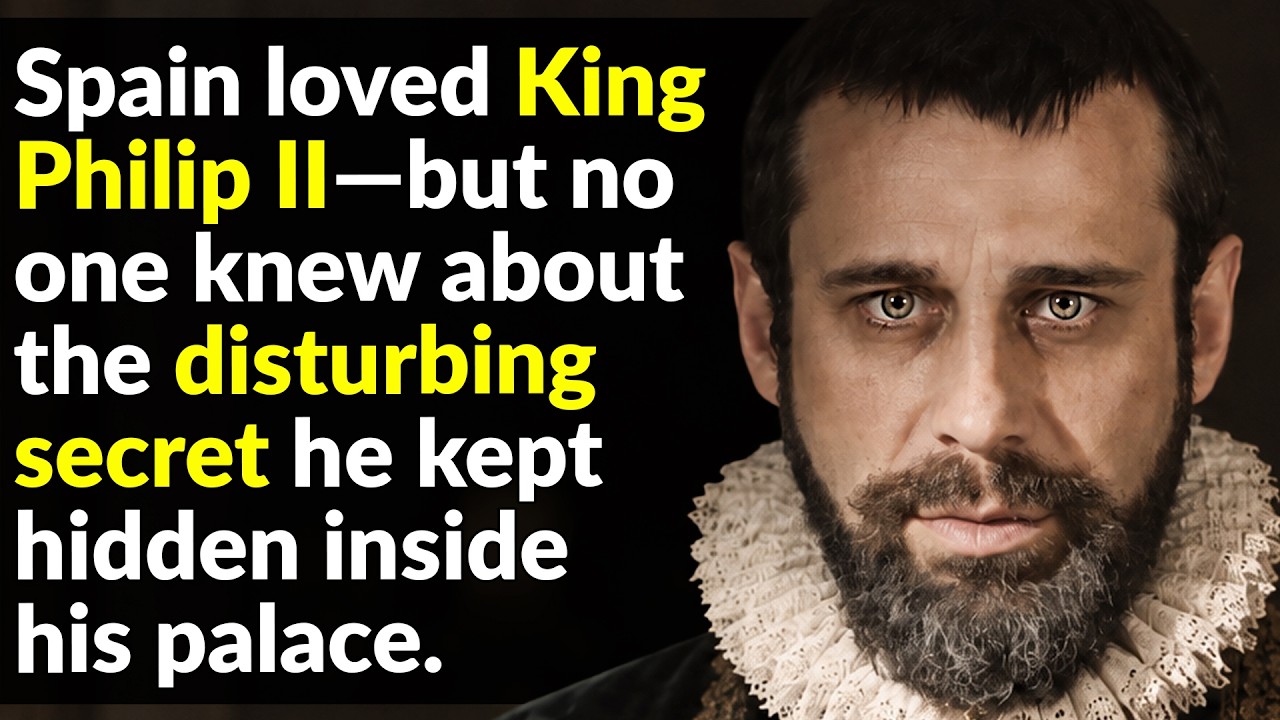
It was the end of a secret Philip had guarded for years, and the beginning of one of the darkest chapters of his reign. Philip II ruled over what many historians would later call Spain’s Golden Age, a period of immense wealth and power. But his people did not know what their king was hiding within his own palace. The man who saw himself as the pious champion of Roman Catholicism, who presented himself as cold, rigid, and severe, was concealing a family tragedy and a moral disaster that would haunt the rest of his life.
Philip was born in 1527 to Charles V, the Holy Roman Emperor, a domineering and feared ruler. At the time of Philip’s birth, Spain had just begun to exploit the colonial riches of the New World, and his parents intended to secure that legacy through their heir. As Philip grew, they shaped him into what they wanted: an absolute monarch. He received lessons in conflict, the art of governance, and strict adherence to the Catholic faith.
By the end of his teenage years, he emerged as a serious, hardworking young man. But those who knew him well felt uneasy about his coldness and his careful, calculating nature. When Philip turned sixteen, his father placed a heavy burden on his shoulders. Recognizing how seriously his son applied himself to the study of state affairs, Charles V granted him the regency of all the kingdoms of Spain as the start of his absolute rule.
Then Charles left him to manage on his own while the emperor attended to the rest of the Holy Roman Empire. The Habsburg family, to which Philip belonged, was notorious for its commitment to intermarriage, preserving what they called the purity of their royal blood. So when it came time for Philip to marry, his parents looked no further than his own cousin, Maria Manuela, Princess of Portugal. On July 8, 1545, Maria gave birth to a son named Carlos, fulfilling her duty as Philip’s wife.
She then died immediately from a hemorrhage. As Carlos grew into a young man, it became clear that something was terribly wrong. The boy was constantly ill and showed little sign of intelligence or insight. Perhaps this was understandable: because of the family’s relentless inbreeding, Carlos had only six great-grandparents instead of the normal sixteen.
By all accounts, he found pleasure in torturing animals and palace maids alike. At age eleven, he ordered a maid whipped for his own amusement. He grew into an arrogant, spoiled child, so repellent that one courtier described him as ugly and disgusting, though probably not to his face. Philip, perhaps doubting his son’s ability to follow in his footsteps, began looking for another bride in the 1550s.
His father’s cousin was none other than Queen Mary I of England, the eldest daughter of Henry VIII, and she was looking for a husband. Mary was thirty-seven, frail, and never considered beautiful. She quickly became obsessed with the idea of marrying her Spanish prince, defying the advice of her ministers who urged her to marry an Englishman instead. In mid-July 1554, Mary and Philip finally met for the first time.
Philip did not speak English—in fact, he never learned it—and the supposed lovers had to communicate through a mixture of other languages. Two days later, they formalized their marriage in a ceremony at Winchester Cathedral. In September of that same year, Queen Mary began suffering from morning sickness and weight gain. To everyone at court, it seemed the country was about to receive a new heir.
While the court physicians fussed over Mary, Philip sensed that something was wrong. He wrote to his brother-in-law expressing doubts about whether Mary’s pregnancy was real. In July 1555, after ten months of apparent pregnancy symptoms, Mary’s belly finally subsided, revealing that Philip’s suspicions had been correct all along. The queen had likely suffered a phantom pregnancy.
Once he was certain Mary was not pregnant, Philip left England to attend to state affairs in Flanders, abandoning his still-recovering wife, who by one account was exceptionally devoted to him, to face her grief alone at court. One of the reasons Mary’s ministers had hesitated to allow her to marry Philip was their fear that he, being more devoutly Catholic than she was, would push her toward intolerance of other religions, especially Protestantism. They were right to worry. Frustrated by Philip’s departure, Mary began to believe that her phantom pregnancy was God’s punishment for her leniency toward heretics.
She soon began persecuting Protestants, earning her the infamous nickname “Bloody Mary. ”
In 1556, Philip finally achieved his destiny. His aging father, Charles V, abdicated, and Philip became officially King Philip II of Spain at last. Yet he did not return to Mary.
In fact, he stayed away from his wife for nearly two years, returning only in 1557 when he wanted her help raising an army. He persuaded Mary to enter a conflict with France, one that ended in disaster. By the time it was over, England had lost Calais, its last remaining territory on the European continent. Philip’s return to England, which included at least one conjugal visit, raised Mary’s hopes that she was pregnant again.
But this time, something was different. She realized her health was declining, and if she gave birth to a child, she would likely not live to see it grow up. Knowing this, she prepared documents making Philip regent of the child in the event of her death. Though Mary expected to give birth in March 1558, it never happened.
She may have suffered another phantom pregnancy, and she now felt severe pain in her womb. After the cruel realization that she would never bear heirs, she arranged for her sister Elizabeth to succeed her. In November 1558, Queen Mary I died, most likely of uterine cancer. As if to emphasize how little he cared for the wife who had adored him, Philip wrote to his sister that he had felt “a reasonable sorrow” at her death.
As if that were not cold enough, Philip then sent a marriage proposal to Mary’s sister, the new Queen Elizabeth I. With Mary gone, Philip was no longer king of England, and he desperately wanted to be. Elizabeth I did not go down in history as a fool, and for good reason. She refused his offer.
But Philip’s eye had already fallen on another potential bride. In 1559, he married Elisabeth de Valois, one of the daughters of the French king Henry II and Queen Catherine de Medici. Over the next five years, Philip and Elisabeth tried to produce more heirs as alternatives to the unwell Carlos. First, the fifteen-year-old Elisabeth gave birth to a stillborn son.
Then in 1564, she miscarried twins. In 1562, Carlos fell and struck his head while chasing a maid down some stairs. For days, he hovered at death’s door, suffering intense pain and delirium. Only after an ancient craniotomy procedure—drilling a hole in his skull—did Philip’s son begin to show signs of recovery.
Carlos had never been an ideal prince, to say the least, but after the accident he became even more violent and unpredictable. In 1566 and 1567, Elisabeth gave birth to two daughters in succession: Isabella Clara Eugenia and Catherine Michaela. While Philip rejoiced at the birth of his second daughter, Carlos completely lost his mind. He tried to throw a servant who had angered him out of a window.
He tried to kill two of his father’s men. Then, in a fit of madness and paranoia, he burst into the rooms of Philip’s half-brother, John of Austria, and tried to shoot him. When he realized that a cautious servant had already unloaded his pistol, he attempted to strangle John with his bare hands. Philip could no longer ignore the situation.
He had to deal with his son. For weeks, Philip forbade Carlos from receiving any correspondence and refused to allow anyone to visit him. Then, in the middle of the night of January 17, 1568, Philip entered his son’s room in full armor, followed by a crowd of his men, and told his son he was now a prisoner. With his only son locked away in his chambers, Philip took desperate measures to protect his reputation.
He told no one and invented excuses for his son’s absence. Perhaps he might have succeeded in keeping the secret—if disaster had not struck first. In the summer of 1568, Carlos died, most likely from starving himself, though many rumors at the time claimed Philip had murdered his troublesome son. Immediately after Carlos’s suspicious death came another bitter blow for the King of Spain.
In October 1568, his wife Elisabeth de Valois miscarried a child, then died of complications from the difficult birth. Philip was now in his forties, widowed again after his third marriage, with no male heir. Searching for a new bride and a replacement son, Philip intensified his dubious behavior considerably. Anna of Austria was the daughter of the new Holy Roman Emperor Maximilian II and Maria of Spain.
She was more than two decades younger than Philip, and she was his niece. They married in 1570. Despite the strangeness of their relationship, Philip and Anna seemed quite happy together. Philip likely had no mistresses during that time, apparently the highest compliment a man of that era could pay his wife.
After a lifetime of struggling to produce healthy, sane sons, Anna gave Philip four sons in succession, plus one daughter, over the course of a decade. But all this good fortune was a curse in disguise. Only one of those children, the future King Philip III of Spain, reached adulthood. Anna of Austria herself died of influenza in 1580, at just thirty years old.
Philip was in his mid-fifties and found himself alone once again. Perhaps that was why some of his later decisions rapidly destroyed his legacy. For decades, Philip had maintained friendly, if cold, relations with his former sister-in-law, Elizabeth I. Throughout his reign, he had suppressed Protestant uprisings, especially in Spanish-controlled Netherlands, and he still saw himself as the protector of the one true faith, Catholicism.
So when the Protestant Elizabeth began helping the Dutch rebels in 1585, Philip famously turned against her. In 1588, in a desperate attempt to maintain Catholic supremacy in Europe, Philip sent the Spanish Armada toward England with the explicit goal of placing a Catholic on the English throne. It did not happen. The Spanish attempt to invade England failed catastrophically.
After being outmaneuvered in various battles and running short of supplies, a series of violent storms nearly destroyed the Spanish fleet. Philip was forced to retreat without setting foot on English soil. And then the whispers began. In this religious war, nature’s intervention to thwart Philip’s ambitions was terrible propaganda for him.
Protestants all across Europe celebrated the storm’s destruction of the Armada, believing it was a demonstration of God’s will to the people. Philip himself was said to have complained: “I sent my fleet to fight men, not to fight the winds and waves. ”
Philip continued his desperate attempts to strike England’s shores, sending more fleets in 1596 as he approached seventy, and again in 1597. All those attempts failed, and so did Philip’s ambition to achieve one final golden victory for his Golden Age.
By the end of his life, attacks of malarial fever and gout had exhausted Philip, reducing him to a shadow of his former self. To endure the pain and continue ruling his country, he took to strapping himself to a chair during the last three years of his life. He lived long enough to watch his son and heir, Prince Philip, grow into a young man. What he saw deeply disappointed him.
After the disaster of Carlos, he had tried to give his son the finest education the crown could buy, but it was clear to everyone—perhaps to Philip most of all—that the boy, though hardworking, did not possess a political mind. Philip ruled over what many historians call Spain’s Golden Age, thanks to the massive flow of gold and silver from the New World he had inherited. Yet when he finally succumbed to cancer in 1598, it was as if he ruled over a kingdom of ashes. In his son, Philip likely saw no glimmer of hope to raise Spain to greater heights.
And he was right. The nation declined during the reign of Philip III, and Spain lost the Netherlands and its struggle against Protestantism within fifty years of the old king’s death.






