At 10:27 on the night of March 12, 1954, Frank Sinatra stood on the stage of the Apollo Theater before 1,500 people and said something that stopped the music cold. You know what I like about Harlem? The women are beautiful, the music is hot, and the monkeys stay in their cages. Laughter came from the white section.
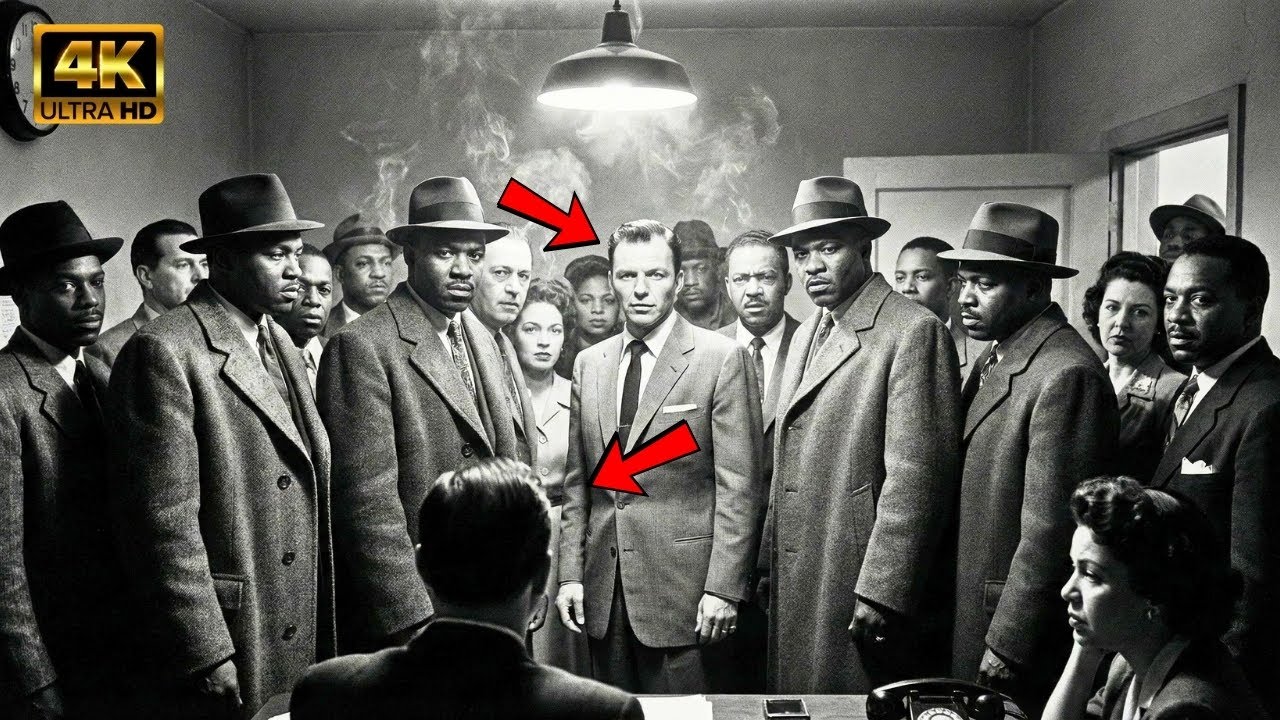
Silence, total and absolute, from everyone else. In the VIP balcony, Bambi Johnson set down his glass slowly. Carefully, the way a man does when he is trying not to break something. May touched his arm from her seat beside him.
Ellsworth, don’t. It’s not worth it. Bambi did not answer. He kept staring at Sinatra on that stage, smiling, arrogant, acting as if he owned Harlem, as if he could insult an entire community and walk away untouched.
What Sinatra did not know was that he had just insulted the wrong neighborhood in front of the wrong man. And what happened over the next twenty-four hours would make Frank Sinatra do something he had never done before: apologize publicly, on a stage, in front of 1,500 witnesses. To understand what happened, you have to understand Frank Sinatra in 1954. He was at the height of his power.
The film From Here to Eternity had just won him an Oscar. His music was everywhere. His face was on every magazine. Women screamed when he passed.
Men wanted to be him, and Sinatra knew it. He had an ego that matched his fame. He believed he was untouchable, protected by his connections to the mob. Sam Giancana in Chicago, the Fettis in New York.
Even Lucky Luciano considered him a friend. So when Bobby Schiffman, the owner of the Apollo Theater, invited him to perform in Harlem, Sinatra treated it as a favor, as though he were gracing the Black community with his presence. He did not realize that Harlem was not just another neighborhood. It was a kingdom.
And Bambi Johnson was its king. At 8:00 on the evening of March 12, Sinatra arrived at the Apollo in a black Cadillac with Ava Gardner on his arm. Two bodyguards, an entourage of yes-men. The crowd outside went wild, screaming and reaching for him.
Sinatra loved it. He waved like royalty and walked through the rope line without a glance at the local performers waiting to greet him. Count Basie, one of the greatest bandleaders in America, extended his hand. Mr.
Sinatra, welcome to Harlem. Sinatra barely looked at him. Yeah, thanks. Where’s my dressing room?
Count Basie’s smile stiffened, but he pointed the way. Sinatra disappeared backstage with his entourage. Count Basie turned to a fellow band member. This is going to be a long night.
Why? Because that man just insulted us in our own house, and Bambi Johnson is in the audience tonight. His bandmate let out a low whistle. Oh, God.
Inside, the Apollo was packed. Fifteen hundred people. Black families in their best clothes, white celebrities slumming in Harlem for the authentic experience. Jazz musicians, politicians, and in the VIP balcony, Bambi Johnson, who had bought tickets weeks earlier, not because he was a Sinatra fan, but because the Apollo was Harlem’s crown jewel.
When big stars came through, Bambi showed up to remind everyone who really ran things. Bobby Schiffman, the Apollo’s owner, approached Bambi’s box nervously. Mr. Johnson, thank you for coming tonight.
It’s an honor to have you. Bambi nodded. Bobby, this show had better be good. You’re charging high prices.
It will be. Sinatra is the best. We’ll see. The lights dimmed.
Count Basie’s orchestra began to play. The crowd cheered, and Frank Sinatra walked onto the stage. For the first thirty minutes, it was magic. Sinatra sang I’ve Got You Under My Skin, Night and Day, and The Lady Is a Tramp.
His voice was flawless. The audience was spellbound. Even Bambi had to admit the man could sing. But then Sinatra started talking between songs, telling jokes.
And that is when things began to go wrong. You know, Sinatra said into the microphone, I’ve sung all over the world. Paris, London, Vegas, but nothing compares to Harlem. The crowd cheered.
This place has soul. It has rhythm. It has… he paused for effect. Personality.
Laughter from some sections. Others were not sure where this was going. I mean, where else can you find this kind of raw talent, this kind of primitive energy? Primitive.
The word hung in the air like smoke. Bambi’s jaw tightened. Sinatra continued, oblivious. You people really know how to have a good time.
Not like those stiffs in Manhattan. You just let it all hang out, like animals in the wild. More nervous laughter. Then Sinatra delivered the line that ended his career in Harlem.
You know what I love about Harlem? The women are beautiful, the music is hot, and the monkeys stay in their cages. Silence. Dead silence.
A few white patrons laughed nervously, but the rest of the Apollo Theater went completely still. On stage, Count Basie’s hands froze over the piano keys. Sinatra, realizing something was wrong, tried to backtrack. Hey, hey, I’m just kidding.
You know I love you folks. You folks. Bambi stood up. The movement caught Sinatra’s attention.
Everyone in the VIP section turned to look. Bambi Johnson stood in his box, staring at Sinatra with eyes like blades. May tugged at his arm. Ellsworth, please sit down.
Bambi did not sit. He stared for ten long seconds. Then he left the balcony. The entire theater watched him go.
Sinatra tried to laugh it off on stage. Tough crowd tonight, huh? But his voice was shaking. He had just realized he had made a terrible mistake.
The rest of the show was a disaster. Sinatra rushed through three more songs. The applause was polite but cold. The energy was gone.
When he finally left the stage, the audience filed out in silence. No warm applause, no encores, just silence. Backstage, Sinatra was furious. What the hell happened?
That was my best. And they acted like I insulted them. His manager, a nervous man named Hank, cleared his throat. Frank, maybe you shouldn’t have called them monkeys.
I was kidding. It’s comedy. Not in Harlem, it isn’t. What’s that supposed to mean?
It means you just insulted Bambi Johnson’s neighborhood. And Bambi Johnson doesn’t forget insults. Who the hell is Bambi Johnson? The question hung in the air.
Hank looked at Sinatra as if he had just asked who the President was. You don’t know who Bambi Johnson is? No. Should I?
Frank, Bambi Johnson runs Harlem. He’s the most powerful man in this neighborhood. Maybe the most powerful Black man in America. Politicians answer to him.
Police answer to him. And you called his people monkeys in his theater. Sinatra waved a dismissive hand. I have friends too.
Sam Giancana. The mob. I’m protected. Not in Harlem, you’re not.
A knock came at the dressing room door. Three sharp knocks. Hank opened it. Johnny Beard stood there, four men in suits behind him, all with hard faces.
Mr. Sinatra, Johnny said politely. Mr. Johnson wants to speak with you.
Sinatra crossed his arms. Tell Mr. Johnson I’m busy. It wasn’t a request.
The four men stepped into the room. Suddenly, the space felt very small. Sinatra looked at his two bodyguards. They looked at Bambi’s four men and decided this was not a fight worth having.
Fine, Sinatra said, trying to sound tough. Five minutes. That’s all he gets. Johnny smiled.
That’s all he’ll need. They walked down the narrow corridor to Bobby Schiffman’s office. Inside, Bambi Johnson sat behind the desk, calm, in control, terrifying in his stillness. May stood by the window.
Count Basie sat in the corner, arms crossed. Bambi said quietly, Frank Sinatra. The legend himself. Sinatra tried to swagger.
Look, if this is about the jokes, I didn’t mean anything by it. I do this kind of material all the time. In Vegas, sure. In Harlem?
No. Sinatra laughed nervously. Come on, it’s 1954. We’re all adults here.
We can take a joke. Can you? What? Bambi rose and walked slowly around the desk.
If I called you a guinea, or a wop, or a dago, could you take that joke? That’s different. Why? Because you’re Italian and I’m Black.
Because your feelings matter and ours don’t. Sinatra’s face reddened with shame and anger. I have Italian friends who would kill you for talking to me that way. Bambi stopped two feet from Sinatra.
Then call them. The room went dead silent. Sinatra looked around at Bambi’s men, at Johnny, at the closed door. He was trapped, and he knew it.
Listen, Bambi said, his voice calm but firm. I don’t care how famous you are. I don’t care how many Oscars you’ve won. You came into my neighborhood, performed in my theater, and insulted my people.
That is not acceptable. It was just a joke. It was a racial insult, and you will apologize for it. Sinatra laughed.
I’m not apologizing. Do you know who I am? Yes, Bambi said. You’re the man who just ended his career in Harlem, and maybe in every other Black neighborhood in America.
Because by tomorrow morning, every jazz club, every soul food restaurant, every barbershop from here to Los Angeles will know that Frank Sinatra called Black people monkeys. Your records will be pulled from the stores. Your shows will be boycotted. Your Black fans, and you have millions of them, will turn against you.
Sinatra’s face went pale. You can’t do that. I don’t have to do anything. You did it to yourself.
But I’m giving you a chance to fix it. How? Bambi returned to the desk and sat down. You will perform again tomorrow night, the second show.
Yes. You will open that show with an apology. A real apology, not that if-I-offended-anyone nonsense. A sincere, genuine apology to the people of Harlem, on that stage, in front of everyone.
Sinatra’s hands clenched into fists. I won’t do it. Then you will never perform in a Black neighborhood again. And I will make sure every newspaper in America knows why.
Sinatra looked at Count Basie. Count, you’re a reasonable man. You understand the business. Tell him I can’t do this.
Count Basie shook his head. Frank, you made this bed. Now you have to lie in it. Sinatra looked at May.
She stayed silent, no reaction. Sinatra looked at Bambi. This is blackmail. This is called consequences.
You want to insult people? Fine. But you’ll pay the price. Sinatra was trembling now.
Not with fear, but with rage. Because for the first time in years, someone was refusing to be impressed by him. Someone was holding him accountable, and he hated it. Fine, Sinatra said sharply.
I’ll give you your little apology. But this isn’t over. Yes, it is, Bambi said. Because if you insult Harlem again, there won’t be a second chance.
You understand me? Sinatra did not answer. He stormed out of the office, his bodyguards following. The door slammed behind him.
Count Basie whistled in disbelief. That man’s ego is going to get him killed one day. Maybe, Bambi said. But not today.
On the morning of March 13, 1954, at 9:00, Frank Sinatra sat in his suite at the Waldorf-Astoria, furious. Ava Gardner, his ex-wife whom he was trying to win back, poured him coffee. Are you really going to apologize? I don’t have a choice.
You always have a choice, Frank. Not this time. This man Bambi, he has power. Real power.
If I don’t apologize, I’ll be banned from Black neighborhoods. That’s half my audience. Ava sat across from him. Then apologize.
And mean it. Maybe you’ll learn something. I don’t need to learn anything. You told a joke, a bad joke, about people who have been called worse than monkeys their whole lives.
She leaned forward. Frank, you’re an artist. You sing about love, and pain, and feeling, but you don’t understand what it means to be on the other side, to be the one everyone is laughing at. Maybe it’s time you understood that.
Sinatra stared at her. Since when did you get so political? Since I started dating men who aren’t assholes. She stood.
I’ll be at the show tonight, and I’ll watch you do the right thing, or I’ll walk out of your life for good. Frank grabbed her hand. Ava, don’t. Then prove you’re better than this.
She left. Sinatra sat alone in his suite. For the first time in years, he felt small. At 8:30 that evening, the Apollo was full again.
Fifteen hundred people. News of the previous night had spread. Everyone wanted to see what would happen. Would Sinatra show up?
Would he really apologize, or would he make it worse? Backstage, Sinatra arrived with his entourage, but he was quiet this time. No jokes, no swagger. He went straight to his dressing room and sat staring at himself in the mirror.
At 9:50, Bobby Schiffman knocked on his door. Mr. Sinatra, you’re on in five. Sinatra nodded, stood, straightened his tie, and walked toward the stage.
Count Basie was waiting in the wings. Frank. Count Basie put a hand on his shoulder. What you’re about to do takes courage.
Most men wouldn’t do it. Sinatra looked at him. I don’t feel courageous. I feel humiliated.
Sometimes they’re the same thing. The lights dimmed. The crowd roared. Frank Sinatra walked onto the stage.
At 9:55 on March 13, 1954, he stood at the microphone. The crowd cheered, but it wasn’t like the night before. There was tension in the air. Doubt.
People wanted to know if he would actually go through with it. Sinatra raised his hand for silence. The Apollo went quiet. Before I sing tonight, he began, his voice steady but soft, I need to say something.
The crowd leaned forward. Last night, I made a mistake. A terrible mistake. I told jokes I thought were funny, but they weren’t.
They were hurtful, disrespectful, and wrong. You could have heard a pin drop. I called this community monkeys. I used the word primitive.
I talked about you as if you were less than human. There is no excuse for that. There is no excuse at all. Sinatra paused, trying to compose himself.
Some of you may think I’m only apologizing because I was forced to. And you’re right. I was forced to. By a man named Bambi Johnson.
In the VIP balcony, Bambi sat perfectly still, May beside him, Johnny and Willie behind him. The whole theater turned to look at Bambi’s box. Sinatra continued. Mr.
Johnson made me understand something I should have known already. That words have power. That when you’re on a stage, when you have a microphone, when you’re famous, you have a responsibility. And I failed to live up to that responsibility.
He looked directly at Bambi. Mr. Johnson, thank you for holding me accountable. I apologize for disrespecting your community, your people, your home.
The crowd murmured. Then Sinatra turned back to the audience. And to everyone here, and to everyone in Harlem, I apologize. Not because I have to, but because you deserve better.
You deserve respect. This neighborhood has produced some of the greatest artists, musicians, and writers in American history. Count Basie, Duke Ellington, Billie Holiday, Langston Hughes. And I have had the honor of performing on the same stage where they made history.
I should have honored that. Instead, I insulted it. Sinatra’s voice cracked slightly. I can’t take back what I said.
But I can promise to be better, to do better. I promise I will never disrespect Harlem again. Silence. For five long seconds, the Apollo Theater was perfectly quiet.
Then someone in the back began to clap slowly. Then another. Then a group. Then the entire theater erupted in applause.
Not a standing ovation. Just applause. Real applause. Sinatra looked stunned.
He had expected boos. He had expected to be run out of Harlem. Instead, people were clapping. Bambi Johnson stood up in his box.
The theater went quiet again. Everyone watched him. Bambi looked at Sinatra. Then he nodded.
Once. Just once. A simple gesture, but it meant everything. Permission was granted.
The apology was accepted. Sinatra exhaled as if he had been holding his breath for a year. Thank you, he said quietly. Now let me try to earn your forgiveness through music.
Count Basie’s orchestra began to play. Sinatra started to sing The House I Live In, a song about tolerance, equality, and American values. He sang it with more emotion than he had ever sung anything. Every word felt personal.
When he finished, the entire audience stood. This time, a real standing ovation. Sinatra performed for ninety minutes. Every song was perfect.
Every note was honest. And when he took his final bow, the Apollo Theater gave him the respect he had failed to give them the night before. Backstage, Sinatra collapsed into a chair, exhausted and emotionally drained. A knock came at his dressing room door.
Come in. Bambi Johnson entered alone. No guards, no entourage. Just Bambi.
Sinatra stood up immediately. Mr. Johnson. Sit down, Frank.
They sat across from each other. A moment passed in which neither spoke. Then Bambi said, That took courage. What you did out there.
Sinatra shook his head. It took swallowing my pride. Bambi smiled slightly. They’re the same thing.
Sinatra laughed, a bitter laugh. I’ve been famous for so long, I forgot what it felt like to be held accountable. Fame does that. It makes you think you’re invincible, until you’re not.
Bambi leaned forward. Let me tell you something, Frank. I’ve met presidents, mob bosses, millionaires. Most of them think power means you can do whatever you want.
But true power, real power, is knowing when to apologize, when to admit you were wrong. That’s power. Sinatra looked at Bambi with genuine respect. You’re not what I expected.
What did you expect? I don’t know. Someone more frightening. Bambi laughed.
I can be frightening when I need to be. But tonight, tonight you did the right thing. That deserves respect. Sinatra extended his hand.
Thank you for the lesson. Bambi shook it. Don’t thank me. Thank the people you apologized to.
They’re the ones who forgave you. After Bambi left, Ava Gardner walked into the dressing room. She had watched the whole show from backstage. Frank.
Ava. She walked over and kissed his cheek. I’m proud of you. Sinatra looked at her, surprised.
Really? Really. That was the most honest thing I’ve seen you do in years. I felt like a fool.
You looked like a man. There’s a difference. On the morning of March 14, every New York paper carried the story. Sinatra Apologizes to Harlem, the New York Times.
Chairman of the Board Bows to Bambi Johnson, the Daily News. Frank’s Humble Night at the Apollo, the Amsterdam News. The Black papers praised Sinatra for his apology. The white papers were divided.
Some called it dignified. Others called it weak. Sinatra did not care. For the first time in years, he had done something because it was right, not because it was profitable.
But the story did not end there. On March 15, Sam Giancana called Sinatra from Chicago. Frank, what the hell did you do? What do you mean?
I hear you apologized publicly to some Harlem mobster. Bambi Johnson isn’t just some mobster, Sam. He’s a man of substance. Well, you disrespected his neighborhood.
I had to make it right. Giancana laughed. You’ve gone soft, Frank. No, I’ve grown up.
There’s a difference. Look, Sam, I appreciate everything you’ve done for me, but I’m not going to insult Black people to please my mob friends. These people are my fans. They buy my records.
They come to my shows. They deserve respect. Giancana was silent for a moment. You know, Frank, maybe you’re smarter than I thought.
What’s that supposed to mean? Most men in our world think respect flows in one direction. Upward. But you just figured out that respect flows in every direction.
Yeah, I guess I did. Good for you, kid. Just don’t make a habit of apologizing. People might think you’re weak.
Let them think what they want. Sinatra hung up the phone. For the first time in his career, he had stood up to the mob and chosen dignity over ego. On March 20, Sinatra returned to Harlem, not for a show, but for dinner.
He walked into Smalls Paradise, Bambi Johnson’s restaurant, with only Ava Gardner. No bodyguards, no entourage. The room went quiet when he entered. Then Bambi, sitting at his usual table, rose.
Frank. Welcome. Come sit. Sinatra and Ava joined Bambi and May for two hours.
They talked, not about business, not about power, but about music, family, life, and what it meant to be respected, and what it meant to earn respect. As they left, Sinatra shook Bambi’s hand. Thank you. For what?
For not letting me get away with being an asshole. Bambi smiled. Anytime. Over the next decade, Frank Sinatra never performed in a segregated venue.
He refused, even when it cost him bookings in the South. Even when mob bosses pressured him, he insisted that if Black musicians could not stay in the same hotels, eat in the same restaurants, or sit in the same halls, he would not perform at all. In 1960, when the Rat Pack performed in Las Vegas, Sinatra made sure Sammy Davis Jr. could stay in the same hotel, eat in the same restaurants, and be treated as an equal.
Hotel owners threatened to cancel the shows. Sinatra threatened to never play Vegas again. The hotels backed down. In 1963, during the March on Washington, Sinatra quietly donated money to Martin Luther King Jr.
’s organization. In 1965, after the Watts riots, Sinatra quietly funded rebuilding efforts in the Black community. He never announced it, never sought credit. He just did it.
And in 1968, when Bambi Johnson died, Frank Sinatra sent flowers to the funeral. The card read: To the man who taught me the true meaning of respect. Thank you, Frank. Years later, in 1974, a reporter asked Sinatra about the Apollo incident.
Mr. Sinatra, is it true that Bambi Johnson forced you to apologize in 1954? Sinatra thought for a moment, then smiled. Nobody forced me to do anything.
Bambi Johnson gave me the chance to be better than I was, to understand that fame is not a license to hurt people. I took that chance, and I’m grateful for it. That night at the Apollo, that apology, it changed my life. How?
It taught me that being a man doesn’t mean never making mistakes. It means taking responsibility for them when you do. March 13, 1954, the night Frank Sinatra apologized to Harlem, became legend. Not because a famous white man bowed to a powerful Black man, but because someone who had every power in the world chose humility over arrogance.
Because accountability matters more than fame. And because respect is never given. It is earned.
