In the autumn of 1923, a man named Perl Gar sat in a rented room above a boarding house in the mountains of western Virginia and stared at a photograph he could not explain. The photograph showed the interior of a house, a parlor with floral wallpaper and a stone fireplace, everything ordinary except for one detail. On the far wall above the mantle there were marks, burned into the wallpaper from the inside, as though something behind the wall had been pressing outward with tremendous heat. If you tilted the photograph just right, you could almost see a shape.
Almost. Perl was 38 years old, tall and lean as a fence rail, with deep-set gray eyes and hands that were always inkstained. He was a journalist by trade, though by 1923 he had published nothing of significance in nearly five years. He had worked for three different papers in Baltimore, each time leaving under circumstances he never fully explained.
Some said he drank. Others said he had a temper. A few whispered that his last editor had fired him after Perl turned in a story so disturbing the paper refused to print it. Whatever the truth, he was a man running out of chances.
The photograph had come from a retired sheriff named Odell Craravensworth, a heavyset man of 61 with a white mustache stained yellow from tobacco and a voice like gravel shifting in a bucket. Odell had written to Perl claiming he had a story that would, in his exact words, make every paper in the country sit up straight. Perl almost didn’t come. He had heard promises like that before.
But the photograph changed his mind. He arrived in Lockwood on the 7th of October, driving a rusted Model T that wheezed and shuddered on the mountain roads. Lockwood was not a big town, maybe 90 people at its peak, most of them connected to the lumber trade or the railroad spur that ran through the valley like a scar. It sat in a hollow between two ridges so steep that sunlight only touched the main road for about four hours a day in winter.
The rest of the time, the town lived in shadow. People who passed through always said the same thing: Lockwood felt like a place that had already ended even while people still lived there. The post office had closed in 1919. The general store kept irregular hours.
And the only church, a small wooden structure with a crooked steeple, had not held a proper service in over two years. The only boarding house was a crooked two-story building run by a woman named Hetty Slade. She was 53, short and broad-shouldered, with steel-colored hair pinned tight against her skull and a face that looked carved from the same stone as the mountains. She did not smile when Perl introduced himself.
She looked at his car, then at his ink-stained hands, then at his face. “You’re the writer,” she said. It was not a question. She gave him a room on the second floor at the end of the hall.
Small, clean, with a single window that faced the ridge. The bed was narrow, and the mattress smelled faintly of cedar. Hetty told him breakfast was at six, supper at five, and the front door was locked at nine. She paused at his door before leaving and said something Perl would remember for the rest of his life.
“Whatever Odell told you, it’s not the whole truth. It never is with him. ” Then she closed the door, and her footsteps faded down the hall. Perl met Odell the next morning at a small diner near the rail yard.
The place had no name, just a hand-painted sign that said Coffee and Food. Odell was already there, sitting in a corner booth with his hat on the table and a cup of black coffee in front of him. He looked older than Perl had expected. His eyes were bloodshot and ringed with dark circles, and his hands trembled slightly when he lifted his cup.
They talked for two hours. Odell explained that twenty years earlier, in 1903, a family had lived in a house on the eastern edge of Lockwood, near where the tree line met the base of the ridge. The husband, a man named Fesus Nettleford, was a timber surveyor, 44 years old, known around town as quiet but dependable. His wife, Dorathea, was 39, a former schoolteacher from Richmond who had moved to the mountains after their marriage.
They kept to themselves mostly. In the summer of 1903, something changed. It started small. Fesus stopped coming into town for supplies.
Dorathea was seen less and less. When someone did catch a glimpse of her, she looked thinner, pale. Her eyes, people said, had a quality to them that was hard to describe, like she was looking at something that wasn’t there. By August, no one had seen either of them in weeks.
Odell, who was a young deputy at the time, only 21, was sent to check on the property. He went alone on horseback on a Tuesday afternoon. The ride took about 40 minutes from the center of town. He said the forest got quieter the closer he got.
Not the natural quiet of deep woods. A different kind of quiet. The birds had stopped. The insects had stopped.
Even the wind seemed to have pulled back, like the air itself was holding its breath. He found the house standing. No damage, no sign of trouble from the outside. The garden had gone wild, tomatoes rotting on the vine, weeds choking the pathway.
The front door was closed but not locked. He knocked. No answer. He called their names.
Nothing. He pushed the door open. And here is where Odell’s voice changed. Perl noticed it immediately.
The old man’s hand stopped trembling. His eyes went flat, and he spoke in a tone that was almost mechanical, as if he had rehearsed this part so many times that the emotion had been worn out of it completely. The inside of the house was wrong, not damaged, not ransacked, wrong. Every piece of furniture was in its place.
The dishes were clean and stacked. The beds were made. But the air inside was cold, not cool. Cold like stepping into a root cellar in January.
And there was a smell, faint but persistent, like the air after a lightning strike. And then there were the walls. The marks Perl had seen in the photograph were everywhere, not just above the fireplace. On every wall in every room.
Burned into the wallpaper and the plaster beneath it. Shapes, patterns. Some looked almost like hands pressed flat. Others looked like faces, distorted, stretched, as if someone had been pushed against the wall from the other side with tremendous force and heat.
Odell stood in that parlor for maybe three minutes. He said it felt like an hour. The cold wasn’t just temperature. It was a feeling, a presence.
Something in that house was aware of him. He could feel it the way you feel someone standing behind you in a dark room. He left. He got on his horse and rode back to town and told the sheriff what he had found.
The sheriff, a man named Cornelius Ager, 60 years old with a bad knee and worse judgment, told Odell to forget about it. Said the Nettlefords had probably left town. Said mountain people do that sometimes. Said there was no crime to investigate.
But Odell couldn’t forget. He went back three more times over the next two weeks. Each time the marks had changed, not grown exactly, shifted, as if whatever had made them was moving slowly behind the walls. On his last visit, he brought a camera.
That was the photograph he sent to Perl twenty years later. After that fourth visit, Odell stopped going. He said something happened on that last trip that he wasn’t ready to talk about. Not yet.
He told Perl he needed a few days. He said there were other people in town who knew things, who had their own experiences, and that Perl should talk to them first. The first person Perl spoke to was a woman named Orly Wickham. Orly was 70 years old, a former midwife who had delivered half the people in Lockwood and buried a fair number of them too.
She was sharp-eyed and sharp-tongued, with a thin frame that seemed held together by willpower alone. She lived in a small cabin on the north side of town, surrounded by jars of preserved vegetables and stacks of old almanacs. Orly did not want to talk at first. She stood in her doorway and looked at Perl the way you might look at a stray dog that wandered onto your porch.
But when he mentioned the Nettleford house, something shifted in her expression. Not fear, exactly. Recognition. The look of someone who has been waiting a long time for a question they hoped would never come.
Over strong tea and cornbread, Orly told Perl that the Nettleford house had a history that went back long before Fesus and Dorathea. The house had been built in 1871 by a man named Harland Cruz, a coal speculator who came to the mountains looking for deposits. Harland was 46 when he built the house. A large man with red hair and a reputation for being both brilliant and deeply strange.
He had studied geology at a university in Philadelphia but had left under unclear circumstances. Some said he had become obsessed with certain ideas his colleagues found disturbing, ideas about what lay beneath the surface of the earth. Not coal. Not minerals.
Something else. Harland lived in that house alone for seven years. During that time, he was seen infrequently. When he did appear in town, he looked progressively worse, thinner, paler.
His eyes had developed a strange quality, a kind of intensity that made it uncomfortable to hold his gaze. He bought unusual supplies. Large quantities of salt. Iron filings.
Candles made from tallow. Rolls of copper wire. When asked what he was doing, he would only say that he was conducting research. In 1878, Harland Cruz disappeared.
No body was found. No note. His horse was still in the stable. His belongings were still in the house.
The only thing missing was a leather journal that several people had seen him carrying, a thick worn book that he wrote in constantly and guarded with obvious paranoia. The house sat empty for fifteen years after that. No one wanted to buy it. No one wanted to live in it.
People who walked past it at night reported hearing sounds from inside. Not voices, not footsteps. A low hum that you felt more in your chest than in your ears. Some people said the hum made them feel sick.
Others said it made them feel something worse. Sad. Desperately, inexplicably sad. In 1893, Fesus Nettleford bought the property for almost nothing.
He and Dorathea moved in that spring. For ten years, everything seemed fine. And then in the summer of 1903, the pattern repeated. Isolation.
Silence. Disappearance. Orly told Perl she believed the house itself was the problem. Not haunted.
She said that word was too simple. She said the house was like a door that had been left open, and something on the other side had been coming through slowly for decades. Perl asked her what she meant by something. Orly looked at him for a long time.
Then she said, “I don’t know what it is, but I know what it does. It takes the warmth out of things. Out of the air. Out of people.
Out of time itself. And it leaves those marks behind like fingerprints on a window. Like something pressing against the glass, trying to get all the way through. ”
Perl spent the next three days interviewing other residents of Lockwood.
Each conversation added another layer to a story that was becoming increasingly difficult to dismiss. A man named Sherwin Pulk, a 47-year-old railroad worker with forearms like tree trunks and a voice so quiet you had to lean in to hear him, told Perl he had been inside the Nettleford house once on a dare when he was 20. He made it as far as the hallway before he turned around. The air was so cold that his breath came out in clouds even though it was July.
And he heard something. Not a sound exactly. More like a thought that wasn’t his. A thought that said, in a voice that was neither male nor female, “Stay.
” Just that one word. Stay. Sherwin said he ran. He never went back.
He still sometimes heard that word in his dreams, and when he did, he woke up freezing no matter how many blankets were on the bed. A woman named Vashi Elmore, 62, who ran the post office before it closed, told Perl that in 1901, two years before the Nettlefords disappeared, Dorathea had come to the post office to mail a letter. Vashi remembered it because Dorathea’s hands were shaking so badly she could barely hold the pen. The letter was addressed to a professor at the University of Virginia.
Vashi, who admitted she was not above reading other people’s mail, had held the envelope up to the light. She could only make out a few words. Among them were “marks beneath” and the phrase “It knows we are here. ” Vashi said she thought about opening the letter.
Something stopped her. Not conscience. Fear. The envelope felt wrong in her hands.
Too heavy for a single sheet of paper. And cold. Always cold. She mailed it.
She never found out if it arrived. By the fourth day, Perl had filled two notebooks with interviews and observations. He was beginning to form a theory, or at least the outline of one. The house on the eastern edge of Lockwood was not simply a site of disappearances.
It was a location where something was happening. Something slow and persistent and possibly still ongoing. The marks on the walls, the cold, the strange hum, the feeling of being watched. These were not random phenomena.
They were symptoms. And whatever was causing them had been active for at least fifty years. On the fifth day, Odell came to see Perl at the boarding house. It was evening.
Hetty had already locked the front door, but Odell knocked with a specific rhythm, three quick, two slow, and Hetty let him in without a word. The old sheriff looked worse than before. His face was ashen, and his eyes had a haunted quality Perl had seen before, in soldiers returning from the war, in men who had witnessed things that could not be reconciled with normal life. They sat in the small parlor by the wood stove, and Odell told Perl what had happened on his fourth and final visit to the Nettleford house.
He had gone in the late afternoon when there was still light. He brought his camera and a lantern. The house looked the same as before, the wild garden, the closed door, the impossible cold seeping out through the cracks. He went inside.
The marks on the walls had changed again, more numerous now, covering nearly every surface in the parlor and hallway. He took photographs. He moved through the house methodically, room by room. In the back room, the room Fesus had used as a study, Odell found something new.
The floor had been pulled up, not by force. The boards had been carefully removed and stacked against the wall, as if someone had been doing planned, deliberate work. Beneath the floorboards was bare earth, hard-packed clay. And in the center of that exposed ground was a hole.
Not large, maybe two feet across. Perfectly round. And deep. Odell held his lantern over it and could not see the bottom.
He dropped a stone into it and listened. He counted to seven before he heard it hit something. But the sound that came back was wrong. It wasn’t the sharp crack of stone on stone.
It was soft. Muffled. Like stone hitting flesh. Odell stared at that hole for a long time.
The cold was intense now, so cold that ice had formed on the edges of the opening. The hum was louder here, emanating from the hole itself, rising up like heat from a furnace, except there was no heat, only that bottomless, aching cold. And then he heard something else. Breathing.
Not from the hole. From behind him. Odell turned around slowly. The study was empty.
The hallway behind him was empty. But the breathing continued, slow and rhythmic, and it was coming from inside the walls. From behind the plaster and the wallpaper and the marks. Something was in the walls.
Not behind them. In them. As if the walls themselves were alive, as if the entire house was a living thing, and he was standing inside its chest, listening to its lungs expand and contract. Then the marks on the walls began to move.
Not quickly. Slowly, like condensation sliding down a cold window. The shapes shifted. The handprints pressed outward.
The face-like impressions turned. And Odell realized, with a horror he could not adequately describe, that they were all turning toward him. Every mark on every wall was orienting itself in his direction, as if whatever was making them had just become aware of his presence. Odell ran.
He ran through the hallway and out the front door, and he did not stop running until he reached his horse. He rode back to town at a gallop. He never went near that house again. That was twenty years ago, he told Perl.
Twenty years, and I can still feel it. That cold. That breathing. It follows me.
Some nights I wake up and my bedroom is freezing and I can hear it, that slow breath in the walls of my own house. And I think it’s spreading. Whatever is in that house, it’s not staying in that house anymore. Perl sat with this information for a full day.
He did not eat. He barely slept. He sat in his room and stared at the photograph and thought about what he had heard. Every rational part of his mind told him there was an explanation.
Gas leaks could cause cold spots and hallucinations. Subsidence could create holes in the ground. Paranoia was contagious in small isolated communities. There were reasons.
There were always reasons. But the photograph was real. He could see the marks. He could trace them with his finger.
And they looked exactly like what Odell had described. Like something pressing through from the other side. On the seventh day, Perl made a decision that would define the rest of his life. He decided to go to the house himself.
He did not tell Odell. He did not tell Hetty. He packed a bag with a lantern, a notebook, two pencils, a compass, and a small flask of whiskey. He waited until mid-morning when the light in the hollow was at its strongest, and he drove his Model T as far up the eastern road as it would go, then walked the remaining quarter mile through the trees.
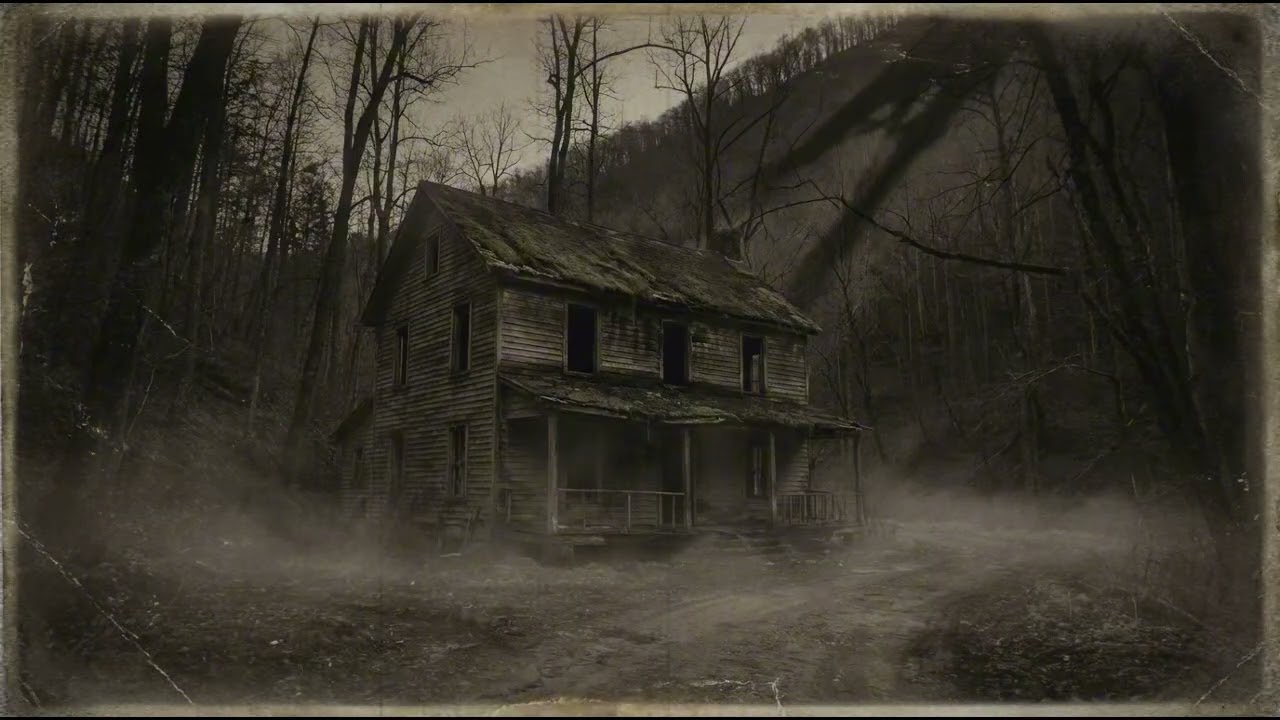
The house appeared through the forest like a photograph developing in solution. First the roofline, then the walls, then the windows, dark and empty as eye sockets. Twenty years of neglect had taken their toll. The porch had partially collapsed.
The garden was now a tangle of wild growth. But the structure itself was intact, stubbornly solid, as if something was holding it together from the inside. Perl stood at the edge of the clearing for ten minutes before approaching. He was not a superstitious man.
He had spent his career dealing in facts, in evidence, in the verifiable and the concrete. But standing there looking at that house, he felt something he had never felt before. Not fear. Something older than fear.
Something primal that lived in the base of his spine and whispered with the voice of a thousand ancestors. Do not enter. He entered. The front door opened with a groan that sounded almost human.
Inside, the cold hit him like a physical force. His breath came out in thick white clouds. Frost clung to the window frames, to the furniture, to the floral wallpaper he recognized from the photograph. And the marks were everywhere, just as Odell had described, covering the walls from floor to ceiling in patterns that were almost, but not quite, recognizable.
Like letters in a language that had never been spoken. Like a message written by something that had no concept of human communication but was trying desperately to make itself understood. Perl took out his notebook and began to write. He documented everything.
The temperature, which he estimated at well below freezing despite it being October and the outside air mild. The frost patterns, which seemed to radiate outward from the walls rather than forming from ambient moisture. The hum, which he could now hear clearly, a low steady vibration that seemed to come from everywhere and nowhere at once. And the smell, that electrical smell like ozone after a storm, but underneath it something else.
Something organic. Something that reminded him of a hospital ward. Bodies. Disinfectant.
And something that no amount of cleaning could fully remove. He moved through the parlor, into the hallway, toward the back of the house. The marks on the walls grew denser as he progressed, layering over each other in complex arrangements that made his eyes ache if he looked at them too long. Some of them seemed to move at the edges of his vision, but when he turned to look directly, they were still.
He told himself it was a trick of the light. He almost believed it. The study was at the end of the hallway. The door was open.
Inside, everything was as Odell had described. The removed floorboards. The exposed earth. The hole.
Perl approached the hole slowly. The hum was loudest here, vibrating through the soles of his boots, through his bones, through his teeth. The cold was so intense his fingers were going numb. He knelt at the edge and held his lantern over the opening.
The hole was perfectly round. The walls of the hole were smooth, almost polished, like the inside of a well. But wells were lined with stone. This was earth, bare clay, and it was smooth in a way that suggested not construction but erosion, as if something had been moving through this passage back and forth for years, wearing the walls down with its passing.
Perl dropped a stone. He counted. One. Two.
Three. Four. Five. Six.
Seven. The sound that came back was soft, like stone hitting something that yielded. And then immediately after, another sound. A sound that made Perl’s blood turn to ice in his veins.
A whisper rising up from the hole like smoke. Faint, barely audible over the hum, but unmistakable. A human voice, or something very close to a human voice, forming words Perl could not quite make out. He leaned closer.
The cold from the hole was searing now, burning his face like frostbite. The whisper grew slightly louder. He could almost hear it. Almost understand.
And then two things happened simultaneously. The lantern went out. And something touched his hand. Not from the hole.
From beside him. From the floor. Something cold and smooth pressed against the back of his right hand where it rested on the edge of the opening. It felt like fingers.
Long, impossibly cold fingers that wrapped around his hand slowly, almost gently, as if greeting an old friend. Perl screamed. He threw himself backward and scrambled across the floor on his hands and knees, and he did not stop until his back hit the far wall. His lantern was out.
The room was dark, but not entirely dark, because the marks on the walls were glowing. Faintly. With a pale blue light that pulsed slowly, rhythmically, in time with the hum, and in time with what he now realized was the breathing Odell had described. The house was breathing.
And in the blue glow of those pulsing marks, Perl could see the hole in the center of the floor. And he could see that something was rising out of it. Not quickly. Slowly, the way fog rises from a lake at dawn.
A shape, dark against the blue light. Formless at first. Then gradually taking on dimensions. Height.
Width. Something that was almost, but not quite, a human silhouette. It rose until it stood, if standing was the right word, about six feet above the floor. And then it stopped.
Perl could not move. His body had locked. Every muscle, every joint, every fiber of his being was frozen. Not by the cold.
By something deeper. Something that bypassed his conscious mind entirely and spoke directly to the ancient animal part of his brain that understood predators and prey, and the absolute necessity of stillness in the presence of something that could end you. The shape stood there. It did not move.
It did not speak. But Perl could feel it looking at him. Not with eyes. It had no eyes.
With something else. An awareness that pressed against his mind like a thumb pressing against the surface of a bubble. Testing. Probing.
Measuring the resistance. And then in his mind, not in his ears, he heard a voice. It said, “You came to write the story. ”
Perl could not respond.
He could not think. The voice was inside him. In the spaces between his thoughts. In the silence between heartbeats.
It said, “Many have come to write the story. None have finished it. ”
The blue light pulsed. The shape shifted.
And Perl felt something he would later struggle to describe. He felt the shape reach into him. Not physically. Mentally.
Emotionally. It reached into his memories, his experiences, his fears. And it examined them the way a person might flip through the pages of a book, casually, without urgency, as if it had all the time in the world. It found something.
Perl didn’t know what. But the shape paused. The hum changed pitch slightly. And the voice said one more thing before Perl lost consciousness.
“You will write the story, but you will not publish it. You will hide it where it can be found, and you will never speak of what you’ve seen. Because if you do, I will visit you again. Not here.
Wherever you are. Wherever you go. I will find the warmth inside you, and I will take it the way I have taken it from everyone who has stood where you are standing now. ”
Perl woke up outside.
He was lying on the ground in the clearing, twenty feet from the front porch. The sun was low on the horizon. Hours had passed. His lantern was beside him, unlit.
His notebook was open on his chest. And in it, in handwriting that was his but tighter and more erratic than usual, were pages of notes he did not remember writing. Descriptions of the marks. Drawings of the hole.
Transcriptions of things the voice had said. And on the last page, a single sentence underlined three times. It has always been here. Before the house.
Before the town. Before the mountains. It was here when there was nothing, and it will be here when there is nothing again. Perl drove back to town in a daze.
He went straight to his room at Hetty’s boarding house and did not come out for two days. Hetty left food outside his door. She did not knock. She later told Odell she could hear Perl inside writing.
The scratch of his pen on paper went on for hours without stopping. She said it sounded frantic, desperate, like a man trying to get something out of himself before it settled too deep. On the third day, Perl emerged. He was thinner.
His eyes had that quality Orly had described in Dorathea Nettleford. The look of someone who was seeing something that wasn’t there. Or perhaps seeing something that was always there, but usually invisible. He found Odell at the diner.
He sat down across from him and placed a thick stack of handwritten pages on the table. “This is the story,” he said. “Everything. Everything I saw, everything I felt, everything it told me.
It’s all here. ”
Odell reached for the pages. Perl stopped his hand. “You can’t publish this,” he said.
His voice was flat. No emotion. No inflection. Like a man reading words off a wall.
Odell stared at him. “That’s why I brought you here. To publish it. To tell people what happened.
”
Perl shook his head. “You don’t understand. It’s not a ghost. It’s not a spirit.
It’s not anything that has a name. It’s a presence. It lives in the cold and the dark and the deep places. And it feeds on warmth.
Human warmth. The warmth of attention, of fear, of belief. If I publish this story, if people read it, if people think about it, they feed it. They make it stronger.
That’s why it let me write it. That’s why it didn’t stop me. Because it wants the story told. It wants people to know about it.
Because knowing is the same as inviting. ”
Odell was silent for a long time. “Then what do we do? ” he asked.
Perl said, “We hide it. We put it somewhere it can be found, but not easily. Not by someone looking for a story. By someone looking for the truth.
Someone who will understand what they’re reading and know not to share it further. ”
They spent the rest of that evening deciding where to hide the manuscript. Perl suggested the walls of the Nettleford house itself, a kind of grim symmetry. Odell refused.
He would not go near that house again. Eventually they settled on Hetty’s boarding house. They chose a wall in the upstairs hallway, a spot where the plaster was already cracked and could be opened and resealed without raising suspicion. That night, while Hetty slept, Perl and Odell opened the wall, placed the manuscript inside wrapped in oilskin, and sealed it back up.
Perl mixed the plaster himself. When it dried, you could not tell it had been disturbed. Perl left Lockwood the next morning. He drove his wheezing Model T down out of the mountains and never returned.
He went back to Baltimore. He never worked as a journalist again. He took a job as a typesetter at a small printing company and lived quietly for the next thirty-one years, until his passing in 1954. People who knew him in those later years described him as pleasant but distant.
He never married. He had few friends. He was known to keep his house very warm, even in summer, and he slept with every light on. He never spoke about Lockwood.
He never wrote another word about what happened there. But Odell could not let it go. In the years that followed, the old sheriff became increasingly obsessed with the Nettleford house. He did not go back inside.
He was true to his word on that. But he watched it. He walked to the edge of the clearing every few weeks and stood there observing. And he noticed something that terrified him more than anything he had experienced inside.
The marks were appearing on the trees. Not on the house. On the trees surrounding it. The same burned patterns.
The same handlike impressions. The same almost-faces pressing outward from the bark. They started on the trees closest to the house and spread outward slowly, tree by tree, year by year, moving deeper into the forest. It was spreading, just as Odell had feared.
By 1925, two years after Perl’s visit, the marks had reached nearly a quarter mile from the house. Odell tried to tell people. No one listened. Lockwood was dying.
The lumber company had moved on. The railroad spur was decommissioned. People were leaving. By 1930, fewer than twenty people remained.
By 1935, the town was empty. Odell was the last to leave. He was 73 years old, his health failing, his mind sharp but burdened by decades of a secret he could not share. Before he left, he did one final thing.
He went to Hetty’s boarding house, which was now abandoned, and he checked the wall where the manuscript was hidden. The plaster was intact. The oilskin package was still there, undisturbed. But the wall around it was cold.
Not the seasonal cold of an unheated building. The deep, penetrating, wrong cold of the Nettleford House. Odell pressed his hand against the plaster, and he felt something he recognized. The slow, rhythmic pulse of breathing.
The thing from the Nettleford house was here. It had followed the manuscript. Or perhaps the manuscript was part of it. A seed that carried its essence the way a spore carries the essence of a fungus.
Perl had written it while under its influence, in a state of unconscious communion. And the words on those pages were not just descriptions of the entity. They were the entity, encoded in ink and language and human thought. Odell left the manuscript in the wall.
He could not bring himself to touch it. He walked out of Lockwood for the last time and drove to his daughter’s house in Charlottesville, where he lived out the remainder of his years. He passed in 1939 at the age of 77. His daughter found a letter in his belongings, addressed to anyone who might find it.
In the letter, Odell described the location of the manuscript and warned the reader not to open it. He wrote, “Some stories are not meant to be read. Some stories are traps. What is written in those pages is alive, and it is hungry, and it has been waiting in the dark for a very long time.
”
The letter was dismissed as the ramblings of a senile old man. It was filed away with his other papers and forgotten. And Lockwood disappeared. Not dramatically.
Not overnight. The way places disappear. The buildings rotted. The roads washed out.
The forest reclaimed what had been taken from it. By 1950, there was nothing left but foundations and chimney stacks and the occasional trace of a path. Maps were updated. Lockwood was removed.
The mountains closed around the hollow like a wound healing over. In 1987, sixty-four years after Perl Gar hid his manuscript in the wall of Hetty Slade’s boarding house, a group of hikers found the ruins of Lockwood. They were exploring the area, looking for old logging roads, and they stumbled upon the foundations. Most of the buildings had collapsed entirely, but one structure was still partially standing.
A two-story building at the center of town. The upper floor had caved in, but the ground floor walls were mostly intact. One of the hikers, curious, began poking around in the debris. He found broken dishes, rusted nails, the remains of a wood stove.
And in one wall, behind crumbling plaster, a package wrapped in oilskin. He opened it. Inside was a manuscript, handwritten, hundreds of pages. The ink was faded but legible.
The title page read, “The Lockwood Incident, by Perl Gar, October 1923. ”
The hiker read the first few pages. He found the content strange, vivid, compelling. He took the manuscript home.
He showed it to friends. He considered contacting a publisher. And then strange things started happening in his house. The temperature dropped in certain rooms.
Marks appeared on the walls, faint at first, like stains, but growing more defined over time. A low hum, barely audible, began emanating from the wall where he stored the manuscript. And at night, in the space between sleep and waking, he heard breathing. Not his own breathing.
Something else. Something patient. He got rid of the manuscript. He said he burned it, though people who knew him questioned whether he actually did, because the behavior continued.
The cold. The marks. The breathing. It diminished over time, fading like an echo, but it never fully stopped.
To this day, if you ask him about Lockwood, his face changes, his eyes go flat, and he says the same thing every time. Some things, once you let them in, they don’t leave. They just go quiet for a while.
