The Fiji mermaid was never a creature, but for a time it was the most famous thing in America. It was a crude mashup, the dried torso of a monkey sewn onto the tail of a fish, and under the dim light of P. T. Barnum’s museum it looked real enough to start a national argument.
Newspapers debated its authenticity. Scientists weighed in. Preachers warned against it. Barnum did not care about any of it.
He had bought the thing off a sailor and turned it into a sensation, forging letters and hiring fake professors to muddy the waters so thoroughly that people bought tickets just to decide for themselves. It was never about belief. It was about doubt, and doubt filled seats. By the time the hoax was exposed, the fortune had already been made.
The mermaid did not need to be real. It only needed to be convincing in the moment, and in that moment it proved something larger: an illusion sold right will always beat the truth in a crowd. The same grim arithmetic governed the lives of the people who filled the late nineteenth and early twentieth century freak shows, people whose bodies were their livelihoods and whose names were often the only thing they controlled. Some of them were children before they understood what was happening.
Nicholas Ferry never had that chance. Born in 1741 in rural France with a form of dwarfism that kept him under three feet tall, he was scooped up by King Stanisław of Poland and treated as a living toy. The king housed him in the Château de Lunéville like a pet in a palace, dressed him in lace, pampered him, mocked him, and paraded him before the court for laughs. He was known simply as Bébé, the baby, never as a person.
At first the novelty charmed everyone. But when another dwarf named Joseph Boruwłaski visited the court—smarter, sharper, and better liked—Bébé’s insecurity snapped. He lashed out, and the king had him beaten. From that moment his health unraveled.
His bones softened, his posture collapsed, and by twenty he was aging in reverse. He died at twenty-two, more spectacle than man. His skeleton was studied, his clothes and furniture preserved in museum drawers. His pride was not.
Count Primo Magri, who stood just under three feet tall, played the same game with far more skill. He was a performer, a businessman, and a strategist who understood exactly how to market his image. In 1885 he married Lavinia Warren, the widow of General Tom Thumb, and their wedding became a headline event. Some said his title came from Pope Pius IX; others claimed it was simply good branding, and either way he wore it with pride.
Alongside Lavinia and his supposed twin brother Jeppe, who performed as Baron Littlefinger, Magri toured internationally, acting in stage plays like Gulliver Among the Lilliputians and The Rivals. They eventually opened a roadside attraction in Massachusetts and stayed active for decades. In 1915 he starred in a silent film with Lavinia. When he died in 1920 he was still working.
Magri did not fade into circus history. He walked through it in tailored shoes. Others left almost no trace at all. The woman billed as the Mammoth Lady was known only as Susan Barton, and even that name may have been a stage invention.
Her image appeared in an 1849 Currier and Ives lithograph describing her as weighing 579 pounds with a waist seven feet around, a number that was either true, exaggerated, or outright circus fiction. Barnum’s American Museum took her in anyway, and people came to gawk at a woman reduced to a measurement. There are no letters from her, no recorded voice, just a frozen image of a woman standing still, being seen but never heard. She did not breathe fire or swallow swords.
She simply existed, and that was enough for a paying crowd. Maybe she hated it. Maybe it paid the rent. No one will ever know, because everything else about her vanished so quickly that her size is all that survived.
Alice Doherty, the Minnesota Woolly Girl, was luckier in one sense. Born in Minneapolis with hypertrichosis, she was covered from birth in fine blonde hair across her face and body. She did not ask to be stared at, but she was shown anyway, first by her parents who managed her bookings and then by a string of small-town showmen. Her name became a brand, though most people who met her described her as quiet and gentle, the exact opposite of the nickname slapped on every poster.
She spent her childhood in dime museums across the Midwest, seated in a chair and letting people look. Unlike more famous performers with the same condition, she never had a major backer or a global spotlight. By 1915 she left it all behind, retreating from the world that had profited off her difference. Her life did not end in scandal or collapse.
It simply moved on. Carl Brue, known on stage as Tom Jack, made his difference into armor. Born in Austria with albinism, his ghostly appearance set him apart long before he ever performed. Apprenticed to a traveling magician as a teenager, he threw himself into escape artistry with a hunger for danger.
Locked crates, ice tanks, blazing cages—whatever could kill him, he practiced escaping it. Inspired by Houdini, he rebranded himself the Ice King and carved out a niche as Europe’s only albino escape artist. He was locked in frozen coffins, submerged in icy rivers, and buried beneath snow, and each time he clawed his way back out, his pale skin and white hair became more than a look. They were his armor.
People came for the spectacle, but they remembered the stare: calm, cold, unbothered. He never made millions, but in a brutal business he made a name that stuck, not because he escaped ice but because he never cracked under it. Ella Harper spent far less time in the spotlight and chose her own exit. Born in Hendersonville, Tennessee, just after the Civil War, she had a condition that caused her knees to bend backward.
Standing upright was painful, but she moved easily on all fours, which made her the Camel Girl. In 1886 circus manager W. H. Harris paid her two hundred dollars a week to appear beside an actual camel, leaning hard into the comparison.
Ella accepted the job, completed one season, and that was enough. The attention, the pointing, the staring—she left it all behind and focused on her education, disappearing from public view entirely. Her father died in a house fire in 1899, and her younger brother passed away just five years later. Little else remains of her: no memoir, no interviews, just a few photographs and show posters.
But that silence says more than applause ever could. She did not build a legacy out of pain. She left it behind and chose her own ending instead. Some never got that choice.
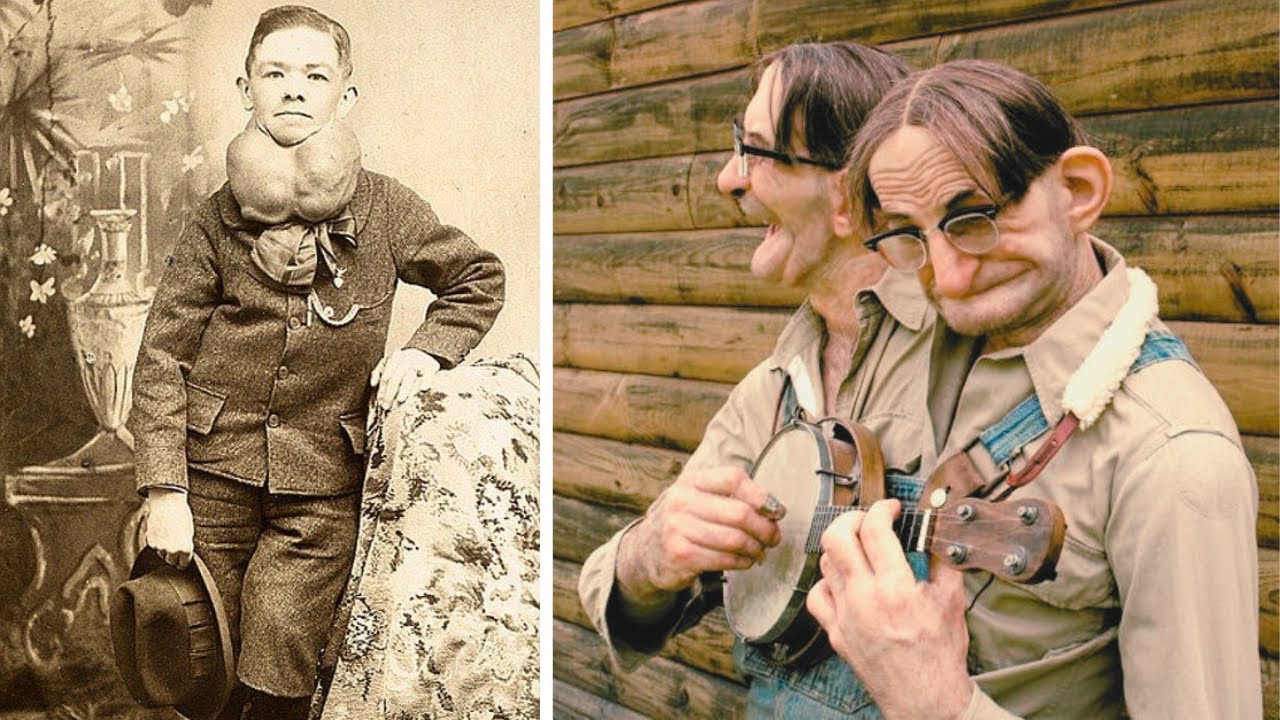
In 1783 Bengal, a boy was born with a second head fused upside down to the top of his own. From birth the locals feared him, and his midwife tried to burn him alive. He survived, scarred, silent, and stared at. His parents hauled him to Kolkata and began charging crowds to see the spectacle, hiding him beneath a sheet between viewings.
British doctors and officers came to witness it firsthand. The second head blinked, drooled, and moved its lips. When the boy ate, the other mouth watered. When he slept, the second head stared into nothing.
At age four a cobra ended his life. His body was stolen, dissected, and shipped to England, where scientists confirmed that both skulls contained separate brains. His remains still sit behind glass in London’s Hunterian Museum, and the condition is now known as craniopagus parasiticus. He was never given a name.
He was born, feared, exhibited, died, and buried in a cabinet for curiosity. Alfredo Codona fell from fame rather than fading. Born into the legendary Codona circus family of Mexico, he was raised in the air, training until perfection became habit and eventually becoming the first trapeze artist to land a triple somersault mid-flight. He was fast, smooth, and fearless, equal parts athlete and spectacle.
He married fellow aerialist Lillian Leitzel, and together they were circus royalty. But their marriage was volatile, and their lives were defined by risk. In 1931 Lillian died from a fall during a show in Copenhagen. Alfredo never truly recovered.
He tried to keep performing, but a shoulder injury ended his career. He remarried, but depression followed him everywhere. In 1937, in a fit of rage and grief, he killed his wife Vera Bruce and then turned the gun on himself. He was thirty-two years old.
He had spent his life chasing height and applause, and when the spotlight dimmed and the rigging was gone, he had nothing left to hold on to. Other stories were never true at all. Edward Mordrake was said to be young, wealthy, and well-liked, but cursed. Behind his head, according to old reports, grew a second face, distorted and grotesque.
It never spoke aloud, but supposedly whispered at night, tormenting him with cruel voices only he could hear. He pleaded with doctors to remove it, but no one dared operate. The story ends with him taking his own life at twenty-three, leaving a note begging that the devil’s face be destroyed before burial. The tale first appeared in an 1896 medical book written as though factual.
But Edward Mordrake never existed. There was no nobleman, no second face, no documented medical case. The entire story was fiction, crafted from sideshow rumors and passed off as strange truth. Still, the myth refused to fade.
It became folklore, inspiring horror films and endless retellings. His imagined pain lingered long after his invented death, proof that sometimes myth is more powerful than fact. The Jones twins never even got the dignity of a lasting myth. They were born conjoined and immediately turned into money.
Dragged across America in the late 1800s, they were shown off while still in diapers, their bodies treated like merchandise. Promoters did not care. Strangers stared, doctors poked, and their parents, likely desperate, agreed to the whole deal. The twins were paraded from city to city, spending most of their brief lives under canvas tents.
They lived just fifteen months, half of that time spent on display. No official cause of death was recorded—perhaps illness, perhaps neglect—but it made no difference. Their deaths produced no headlines and no protests, just silence. In circus archives they are a footnote, with no names and no legacy, remembered only as an exhibit in a world where childhood meant business.
They were not mourned as individuals or remembered as stars. They were just two infants born stuck together and used until they were gone. Daniel Cajanus at least outlived the machinery that consumed him, if only barely. Born in 1704 in Finland, the son of a Lutheran clergyman, he stood nearly eight feet tall by adulthood, towering over everyone he met.
His size brought discomfort but also opportunity. He joined the elite Potsdam Giants, an army unit made of exceptionally tall men, and later became a touring spectacle across Europe, appearing before royalty and artists alike. In Paris he was received by King Louis XV. In London he was examined by physicians, painted by artists, and stared at by crowds.
Despite the attention, he was not a showman. He carried himself with dignity, wrote poetry in his spare time, and retired to Haarlem, where he lived quietly. Before his death in 1749 he requested a reinforced grave to protect his body. Even then it was not enough.
His bones were eventually taken for display. In life and in death, Cajanus was never left alone; his height became both his curse and his legacy. The Great Waldo occupied a weirder corner of the business. He did not look like a sideshow act.
He wore suits, spoke politely, and could have passed for a banker, which made what he did on stage all the worse. He would swallow marbles, coins, and stones, then bring them back up moments later in perfect order. He even regurgitated live animals, usually mice, still wriggling. There was no trick and no sleight of hand.
He trained his throat, his stomach, and his timing until his body obeyed. Audiences did not know whether to clap or vomit. Women fainted, men gagged, and the posters called him the Great Waldo, Swallower of the Impossible. Doctors thought he was disturbed.
He did not care. He found a space between horror and talent and made a career out of it. When vaudeville declined and the appetite for disgust faded, so did he. No one knows where or when he died, but for a few queasy years he was the only man who turned swallowing into a full-time profession.
Johnny Eck squandered none of his time. Born with a condition that left his body ending just below the ribs, he had no functional legs, but that never stopped him. Raised in Baltimore alongside his identical twin brother Robert, he entered show business early. Their most famous act came in 1937 with the magician Rajah Raboid.
Robert would be sawed in half, and Johnny, strapped to a false lower body, would crawl out mid-act, sending audiences into chaos. But Johnny had already made a name for himself long before that. He performed with Ringling Brothers and Barnum, appeared in the cult film Freaks, and later ran a penny arcade, designed model trains, painted backdrops, and gave shows in his own backyard. He did not dwell on pity or seek applause.
He lived to create, perform, and share. By the time he died in 1991 he had outlived the sideshow world entirely, but he never stopped being a showman. He was half a body and twice the talent. The one who controlled her own narrative from start to finish was Aloia Wagner, known on stage as Violetta.
Born in Germany in the early 1900s with tetra-amelia, she had no arms or legs, but where others saw limitation she built a life. She moved to New York and began performing at Coney Island’s Dreamland and later with Ringling Brothers. Her performances were not shock shows. Using only her mouth and shoulders, she dressed herself, combed her hair, sewed, and even wrote.
People came expecting pity. What they got instead was poise. Newspapers called her the Armless and Legless Venus, but her real strength was her presence. She later married, wearing her ring on a chain around her neck, and continued performing for years until her death in 1940.
In a business that often reduced people to labels, Violetta never lost her name, her control, or her dignity. She did not beg for sympathy or rely on gimmicks. She simply did what others could not, and she did it with grace.
Her act was her life, and it was hers alone.






