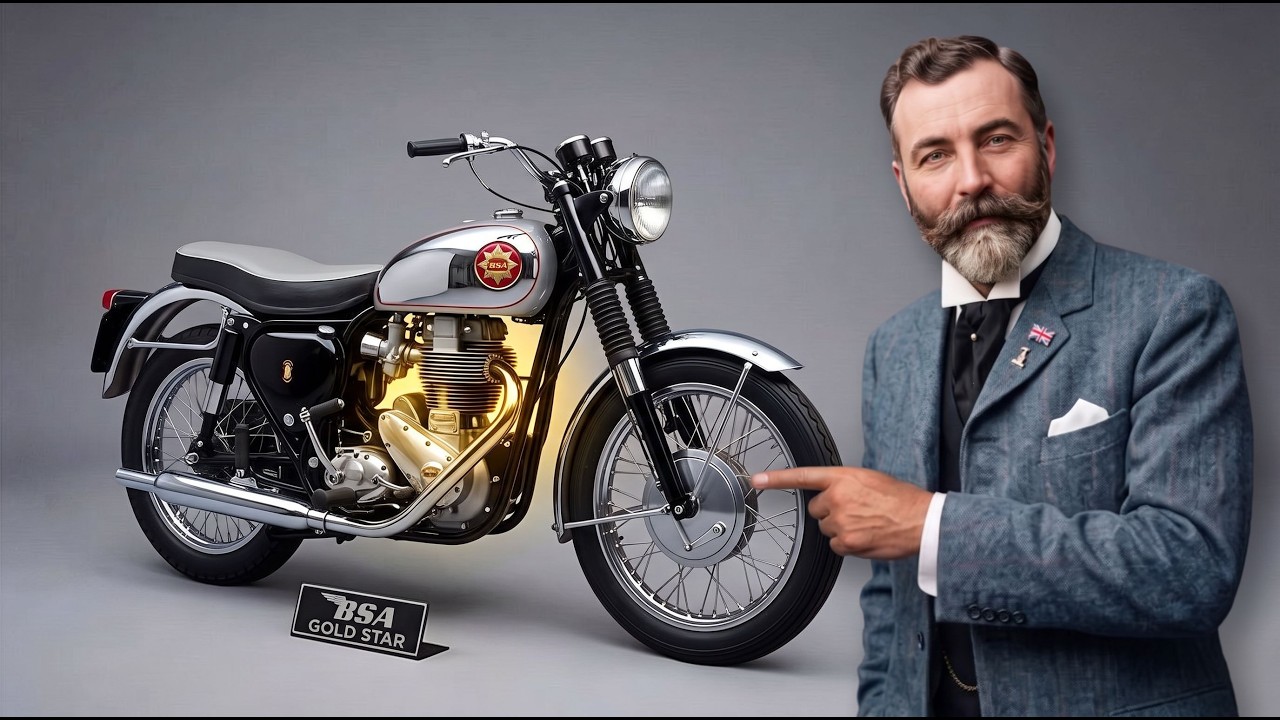
In the summer of 1956, at the amateur Clubman’s Tourist Trophy races on the Isle of Man, a rider named Bernard Cod won both the junior and senior events in the same week. It had never been done before. Both wins came on BSA Gold Stars, the handbuilt racing singles from the Birmingham Small Arms Company. And by winning so completely, the Gold Star effectively ended the very race that had made it famous: the organizers quietly discontinued the event, because there was nothing left to watch when every serious entry rode the same machine.
It was a strange kind of epitaph for a motorcycle that was already becoming a legend. But by then, the Gold Star had outgrown the racetrack and had found its real home out on the open road, in the hands of the cafe racers of Britain. The story of BSA began in June 1861, when fourteen Birmingham gunsmiths sat down in a hotel room with a problem they could not solve alone. The Crimean War had exposed the old trade’s limits.
For centuries, Birmingham gunmakers had worked the traditional way, handfitting every part, each weapon unique to itself. It produced fine guns, but it could not produce them fast. When the government’s factory at Enfield turned out rifles with machine tools and interchangeable parts, the future arrived, and Birmingham was on the wrong side of it. So the fourteen formed a company to build guns by machinery, the same way Enfield did.
They called it the Birmingham Small Arms Company. It would become the largest motorcycle maker on Earth, and its founding faith, precision, scale, and parts that fitted every time, would define everything that followed. They bought twenty-five acres of farmland at Small Heath and opened a square fortress of a factory in 1863, standing alone in open fields. Their first great order was for 20,000 rifles bound for Turkey, with the machines shipped over from Massachusetts.
But an arms company lives and dies by other men’s wars. In the winter of 1878, the orders vanished, and the factory fell silent for a year. It was the first near death, and it taught BSA the lesson it would never forget: never depend on one thing. So they turned to bicycles in the 1880s, then to motorcycles.
The first true BSA motorcycle arrived around 1910, solid and unglamorous, and it sold out three years running. By the turn of the century, BSA was an industrial combine, making steel, machine tools, cars, and motorcycles, and it had learned how to survive almost anything. The legend began almost by accident on a summer evening in 1937. Brooklands, the great banked speed bowl in Surrey, offered a small enameled gold star badge to any rider who lapped its outer circuit at over 100 mph.
BSA’s competition manager, Bert Perrigo, wanted one for the sporting 500 called the Empire Star. He had a single machine specially prepared, with the engine built up by a fitter named Len Crisp, tuned by an engineer named Jack Amitt, and set to run on methanol. Then he persuaded a retired racing legend, Wal Handley, to ride it. On the 30th of June 1937, Handley took the modified machine onto the concrete banking and averaged 102 mph, with a fastest lap of 107.
He proved that a BSA barely removed from the showroom could run with the fastest bikes in the country. The following season, the company launched a new sports machine built on the lessons of that single lap, and gave it the only name it could carry: the Gold Star. The racing magneto, a key part of the machine’s performance, was fitted from the very first one sold. Fewer than 500 pre-war Gold Stars were built before history interrupted.
In 1939, the world went to war again, and BSA became the arsenal of the nation, running 67 factories and turning out around 126,000 military motorcycles. Because it was the country’s arsenal, it became a target. On the night of the 19th of November 1940, the Luftwaffe found Small Heath. The bombs came through the roof, and 53 people sheltering behind the blast walls were killed, men and women aged from 18 to 68.
Rifle production stopped for three months. The company buried its dead, cleared its ground, and went straight back to arming Britain. The Gold Star was reborn after the war in 1948, built to do one thing above all: win. It came in 350 and 500 versions, and it was hand assembled in small numbers.
The idea was simple and irresistible: a man could buy one from a showroom, ride it to work all week, then take it to the Isle of Man and race the best amateurs in the world. And it won, almost from the moment it appeared. Then, in the spring of 1949, the engineer Bert Hopwood walked through the gates at Small Heath. He redesigned the 500 cylinder head from the ground up, and the improvement was transformative.
What had been a strong engine became a genuinely great one. Year after year, the bike got better, culminating in 1956 with the release of the ultimate version, the DBD34. It was a weapon: a big fin alloy engine, clip-on handlebars, a close ratio racing gearbox, and an enormous racing carburetor, an inch and a half across, big enough, enthusiasts said, to swallow a sparrow. It would run to 110 mph and could pull 60 in first gear alone.
Every DBD34 came with its own test sheet, its own engine run on a dynamometer, its power recorded. You did not buy a Gold Star the way you bought an appliance. It was a handmade racing machine that happened to be road legal, assembled one at a time by men who knew every part by feel. It was also expensive, slow to build, and temperamental, an anachronism in a world already moving toward a different future.
In the cafe racer culture of the late 1950s, the Gold Star was king. Young men in black leather, the ton-up boys who became the rockers, stripped the bikes down, fitted clip-on bars and swept exhaust pipes, and raced out of places like the Ace Cafe on the North Circular. Their ambition was the ton, a hundred miles an hour, and the Gold Star was the machine they measured themselves against. While the riders raced through the night, the company stood at the absolute summit of its power.
In the early 1950s, BSA built around 75,000 machines a year, exported to every corner of the earth, and stood as the largest motorcycle manufacturer on the planet. The works sprawled across more than a million square meters and employed more than 12,000 people. The slogan was known by everyone: one in four is a BSA. But the seeds of destruction were already in the soil.
In 1951, BSA bought its great rival, Triumph. On paper it was a master stroke, but in practice it planted a rivalry inside the company that never healed. In 1956, Edward Turner, the genius behind the Triumph twin, took charge of the whole automotive division and pointed the group toward unit construction, the modern way of casting engine and gearbox as a single unit. BSA spent its design money there, on new learner bikes, and quietly decided not to modernize the Gold Star.
Then came Lucas, the electrical firm that supplied half the British industry. In the late 1950s, it decided to wind down the separate magnetos and dynamos of the old world and move to modern alternator and coil ignition. The rest of the industry adapted. The Gold Star alone was left out, because the company had already decided it was not worth adapting.
In the early 1960s, Lucas confirmed it was ending production of the racing magneto. BSA could have re-engineered the Gold Star to take modern ignition, but it was an outdated machine by every cold commercial measure, expensive to build and beaten on the track and the dirt. The company stopped. In 1962 and 63, the last Gold Stars left Small Heath.
There was no ceremony, no last photograph, no speeches. The greatest sporting single Britain ever built was simply no longer in the catalog. The magneto withdrawal did not kill the Gold Star. It handed BSA an excuse to finish off a bike it had already decided to let go.
No replacement was built at the factory. That job fell to men like Eddie Dow, who ran a business devoted to the Goldie and kept the flame burning from the outside. The company itself ran on for another decade, and the men who truly killed it had not yet made their worst mistakes. In 1964, Bert Hopwood hoped for the top job but did not get it.
The position went instead to Harry Sturgeon, a dynamic outsider from the aircraft industry who drove the group hard and backed a bold new three-cylinder superbike, the Trident. For a moment, there was momentum. Then, in 1966, Sturgeon was diagnosed with a brain tumor and died. His successor, Lionel Jof, built a grand group research center at Umberslade Hall, miles away from the factory floor, staffed by 300 people and costing a million pounds a year to run.
The workforce called it Slumberlade Hall. It produced designs cut off from the men who actually built the bikes, while the Japanese poured their money into production engineering. Out of it came a disaster: a new oilbearing frame that arrived late, did not work properly, and forced the assembly line to dismantle the engines to make them fit. The finished bikes stood so tall that the seat sat 34 inches off the ground, too high for ordinary riders to get a foot down.
The numbers came due in 1971. BSA’s motorcycle business lost around three million pounds that year. On the 16th of July, the company announced that some 770 jobs would go, the first of many. The workers attempted a sit-in, but it collapsed within a week.
One who was there called it an ignominious defeat, a battle barely joined. The wage packets were collected in near silence. In the autumn of 1972, the government stepped in with a rescue, but only on one condition: BSA and Triumph would have to merge with Norton Villiers to survive. The new company was called Norton Villiers Triumph.
There is no BSA in that name. The oldest and proudest name in the whole story, the name of the 14 gunsmiths and the million and a half rifles and the one in four bikes on the road, simply vanished. On the very day the board sat down to wind up BSA motorcycles, Bert Hopwood and his colleague Doug Hele were presenting a plan: a modular range of machines, singles, twins, and triples, sharing common parts, designed to be built efficiently the way the Japanese built. By the account Hopwood himself set down, it could have carried BSA into the 1980s.
The board chose instead to switch off the lights. Small Heath did not close in a single day. It wound down over years, and then the demolition men came. The vast buildings came down across the 1970s, cleared away load by load until the map of Birmingham had a hole in it.
The workforce that had peaked at 28,000 in 1945 had fallen to around 3,700 by 1973. The particular craft of building a Gold Star by hand walked out of the gates in the pockets of aging men and never came back. Today, a firm mends taxis in a surviving works building. A chemical company runs a plant on part of the ground.
BSA Guns, a separate concern, still proofs air rifles at Armory Road. The 53 who died behind the blast walls in 1940 are remembered now, though it was only in 2010 that a small band of the faithful laid the first wreath at Armory Road in seventy years. The name itself did not die. In 2016, an Indian company bought the rights, and in 2021 a new BSA Gold Star was launched, wearing the oldest badge in British motorcycling.
It closed the circle, but a long way from Small Heath, on a bike that shares with the original only a name and a longing. What remains is not the factory. It is the feeling. The gold star refuses to die.
An owner’s club keeps the flame burning, tracing histories and holding the machines in trust. In Norfolk, a specialist remanufactures Gold Star parts from scratch, making by hand the pieces of a machine the factory stopped building sixty years ago. At Brooklands, the museum keeps a replica of the Empire Star that started it all. Stand on Armory Road now, and there is almost nothing to tell you what was here.
But close your eyes, and if you ever heard it, you can hear it still: the hard bark of a big single settling to its work, and then, as the throttle closes, that strange and beautiful clatter the old hands called the twitter on the overrun. The sound of the fastest thing on the road, made by hand in Birmingham, and gone.
