The knock came at the second-floor window at nine o’clock by the small table clock. Two taps. A pause. Two taps again, polite as a visitor in a city where knocking on doors is considered courteous.
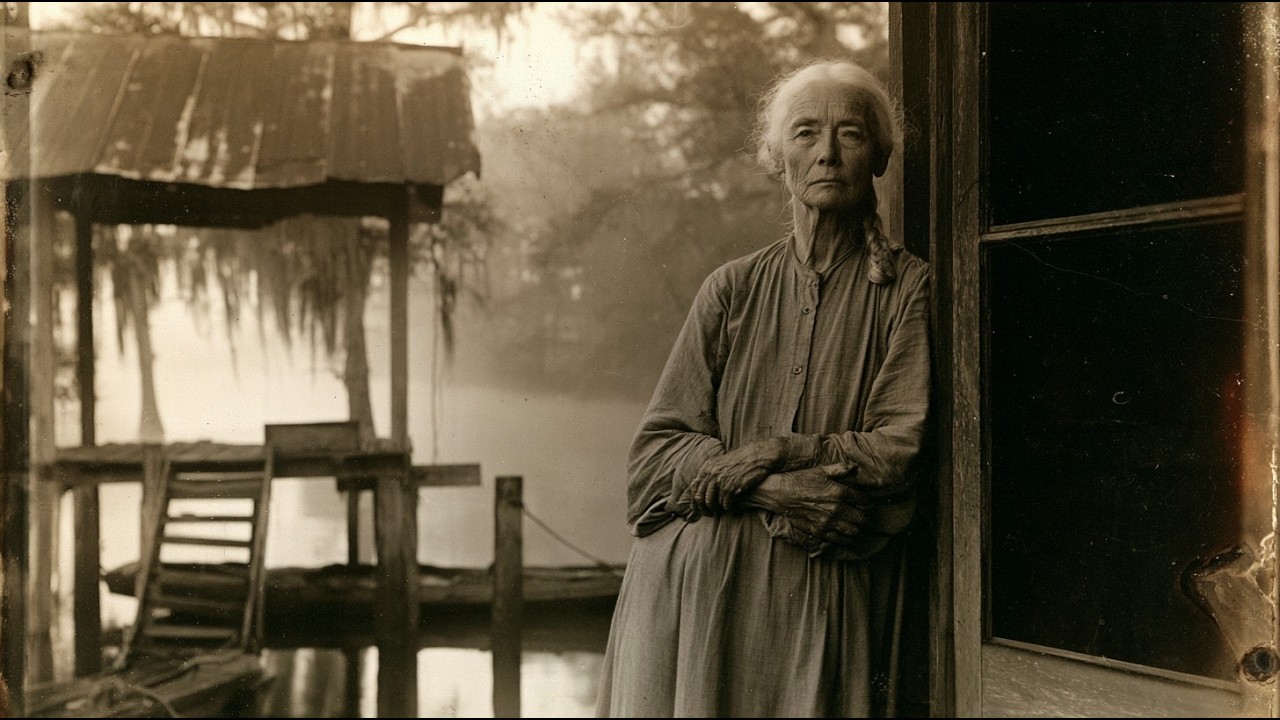
There was nothing outside that window but a two-story drop to the yard below. Ansel Thibodeaux sat perfectly still on the edge of the bed, his coat still on, his shoes still tied, the lamp turned low. The knocking continued for perhaps ten minutes. Then a voice spoke through the shutter, thin and patient, using his name.
Ansel. Ansel, open the shutters. It was not her voice. It was almost her voice.
There was something wrong with the vowels, something wrong the way a careful drawing of a face is wrong—every feature in its place, and yet not a face you would ever want to kiss. He did not open the shutters. He sat with his hands flat on his knees and listened. After a while, the voice stopped.
After a while longer, the knocking stopped. Then came the part he would write down the next morning and underline in his notebook. Something breathed outside his window, a slow, deep breath, the way a great animal breathes at the end of a long day. It was close, so close the wood of the shutter seemed cold against his face from three feet away, as if the breath had pulled the warmth out of the room, out of him, out of the wall between them.
He counted to sixty in his head, the way a man does when he is trying to keep himself from doing something foolish. When he reached sixty, he began again from one. He reached sixty a second time. He was halfway through a third count when the thing left.
It moved down the wall, scraping as it went, taking as long as a heavy man taking stairs, with the same rhythm of pauses, as though it were thinking about turning back. Then the yard below the window went silent. He did not sleep. He sat with his hands on his knees watching the shutter until the first gray light of morning showed through its cracks.
In the daylight he opened it, because daylight had come. There were no marks on the shutter. There was nothing in the yard. But there was a track in the mud under his window that he chose not to describe in his report.
It was not a boot print. It was not a hoof. It was not the track of any animal he knew, and he had grown up on a farm in western Kentucky and knew the shape of most animal tracks. It was long, longer than a man’s forearm, and its pattern—if pattern was the right word—was not the stride of anything that walked upright, nor anything that walked on four legs.
He stood over it for a long time in the wet morning without any thought forming into a sentence. Then he covered it with the toe of his boot and scraped dirt over it until it was gone. He did not know why he did that. He would think about it later.
When he came downstairs, the boarding house was unnaturally quiet. The proprietress, a heavyset woman named Idelia Beaumont, sat at the kitchen table crying silently. Ansel asked what was wrong. “Cyrian’s gone,” she said without looking up.
“Gone how? ”
“His boat came in to the landing this morning. Paddle inside it, coat folded on the seat. ” She said she had sent her sister to fetch him the night before to walk her home from the store, but he never arrived.
Someone said they saw him at the landing at eleven o’clock, heading west, calling out. She stopped there because she did not want to say the rest. “Calling what, Idelia? ”
“Calling that he heard her calling him.
”
Ansel went back up to his room and packed his bag. He wrote a telegram to Baton Rouge, a telegram to New Orleans, and a telegram to his company, and walked them to the small telegraph office. In each telegram he wrote different words, but the meaning was the same in all of them. He was going back to West Run.
He was not going to leave anyone else where he had left Cyrian. He went to the sheriff’s office and told Renaud Boise everything. The note from the lunch pail. The woman at her table.
The knocking at the window. The voice. The breath. The track in the mud.
He added no exaggerations and no personal commentary. He was an insurance man, so he described what he had seen the way an insurance man describes damage. When he finished, Renaud Boise was silent for a long time. He sat at his desk with his broad hands on his knees, looking at the wall.
Then he spoke. “There’s something I never told you when you came here,” the sheriff said. “Tell me now. ”
“My older brother disappeared in 1897 on West Run.
He was twenty-eight years old. Strong on the water. Went the same way. His boat came to the landing.
His coat was folded. There was a note in his pail saying he heard her calling him. ”
Boise said he had hated Margaret Hollow for fifteen years. He had never been able to prove she did anything.
So he would go with Ansel today, and anything they found in that stilt house, Boise would handle. Ansel said he understood. They took the sheriff’s flat-bottomed boat with the small motor, which Boise did not start until they were half a mile out of Little Cain, because, he said, West Run did not like motors and he did not want to anger it before he had to. They moved through the hanging moss while the little engine coughed.
The water was blacker than it had been the day before. Ansel had not believed that was possible. The cypress knees looked bigger, or perhaps more numerous, or perhaps more watchful. He could not say what the difference was, only that it was there.
Midway to the third bend, they passed a place where the water was so still it looked poured. Ansel saw, or thought he saw, or would later tell himself he imagined, a face just beneath the surface. Not a body. A face, turned up, eyes open, watching.
He did not point at it. He told himself he had imagined it. A hundred yards past the still place, the sheriff cut the motor. “Do you hear that?
” he said. What Ansel heard was Cyrian Rocque’s voice, far off among the trees, calling his name. “Sir. Sir.
Help me. Sir. I’m here. ” It was Cyrian’s voice, exactly Cyrian’s voice, even the way the boy dropped his r’s at the end of a word.
Ansel almost stood up, almost answered. A heavy hand closed on his shoulder and pressed him back onto the bench. Renaud Boise put a finger to his lips and shook his head very slowly, mouthing the word no. They sat in the boat.
The voice called again from a different direction, then from a third, then, horrifyingly, from directly under the boat, a wet, small whisper against the planking, and Ansel felt the wood under his boots grow cold. Boise turned the motor, turned the boat, and ran them the rest of the way to the third bend at a speed that was probably not safe. Behind them the voices multiplied. Ansel heard Osias Daughtefair, whose voice he had never heard in life, calling his widow by her name.
He heard Delphin Verreux mention a debt still owed. He heard Renault Sykes singing something wordless, which was somehow worse than words. They came around the third bend to the ladder of Margaret Hollow’s house, and when they tied off the boat, the swamp behind them was thick with the voices of every man ever lost on West Run, calling in voices from long before Ansel Thibodeaux was born. Margaret Hollow stood at the top of the ladder in the same gray dress.
She looked at Renaud Boise. “You shouldn’t have brought him,” she said. “I know it,” Boise said. “Come up, then.
”
Inside the long clean room, the iron stove burned harder than it had the day before. Three lamps were lit, though it was full daylight. The bundles of dried herbs swayed slightly on their cords, though no window was open and no breeze moved through the house. She sat them at the table.
She did not serve tea. “It’s under the floorboards,” she said. It had been under the floorboards since yesterday noon. It was angry because she had not given it Ansel’s name the day before.
It was angry because she had not opened the door she guarded. It wanted a name to answer to. If she gave it a name, it would take that person and be quiet for another eight years. If she gave it no name, it would come up through the floor tonight and take every soul in Little Cain by morning.
“That’s the choice,” she said. She said it the way a woman recites the weather. Boise asked about his brother, and Margaret Hollow answered. She said, “I chose silence that year, because the man I would have had to name was a man I loved forty years ago, when I was still young enough to think someone in this parish would marry a Hollow girl.
And I was not strong enough, Renaud, so your brother went instead. And I have paid for that choice for fifteen years, and I will keep paying it until the day I close my eyes for the last time. ”
Boise put his face in his hands. He did not weep.
He sat that way for a long minute. Then he stood and went to the window and looked out at the water. Margaret Hollow turned to Ansel. “Mr.
Thibodeaux, there is a way out tonight. It’s not a kind way, but it’s a way. ” And Ansel Thibodeaux, a man of ledgers who had come south to identify a widow’s claim, asked the four words that would haunt him for the rest of his life: “What do you need? ”
“I need you to sit in that rocking chair,” she said.
“I need you to stay in that chair until sunrise, no matter what you hear. I need you to keep your eyes on this. ” She took a small clay bowl from the shelf and set it on the table. In the bowl was an ordinary river stone, dark, about the size of a hen’s egg.
“This is the door,” she said. “This is what my father made when he built this house. This is what I have kept for forty-three years. It must be guarded by someone who has never lied to it.
That’s the only rule. I can’t guard it because I lied to it once. Renaud can’t because he’s hated me for fifteen years and he’d break it in the first hour if he had the chance. You haven’t been here long enough to lie to it, Mr.
Thibodeaux. So you will guard it. And Renaud and I will go down to the water tonight, because that’s where the contest is, and someone has to contest it. We’ll be back before sunrise, or we may not come back at all.
”
Ansel asked what would happen if he looked away from the stone. “It will speak in a voice you know,” she said. “It will call you by the name your mother gave you. It will ask you a question you have wanted the answer to for thirty years.
It will show you the face of someone you have wanted to see for that long. And if you take your eyes off the stone, Mr. Thibodeaux, even once, it will come through the stone, and there will be no running after that. Do you understand?
”
He said he understood. “Good,” she said. “Eat something, then. It’s a long night.
”
Ansel did not remember eating. He remembered sitting in the rocking chair. He remembered the door closing behind Margaret Hollow and Renaud Boise, their slow wet steps down the ladder, the distant push of a small boat leaving the pilings and heading into the channel. He remembered the small clay bowl on the table in the yellow lamplight, and the dark ordinary stone inside it, and how it looked like nothing at all.
He remembered the swamp beginning to call again, closer now. He remembered hearing his mother’s voice at the window, though she had been dead nineteen years. He remembered hearing his name in the voice of a woman he had loved and lost in the summer of 1893, a woman he had not spoken aloud since the day of her funeral. He remembered the creak of the shutters, a slow wet sound climbing the ladder outside, the same sound as the sheriff’s boots going down, but heavier and heavier.
He remembered the color draining from his own hands as he gripped the arms of the chair. He remembered the cabin door, still latched, beginning to rattle gently, as if someone leaned against it from the other side, and a woman’s voice saying softly, “Here at the crack of the door, Ansel. It’s not a big thing to ask. Just look at me.
Look at my face. It’s been so long. ”
Ansel Thibodeaux, who had loved a woman named Charity Verlin when he was twenty-four and buried her at twenty-five before he had finished paying for their wedding, felt every muscle in his neck go rigid against the urge to look up. He kept his eyes on the stone.
The stone did nothing. Nothing at all. It sat in the small clay bowl like any river stone a man might pick up on a walk. He remembered the door rattling harder.
A second voice joined in, a man’s faint voice he did not recognize, and a third that was his father’s voice, who had died in the winter of 1889. He remembered that he did not look away. He remembered the stone in the bowl beginning to hum, very faintly, at about two in the morning, a low note like a finger passing around the rim of a wet glass. He remembered that he did not look away.
He remembered the hum rising, the way a tuning fork rises when a string touches it, until the tin cup on the table vibrated against the wood, until the hung herbs on their cords swung in slow arcs, as if a hand had touched each one and set it moving. Then everything stopped. The hum. The voices.
The rattling at the door. The scraping on the ladder. The shutters stopped moving. There was a very long time when nothing happened at all, which was somehow worse than what had come before, because in that nothing he had to listen to his own breathing, and his breathing was the only sound in the world.
He remembered that nothing came through. Near dawn he must have dozed in the chair, his eyes still fixed on the stone, because he woke to gray light and the sound of the door opening. Renaud Boise came in first. He was soaked to the collarbone, his hair plastered to his skull, his face pale.
He carried his hat in his hand, which was strange, because he had worn it low the whole way out. He looked at Ansel. He looked at the stone in the bowl, which was quiet again, just a stone. “She’s not coming back,” he said.
“What happened? ”
“She went into the water and gave it a name. ”
“What name? ”
Boise sat down in the other chair.
“Her own. She told him her own name, Mr. Thibodeaux. She said, I am Margaret Hollow and I am the door.
Take me and be quiet for another hundred years. She said it three times, and the water went calm and took her and she never surfaced again. That’s what happened. ”
Ansel said nothing.
He looked at the stone. The stone looked like a stone. After a while Boise rose, took the bowl from the shelf, carried it to the stove, opened the stove door, and set the bowl inside on the coals. He closed the door and stood there a full minute with his broad flat hand on the stove door.
Neither man spoke. Outside the window the sky was turning the color of old copper, and the water under the pilings was beginning to move again, small ordinary ripples, small ordinary sounds, the swamp becoming itself. A bird called from the far side of the channel, then another answered. Boise lifted his hand from the stove door, turned, and said, “We should go.
”
They came back to Little Cain in the sheriff’s boat with the motor off, because there was no need for it. The swamp on the way back was quiet. There were birds. Ansel heard a red-winged blackbird at the second bend and almost cried, which was not a thing he did.
When they reached the landing, the townspeople were waiting, because word had spread the way word spreads in a town of two hundred that had stayed awake all night listening. Idelia Beaumont stood at the front of the crowd. Ansel did not know what he would say to her. Then, from the far side of the landing, out of the reeds where the water met the planking, Cyrian Rocque walked into view, drenched, his face empty.
He remembered nothing from the moment he tied off his boat at eleven the night before until waking in the mud at the channel’s edge at dawn. He was cold and very hungry. There was a small cut on the palm of his right hand that he did not know how he got, but he was whole. He was alive.
Idelia Beaumont fell to her knees on the planks. Cyrian looked at Ansel and said, “Mr. Thibodeaux. ” Ansel went to him and put his own coat over him, because Cyrian’s coat had been found folded on the seat of his boat, and neither of them mentioned it.
The widow of Osias Daughtefair was paid her claim. The widow of Delphin Verreux was paid under a policy Ansel had not been required to open, but he did anyway. Renault Sykes had no widow but had a sister in New Orleans, and Ansel saw that the small sum due the estate reached her without difficulty. He delivered the checks himself, hat in hand, answering every question they asked, and he did not say the name Margaret Hollow to any of them.
Not once. The company accepted his report, which described the case as accidental deaths in the Louisiana swamps with recovery of remains impossible due to the nature of the terrain, and the report did not mention Margaret Hollow at all. His supervisor, a man named Ephraim Prather, read the report, looked across the desk at Ansel, and asked one question: “Is there anything in that parish that might come back to haunt us? ”
“No, Mr.
Prather,” Ansel said. “Nothing in that parish will ever haunt anyone again. ”
Renaud Boise remained sheriff of Little Cain until 1928, when a stroke put him in a chair by a window for the last two years of his life. He never married.
He never took a boat past the third bend of West Run again. He sat at that window watching the water and drinking chicory coffee. Once, near the end, a young deputy who had come to check on him asked what he was watching out there all that time, and the old sheriff only said, “I’m watching to see if she comes back. ” The deputy asked who, and Boise did not answer, and the deputy did not repeat the question, because something in the way the old sheriff looked at the water made him not want to be part of it.
The stilt house stood empty. A hurricane took the roof in 1921, the walls after that, and finally the pilings in 1936. By the time the war came, the pilings had gone back into the water without a trace. But the men of Little Cain noticed something and passed it quietly from father to son without ever writing it in any record.
Every eight years from 1912, the pattern that should have begun again did not begin. No men disappeared on West Run. Not in 1920, not in 1928, not in 1936, not in 1944, not in 1952. It was quiet for a very long time.
As quiet as she said it would be. Ansel Thibodeaux returned to New Orleans. He worked for the company eleven more years. He never took another case in a parish with still water.
He wrote a private account of what had happened in the autumn of 1912, sealed it, and it went to his son upon his death in 1941. In the 1960s the son gave it to a small university library that kept boxes of such things. That is how the story is known. On the last page of the account, in his precise, ink-stained handwriting, Ansel Thibodeaux wrote something.
He wrote that he did not know what Margaret Hollow was. He had thought she was a witch. He had thought she was a saint. He had thought she was a woman doing a job no one asked her to do, that no one thanked her for, that no one released her from.
And he thought that was probably the truest thing he could say about her. But sometimes, on a quiet night with the window open, he thought about the stone in the fire. She had said it would take exactly a hundred years. He wondered what would happen in the year after the hundred.
He wondered that too, because if the clock started in 1912, the hundred years were already long past. The maps in the parish office no longer show Black Rush. West Run has silted in until you cannot pass even a small boat past the first bend, and no one has looked for anything under those pilings for a very long time. Little Cain is barely a place now—a dozen houses, a gas station that closes at six, a post office open three days a week as of the last time anyone checked.
The parish courthouse still stands, but the record Ansel Thibodeaux sat with for six hours in 1912 burned in a fire in 1948, and no copy was ever made. There is no record left to count from. No one watches the eight-year clock. Perhaps she bought more time than she said.
Perhaps she bought eternity. Ansel Thibodeaux said he hoped she had. But he did not think she had. He thought a hundred years is a long time to a human being and a very short time to anything that lived under those boards.
And he thought the pattern had come due somewhere in what used to be West Run, in water no boat visits and no map records.
