Vada Thrill woke at three in the morning with the certain knowledge that her husband was not asleep. He lay beside her in the dark of the bedroom at Sinner’s Bend, talking in a low, reasonable voice, the way a man talks when he is answering questions in an interview. She had lain beside this man for thirty-five years and had never once heard him talk in his sleep. She understood inside three seconds that he was not asleep, that he was not talking to himself, that he was answering somebody.
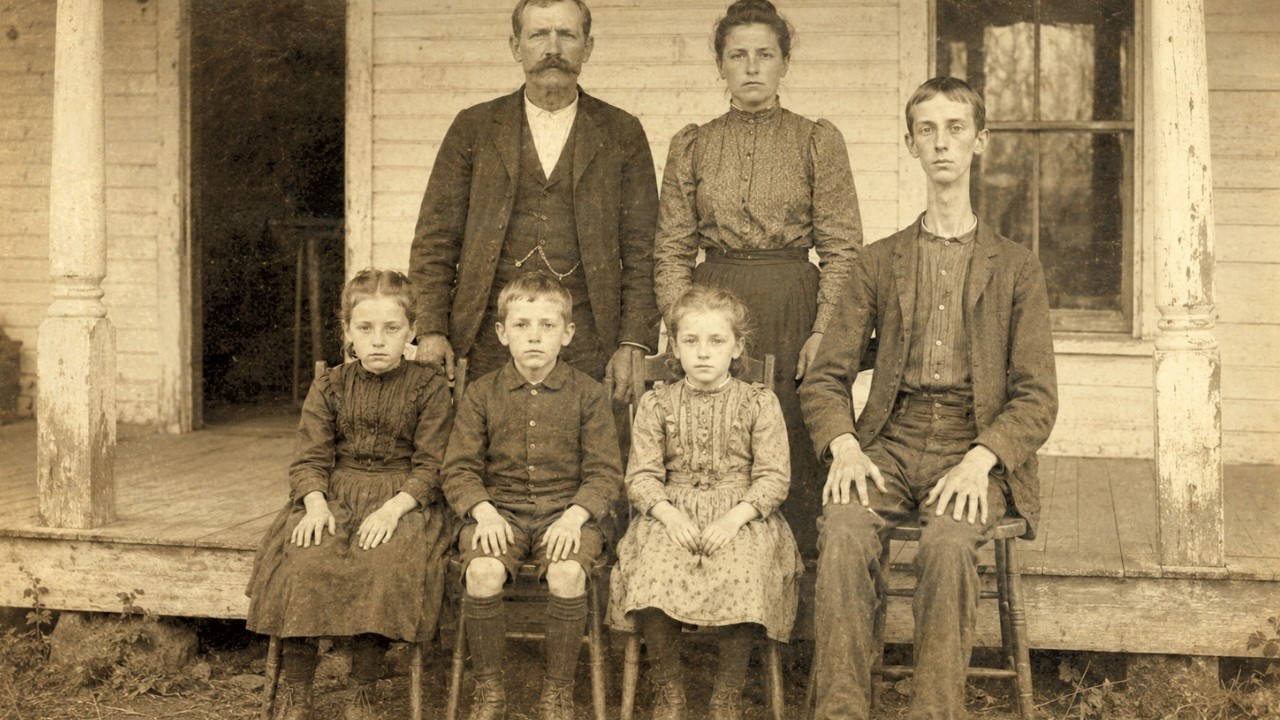
She kept her eyes closed and her breathing steady. The copiest had come to her for twenty-one years and eight months, and she had never answered it. It had learned, on the night of the eighth of January 1923, to try a different door. Isaiah was saying, “I put it in the will, uncle.
I put it in the will. I did not tell her about the will. I know I should have told her. ” A pause of eleven seconds.
Then, “No, uncle. No. I do not want to know how it comes on a man. I already know how it comes on a man.
” A pause. His voice changed, quieter, older in a way she had never heard. “No. I will not.
She is asleep. I will not. ” Then a long minute of silence. Then, “I know she does not answer.
She has never answered. She has been in this house not answering for twenty-one years, and she is not going to answer tonight. But I hear you, uncle. I hear you.
I will not open the door. ”
Vada felt the mattress shift as he sat up on the edge of the bed, then stand in the cold room in his nightshirt in his bare feet. She opened her eyes. He faced the bedroom door, his hands at his sides, his hands fists.
She said, quiet, in her ordinary voice, “Isaiah, come back to bed. ”
He did not turn. He said, quiet, without turning, in the same voice he had used to answer the room, “Vada, you know. I have been hearing him for a while.
”
She said, “I know. ” He said, “I did not tell you. ” She said, “I know. ” He said, “He says the door is in the springhouse.
All I have to do is go out and open the springhouse door and let him out. He says he has been in the springhouse the whole time. He says I built the springhouse over him in 1889, and he has been down there ever since. He says he only wants out, Vada.
He says he is tired. He says twenty-two years is a long time. ”
She said, “Isaiah, listen to me. That is not your uncle.
That is not any person that ever was. That is a copiest, and it has been in this house twenty-two years, and it has been in your uncle’s copy book the same as it has been in Bula’s copy book and mine and all of ours. It is telling you a story tonight because Aura is gone and Juny is gone and Reeba is gone and Cletus is gone and I am not answering it, and it needs somebody, and tonight it needs you. Do not go out to the springhouse.
Do not open the door. Do not, whatever it says, do not. ”
Isaiah sat on the edge of the bed for a long time. Then he said, in a voice that was small in the way his voice was almost never small, “Vada, he sounds like uncle.
He sounds exactly like uncle. He knows things only uncle knew. He knows about the summer I was fifteen and we roofed the springhouse together, and about the argument we had about the pitch of the roof. He knows the words I said to uncle in the argument.
Uncle is the only person alive who ever heard those words. And uncle has been dead for thirty-five years, Vada, and I have not said those words to any living person in thirty-five years. And he knows them. ”
Vada said, “Isaiah, look at me.
” He turned his head. His eyes in the moonlight were the eyes of a man who had been listening for a year and was tired and wanted to lay a burden down. She said, “Isaiah, in the morning we are leaving this place. We are packing what we can carry, and we are going down the valley to Cletus’s, and we are not coming back.
You are going to sit right here on the edge of this bed with me until first light, and you are not going to answer anything that speaks in this house between now and first light, and neither am I. We are going to walk out of this house at first light, and we are not coming back. ”
He looked at her a long minute. She said later that she did not know in that minute whether he was going to say yes or whether he was going to get up and walk out of the bedroom and go out to the springhouse in his bare feet on the frozen ground and open the door.
He said, “Yes, Vada. ” She got out of the bed on her side, walked around, and sat beside him. She took his hand in both of hers. They sat side by side on the edge of the bed in the moonlight, not speaking, from a little before three until a little after seven, when the first gray light came into the small east window and the bedroom became a bedroom again.
Through those four hours, the copiest tried three more times. At about half past three, in Roland Thrill’s voice from just outside the door, it said, “Isaiah, boy, please. It has been so long. Please.
” Isaiah did not answer. Vada squeezed his hand. At about half past four, in a voice she recognized inside two seconds, the voice of Bula, her daughter dead twenty-four years, said, “Mumsy, Mumsy, are you awake? Mumsy, please open the door.
It is so cold out here in the front room. Mumsy, I was in the picture. Mumsy, I saw you looking at me. Please open the door.
” Vada did not answer. Isaiah squeezed her hand back. At about six, in a voice that was Vada’s own voice, exactly, from just outside the door, Vada’s own voice said, “Isaiah, I am out here in the kitchen. I am up.
Come get me. I fell. ” Isaiah closed his eyes. He held Vada’s hand very hard.
He did not move. At seven they stood up. Isaiah put on his trousers, his coat, his boots. Vada put on her dress, her coat, her boots.
They went out of the bedroom together holding hands. The front room was empty. The cups on the shelf were four and the tin cup, and there was no sixth. The pump organ was closed.
The blue chair was against the wall. Isaiah hitched the mule to the small wagon. Vada packed a single carpet bag with two changes of clothing for each of them. She took the small tintype of Bula from the mantelpiece and the wedding photograph from the bedroom wall, and she put both photographs face down in the bottom of the carpet bag between the clothing.
She went out onto the porch and closed the door behind her and did not lock it, because she said in the diary later that she was not going to lock a door she was not coming back to. They went out of the yard and down the lane and turned south on County Road 14. She turned around one time. She said in the diary that she looked back at the house, and that in the small east window of the bedroom from a hundred yards, in the first full light of the morning, she saw the pale small shape of a girl of four standing on one foot, watching the wagon go.
She looked for three seconds. She turned back. She faced south. She did not turn around again.
Isaiah, who was looking straight ahead the whole time, did not turn around and did not ever ask her, in the twenty-one years he had left to live, what she had seen when she turned around. How it had come to this is a story that begins in a hollow called Sinner’s Bend, in the western spine of North Carolina, where the Blue Ridge and the Black Mountains fold into one another. Grling County sat in that country, 411 square miles. In the census of 1900 it held 6,419 people, and it would never again reach that number.
The land was the kind a mapmaker gives up on. At the north end of a stretch where the Little Fool River runs due north for a mile and a quarter, a thing rivers are not supposed to do, the river hits a ledge of hornblende schist and turns east hard in a hook shape about two hundred yards across. Inside the hook, a bench of flat ground, about seven acres, held a house from 1868 to 1923. The bench and the bend and the house belonged to the Thrill family.
The land had a name, Sinner’s Bend, and three explanations for it. The county history says a surveyor named Absalom Sinner put his name on it in 1812. The old people said the Cherokee would not cross onto it. A woman named Neva Sarver, the great-niece of Vada Thrill, told the visitor who came to see her in 1994, “The ground there sinned, honey.
Something happened in that ground that the ground did not have permission to do. ” Nobody who ever bought the place stayed long. From 1841 to 1868, the property changed hands eleven times, one- and two- and three-year holdings, no seller ever leaving a written reason. Then Roland Thrill bought it and stayed twenty years, the first person in twenty-seven years who did not sell it.
Roland Thrill built the log house, the spring house, set the four apple trees along the south fence line. He came to town no more than four times a year, bought coffee, flour, thread, kerosene, and left before dark. He never allowed a photograph to be made of himself or of the house. In 1879 a traveling portrait man named Rufus Chumley pulled his wagon into the yard, and Roland came out with a shotgun broken over his forearm and told him to leave.
Chumley wrote one line in his journal: “Called on Thrill place, Little Fool River. Will not sit. Will not permit even of house. ” He died on the 8th of March 1888, in his chair by the fire, of no cause anybody could name.
The neighbor who found him said the eyes had a look in them, that Roland still seemed to be watching him. He told his son that when he left the house and got on his horse and looked back at the front window, Roland Thrill turned his head. Roland was dead, had been dead for two days, with the cold of a March corpse in the room, and the head had turned. Isaiah Thrill, born in 1862, a cooper by trade, a quiet man who did steady work, married Vada Corum in the fall of 1887.
She was nineteen. He was twenty-five. Isaiah inherited the property from his uncle Roland by a will written in pencil on butcher paper. At the bottom, in the same hand, was a line not required by any law of North Carolina, a codicil that read: “Isaiah, my nephew, do not sit for a picture in this yard.
Do not let no one else sit for a picture in this yard. Do not build no thing that will hold a picture in this yard. If you cannot honor this, then sell the place and go, and I will not hold it against you, for I know how it comes on a man. ” Isaiah read it, folded the paper, put it back in the envelope, moved into the house, and did not tell his wife about it.
Vada was the sort of woman who noticed everything. Her older brother said she had been born knowing more than she should, that she had come to him one afternoon when they were children and told him, without any fuss, that their mother was going to bleed that night, and their mother had. She could look at a room she had never been in and tell you which chair had been moved and by how many inches. Isaiah did not tell her about the codicil.
If he had, she would have made the decision she made thirteen years later, on the morning of the 7th of May 1901, very differently. The Thrills had five children between 1889 and 1898. Cletus, the oldest, born April 1889, was a serious boy who never lied and had the long legs of his father. Reeba, born June 1891, was loud and quick and could imitate any voice in the county, with bright copper-colored hair that curled without help.
Bula, born February 1894, died of scarlet fever in November 1898 at four years and nine months old. She had been the only left-handed child in the family. She had a small white scar, half an inch long, across the pad of the left thumb, from a pairing knife cut she gave herself at three, trying to help her mother snap beans on the porch step. She tugged at her right earlobe when she was thinking.
She counted things, everything, out loud when she was little and under her breath when older, the plates on the shelf, the knots in the pine boards of the front room floor. She died on the 16th of November 1898 at eleven minutes past three in the morning, on the ninth day of the fever, with her mother sitting on the edge of the bed. On the ninth day she stopped counting. Vada leaned in and asked her to count the boards on the ceiling for Mumsy, and Bula looked at the ceiling for a while, then looked at her mother and said, in a voice that sounded like it was coming from underwater, “They are counting me now.
” Those were her last words. Three days after the burying, Vada went up to the loft, took down her mother’s wooden box, and took out a pair of scissors and a length of red thread. She cut a lock of her own hair from the nape of her neck, tied it with the red thread, went out to the family plot on the ridge, and buried the lock of hair on top of Bula’s grave in the loose soil. A woman she had known as a girl had told her that a mother who has lost a small child can leave a lock of her own hair on the grave tied in red thread, and the child will know where to find the mother and will not wander.
She told no one. She wrote it forty-two years later in a diary, and she wrote this sentence: “I did not think of it at the time that the same tying that keeps a thing from wandering is the same tying that tells a thing where to find you. ”
After Bula died there was another girl, Aura, born December 1895, quiet, with almost-white hair, who talked to herself in a low steady murmur from about age two. And the last child, Junius, called Juny by everybody, the baby, born August 1898, three months before Bula died.
He had never known his sister, had no memory of her, only a name and a tintype on the mantelpiece. On the 7th of May 1901, a traveling portrait photographer named Elmore Cisk drove his canvas-topped wagon up the lane at Sinner’s Bend. He had been making his living for sixteen years photographing mountain families on a wide loop through the counties of western North Carolina, at a dollar fifty for an eight-by-ten mounted portrait, payment accepted in coin or chickens or a Sunday dinner. He kept a leather-bound account book, one line per sitting, and his entry for that day read: “May 7, Tuesday.
Thrill I, Sinner’s Bend, Graing Co. 8 x 10 fam grp $1. 50 paid coin. Wife would not be still.
Plate spoiled. Retook. c plate 2. ”
The sitting itself was ordinary.
Grief had settled into a shape Vada could live with. She had said yes to the portrait because she wanted, in her exact words, “my four children and me in a frame on the wall so that when I am old I can look at us and know what we had. ” But that morning, at about seven, Aunt Nomi Cheek, the old woman who knew things, had come six and a quarter miles down the valley in her buggy and stood in the yard and gave Vada three warnings. The first: “Do not have the picture made today, and do not have it made another day either.
Not in that yard. ” The second: “If you must have it made today… then you sit for it inside the house, at the table, with all six of you facing the west window. Do not sit for it on the porch.
Do not sit for it in the yard. Anywhere the ground has been sacred ground, do not stand on it in front of a camera. It is the ground that gets in through a picture, not the sky. ” The third: “If you sit for a picture in that yard today and it comes out with your Bula in it, do not hang the picture on a wall.
Do not put it where any of you can look at it for longer than the length of a Lord’s Prayer… keep the cloth on it. And do not under any circumstance in the world take the picture out and look at it at night. ”
Vada had already made up her mind.
She made her pound cake, washed her face, put on her good dark dress, called the children in, combed their hair. At a quarter past two she saw the wagon coming up between the trees. She was going to have the picture made on the porch, with all four of the living children in it, and if some accident of the light and the plate should also, by God’s grace, put Bula into it, she was going to accept that as a gift. Elmore Cisk arranged them.
Isaiah stood on the porch behind the row, hand on the back of Vada’s chair. Vada sat in a straight-back chair with Juny standing on the step in front of her, her two hands on his shoulders. Cletus at the left, Reeba at the right, Aura between Reeba and Juny. He went under the cloth, composed, came out, said, “Hold still now,” and squeezed the bulb.
In the middle of the eight-second exposure, Vada moved. She said later she felt on the porch step beside her, at the height of a four-year-old, a hand come to rest on her forearm. Not a real hand. A small pressure, warm, on the inside of her right forearm.
She looked down without meaning to, saw nothing, looked back up, and the exposure was ruined. Cisk straightened up and said, politely, “Ma’am, would you mind if we tried that again? ” She said yes, sat back down, put her hands on Juny’s shoulders. This time she did not move.
Not even when the hand came to rest on her forearm a second time, exactly as before, warm, small, in the same place, for the entire eight seconds of the second exposure. She did not tell Isaiah. She did not tell Elmore Cisk. She wrote it forty years later: she had felt Bula’s hand on her arm during the second exposure, and she had known even then it was Bula’s hand, and she had made the decision in that exact moment to sit still and let the picture take.
That night, six miles down the road, Elmore Cisk set up his lantern in the back of the wagon, unrolled his darkroom curtain, and developed the plates. The spoiled plate came up a competent negative of a woman with her head turned, nothing of interest. He set it aside. Then he developed the second plate.
In a letter he wrote eleven years later to his sister Nella, he described what came up in the red light of the lantern. It was a clean, well-focused eight-second exposure of six figures on the porch step. But when he looked at the children in the row, he could not make sense of them. “The four children in the row all had their hands where a photographer would put them, hanging at the sides or clasped in front.
All except the youngest boy, who had his mother’s two hands on his shoulders and whose own two hands were down at his sides. There were eight children’s hands visible in the composition. Nella, none of the eight hands belong to the four children in the row. ” The oldest boy’s right hand at his side was not a twelve-year-old boy’s hand.
It was smaller, a hand of maybe four or five. The girl next to him had both hands clasped in front of her, and both were the hands of a girl of about six. The next girl’s right hand was her own, correct for her age, but there was a hand on her right shoulder that was not in the composition he had posed, a small hand about the size of a four-year-old’s, with no arm and no body attached to it, coming up out of the air behind the row where nothing was standing. He counted the hands eleven times.
Every count came out to nine visible hands, not counting the mother’s two on Juny’s shoulders. Eight children’s hands in a photograph in which there were four children, plus one further hand on Aura’s shoulder that should not be in the frame at all. And on the ninth hand, on the pad of the thumb, there was a small pale line about half an inch long across the pad. A scar.
A scar of a knife cut healed a good while ago, on a small hand of a four-year-old, on the thumb of the left hand. He kept the plate. He did not send the family a print. He told them the plate had spoiled a second time, refunded the mother’s dollar fifty, and asked if he might come again on a future trip.
He never went back into Gring County. He kept the plate in a drawer with a lock on it, and he looked at it once a year on the anniversary of the exposure, in daylight, for the length of a Lord’s Prayer. He wrote to Nella: “If I die before you do, please take this plate and put it in the earth, in a grave, not in a river, and not in a fire, and put a stone or a board over it, and do not tell anybody where. ”
The Thrills never saw that photograph.
They believed from May of 1901 until September of 1912 that no portrait of the family existed. But the sitting had already happened. The plate was not the door. The photograph was not the door.
The eight seconds of the exposure, in which a grieving mother had felt her dead daughter’s hand on her forearm and chosen to sit still, was the door. The plate was only the receipt. And the receipt could go a hundred miles away, and the door was still open in a yard on a bend of a river. The first thing Vada noticed was on the morning of the 9th of May, two mornings after Elmore Cisk had gone.
She went to the window over the washbench to open the curtain and stopped with her hand on the curtain. There was a fifth cup on the shelf above the washbench. The Thrills owned four adult cups and one child cup. There were six cups on the shelf that morning: four adult ironstone, one child tin, and one more ironstone, exactly matching the other four, sitting in the place where a sixth adult cup would have gone.
She took it down, turned it over, saw no mark. It matched. It matched too well. She wrapped it in newspaper and put it in the loft in a wooden box.
On the 12th of May, Reeba’s copper penny, an 1899 Indian Head cent her father had given her on her eighth birthday, disappeared from its tin box. At half past four that afternoon, Vada opened the tin of flour, and on top of the flour in the center, face up, was the penny, bright and clean and newly polished. She gave it back to Reeba and did not say where she had found it. That night she looked in Reeba’s tin and found a small white pebble about the same size and weight as the penny.
She threw it into the woods behind the springhouse and washed her hands. By the end of September there were forty-one small wrongnesses. A kitchen towel folded a different way than Vada folded it, folded the way her own aunt had folded towels, and the way Bula had once tried to fold them and been laughed at for. Bula’s chair, the blue chair, pulled six inches out from the table when nobody had been in the room.
Aura’s low murmuring changed in July, began to run through with a phrase Vada could almost make out. And in August, Juny, who was two and a half, walked into the front room after his nap and stood in the middle of the floor and said out loud, “Do you see her? Mumsy. ” Vada asked who he saw.
He said, “The little girl. She is standing in the corner. She is looking at me. ” She asked what the little girl looked like.
He said, “She is little. She is smaller than me. She has yellow hair. She is standing on one foot.
She has her finger in her ear. ”
Standing on one foot. That was not Bula. But it was Aura, who had had that habit at three.
And her finger in her ear: Bula had tugged at her earlobe. The thing in the corner was pieces of Bula and pieces of the sister who came after, arranged in a way a two-year-old could report as a whole child. Vada understood that something had come into her house in May, and it had been there all summer, and it was learning her. It was picking up pieces of everyone who had ever lived in that house and putting them together into a shape it could show to the youngest and least defended member of the household.
On the 21st of August, she rode six and a quarter miles in the dark to Aunt Nomi Cheek and told her everything. Aunt Nomi listened, made tea, and gave her four things. First: “You were told… What is done is done.
There is not a way to undo it. There is only a way to live with it. ” Second: “It is not Bula. It is not your daughter.
It is a copiest, and it has your daughter in its copy book… Every day it copies you, it gets better. ” Third: “The way you live with it is the way you live with a dog you did not want and cannot get rid of. You do not feed it.
You do not name it. You do not answer it… Every time you notice it doing something, you notice quiet and you do not react. ” And fourth: “The one thing you must never do in any circumstance in the world is answer it in Bula’s name…
the day you do that, it will have your voice giving your Bula’s name to it. And it will use that name the way a lockpick uses a key, and it will open every door in your house, and it will get to the four children you have left, and they will not be four for very long. ”
Vada kept the rules. She did not answer to Mumsy.
She did not answer to Mama. She did not answer to Vada in a whisper in the dark. She did not go into the loft after dark for the rest of her life in that house. She kept the sixth cup in the wooden box.
She gave it no water. She did not weep in the front room. She did not laugh out loud at the table. She did not raise her voice, even when Reeba fell off a chair and cut her chin.
The price was that she went twenty-one years and eight months in her own house without weeping, without laughing, without ever telling her husband plainly that she loved him. And by the time they left, she had trained her own face out of using itself. The first real test came on the night of the 12th of December 1901. She woke at three to the sound of pages turning in the front room, a rhythm, not a wind rhythm.
She counted eleven turnings, and then a small child’s voice said, from just outside the bedroom door, “Mumsy, I cannot find my picture in the book. ” She had a very clear thought: Bula never called it a picture. Bula called it a pretty. Then the voice corrected itself, ten seconds later: “Mumsy, come and help me find my pretty.
” It had learned. And in that moment, Vada understood the full nature of what she was living with. It was not only in the room. It was in her head.
Anything she noticed, it noticed her noticing. The only way to play a chess game against an opponent who could read her mind was not to think. She lay in the bed and made her mind go flat. She counted stovewood splits until dawn, 5,011 of them.
The voice said her name four more times, knocked twice with small knuckles low down at the level of a four-year-old’s fist, and at five gave up. At six she got up and built the fire. Nobody had heard anything in the night. Meanwhile, in Bunkham County, Elmore Cisk was having a different kind of year.
After that first week, he printed one contact print from the Thrill plate in daylight, held it up in the yard on a May afternoon, and stood for eleven minutes without moving. Then he put it in a manila envelope, wrote “Thrill, May 7, do not print again,” and locked it in a drawer. But starting in June, small things began to happen in his darkroom. About one plate in forty came up with an extra figure in it: a small pale shape of a child in a doorway, a small hand on a groom’s shoulder, a girl of four asleep on a rug beside an old woman who had been alone for eleven years.
By September of 1902 he had eight of these plates, and he began to notice that the extra figure was becoming more particular. The same girl. The same small girl of four, in different poses, in different frames, at different sittings in five different counties. And in every one of them, on the pad of the thumb of her visible hand, a white line half an inch long, a healed scar.
He understood that whatever was on that plate from May of 1901 had not stayed on that plate. It had come out of it and into his equipment, or his chemistry, or him, and it was riding along, and every time he made an exposure, it was there in the background. He could not quit, he could not burn the plate (he tried once, stood over the burn pile with his fists closed and could not open his hands), so he kept working, kept his compositions tight, kept his backgrounds plain. The extra figure appeared less and less often, one in forty, one in fifty, one in seventy.
By 1909, about one in two hundred. In September of 1912, he pulled a print from a plate he had exposed the week before at a farm in Bunkham County, a portrait of a married couple with their four-year-old son. The print came up normal, and at the far right edge of the frame, standing at the corner of the porch, was a woman. She was thirty-three or thirty-four years old.
She wore a plain dark dress with a brooch at the throat, her hair pinned up, a level flat gaze. He recognized her inside three seconds. It was Vada Thrill, from Sinner’s Bend, a hundred and fifty miles away, in her 1901 clothes, at her 1901 age, standing at the corner of a porch of a farmhouse she had never been to, in a portrait she had never sat for. The copiest had learned in eleven years to put more than the extra child in the frame.
It was practicing. He understood that whatever he was going to do had to be done now. He thought about it for three weeks. He printed one more copy of the Thrill plate, wrapped it in black cloth, sealed it in a paper envelope, addressed it to Mrs.
Vada Thrill, Sinner’s Bend, Graing County, North Carolina, with no return address, and mailed it. He shipped the original plate to a friend in Charleston with instructions to keep it in a locked safe. Then he waited. The print arrived at Sinner’s Bend on the afternoon of the 26th of September 1912, at four o’clock, in the rain.
Vada took the envelope with her name in a hand she did not recognize, brought it inside, put it on the kitchen table, and did not open it until Isaiah and the children were asleep. At ten o’clock, alone with a lamp, she opened the envelope, unwrapped the black cloth, and looked at the photograph for the length of one Lord’s Prayer. She saw Isaiah standing in the back, herself sitting in the chair with her hands on Juny’s shoulders, Juny on the step, Cletus on the left, Reeba on the right, Aura between. She saw the six of them as she had posed them, and for the first minute, she saw only what a mother sees, and she felt a thing in her chest she had not felt in eleven years, that she loved her husband and her children, and she nearly wept.
Then she looked at the hands. She saw the wrong hand at the end of Cletus’s right sleeve, a four-year-old’s hand. She saw Reeba’s two hands, too small. She saw on Aura’s right shoulder, from behind, a small hand, a four-year-old’s hand, coming up out of nothing.
And on the pad of the thumb, in the lamplight, the pale line of a healed scar, half an inch across. She sat at the table for what she later understood was sixty-eight seconds. She was counting in her head, the way she had learned to count when a thing came at her. She stopped counting, looked at the picture, and did the thing she had spent eleven years training herself not to do.
She let herself think. She thought, Bula is in this picture. And the moment she thought it, she heard from the loft above the kitchen a small, quiet sound of pages turning. She stood up.
She folded the cloth back over the picture without looking at it a second time. She put it back in the envelope, carried it into the front room to the foot of the ladder to the loft. She said out loud, in a voice that was not loud but was not soft either, “This is not going up there tonight, and neither am I. ” She went into the bedroom and closed the door.
At first light she got up, went out through the front room, picked up the envelope from the bottom rung of the ladder, went out onto the porch, sat on the porch step in the first light, opened the envelope one more time, took out the picture, and looked at it in daylight for the length of one Lord’s Prayer. Then she wrapped it in the cloth, put it in the envelope, took a shovel, went out to the far corner of the yard against the north fence line, dug a hole three feet deep, put the envelope in the hole, covered it, and tamped the ground down flat. She understood that the picture belonged to the ground and not to her. She gave it back to the ground, and the ground took it.
She noted in the diary that she had slept through the night for six nights in a row for the first time in eleven years. The copiest got quieter for about six years. Small things still happened, but the frequency dropped from about one a week to one a month. Then in the fall of 1918 the frequency began to climb again.
Aura had gone off to a teachers’ academy. Juny was fifteen and would be leaving. Cletus had married and moved away. Reeba had married and gone across the ridge.
The copiest had understood that its supply of children in the house was running down, and it was beginning to try to hold what it had. In the summer of 1922, the house was down to Isaiah and Vada. And that summer, Vada began to notice Isaiah listening. He would stop in the middle of a chore and look up and listen for a long minute.
He would wake in the night, three or four times a night, and lie in the bed listening. He had not been sleeping. She let him listen. She carried them through the summer on her own, not thinking.
And on the 8th of January, 1923, the copiest came to Isaiah instead. Isaiah never went back to Sinner’s Bend. The morning they left, he said he was going to sell the place, and if no one would buy it, he was going to sign the deed over to the county for taxes owed and be done with it. He signed the deed on the 14th of March 1923.
He got not a penny for it. The county took possession of the seven acres, the house, the springhouse, the family plot on the ridge with the graves in it. The property did not sell in April, or May, or June, or that year, or the next. It has not sold.
It is still in the county’s name. Nine buyers have made offers over the years. Two have taken possession briefly, in 1941 and 1979, and both deeded it back to the county inside of a year, and neither said why. Isaiah rented a small house in Pus, worked as a cooper’s helper for eight years.
In the fall of 1931 he had a stroke at the barrel shop, and he died at the county hospital on the 14th of November 1931, at the age of sixty-nine, with Vada beside him and all four remaining children in the room. He was buried in the Pus Methodist churchyard, not on the ridge above Sinner’s Bend. In the hospital bed, seven days before he died, he told Vada he did not want to be buried on that ridge. She said, “Of course not, Isaiah.
” It was the last conversation they had about the place. Vada lived twenty more years, alone in the small house in Pus. She kept the diary from 1940 to 1943, and it is the source of nearly everything known about this case. She counted things: the plates, the eggs, the buttons on her coat.
She counted the four remaining children when they came over for Sunday supper, and again when they left, and her twelve grandchildren, and checked in her head every hour or so to see that the number stayed twelve. She kept the mirror in her house covered at night. She would not sit with her back to a door. She kept a small pantry cup on a shelf above her washbench, alone in the place where a sixth cup would go, always empty, always washed.
She kept in her pocket the small pairing knife she had used to bury the photograph, and it was found in the pocket of her apron by Reeba, who dressed her for the burying. In the last years she talked in her yard to someone who was not there. The small children of Pus said that Miss Vada talked to somebody in her yard. In the diary, five weeks before she died, she wrote that she had been talking to Bula.
Not to the copiest. To her actual daughter. She wrote: “This is not the copiest. I know the copiest, and this is not it.
This is my Bula. And I know, because Bula does not ask me to open a door. And Bula does not knock. And Bula does not call me from another room.
Bula stands beside me while I hang laundry, and she hums. And the humming is off-key, the way she hummed at three. And the copiest could not do off-key. ” She wrote that she thought the lock of her own hair she had buried on Bula’s grave in 1898 had done what she had asked it to do, which was to tell Bula where to find her.
“And after forty-five years of a thing that asked and asked and asked, a daughter who does not ask is a mercy I will take and not question. ”
She died on the 18th of March 1943, at the age of seventy-five, of pneumonia. She was buried beside Isaiah. At the grave, Cletus took the first shovel of dirt, Reeba the second, Aura the third, Juny the fourth.
There was a fifth shovel of dirt taken at the far end of the grave from a small pile there. None of the four of them took it, none of the mourners took it, the preacher did not take it, the sexton did not take it, but it was taken. Reeba Vess, standing on the west side of the grave, saw the shovel come out of the pile and go into the grave and go back, and the dirt land on the coffin. She said so later to her son, and her son wrote it down.
The visitor who tells this story has thought about that fifth shovel for a long time and does not say what he thinks about it. In the fall of 1987, Otis Beard’s granddaughter, a woman named Luella Beard Apprentice, seventy-one years old, cleaned out the safe in the back office of the Beard Studio in Charleston. She found a padded wooden box she had never opened. Inside was a glass photographic plate, eight by ten, wrapped in a piece of black cloth.
An archivist identified it as a dry-plate glass negative from about 1900, pulled a modern contact print from it, and asked her if she had any idea whose family this was. She said no. The plate was donated to the North Carolina collection at the state archive in Raleigh, with the papers of Elmore Cisk. On the plate is a photograph of a family on a porch.
There are eight children’s hands visible on the four children in the row. Counted twice, both counts come out to nine, not eight. The ninth hand is on the right shoulder of the second girl, coming up out of nothing behind the row. It is a small hand, a four-year-old’s hand.
On the pad of the thumb, under magnification, there is a white line half an inch long, a healed scar. That is what is on the plate. The plate is not the door. The photograph is not the door.
The eight seconds of the exposure was the door, and a mother sat still for it. She carried the not-knowing for forty-five years and did not let it eat her. There is a piece of ground in Gring County at the northwest corner of a fence line on a bench of the Little Fool River, in the yard of a house that has not been a house since 1923, where a photograph of a family from 1901 is in the earth three feet down, wrapped in a piece of black cloth in a paper envelope, in the exact condition in which Vada Thrill put it there on the morning of the 27th of September 1912.
