On September 16, 2026, police in Prince George’s County announced the arrest of a man in connection with a disappearance that had haunted the region for more than three decades. Joseph Lynch, sixty-one years old, had confessed to killing a ten-year-old boy named Junior Pruitt, who vanished in 1993. Lynch had lived in the same working-class neighborhood as the boy at the time of his disappearance and murder. Investigators had known his name for thirty-three years.
In 1994, he was convicted in a separate investigation that had begun with that same boy’s disappearance. He lived just a few blocks from the child’s family and spent years in prison, yet he was never charged in connection with Junior’s case. Police said everything changed after an interview with a man they had not known was one of Lynch’s victims. Junior Pruitt was ten years old.
Everyone called him Junior. He was a student at Thomas Stone Elementary School and lived in Brentwood, Maryland, a working-class neighborhood northeast of Washington, D. C. His parents were George and Barbara Pruitt, and he had siblings, including a younger sister named Virginia.
A year before his disappearance, an incident occurred that would later prove significant for his family. In the summer of 1992, an adult man named James Kowalski took Junior to a flea market. Kowalski promised to have the boy home by 5:30 that evening, but he returned Junior around 8:30, about three hours late. Junior’s father told him to stay away from Kowalski.
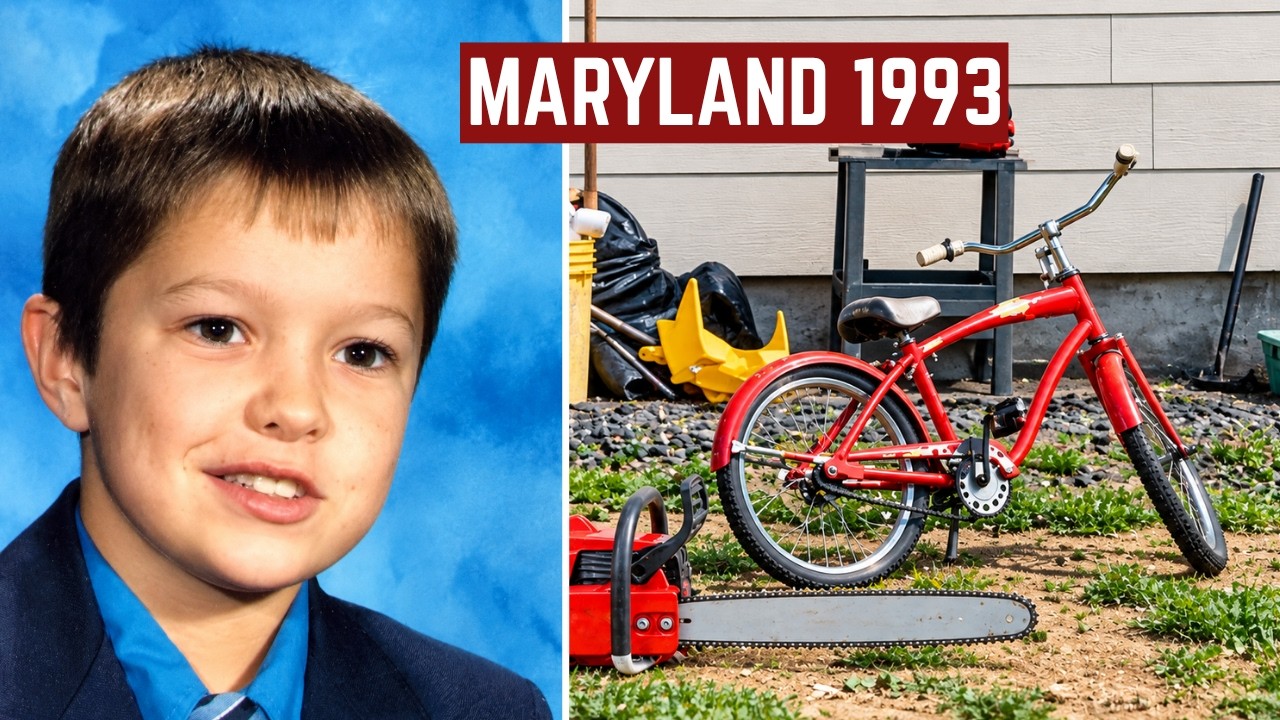
Then came Monday, May 24, 1993. Around 3:30 in the afternoon, Junior left home on his bicycle. It was a red and white Schwinn from the 1950s, with a large seat and wide handlebars. A spare tire was tied to the handlebars.
The rear fender was missing. It was not clear where he was headed. His parents told reporters he had gone to meet friends, though other accounts suggested he was on his way to see a single friend. The sources disagree, and the public record has never resolved the question.
What is not in dispute is the time he left and that he never returned. When Junior did not come home by evening, his father became worried. As darkness fell, George Sr. went out to look for him.
He called the police and began distributing flyers. The search for Junior quickly expanded. Prince George’s County police searched the neighborhood on foot and brought in police dogs. Helicopters swept the area from above.
Within hours, a team of local and federal officers was searching for evidence and interviewing neighbors. The small FBI office in Hyattsville joined the effort, and before it ended, the search was described as the largest in the county’s history. Residents joined the operation. Neighbors copied flyers with Junior’s picture and distributed them.
A local Domino’s branch went further, printing his poster on pizza boxes. Tips poured in, some reporting possible sightings, but none led police to him. One piece of physical evidence surfaced: a spare tire matching the one tied to Junior’s handlebars. The bicycle itself was never found.
In Brentwood, daily life changed. A reporter covering the case at the time wrote that parents stopped letting their children walk or play outside alone, even in daylight. Six days after the disappearance, authorities publicly stated they believed Junior was still alive. That meant investigators were still searching for a living child.
Every tip had to be checked, and so far none had produced anything. In those early days, agents and detectives spoke with the children of Junior’s neighborhood. One name kept coming up: James Kowalski. He was in his fifties.
FBI agent Bob Coffey said the boys described a man who took them on trips, fed them, bought them clothes, and gave them money. Another agent, Lou Luciano, remembered that some of them mentioned computers. Many families in the neighborhood were struggling financially. On Thursday, May 27, three days after Junior disappeared, police acted on tips from Brentwood residents.
They raided Kowalski’s home in Winchester, Virginia, where he had moved just six weeks earlier. The raid was part of the search for a missing child, but what it uncovered pointed in another direction. Police found evidence that Kowalski had committed crimes against other boys. That same day, they charged him in cases involving two boys from Brentwood.
Within days, several more came forward. The case split in two. Half became a criminal prosecution. The other half, the search for Junior, made no progress.
Investigators searched for any link between Kowalski and Junior. Kowalski said he had not known Junior was missing, but in his home, investigators found a videotape containing news coverage of the search for the boy. Beyond that, the evidence was thin. One account said the only evidence Junior had been inside the home was that he had once played a video game on a computer there.
A neighbor in Winchester told a local newspaper at the time that he had seen Junior at the house. Police could not connect Kowalski to Junior’s disappearance. Then, on June 15, a second set of charges was filed. Police charged a woman from Brentwood with obstructing the investigation, claiming she had lied about the last time she saw Junior.
The available records do not clarify how that charge ended. Three weeks later, police had filed charges in two cases. They still had no trace of Junior. As the investigation expanded, investigators learned something about the adults surrounding Junior.
He and some of his friends had spent time in the homes of three men. The first was James Kowalski. The second was Steven Bruce Lake, who had rented a house in Hyattsville. The third was Joseph Lynch, who was in his late twenties and lived in the neighborhood.
Police believed the three men had committed crimes against two of Junior’s friends during the weekend before his disappearance. That finding supported the charges but did not explain what had happened to Junior. Many of the boys told agents the same thing. They had talked with Kowalski and other men through computers.
In 1993, that sentence meant little to most investigators. Lou Luciano, the lead FBI agent in Hyattsville, had never worked on a computer and had to ask the boys what they meant. He learned that Kowalski had provided computers to some of them. One agent on the case understood.
Doris Gardner, then known as Doris Huebler, had graduated from the FBI Academy only about six months earlier. She had a background in mathematics and computer science and had been assigned to white-collar crime. When the investigation expanded, she was asked to help the team in Hyattsville. She pushed for one particular thing: the search warrants must include computers.
Bob Coffey later said most people did not know where to look for such evidence. Gardner did. It was an unusual request. The FBI had only a few digital forensics experts, all at headquarters in Washington.
They agreed to help and examined the devices. They recovered conversations, file exchanges, and videotapes. Prosecutors used the evidence to charge Kowalski with crimes against six children from Brentwood and Hyattsville. The computer evidence soon became a case of its own, assigned to Gardner, who left her white-collar work to handle it.
The evidence also raised a bigger problem. It showed adults using computers to communicate with children and with each other. When agents asked prosecutors how the law applied, Coffey remembered the answer: there was no law for this. In 1993, most homes did not have internet access.
Agents were facing online behavior that existing laws and investigative practices were not designed to handle. The Hyattsville FBI office worked with headquarters and the Justice Department to find a legal path. Then they tried something new. The office was small, with only two squads, one for drugs and one for violent crimes.
Three agents were pulled from that group to work online under assumed identities: Al Little, Jerry Dower, and Dan Chadwick. They worked from the phone closet the office used for wiretaps. Leads came in within hours. A few months later, a detective from Florida contacted Doris Gardner about a man in New Hampshire who was trading illegal material online.
That case led to hundreds of others. In September 1995, the FBI executed 116 search warrants across the country on the same day, the largest number the bureau had ever executed in a single case on a single day. The timing mattered: offenders could warn each other and delete files within minutes. That operation led to the launch of the Innocent Images National Initiative.
In fiscal year 2020, the FBI opened 3,351 child exploitation cases, made more than 1,600 arrests, and identified or located 1,410 child victims. The FBI attributes all of it to the investigation that began in Brentwood. But in that same 2020 report, the bureau noted something else. No one had ever been charged in Junior Pruitt’s disappearance.
The trials answered one question: who committed the crimes against the boys in Brentwood? They did not answer the other. James Kowalski was the first convicted. On August 9, 1993, he was sentenced in Winchester Circuit Court to fourteen and a half years for crimes against boys in Virginia.
Junior’s parents attended the hearings and distributed flyers asking anyone with information to come forward. In Maryland, on July 6, 1994, Kowalski was convicted of crimes against four boys, with a sentence of sixty years. In October 1995, Maryland’s Court of Special Appeals overturned those convictions, ruling that Kowalski did not meet the legal definition of an adult responsible for the care of those boys. His current status is unclear.
Steven Bruce Lake was convicted and sentenced to sixty years; the same appeals court reduced that by thirty years, and he has since been released. Joseph Lynch stood trial and was convicted in October 1994 on two counts of sexual crimes involving a minor. He was sentenced to twenty years and released in 2006. The decades passed, and the case remained open.
Junior’s family kept circulating his picture. Age-progression images were produced to show how he might look. Barbara Pruitt said she called police frequently over the years. In March 2002, investigators went to her instead.
They told the family they had developed a new hypothesis: Junior had died shortly after his disappearance. Detective Mike Butler, who had worked the case since 1993, said investigators were re-interviewing people, including Junior’s friends, who were now adults. Police refused to identify the person they were focusing on. No charges followed.
In 2021, George Sr. died without ever seeing an answer. On the same decades, one person in Mount Rainier kept making phone calls. Joan Paulett grew up there and went to school with Joseph Lynch.
She told Fox 5 she had wondered for nearly thirty years whether he was involved in what happened to Junior. She called investigators for updates about once a year until this year. When Paulett called again, investigators told her something different. There was new evidence.
It did not begin with Junior. It began with Joseph Lynch and a different set of allegations. Earlier in 2026, Prince George’s County police charged Lynch in separate cases, accusing him of crimes against two teenage boys between 2007 and 2014 at a home in Mount Rainier. He was also linked to a 2012 arson.
Lynch had been held in custody since the spring. As those new cases moved forward, two members of the cold case unit, D. J. Windsor and Nicole Vizbal, returned to the people connected to 1993.
They re-interviewed everyone they could find. The method was simple: ask the questions again and listen. One person they spoke with was a man in his mid-forties who had lived in Junior’s neighborhood as a boy. Sources told Channel 7 that police had not previously known he was one of Lynch’s victims.
Commander George Nader said the man was thirteen years old in 1993 and reported being abused by Lynch for more than four years. In those conversations, police say, he told investigators something that changed the course of the case. He said that on the day Junior disappeared, he was inside a home with Junior and Lynch. According to police, Lynch was there and ordered the assault.
Junior was seriously injured and died. Police say Lynch then removed Junior’s remains from the home. The indictment documents, as reported by Fox 5, add that the man told police Lynch forced him to participate. He was thirteen years old.
Commander Nader and State’s Attorney Tara Jackson said his age at the time prevents him from being charged. Sources indicate he is cooperating, and police say the investigation is ongoing. On September 16, 2026, Joseph Lynch was charged with second-degree murder and three related sexual assault charges. The next day, Commander Nader and the FBI announced the charges publicly.
On Friday, September 18, Lynch appeared in court for the first time. He was already in custody on the earlier charges. His public defender requested no change in bail, and he remains held without bond. No plea of guilty or not guilty has been reported.
No trial date has been set. No conviction has been entered. Police have not explained how Junior died. Because no remains were found, no autopsy was performed.
Commander Nader said their recovery is unlikely, and police have not described any physical evidence supporting the witness’s account. In the September 17 press conference, Virginia Pruitt spoke on behalf of her family. She said their hearts are aching. The case contributed to changing how the FBI investigates crimes against children.
For Junior’s family, the case has so far produced only a charge, with no verdict and no remains. The next step is a preliminary hearing on October 16. Until a court rules, Joseph Lynch is presumed innocent. For thirty-three years, investigators knew Joseph Lynch’s name.
What police say they lacked was a witness who could place Junior with him on that day. Questions remain unanswered. Junior’s remains have not been found. No corroborating evidence has been announced, and the witness’s account has not been tested in court.
George Stanley Pruitt Jr. disappeared on May 24, 1993. He was ten years old.
The court will decide the rest.
