On the 11th of December 1936, a king gave up the throne of England for an American woman, and the whole world watched him do it. But there was a second American woman in that story, and almost nobody has heard of her. When the news reached her, she wept and said seven words that tell you everything about what she had been doing for the previous two years. How could he do this to me?
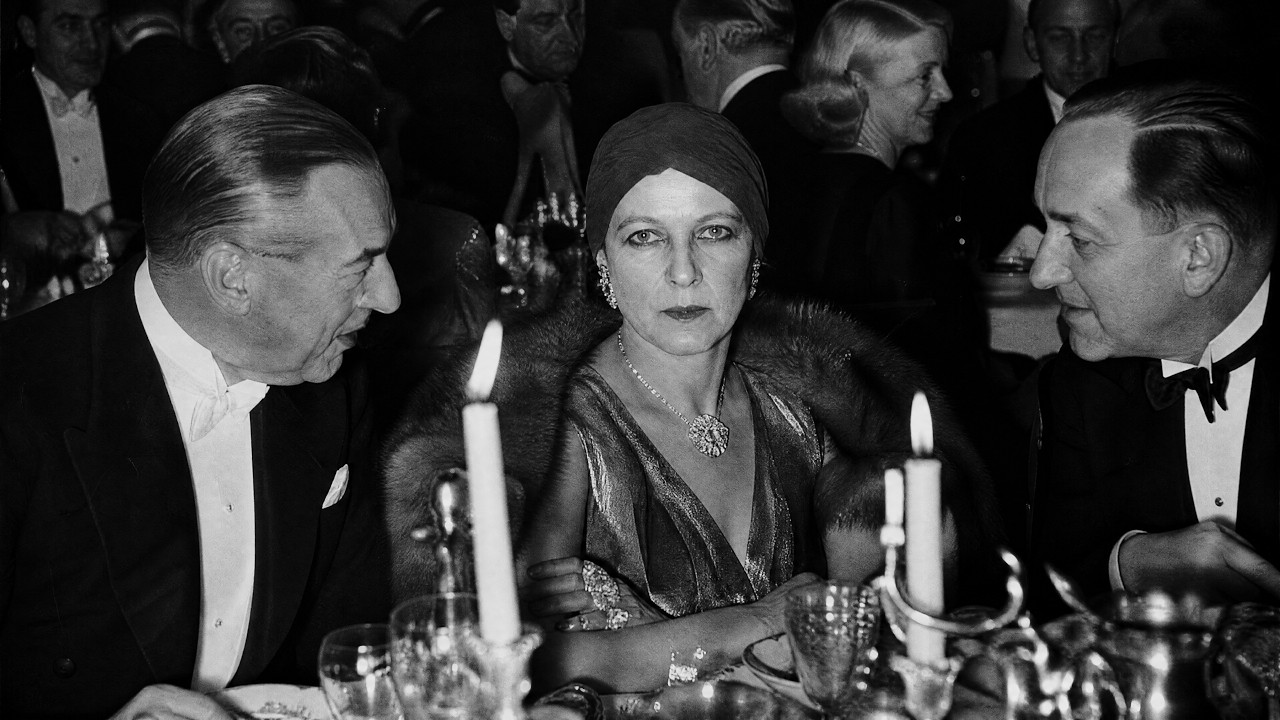
Her name was Maud Alice Burke from San Francisco. In London, she called herself Emerald. For 25 years, she ran the dinner table where England decided who was acceptable. And she had spent every last piece of that power making Wallis Simpson possible.
She was about to find out what it cost. Maud Burke was born in San Francisco on the 3rd of August 1872. Her father was James Burke, an Irish American who liked to say the family came down from Robert Emmet, the Irish rebel. Her mother was Alicia Salandin, described in the records as half French.
It was a household on the edge of a young city, one that had arrived somewhere without yet arriving anywhere that mattered. The child was moved east and brought up in New York. That is where the music found her. She sat through the whole of Wagner’s Ring Cycle at the age of 12, and something in her fixed permanently on the sound and on the world that produced it.
Sixty years later, at the end of a life spent paying for opera, that was still the thing she had been chasing. It began with a girl in New York who was too young to be there. She read constantly, and in two languages. Those who knew her later were struck by how much of French and English literature she had actually consumed, not skimmed for conversation.
A hostess with a genuine library is a rarer creature than the phrase suggests, and the reading was the foundation of everything she built afterwards. Writers came to her table because she had read them. Composers came because she knew the scores. Her gift was recognizing talent early and making herself indispensable to it.
Then her mother remarried, and Maud’s life took the turn that decided the rest of it. A New York lawyer named Horus Carpentier had once been attached to her mother. When Alicia married again, Carpentier offered to take the girl into his household. She was about 18.
He was a man of enormous wealth, a Columbia College graduate who had gone to California in the gold rush of 1849 and come back with a fortune built out of land, telegraph wire, and railroad stock. The scale of the man mattered because the whole of her London career rested on what other people assumed about it. Horus Carpentier went west in 1849 with the gold rush. He came back rich from land rather than gold.
He squatted on a muddy spit on the eastern shore of San Francisco Bay, bought out the debt-burdened Mexican titleholder, laid out the streets, got himself into the state legislature, had the place incorporated as a city under a new name, and was elected its first mayor. The name he chose was Oakland. He went on to run the Overland Telegraph Company, which put the Pony Express out of business, and to sit as a director of the Central Pacific Railroad. So a girl from San Francisco, with a good ear and a great deal of reading, became the ward of a rich old man who had personally founded a city.
In 1890, when she was 18, he took her to Europe on a shopping trip. The article he intended to buy was a title, and she was the currency. This was standard practice and nobody pretended otherwise. In the last quarter of the 19th century, hundreds of American families sent their daughters across the Atlantic with money attached, looking for European rank, and hundreds of European families with rank and no money were waiting for them.
The exchange rate was well understood on both sides. Maud Burke became remarkable for what she did after her first transaction collapsed, because it collapsed, and publicly, in Europe. She secured an engagement to Prince Andre Poniatowski, a French-born descendant of Polish kings. For a girl from San Francisco, this was the whole prize in a single move.
A prince, a royal Polish line, a name that opened every door in Europe. She had done in one season what most American mothers spent a decade attempting. Poniatowski then traveled to San Francisco. He was a shrewd man and he understood American opportunity better than most Americans did.
He invested in gold mines, in railroads, and in electric utilities, and he made money doing it. He also met another Californian, a member of the Crocker family whose fortune came out of banking and the railroads, and who represented something Maud Burke did not. She represented certainty. The Crocker money was there, visible, already made, and attached to a name that San Francisco knew.
He married the Crocker girl. Maud Burke had been jilted by a prince in front of everybody who had heard about the engagement. In most versions of this story, that is where the woman disappears. She goes home.
She marries a local man of business. She becomes a name in a church register. She stayed, and she recalculated. The lesson she took from Andre Poniatowski was about pricing.
She had been sold as a fortune rather than as a person, and a fortune can always be outbid. Somebody will always have more. So the next time she went into the market, she went in carrying something no check could match, which was herself: the reading, the music, the speed of her talk, the ability to assemble a room and make it crackle. Those were not assets a Crocker could match with a larger check.
There was a second lesson underneath the first, and it concerned the thing she had been carrying without owning. Everybody involved in the Poniatowski engagement had been trading on an expectation, a sum of money that would arrive when an old man died. Nobody had seen it. Nobody had counted it.
It existed as a figure in conversation, and a figure in conversation had bought her a prince and then lost her one. She would spend the rest of her life demonstrating that a reputation for money moves people almost as efficiently as money does. And she would find out decades later, and in the worst possible way, exactly where the difference lies. She had also learned something colder and more useful.
She had learned exactly how the English and the European aristocracy priced an American girl, and how quickly that price could be revised. She would spend the next 50 years on the other side of that transaction, deciding who was worth what, and she never once forgot how it had felt to be the one being valued. Within five years, she would be a titled English woman living in a great Leicester house, married to a man 21 years older whom she barely knew. Within 20, she would be running the most consequential dinner table in London.
The man who made the first of those things possible was at that moment in serious trouble with his bank. Sir Bache Cunard, third baronet, was born in 1851, and he had one of the best names in England attached to one of the emptier bank accounts. His grandfather was Samuel Cunard, who founded the Cunard shipping line. That was the name.
The reality by the 1880s was a Leicester estate that could not pay for itself. By 1886, Sir Bache found himself in constrained financial circumstances and mortgaged the estate. By 1893, the mortgagees wished to foreclose. This is the ordinary arithmetic of the late Victorian English gentry, and it is the reason the marriage happened.
Great houses were expensive to keep warm and impossible to staff cheaply. A baronet with a famous name and a mortgaged estate was, in the language of the marriage market, available. He was also by temperament entirely uninterested in the world Maud Burke had spent her life preparing to enter. He hunted, he rode, he played polo, he worked metal with real skill.
He liked Leicestershire, and he liked it best when nothing in it changed. They married in April 1895. She was 22 going on 23. He was 43, 21 years her senior.
The marriage announcements of the period reported the match in the terms everybody understood. The bride’s dowry, it was said, might reach $2 million on the death of her guardian. That figure did a great deal of work. It went into the announcements.
It went into the gossip. And it went, crucially, into the calculations of the men holding the mortgage on Nevill Holt. An heiress to $2 million marrying into a baronetcy was a solvent proposition. The foreclosure that had been threatened two years earlier did not happen.
Her marriage allowed the estate to be maintained. The transaction was so common in those decades that it had its own vocabulary. American money went east and European rank went west, and both sides pretended the arrangement was romantic. What made this particular exchange unusual is that only one half of it was real.
The rank was genuine, ancient, and legally binding. The money was a figure in a newspaper. Each side thought it was buying something different. Sir Bache believed he was buying solvency and a wife who would take to the county.
He got a woman who found the county unbearable. Maud Burke believed she was buying a title, a great house, and a position from which the rest of her life could be launched. On that side of the ledger, she was entirely correct, and she would collect on it for the next 53 years. For the moment the arrangement held.
She became Lady Cunard, and she took possession of Nevill Holt, and she began almost immediately to do the only thing she had ever wanted to do. She began to gather interesting people. What she had was a taste for the arts, or at least for artists, and especially for musicians. It was the first small working model of the machine she would later run at national scale, and it was assembled in a hunting county by a woman of 23 who had been in England for a matter of months.
On the 10th of March 1896, 11 months after the wedding, she gave birth to a daughter in London. The child was named Nancy Clara Cunard. Nancy was raised at Nevill Holt, and one of her biographers described her in three words that hang over this entire story: gifted and lonely. She was largely neglected by both parents.
Her father was in the stables and the workshop. Her mother was assembling the room. The child grew up in an enormous house surrounded by adults who were performing for one another. Into that house came a novelist.
George Moore was Irish, celebrated, and 43 years old when Lady Cunard first drew him in. He fell deeply and permanently in love with her. He would put her into his novels in many guises for the rest of his working life. Her feeling was returned, but at a lower temperature.
She kept him close. She read what he wrote. She let him adore her, and she never resolved the question of what he was to her. He remained in that position for more than 30 years, until his death in 1933.
He was also, whether by design or by silence, the source of the rumor that has followed the family ever since. Moore did not discourage the widespread belief that he, and not Sir Bache, was Nancy’s father. Historians do not generally credit it, and it is not certain that his relationship with her mother was ever more than platonic. Some who knew him believed he was impotent, and one contemporary summary of him has survived as a single devastating line: that he was a man who told but did not kiss.
The truth of Nancy’s paternity is not established. What matters is the shape of the household. There was a husband in the stables, a novelist in the drawing room, a small girl on the stairs listening, and a young American woman at the center of it, discovering that she could hold three or four people in orbit at once without ever having to choose between them. That was the skill.
Everything she built afterwards was that skill applied to larger and larger rooms. By 1910, she had been Lady Cunard for 15 years, and she had come to a conclusion about her marriage that most women of her era could not afford to act on. In 1911, she walked out of the house, out of the county, and out of the marriage, and kept the name. That year, she and Sir Bache formally separated by common agreement.
They did not divorce. They never divorced. He lived on in the country and then in Cambridge for another 14 years, and she remained in law, and in every address book in England, his wife. Understand what divorce would have taken from her.
Divorce in 1911 meant social exclusion, and it fell far more heavily on the woman than on the man. It would have stripped her of the title she had crossed an ocean to obtain, and of the access that made the title worth having. Separation took nothing. She kept the name Cunard.
She kept the style, Lady Cunard. She kept the standing, the invitations, the right to be received anywhere. What she shed was a husband she did not want, a county she could not use, and a house that bored her. Legal freedom and social power were for her mutually exclusive.
She took the power. The cost landed on Sir Bache. With his wife gone, his finances failed again almost immediately. The mortgage on Nevill Holt was foreclosed in 1912, the year after she left.
The sequence is stark. The estate is mortgaged in 1886. The lenders move to foreclose by 1893. The American marries in 1895 and the estate is maintained.
She leaves in 1911. It is foreclosed in 1912. Whatever the newspapers had believed about her fortune, 16 years of her presence had been holding that house up, and one year of her absence brought it down. A house that was failing before she arrived, held up for 16 years while she was there, and foreclosed the year after she left, is a house that was being carried by somebody.
She was the somebody. Sir Bache moved out of the world. He ended his life at Hock House in Cambridge, where he died on the 4th of November 1925 at the age of 74. He was not the villain of this story.
He was a man who married a woman he could not talk to in order to keep a house he could not afford, and he lost both. His wife, meanwhile, had gone to London and started building. Her first independent address was 20 Cavendish Square, an apartment she rented from Herbert Asquith, the former prime minister. The detail is almost too neat.
Her first act on arriving in London as a woman on her own was to take a lease from a man who had run the country. From there the machine started, and it started fast. One biographer of the period put it in a single sentence: soon she had captured all London society, and her salon became the most important destination for musicians, painters, sculptors, poets and writers, as well as for politicians, soldiers and aristocrats, provided only that they were interesting. That last clause is the whole method: so long as they were interesting.
Every other great house in London assembled people who were already alike. Political houses gathered politicians. Artistic houses gathered artists. Aristocratic houses gathered aristocrats.
Lady Cunard did something that sounds obvious now and was close to radical then: she mixed them. She put a cabinet minister next to a composer. She sat a duke beside a soprano. She brought Americans into rooms that had never received Americans, and she did it on the authority of a title she had bought, and a judgment nobody could argue with, because she was almost always right about who was worth knowing.
The mixing was the product itself. People say different things to a stranger than they say to their own kind, and they say a great deal more of it after dinner. A room composed entirely of politicians produces caution. A room where a politician is trying to impress a novelist produces indiscretion.
She built rooms that produced indiscretion, and indiscretion was the currency of London. She ran the table like a conductor, which is a comparison she would have accepted. She wrote the placement herself, and she rewrote it late, moving people at the last moment because a pairing had occurred to her. Guests came away repeating what she had said.
They rarely noticed that she had spent the evening finding out what they thought, and the room was never allowed to settle. The Wagner she had absorbed at 12 had given her a lifelong sense of how a long evening should be shaped, and she shaped every one of hers deliberately. George Moore followed her from address to address, and adored her from each of them. She was by this point in her late 30s, small, quick, extravagantly dressed, and possessed of a wit that people who were frightened of her still repeated for the next 40 years.
And at some point around the separation, she met the man who would define the next three decades of her life and take the largest share of everything she raised, earned, and spent. He was a conductor seven years younger than her, and he had an appetite for grand opera on a scale that no private income in England could support. His name was Thomas Beecham, and he needed exactly what she had. David Lloyd George called her a most dangerous woman, and he was not talking about her looks.
She was not greatly interested in politics, he said. She simply beguiled senior politicians, men such as Lord Curzon, into indiscreet statements at her dinner table. She had no particular use for the secrets themselves. She wanted a table that produced them, because a table that produces secrets is a table nobody in London can afford to skip.
That is the whole machine in one sentence, and it came from a man with no reason to flatter her and every reason to understand how private information moved through London. The engine had four parts. The first was admission. She decided who came in, in a city where a great deal of public business was settled in private houses.
The power to seat somebody was the power to certify them. A young politician who had eaten at her table had been vouched for. An ambassador who had not was quietly nobody. She never held an office and never cast a vote, and she could still change a man’s standing between one Tuesday and the next by writing his name down.
The second was the mixture. The third was extraction, and it is where Lloyd George’s complaint comes from. Men who were careful in the Commons were careless at her table, because the register was social, and the audience was mixed, and the wine was very good. A minister explaining himself to a novelist forgets that the man on his other side has a brother in the city.
Nothing she did was underhand in the legal sense. She simply built the conditions in which powerful men talked, and then remembered every word. The fourth was conversion. Information collected at dinner turned into introductions.
Introductions turned into appointments and contracts and marriages. And appointments and contracts and marriages turned into obligation. Obligation was her working capital. She was owed favors across most of official London, and she called them in for one purpose above all others, which was music.
The addresses tell the story of the climb on their own. 20 Cavendish Square from 1911, an apartment rented from the former Prime Minister Herbert Asquith. 2 Upper Brook Street from 1918, as the war ended. 5 Carlton House Terrace from 1921 to 1924.
And from 1926 to 1940, 7 Grosvenor Square, the address she is remembered by. Four moves in 15 years, each one deeper into the half square mile where England was actually run. The First World War changed her position without damaging it. What came out of those four years was a society that was smaller, faster, and more urban than the one that went in, and it needed somebody to organize it.
She was already organizing it from a house in London rather than an estate in the country, and she came through the war with her address book intact. She acquired a rival, because a woman with that much power always does. Sibyl, Lady Colefax, ran the other great London table, and the two of them competed for guests with a seriousness that entertained everybody who was fought over. The rivalry between them is the texture of 1930s London, and the Second War would finish them both on the same afternoon.
The usual explanation for why a woman was running any of this, that she happened to be charming, explains nothing at all. The real answer is structural. In interwar Britain, the formal levers of power sat in three places. They sat in the House of Commons, which no woman could enter without first being elected, in a country that had only just begun letting women vote.
They sat in the House of Lords, which was closed to women altogether. And they sat in the royal household and the senior civil service, which were closed by custom rather than by statute. A woman of ability in 1925 had almost nowhere to put that ability. What she did have access to was the private house.
A house could be owned, run, staffed, and controlled by a woman. And a great deal of British political business was conducted inside private houses precisely because nothing said there was on the record. The great hostesses were the byproduct of that arrangement. They existed because the country had built a system in which the interesting conversation happened where the women were, and then congratulated itself on keeping the women out of government.
Emerald Cunard understood the loophole better than anybody of her generation and worked it harder. She could not stand for a seat. She could seat the men who held them. What did the power actually look like in operation?
It looked like a young composer being introduced to a man who would fund him. It looked like a politician learning over the fish that the government’s position on something had changed before the House was told. It looked like a woman being lifted from unacceptable to unremarkable by being sat at a good table often enough that objecting to her began to feel provincial. That last mechanism is the one that matters most in this story.
In 1935, she pointed it at one particular American woman and held it there for two years. There was one further thing about her that everybody noticed and almost nobody credited, which was that she was extremely funny. She was small, she was elaborately dressed. She was spoken of in the same breath as canaries and birds of paradise, and she said things at dinner that were repeated in London for decades.
Chips Channon, who was in her rooms constantly and wrote most of it down, described her as rapier-witted. One of the exchanges he preserved catches the register exactly. At a dazzling wedding ball, Channon turned to her and said, “Look, Emerald, this is what we went to war for. ” She looked at the room and replied, “Are they all Poles?
” The joke has an edge on it that is easy to miss. It is the remark of a woman who has spent 40 years watching Englishmen congratulate themselves in expensive rooms, and who has never once forgotten that she was not born in one. That was the disguise, and it worked on nearly everybody. A woman described as amusing is a woman who has been filed as harmless.
The description traveled across London instead of the fact, and the fact was that a former prime minister had taken one look at her table and decided it was a hazard to government. The government had never been the point. She had built the whole machine for one man and one obsession, and between them they cost more money than any private person in England could raise alone. The obsession was opera.
The man was seven years younger than her, and he was already spending money he did not have on the most expensive art form ever invented. Thomas Beecham was born in 1879, heir to the Beecham’s Pills fortune. He was a conductor of real gift and enormous nerve. He had inherited an income, and he had an appetite for grand opera that no income on earth was going to satisfy.
Opera is the most expensive thing a country can decide to make. Orchestra, chorus, principals, designers, a house, a season. In Britain in the early 20th century, it had never once paid for itself, and every attempt to make it do so ended in the same place, which was a rich man discovering he was no longer rich. Around the time of her separation, Lady Cunard fell in love with him, and society understood them as a couple from that point onward.
The attachment lasted publicly and continuously until 1943, 32 years. George Moore, who had adored her since Leicestershire, and had watched her collect and keep him without ever settling what he was, stayed exactly where he was. He would stay until he died in 1933. But the Beecham attachment was different in kind from the Moore attachment, because it came with a job.
She became his fundraiser. That is the flat, unglamorous word for it, and it should be used, because the work itself was flat and unglamorous, and she did it for three decades. It meant knowing who in London had money. It meant knowing which of them could be moved by music, which by vanity, which by the promise of being seen in the right box on the right night.
It meant deciding what each one could be asked for, and then asking. She persuaded a great many rich and upper-class people to underwrite operatic ventures that were extravagant by design and that no sane accountant would have touched. This mattered from the beginning, and it mattered more after 1918, because the First World War left Beecham’s own finances badly depleted. From that point on, the money she raised became a substantial part of what kept the whole enterprise breathing.
The scale of what British opera was trying to do in those years can be measured. In December 1930, Parliament discussed an arrangement between the Imperial League of Opera and the Covent Garden Opera Syndicate that was described as providing an annual income of £70,000 a year for the production of grand opera. Beecham’s Imperial League was funded from the other end of society, entirely by public subscription at two shillings a week, and he crisscrossed the country making hundreds of speeches to raise it. That was the popular half of the campaign.
Lady Cunard ran the other half, and her half dealt in large private checks gathered one dining room at a time. She was a tireless fundraiser, and the word carries its full weight here. There was no committee behind her and no institution. There was a woman in her 40s, and then her 50s, and then her 60s, working a room, remembering who had been moved by what, and converting that memory into a sum of money months later.
An opera season is a machine that eats money continuously. Principals must be engaged a year ahead and paid whether or not the house fills. A full orchestra and a full chorus draw wages every week of a run. Sets are built once and used for a fortnight.
Foreign singers of the first rank cost what foreign singers of the first rank have always cost. Every one of those obligations falls due before a single ticket is sold, which is why grand opera has never in its history been a business, and why the people who make it possible have always been patrons rather than customers. He came back to Covent Garden in 1932 and stayed until 1939. From 1935 he was in sole control, presenting international seasons with eminent guest singers and eminent guest conductors, and her fundraising is part of why they existed at all.
She was called the queen of Covent Garden, and the title worked as a functional description of who found the money. There is a particular kind of invisibility in this work, and she lived inside it for three decades. The conductor stands in front of the orchestra with his back to the audience and every eye in the house on him. The woman who found the money for the season is in a box, or at a dinner three days earlier, and the record of what she did survives only in the memoirs of the people she asked.
Music history has almost no vocabulary for her. It has patrons, which sounds passive, and it has hostesses, which sounds trivial, and neither word describes a woman doing systematic fundraising at a national scale for 30 years. Her patronage reached past the opera house, too. By one account, she solicited enough from her circle to keep James Joyce writing through the 1920s, which means that a portion of the most difficult and important prose of the century was underwritten by a woman moving between drawing rooms in Mayfair, asking people for checks.
Now hold both halves of the ledger up together, because this is the shape of her whole life. She raised the money. He made the music. The music was reviewed, recorded, remembered, and credited to the conductor, which in one sense is correct, because he made it.
And the woman without whom several of those seasons would not have existed appears in the record as a hostess, a social figure, a footnote in the biographies of the men she funded. She was not a saint about it, and there is no reason to pretend she was. The arrangement gave her something no purely social hostess in London had, which was a project with a public face. Every season he mounted was evidence that her table produced results.
It made her something more interesting than a woman who gave good parties. It made her a patron in the old sense, and she was one of the last people in England to operate that way before the state took the job over. There is one detail about the relationship that says everything about what she was to him, and it waits until 1925 to appear. When Sir Bache died that November, his widow began calling herself Emerald.
It was a new name chosen by a woman of 53, and it is the name history has kept. Neither of the two men who had spent their lives closest to her ever used it. Not Moore, not Beecham. To both of them she remained Maud, which was the name given to a girl in San Francisco who had not yet built anything.
He was also, throughout the entire 32 years, married to somebody else. His wife was Utica Celestia Wells. The marriage stayed legally alive for decades while he lived his life elsewhere. Lady Cunard, who had made exactly the same arrangement with her own marriage, was in no position to complain about it, and did not.
Two people who had each kept a spouse on paper, running the most public private partnership in English music. It held for over 30 years. It ended in a hotel in New York, with a piece of gossip she heard from somebody who was not him. But that is 1942.
And there is a question that has to be answered first, because it is the question that hangs over every check she ever wrote and every check she ever asked another person to write. Where exactly was her own money coming from? Everybody in London believed she was an American heiress, and the will that was supposed to prove it left her nothing. The belief was reasonable.
It had been in the newspapers at the time of her wedding. Her dowry, it was reported in 1895, might reach $2 million on the death of her guardian. $2 million in 1895 was a fortune of the first rank on either side of the Atlantic. It was the kind of sum that rescued a mortgaged estate, and everybody involved in the Cunard marriage, including the men holding the mortgage, understood the figure and acted on it.
The figure was an expectation. Expectations depend on old men, and old men have their own ideas. Horus Carpentier lived on and on. He had graduated from Columbia before going west and endowed it later.
He had made his money out of the founding of Oakland, out of the Overland Telegraph, out of the Central Pacific Railroad, and out of the China trade, and he had already decided what he thought of his relations. How that money was made throws a hard light on who eventually received it. The land Carpentier took at the edge of San Francisco Bay belonged to Don Vicente Peralta, who held a Mexican title to it. Peralta was debt-burdened and Carpentier bought him out.
The squatters then laid out the streets of the town they had taken, and the legislature Carpentier had got himself elected to duly incorporated it. He was handed a deed to the entire waterfront of the city he had just named, and then elected its first mayor. That is the fortune. It was built on a debt-burdened man’s misfortune and a young lawyer’s willingness to write his own paperwork, and every penny of it was destined for institutions rather than people.
In 1906, Maud and Nancy went to see him. He was 82. Nancy was 10. It was the only visit, so far as the record shows, that the two of them made to his country house in upstate New York.
Nancy, who grew up to be one of the more formidable judges of character in 20th-century letters, was not impressed by him. Whatever passed between the old man and his former ward that day, it did not change what he had already decided. He included neither of them in his will. What he did with the money is worth stating in full, because it is the measure of the deliberate act.
He gave $1 million to Columbia University. He gave $1 million to Barnard College, including a scholarship for deserving girls, in his own phrase, not excluding Chinese. He left $100,000 to the University of California to buy books and research materials on what he called the five great areas of Asiatic civilization, being China, Japan, India, Arabia, and Babylonia. He endowed a chair in Chinese at Columbia.
He financed a home for the poor, and he gave a significant sum to the Tuskegee Institute in memory of Booker T. Washington. To his next of kin, he left no more than $2,000, and he put on the record that this was not through oversight or failure of memory. That sentence is one of the coldest things in this story.
He wrote it because he knew exactly how the will would look, and he wanted no ambiguity at all. He had considered his own family, and he had declined them in writing. For the woman in London, the consequence was total. Lady Cunard spent five decades at the center of English society on the strength of an American fortune that everybody assumed and nobody could point to.
The $2 million never arrived. Her security was the Cunard name, the settlement that came with the marriage, and whatever income attached to being the wife of a baronet. It was a comfortable position and a modest one, and far below what London believed she was sitting on. And there is a second consequence, quieter and more constant.
Every year that passed without the inheritance was a year of living close to the edge of what she could actually afford. The house, the staff, the dinners, the pictures bought at double their value from friends who needed the money, the giving to Covent Garden, all of it came out of an income rather than a fortune. A woman with $2 million behind her can be careless. A woman without it has to be exact, and has to appear careless while being exact, which is a far harder performance, and one she gave every night for 40 years.
She was not a rich woman deploying money. She was a woman deploying the belief that she had money, and converting that belief into influence, and converting influence into the actual cash of other people, and then handing that cash to a conductor. The whole apparatus ran on credit in both senses of the word. It ran on what people extended to her, and on what they believed she could cover.
That is a far more impressive achievement than inheriting $2 million and spending it. And it is also far more fragile. And she would find out how fragile in December 1936. The illusion held for half a century.
The $2 million figure had been put into circulation at the time of the wedding, and it stayed in circulation, uncorrected, for the rest of her life. She lived well, which is evidence of income and says nothing about capital. She bought her friends’ furniture at double its value, which reads as the gesture of a woman who does not need to count, and which was in fact the most efficient purchase of loyalty available at the price. And she raised money from other people constantly and openly in the name of opera, which meant that the sums moving through her hands were enormous, and none of them were hers.
A woman asking a duke to fund a season at Covent Garden looks like a woman who has already funded one herself. In 50 years of London gossip about Emerald Cunard, and there was a very great deal of it, the one thing nobody seems to have said out loud is that the heiress had never inherited anything. There is a second irony buried in the Carpentier will, and it takes 25 years to detonate. Look at what the old man actually funded.
A scholarship that specifically refused to exclude Chinese girls. Asian studies. A black institute founded by Booker T. Washington.
Every one of those bequests reads as a deliberate act against the prejudices of his own class. His ward’s daughter would build her entire adult life out of exactly that instinct. Nancy Cunard published black writers, edited an anthology of black literature, campaigned against racism and against fascism, and was cut off by her mother for loving a black man. The money skipped the middle generation entirely, and so did the conscience.
But that quarrel is still 20 years away. In the 1920s, Lady Cunard was moving into the last and greatest of her houses, and the belief in the fortune was holding beautifully, and the invitations going out from her front hall were the most valuable pieces of paper in London. There was a house on Grosvenor Square where an invitation to dinner functioned as a form of social benediction. She took 7 Grosvenor Square in 1926 and held it until 1940, 14 years.
It is the address the whole legend attaches to, and it was the operating floor of everything she had spent 30 years building. One formula used about the house at the time has survived intact: a bid to the Cunard mansion at number 7 Grosvenor Square was tantamount to social benediction. That is a strong word for a dinner invitation. A benediction is something conferred from above on a person who is changed by receiving it.
The Times, which was not in the business of flattering hostesses, wrote in her obituary that Lady Cunard was probably the most lavish hostess of her day. That was published in July 1948, when the world she had run was already gone, and there was no reason left to be polite about her. What the lavishness consumed can be counted. A large Mayfair house staffed, heated, and lit.
Dinners several nights a week for years on end. Flowers, wine, a cook of the standard that the guests she wanted would notice. The checks to Beecham’s ventures. And running quietly underneath all of it, a private habit that cost her a fortune, and bought her something no money could buy directly.
Lady Diana Cooper described the habit, and her description is one of the best pieces of evidence anybody left about how Emerald Cunard actually operated. If Emerald caught Diana Cooper or her kind giving up some pleasure for the sake of economy, she would call round, pretend to take a fancy to a picture or a table or a rug, and insist on buying it for double what it was worth. Look at the design of that. It is charity that cannot be refused, because refusing it would require the friend to admit out loud that she needed the money.
It arrives as a whim. It leaves the recipient’s dignity untouched and their finances repaired, and it leaves them permanently and unspokenly in her debt. Over the years, the practice filled her house with an eclectic assortment of art and furniture, bought for reasons that had nothing to do with taste. Alongside it, she assembled something quite different: a focused collection of valuable 18th-century French furniture, acquired over many years on the expert advice of friends and dealers.
The two collections sitting in the same rooms are a portrait of the woman. One was strategy dressed as whim. The other was the real eye and the real appetite of somebody who had been buying beautiful things since she was a girl in New York. Set the whole of it out in numbers and the shape of the operation becomes visible.
20 Cavendish Square from 1911. 2 Upper Brook Street from 1918. Then 5 Carlton House Terrace from 1921 to 1924. Then 7 Grosvenor Square from 1926 to 1940.
14 years in one house. 32 years of raising money for one conductor. 30 years of a novelist waiting in the next chair. 25 years of deciding who London received, run by a woman with no fortune of her own, no vote for most of it, and no office at all.
Across London, the competition continued. Sibyl, Lady Colefax, kept her own table, and the two of them circled the same guests for years. It was a serious rivalry conducted entirely in the language of invitations, and the people being fought over enjoyed it enormously. The name changed in this period too.
Sir Bache died on the 4th of November 1925 at Hock House in Cambridge, aged 74. He and his wife had lived apart for 14 years. She had not been his wife in any sense that mattered since 1911, and she had been Lady Cunard for 30 years because of him. She did not remarry.
She was 53. She was free, and she had precisely no reason to hand her position to another man. What she did instead was rename herself. She began, from about that point, to call herself Emerald.
There is no documented explanation for the choice. A hard green stone, expensive, brilliant, and utterly unlike the plain English Maud she had been christened with. It was the last act of a self-invention that had started in a San Francisco parlor more than 40 years earlier. And the striking thing is that London adopted it.
The papers adopted it. History adopted it. A woman in her 50s simply announced a new name, and the entire British establishment agreed to use it, except for two men. George Moore never called her Emerald, and neither did Thomas Beecham.
To the novelist who had loved her for 30 years and the conductor who had lived on her fundraising for 15, she stayed Maud. They had both known her before the construction was finished. Moore died in 1933, and one of the two people alive who remembered the woman underneath the name was gone. His death closed something that had been opened since Leicestershire.
For more than 30 years he had loved her without resolution, written her into novel after novel in one guise and then another, allowed a rumor about her daughter to attach itself to him and never denied it, and sat in her drawing rooms through four addresses while she looked at other men. Whatever she felt about him, she had kept him, and keeping him had cost her nothing. That was the pattern of her private life, and it had never once failed her. It would fail her exactly twice, and the second time would kill her.
The 1930s opened with her at the height of a career that had no job title. The house ran. The seasons ran. The invitations went out in her own hand and came back accepted by people who cancelled other engagements to be there.
By the middle of the decade, she was past 60 and at the absolute top. Beecham was in sole control at Covent Garden. Her house was the most desirable address in London for anybody with an ambition. Cabinet ministers, ambassadors, composers, novelists, and the heir to the throne of England all came to eat at a table run by a woman from San Francisco who had been jilted by a Polish prince before any of them were born.
She had built it all on borrowed credit and borrowed rank, and she had one thing left that she wanted. She wanted a formal position. Influence she already had, in greater quantity than anybody in London. What she lacked was a post, a title of function inside the royal household.
The thing that would convert 40 years of unofficial power into something written down and permanent, something that could not be withdrawn because somebody had gone off her. In January 1936, an old king died, and a new king came to the throne with a problem that only one woman in England could solve. And she had already been seating the solution at her own table, in front of duchesses who would rather have died than receive her anywhere else. But before that story can run, the other strand has to be paid out, because the daughter is the key to what the mother did with her power.
Nancy Clara Cunard was born in London on the 10th of March 1896, 11 months after her parents’ wedding, and she was raised at Nevill Holt in a house full of adults who were busy elsewhere. A biographer summed up the childhood in three words: gifted and lonely. Both parents largely neglected her. Her father was hunting and working metal.
Her mother was assembling the room. The person who paid attention to her was George Moore. The novelist who loved her mother spent much of her London childhood in her company, and she never forgot it. Half a century later she published a memoir of him.
The rumor that he was her father followed her all her life, and there is no good evidence for it, and it did not stop people repeating it in her hearing. When her mother left the marriage in 1911, Nancy was 15, and she went to London too. She grew up in the shadow of her mother’s salon, watching the most interesting people in England arrive for somebody else. On the 15th of November 1916, in the middle of the war, she married Sydney Fairbairn, a cricketer and army officer who had been wounded at Gallipoli.
Her mother gave them a house in London as a wedding present, which is the exact currency of that family. They separated in 1919 and divorced in 1925. There was a man she did love: Peter Broughton-Adderley was killed in action in France less than a month before the armistice. People who knew her said she never fully recovered from it.
In 1920, aged 24, she had a near-fatal hysterectomy. Then she went to Paris, and became one of the defining figures of the century’s art without ever quite being credited for her own work. She was a muse to Wyndham Lewis, to Aldous Huxley, to Tristan Tzara, to Ezra Pound, and to Louis Aragon, several of whom were her lovers. Huxley put her into two novels, as Myra Viveash in Antic Hay in 1923 and as Lucy Tantamount in Point Counter Point in 1928.
She wrote poetry of her own throughout, and it has been steadily reassessed upward ever since. In 1928 she founded the Hours Press. In three years it published 24 volumes. One of them was a poem called Whoroscope by a young man named Samuel Beckett, and it was the first work Beckett ever published separately.
The press also brought out Ezra Pound’s A Draft of XXX Cantos. A woman in her early 30s published the first Beckett and a foundational Pound in the same short run. Her money at that point came from two places. Her father left her £14,400 when he died in 1925, about £218,000 today, and her mother had been paying her an allowance since 1920, enough to fund an extravagant life.
In 1928, Nancy met Henry Crowder. He was an African-American jazz musician working in Paris. They lived together until 1933. And in those years, she turned into one of the most committed anti-racist campaigners in British public life.
Her mother’s reported reaction survives because Nancy printed it: “Is it true that my daughter knows a negro? ” That question ended the relationship between the two women permanently. Emerald severed the allowance. Look closely at the instrument she chose, because it is the same instrument she used on everybody.
Money and admission. She had spent 30 years deciding who was received and funding what she approved of. And when her own daughter did something she could not tolerate, she reached for the identical lever without a moment’s hesitation. There was no confrontation, no ultimatum, and no scene.
There was simply a payment that stopped arriving. Nancy answered in 1931, and she answered in print. The pamphlet was called Black Man and White Ladyship. In it, she attacked racist attitudes directly and quoted her mother’s question to the world.
It was addressed unmistakably to Emerald. The allowance, already cut, was reduced further and drastically. In 1934, Nancy published the Negro Anthology, a vast collection of poetry, fiction, and non-fiction largely by black writers, including Langston Hughes, Zora Neale Hurston, W. E.
B. Du Bois, and George Padmore, together with her own account of the Scottsboro case. When the press got wind of the project in May 1932, two years before publication, she received anonymous threats and hate mail. She printed some of it in the book.
She reported the Spanish Civil War for the Manchester Guardian and for the Associated Negro Press. In 1937, she compiled Authors Take Sides on the Spanish War, a survey asking the writers of Europe to declare themselves. George Orwell’s famous refusal to take part came back to her. So while Emerald Cunard was seating a king beside a divorced American in Mayfair, her daughter was in Spain filing copy about a war her mother’s friends were arguing should be avoided at any price.
Two women, one family, both spending their lives on the question of who gets to be admitted, and arriving at opposite answers. The most striking thing about the quarrel is how little either woman moved afterwards. Emerald never revised her position. Nancy never softened hers and never stopped publishing.
Neither of them wrote the letter. The mother had a genius for keeping people in orbit, and it worked on a novelist for 30 years, and on a conductor for 32, and it failed completely on the one person she had actually made. The arrangement was permanent. It lasted 20 years, until the mother’s death, and it was never repaired, and the daughter did not come.
But that is 1948. And in 1935, Emerald Cunard was about to make the largest bet of her career. George V died on the 20th of January 1936. His eldest son became King Edward VIII, and the country acquired a monarch in his early 40s who was unmarried.
He was also entirely committed to an American woman named Wallis Simpson, who had been married twice and whose second divorce had not yet come through. That combination created a problem with no obvious solution. The court took its standards from his mother, Queen Mary. A twice-married American could not be presented, could not be received in the great houses that followed the palace’s lead, and could not, in the view of almost everybody who mattered, be anything to the king except a private embarrassment, unless somebody with standing made her ordinary.
That is a specific piece of social engineering, and there was exactly one person in London who could attempt it. She had a house at the center of Mayfair, a reputation for judgment that nobody argued with, 40 years of accumulated obligation across official London, and a private motive that nobody had to explain to her. She was an American, too. From about 1935, Emerald Cunard made Wallis Simpson a fixture of her rooms.
The method was the method she had used on everybody since Cavendish Square: repetition and good company. Mrs. Simpson appeared at her table again and again, seated well, treated as a person of consequence in front of people whose opinions traveled. Objecting to her presence became, week by week, a slightly provincial thing to do.
Nobody was persuaded of anything. They were simply worn into acceptance, which is more durable than persuasion and much harder to reverse. From Wallis Simpson’s side, the method must have felt like rescue. A woman arriving in that world had no idea which rooms she was being tested in.
She was being watched at every meal by people who had known each other since childhood, and who could destroy her with an expression. What Emerald Cunard supplied was cover. At her table, nobody dared be openly rude, because rudeness at Emerald’s table was itself a social error. Under that cover, week after week, a woman with no standing accumulated the only thing that could not be bought, which was familiarity.
She also recruited. In 1935, she went looking for friends for Wallis. And the first person she went to was Chips Channon, the American-born member of Parliament who knew everybody and wrote everything down. Channon came in.
Others followed. Within a year, there was a recognizable social faction around the king and Mrs. Simpson, and Emerald Cunard’s drawing room was at the center of it. The palace noticed.
Queen Mary’s disapproval of the Cunard set is documented, and the phrase itself is the proof of what had been built. A set is a faction. It has members, a center, and a purpose. The Queen of England was actively disapproving of a group of people identified inside the royal household by the surname of an American woman from San Francisco.
Now, the question that decides how this story judges her: why did she do it? The warm answer is that she liked Wallis, that they were two American women in a country that had never fully accepted either of them, and that helping was natural. There is probably something in that. The colder answer is the one the evidence supports.
Emerald Cunard believed that Mrs. Simpson would become queen, and she intended to be paid. What she wanted was the post of Mistress of the Robes. That title needs explaining, because it sounds decorative and is nothing of the kind.
The Mistress of the Robes is the senior woman of a queen’s household. The office is traditionally held by a duchess. She has charge of the queen’s ladies. She organizes the attendance around the sovereign’s wife, and she is in practice the person who decides which women are close to the throne and which are not.
It is the job Emerald Cunard had been doing unofficially for the whole of English society for 25 years, formalized, written down inside the palace, with the authority of the crown behind it. Everything she had ever lacked was contained in that appointment. Permanence, because an office holder cannot be dropped from a guest list. Legitimacy, because the position is granted rather than assumed.
Protection, because the woman who runs the queen’s household answers to the queen and to nobody in Mayfair. And vindication, because a girl from San Francisco who had been jilted by a Polish prince would end her life as the most senior woman in the household of the Queen of England. The tradition that the post goes to a duchess was the one obstacle, and in the circumstances of 1936, it was not much of one. A twice-divorced American queen was going to have considerable difficulty recruiting duchesses.
The household of a controversial consort would have to be built out of whoever was willing, and the woman who had spent two years being willing in public was standing directly in front of her. That is why she spent everything on Wallis Simpson. She was building a court in advance of its existence, on the assumption that the woman who built it would be handed the keys. The plan had a logic to it that is hard to fault on its own terms.
A new queen would need a household. That household would need a woman who understood who was worth having and who was not. The new queen would be an American with no standing of her own in English society and no idea which duchess hated which countess. Who else in England could possibly do it?
And the price of the attempt was already being paid in public while she made it. Queen Mary’s disapproval was not a private mood. It was documented. It was known, and it traveled.
Every great house in England took its cue from the palace on the question of who was respectable. To go on entertaining Mrs. Simpson through 1935 and 1936 in the full knowledge of what the old queen thought was to spend real credit every week in front of witnesses. She spent it anyway, and she spent it fast, because the position she was playing for could only exist for a short window.
Either the king married the woman and there was a household to staff, or he did not and there was nothing. The plan had one weakness, and it was the same weakness that ran through her entire life. Every part of it depended on other people continuing to want what she wanted. She had no contract.
She had no promise in writing. And there is no evidence anybody in the royal household had ever discussed the appointment with her. She had a calculation, an assumption, and two years of very hard work, and she was staking the accumulated standing of a lifetime on a man who had eaten at her table. Through the autumn of 1936, the machine ran at full speed.
The king came to dinner. Mrs. Simpson came to dinner. The British press said nothing at all about any of it, a silence that now seems extraordinary.
Wallis Simpson’s second divorce reached decree nisi on the 27th of October 1936. And on a night in the middle of November, the whole of the alternative court sat down to dinner in one room. On the 19th of November 1936, tiaras nodded, diamonds sparkled, and a king sat down at a private table. The description is Chips Channon’s, from the diary that was published in full only recently: tiaras nodded, diamonds sparkled, and the room swayed with jewels.
The guests were the King of England, Mrs. Wallis Simpson, the Duke and Duchess of Kent, the Prince of Monaco, assorted princesses, Daisy Fellowes, and Emerald Cunard. Three weeks before the abdication, the whole apparatus was assembled in one room eating dinner. Almost everybody at that table held a position that depended on the marriage going ahead.
It is the peak of her life, and she did not know it, and that is exactly what a peak is. Every element of her 40-year career was in that room at once. The king she had entertained. The American she had made acceptable.
The royal duke and duchess whose presence certified the whole arrangement as normal. The foreign prince for glamour. And in the middle of it, a woman of 64, who had arrived in England as a jilted girl from San Francisco with a title bought on the strength of a fortune that did not exist. The diarist who recorded it deserves a word of his own, because without him a great deal of this story would be guesswork.
Henry Channon, known to everybody as Chips, was American-born, sat as a member of Parliament, and kept a diary across the whole of this period in which he wrote down what he saw with a candor nobody expected. It was published in full only recently, in three volumes edited by Simon Heffer. He was inside the Cunard set. He had been recruited into it personally, and he liked Emerald and saw straight through her at the same time, which is the ideal condition for a witness.
Around that dinner sat something darker, and this story has to be careful about it, because the difference between what is documented and what was gossip has been blurred by 80 years of retelling. Start with what is established. In 1935, the Prince of Wales met Sir Oswald Mosley, the leader of the British Union of Fascists, at Emerald Cunard’s house. The heir to the throne was introduced to the leader of British fascism in her drawing room.
She favored appeasement with Germany. She has been described as an admirer of Mussolini and of Hitler. Joachim von Ribbentrop was the German ambassador to Britain from 1936 to 1938, and he moved in exactly the rooms she controlled. It was said she was rather enamored of him.
That is the record. It is bad enough on its own, and it does not need improving. And then there is the gossip, which Channon recorded as gossip, a distinction that matters enormously. It circulated in London that the Prince of Wales had Nazi leanings, and that he had been influenced in that direction by Emerald Cunard through Wallis Simpson.
Channon wrote it down as a thing people were saying. There is no evidence in the sources that she steered the king’s politics, and there is a great deal of evidence that London enjoyed saying she did. Both halves belong in the story. They do not belong in the same sentence.
What can be said with confidence is this. A section of the British upper class in the middle 1930s was actively sympathetic to accommodation with Germany. Some of that came from genuine horror at the prospect of a second war 20 years after the first. Some of it came from admiration for what the dictatorships appeared to have achieved.
And the place where that sympathy was expressed, tested, and made respectable was the private drawing room, because nothing said in a private drawing room was on the record. Emerald Cunard’s rooms were among the most important of those rooms. She had spent 25 years building a machine that made unacceptable things ordinary, and in the 1930s, it was pointed at more than one target. This is the hardest part of her story to hold steady, and the temptation is to resolve it in one direction or the other.
Either she was a fascist sympathizer who helped push an impressionable king towards Berlin, which the evidence does not support, or she was an innocent hostess who happened to have the wrong people to dinner, which is a child’s version of what a drawing room was for. The truthful position is less comfortable than either. She had built an instrument for conferring acceptability. She used it on whoever interested her, and the question of what she was making acceptable does not appear to have detained her.
That is the specific moral failure of the social operator. The machine has no opinions. A woman who spent her life deciding who was worth admitting had trained herself over decades to treat admission as a question of interest rather than a question of consequence. Ribbentrop was interesting.
Mosley was interesting. Wallis Simpson was interesting. Interest was the only test her table applied. And by the middle of the 1930s, it had stopped being enough.
Now hold the two threads together, because November 1936 is where they cross. In the same house, in the same season, the same woman was normalizing an American divorce for the throne of England and hosting men who thought Britain should come to terms with Adolf Hitler. Neither project looked to her like a political act. Both were simply the exercise of the only power she had ever possessed, which was the power to say who was acceptable.
On the 1st of December 1936, the Bishop of Bradford made a set of remarks about the king, and the British press took them as permission. The silence broke, and the story was on the front pages. For the next nine days, the country argued about whether a king could marry a twice-divorced American. The answer that came back from every direction at once was no.
A king could not marry a twice-divorced American, and the machinery that had been trying to make her acceptable was a dinner table in Mayfair. Those nine days were the only period of her adult life in which Emerald Cunard had nothing whatever to do. Every instrument she owned was useless. A constitutional argument between a king and his government could not be influenced by seating anybody next to anybody.
There was no dinner she could give that would change it. For the first time since 1895, the decision that governed her future was being taken in rooms she had never been invited into, by men who had eaten her food for 30 years and who were not thinking about her at all. And in a house on Grosvenor Square, a woman of 64 waited for the outcome of a crisis she had helped make possible. With the entire capital of her life staked on one result, she had spent 40 years learning that people could be moved by seating them correctly.
She was about to learn the limit of that. King Edward VIII signed the instrument of abdication on the 10th of December 1936. It took effect the following day. He gave up the throne, and Wallis Simpson never became queen of anything.
Follow the consequence through coldly in the order it landed. No queen meant no queen’s household. No household meant no ladies to organize, no attendance to arrange, and no appointments to make. And no household meant no Mistress of the Robes.
The post Emerald Cunard had spent two years, and the entire accumulated credit of her life, working towards ceased to exist as a possibility on the 11th of December 1936. And it ceased to exist in a way that could never be revisited. There was no second chance, no other candidate to back, no adjacent office to be consoled with. The whole structure she had been building a place inside simply failed to come into being.
When the news reached her, she wept, and she said seven words: “How could he do this to me? ” Almost everyone who has quoted that line has quoted it to make her ridiculous. A king gives up an empire and a hostess makes it about herself. But read it as a statement of fact, and it stops being absurd.
She had done the groundwork. She had spent the standing. She had opened her house, staked her judgment, recruited her friends, taken on the disapproval of the Queen of England, and made a woman who could not be received into a woman who was received everywhere. She had been the social machinery of the whole affair.
And then the man at the center of it made a personal decision without reference to anybody, and the bill for two years of her work landed on her doorstep, and there was nothing to redeem it against. He did do it to her. He did it to a great many people. She was simply the only one honest enough to say so out loud in the first hour.
What followed was the coldest thing that ever happened to her. Her association with Wallis Simpson tainted her reputation considerably. The word in the sources is considerably. English society, which had eaten her food for 25 years, discovered a sudden and convenient clarity about who was to blame, and the palace she had spent two years working around now had every reason to remember her name.
She began to be excluded at events attended by the royal family. Emerald Cunard had to wait until they had left before she could be admitted. That single humiliation contains the whole of her story. The woman whose invitations had been described as a benediction, who had decided for a quarter of a century who came into a room and who did not, was now standing outside a door waiting to be told she could come in.
The guest list she had written for 25 years had been taken out of her hands, and her own name was near the bottom of it. Then she made the one move that was genuinely beneath her. She began telling friends that she had never met Wallis Simpson. The claim was unbelievable to anybody who had eaten at her table in 1935 or 1936, which was most of London.
Mrs. Simpson had been a regular guest. Channon had been recruited to befriend her at Emerald’s request. The dinner of the 19th of November was three weeks old and had been talked about across Mayfair.
It is a terrible piece of tactics from a woman who had never before misjudged a room, and it reveals the state she was in. A frightened person tries to be somewhere else. She had built 40 years of power on being unmistakably present, on being the woman at the center of the table. And now she was trying to argue that she had never been in the room at all.
Nobody believed her, and the denial did nothing to repair the association. There is a version of this story in which she brazens it out, and she was entirely capable of it. She could have said that she had entertained a friend, that she would entertain her again, and that London could suit itself. Coming from a woman who had faced down duchesses for 30 years, that would have held.
Her authority had always rested on absolute confidence, and confidence is the one asset that survives disgrace. Instead, she panicked and lied about something that could be checked in a city that checked everything. It is an unforced error from a woman who had not made one in 50 years, and the shock behind it must have gone far deeper than her friends were shown. Underneath the humiliation, there was a structural discovery, and she made it faster than anybody around her did.
An office survives its holder’s unpopularity. A minister who becomes a laughingstock is still a minister until he resigns. A duchess who behaves disgracefully is still a duchess. A room survives nothing.
A room is made entirely of the willingness of other people to walk into it. And that willingness can be withdrawn in a fortnight, without a single meeting, a single vote, or a single letter. Everything Emerald Cunard had ever owned was consent. She had spent her life converting consent into influence and influence into more consent.
And she had run that cycle so successfully for so long that it had come to look like property. In December 1936, she found out that she had been renting. Watch how quietly English society reorganized itself around the new arrangement. Nothing formal happened.
Nobody expelled her from anything, and nobody wrote to tell her she was finished. She was simply made to wait at the door of rooms she had once decided the composition of. The machine she had built ran perfectly in reverse. She had spent 25 years demonstrating that repetition and good company could make anybody acceptable.
The same mechanism applied with the same patience in the other direction could make anybody disappear. And the people applying it had learned it from her. And there is a further cruelty in the timing that nobody around her seems to have said out loud. She was too old to start again.
A woman of 40 could have rebuilt a position in five years. A woman of 64, in a country moving fast towards another war, with the great houses already closing and the money already draining out of private patronage, had no second career available. Whatever she had, she had built, and it had just been taken back. She was 64 years old.
She had no fortune, no husband, no child who would speak to her, no office, and for the first time since 1911, no unquestioned right to be in the room. What she did next is the measure of her, and it gets forgotten because the abdication is the better story. She stayed. She kept the house on Grosvenor Square until 1940, in a city that had just humiliated her, at 65 and 66 and 67.
And she went on doing the only work she had ever done. She had one thing left. Beecham was still conducting. The seasons at Covent Garden still ran, and the money still needed raising.
And as long as that was true, she was still the queen of Covent Garden, and there was still a purpose to the day. Then the war came, and that ended, too, along with everything else. The Second World War ended the world Emerald Cunard had spent her life operating in, and it ended it completely in a matter of months. Rationing made a great dinner impossible.
Servants went into the forces and the factories and did not come back. Houses were requisitioned, boarded up, or destroyed. The private patronage of the arts by rich individuals stopped almost overnight and never resumed in that form. Public money took the job over afterwards.
And public money does not need a hostess. Both of them went in the same season. Emerald Cunard and Sibyl Colefax, two rival tables, closed by the same war. She gave up 7 Grosvenor Square in 1940.
Fourteen years in the house that had been the most desirable address in London, given up in the first year of the war. The loss of the house was the loss of the instrument. Everything she had ever done required a specific room with a specific table in it, staffed by people who knew how she liked things, in an address that meant something the moment it was written on an envelope. Take that away, and the hostess has no trade.
A politician out of office is still a politician and can wait for the next election. A conductor without an orchestra can still be engaged by somebody else’s. A woman whose entire profession consists of a dining room in Mayfair, with the dining room gone, has been made redundant by a bombing campaign. She was 67 when she handed back the keys.
There is an account from those months that is the most quietly devastating image in her whole story. The great hostesses, unable to feed anybody properly at home and with no staff to do it, moved their dinner parties into the Dorchester Hotel, and when the bombs fell, Emerald Cunard would get down under the table and read Proust and Shakespeare aloud to her trapped guests until it passed. That account comes from hotel history rather than a diary, so it should be held a little loosely, but the shape of it is exactly right. She had spent 40 years assembling rooms in which brilliant talk happened.
Now the room was a hotel dining room. The guests were under the furniture, and the only performance left to give was to read to them until the noise stopped. She did it. Whatever else she was, she was never a coward, and she never once stopped entertaining.
Beecham went to the United States in the early years of the war, and she followed him to New York. She lived there through 1941 and 1942 in a luxurious hotel. An American woman who had spent almost 50 years becoming English, back in the country she came from, with no salon and no position. The exile has a bitter symmetry to it.
She had left New York in 1890 as an 18-year-old being taken to Europe to be married off. She returned to it at 69, having built and lost the most influential private position in England, to sit in a hotel and wait for a conductor to finish a concert tour. Everything that made her formidable—40 years of accumulated obligation, the memory of who owed what to whom, the instinct for which duchess could be seated beside which ambassador—was worthless the moment she crossed the Atlantic. Social capital does not travel.
That is its defining weakness, and she was living inside the proof of it. A hostess without a country is simply a woman giving parties, and nobody on earth understood that difference better than she did. It was in New York in 1942 that she learned the thing that finished her. An acquaintance told her that Sir Thomas Beecham intended to marry the pianist Betty Humby.
Read the sentence again with attention to who is in it. An acquaintance told her. Not Beecham. After 32 years of raising money for his opera, of persuading dukes and bankers and their wives to underwrite seasons he could never have paid for, of being publicly understood as his companion across four decades of English life, she found out from somebody else.
His divorce from Utica Celestia Wells was granted in December 1942. He married Betty Humby in January 1943, a month later. The exact route by which the news reached Emerald is reported slightly differently in different accounts. And the one thing every version agrees on is the part that matters.
He did not tell her himself. She was 70 years old. Count what had gone in six years. The court appointment in December 1936.
The unquestioned right to be received in the months that followed. Her daughter, since 1928, and beyond recovery. George Moore, dead since 1933. The house in 1940.
The entire social order she had built her life inside of, in 1939 and 1940. And now the man, in the winter of 1942, by way of a third party, in a New York hotel. Everything she had was other people. That had been the design from the beginning, in a Leicester drawing room in 1896.
And for 40 years it had made her the most consequential woman in London. Subtract the people, and there was nothing underneath it: no fortune, no office, no title of her own beyond the one a dead husband had left her. She came back to London. There was a war on, and she came back anyway, because London was the only place she had ever existed.
In 1943, she took a suite at the Dorchester Hotel, and she lived in it for the rest of her life. The Dorchester years ran from 1943 to 1948. Five years in a hotel suite in a bombed and rationed city, at the end of a life that had contained 7 Grosvenor Square, Carlton House Terrace, and a great house in Leicestershire. Post-war London was a gray and exhausted place, still rationed, still full of gaps where buildings had been, and it had no use at all for the profession she had invented.
The people who had made her career were dead, dispersed, or too poor to entertain. The private money that had underwritten opera for centuries was giving way to public funding, which needs committees rather than hostesses. Everything that had made a hostess necessary was disappearing at speed, and there was no replacement career for a woman of 71 who had spent her life running a room. The five years in that suite are the part of her life nobody writes about, and they are the longest continuous stretch she ever spent in one set of rooms after Grosvenor Square.
She was 70 when she took it and 75 when she died in it. The city outside was rationed and half rebuilt. The people who had made her career were scattered, impoverished, or dead. And the profession she had invented for herself, the profession of deciding who was worth admitting to English life, had quietly ceased to exist while she was out of the country.
She kept going. That should be said clearly, because the temptation is to end her at the abdication and let the last 12 years pass as an epilogue. She did not permit that. The Chips Channon exchange about the wedding ball—when he said that this was what the country had gone to war for, and she looked at the room and asked whether they were all Poles—belongs to a woman still in full possession of herself.
Whatever the year, it is the remark of a woman with her house gone, her reputation damaged, and her conductor married to somebody else, who was still the fastest wit in any room she entered. What the suite could no longer do was confer anything. An invitation to a hotel room is an invitation to see a friend. An invitation to 7 Grosvenor Square had been a change in a person’s standing.
The guests might be drawn from the same names, and the talk might be as good. The authority had gone, and authority was the only thing she had ever manufactured. The record is oddly silent about the ending. The eclectic pictures and rugs and tables bought from friends at double their value, and the focused collection of 18th-century French furniture assembled over decades on expert advice, are not accounted for anywhere in the accessible record.
What her estate was worth and what her will said are not established either. For a woman whose whole life was conducted in front of witnesses, the ending is remarkably undocumented. The world she had known had moved on without asking her. What she had left by then was a suite and a reputation, and the reputation had been rewritten in her absence.
The two subjects attached to her name were the abdication and appeasement, and both belonged to the middle of the 1930s. Twenty-five years of running the most interesting room in London. Thirty-two years of finding the money for English opera. And a lifetime of reading.
All of it had been compressed into her worst two years. The account of her life was left entirely in other people’s hands. Channon wrote everything down. Diana Cooper wrote everything down.
Emerald Cunard, who had been in the room for all of it, survives as a supporting character in books about somebody else’s dinner party. She died at the Dorchester on the 10th of July 1948, aged 75. Accounts of the death are consistent on one point, which is that it was lonely. The illness that killed her has been reported as cancer of the throat, but the sourcing for that is thin.
She died in a hotel room in London in the summer of 1948, 75 years old. Her daughter did not come. Nancy Cunard was 52 that year. She was alive.
She was in Europe. And in June 1948, the month before her mother died, she had sailed from Trinidad to Britain aboard the Empire Windrush, in the last weeks of her mother’s life. She did not visit the bedside. She did not attend the funeral.
Twenty years after a question about whether her daughter knew a negro, the account was closed exactly where it had been left. The symmetry of that June is almost too neat to be real. In the same few weeks, a mother lay dying in a London hotel at the end of a life spent deciding which people were fit to be admitted, while her daughter came into Britain on a ship out of Trinidad at the end of a 20-year quarrel about exactly that question. One of them was answering the other, and neither of them ever said so.
Two obituaries, in effect, were written for Emerald Cunard. One appeared in the Times on the 12th of July 1948 and said that Lady Cunard was probably the most lavish hostess of her day. The other was written by the absence of one person from the funeral. Her ashes were scattered in Grosvenor Square.
There was no churchyard. She went into the open ground of the square she had lived on from 1926 to 1940, in the open air outside the house where for 14 years the most useful invitations in England had been written and sent out. Whoever chose that understood her completely. The square was the only permanent address she ever had.
And that is the end of the guest list. Fifty-three years of deciding who came in, of writing names and rewriting them at the last moment, of lifting people into rooms they could not have entered alone. It finished in a hotel suite, and then in a handful of ash on a lawn in Mayfair, in a city that had already stopped needing what she did. The story could stop there, and for a long time it did.
But there is a final reversal in it, and it belongs to the daughter who did not come to the funeral. Go looking for what Emerald Cunard left behind, and the search comes back nearly empty. There is no institution that carries her name. 20 Cavendish Square, where the London career began in 1911 in an apartment rented from a former prime minister, is now the Royal College of Nursing.
7 Grosvenor Square is private property in an expensive square. Nevill Holt, the house her marriage rescued and her departure lost, still stands in Leicestershire. Her ashes are in the soil of the square. There is one accidental memorial.
Nevill Holt, the Leicester house her marriage rescued in 1895 and her departure lost in 1912, now hosts an opera festival. A woman who spent 32 years raising money for opera and who was called the queen of Covent Garden for it is remembered nowhere in Britain by name. And the house she walked out of has opera in it every summer. Nobody planned that.
What she actually built stands under other men’s names. The Covent Garden seasons of the 1930s, mounted by a conductor in sole control from 1935 to 1939, with eminent guest singers and eminent guest conductors, are remembered as his achievement. The money that made several of them possible was raised by a woman going from house to house asking for it. By one account, enough was gathered from her circle to keep James Joyce writing through the 1920s, which means a portion of the century’s most difficult prose was underwritten by her dinner invitations.
None of it carries her name either. She survives in other people’s diaries, in Channon, in Diana Cooper, in the memoirs of everybody who ate at her table. She is a supporting character in the biographies of the men she funded. And her reputation for 80 years has been compressed into two subjects: the abdication and appeasement.
A 50-year career reduced to its worst two years. The comparison that closes the case is the one nobody made at the time. Emerald Cunard raised money for other people’s art and was remembered as a hostess. Nancy Cunard published other people’s writing and is remembered as a publisher.
The same instinct, the same willingness to spend on somebody else’s talent, and two completely different verdicts, separated by which room the work was done in. Nancy Cunard died in Paris on the 17th of March 1965, aged 69, weighing 26 kilograms, which is 57 pounds. She had been declared insane in 1960, and she has been reassessed steadily upward ever since: the publisher of Beckett’s first separate work and of Pound’s Cantos, the editor of the Negro Anthology, the campaigner against racism and fascism who reported Spain and collected the writers of Europe, the poet whose work is now read on its own terms rather than as an accessory to a scandalous life. In May 2018 at Christie’s in New York, Constantin Brancusi’s polished bronze portrait of her sold for $71 million, including fees, a world record price for the artist.
The mother spent her life buying acceptance. The daughter she disinherited became a $71 million object in the history of modern art. Their joint memory was fixed in 1968, twenty years after Emerald’s death and three years after Nancy’s, when Daphne Fielding published a book about the two of them together: Those Remarkable Cunards: Emerald and Nancy, mother and daughter, bound into one volume at last on paper, since it had proved impossible anywhere else. So what did the power make possible?
Emerald Cunard never passed a law, never held an office, never cast a vote in a chamber, and never signed anything that carried the force of the state. She could not stand for Parliament. She could not sit in the House of Lords. She could not conduct the orchestras she paid for.
She could not divorce without destroying herself. Every formal container for ambition that a man of her ability would have used was closed. And she looked at the one instrument left to her, which was a room with a table in it, and she made that room the place where England decided things. She was more powerful than the country ever admitted, and the proof is that David Lloyd George called her dangerous, and the Queen of England disapproved of her by name.
For 25 years, the answer to who was acceptable in England ran through the judgment of a woman born in San Francisco to an Irish-American father and a half-French mother, with no money of her own and no vote for most of it. She made composers solvent. She made a divorced American ordinary. She made and unmade reputations across two generations of a governing class that would have been appalled to admit any of it.
But she proved something else, and it is the harder lesson and the reason this story still matters. She held the room. She never held the door. Everything she had was consent extended by other people, withdrawable in a fortnight, unwritten anywhere.
She spent it all in one enormous wager on a court that never came into being. And when the wager failed, there was no office to fall back into, no charter, no contract, no title of function, only a room. And rooms can be taken. Every woman who has held real influence with no name on the door is standing exactly where Emerald Cunard stood.
The woman who runs the department without the title. The one whose judgment everybody relies on and nobody records. The one who built the network and watched the credits settle on the men in it. She proved that the power is real.
She also proved how fast it evaporates when the people extending it change their minds. She was 75 when she died in a hotel room, and her daughter did not come. She was 64 when a king she had entertained gave up his throne, and she wept and asked how he could do this to her. Take those seven words away from the joke they have always been quoted as, and they are the most honest sentence anybody said in that entire crisis.
She had done the work. She had spent the capital. And she was standing in a house on Grosvenor Square, finding out that none of it had ever been hers to keep.
