Edward VII, King of England, knelt on the nursery floor of a London townhouse and sent two slices of buttered bread racing down his trouser leg, while two little girls placed bets in copper coins on which would reach his shoe first. The girls were the daughters of Alice Keppel, the most famous royal mistress of her age, the discreet, dazzling woman who had held the king’s heart for the last twelve years of his life. One of those girls would become a legend, an outlaw of romance whose story scorched the edges of Edwardian society. The other, the younger one, would be forgotten by history almost completely.
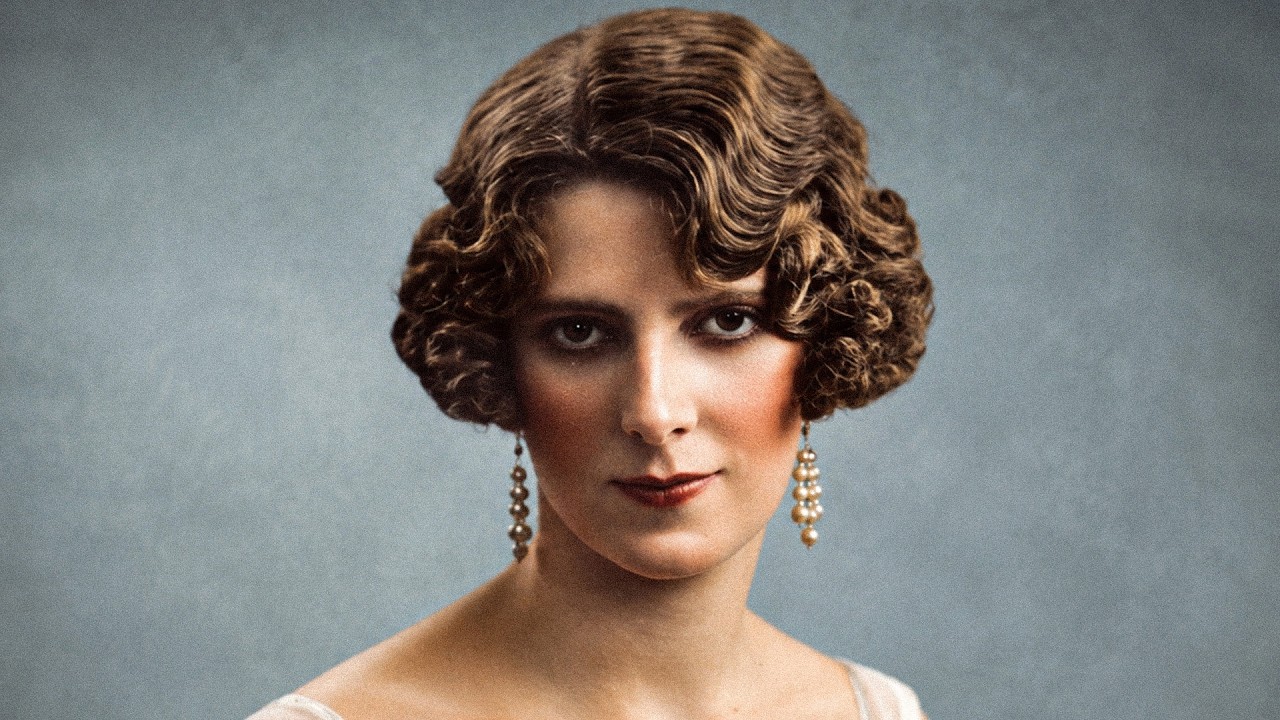
Her name was Sonia Keppel, and she was the grandmother of a queen. Born on the 24th of May 1900 at Number 30 Portman Square, Sonia entered a world that revolved entirely around the schedule of a king. The meals, the flowers, the comings and goings of servants, even the hours the family kept, all arranged themselves around the visits of the portly, genial, gray-bearded man the children were taught to call “Kingy. ” They did not fully understand who he was, only that when he came, the house changed and he was wonderfully kind to them.
Her mother, Alice, was the center of everything, described by her younger daughter as invested with a brilliant goddess-like quality, reclining among lace pillows with chestnut hair loose about her shoulders, the room heavy with the scent of orchids and lilies delivered by horse-drawn van. A goddess, Sonia wrote, is something you worship from below. A goddess does not kneel to your height. Somewhere in that house was a fourth figure growing quieter by the year.
George Keppel, Alice’s husband and the father of her children, was a tall, amiable man of good family and very little money. In a household rearranged around a king, he had learned to take up less and less space until he faded almost into the wallpaper. A visiting grand duke once asked him to his face whether he was related to the king’s mistress. He let the insult pass without a word.
From the very beginning, Sonia did not quite fit the picture the family wished to present. She was shy, asthmatic, easily frightened, prone to hanging back where her elder sister Violet rushed forward. There is a small revealing story she told about herself. She bore a striking resemblance to her great-uncle, Admiral Sir Henry Keppel, a tiny, weatherbeaten old sea dog.
When she was about three, she was dressed up in a miniature version of the old admiral’s uniform for the amusement of the grown-ups. The daughter of the most fashionable beauty in England was presented to the drawing room as a joke, a small girl costumed as a wrinkled old sailor because the likeness got a laugh. It was the role assigned to her before she could even speak. Her sister was the beauty in the making.
She was the funny one, the odd one, the comic relief at the edge of the picture. The two sisters measured themselves against their mother and concluded that they were not as lovable, nor as good-looking, nor as successful as she was. They did not equal her, still less surpass her. Their private phrase for their own lives was “make do and mend,” the language of thrift, of patching what you already have because you will not be given better.
That is what it does to a child to be raised beside a brilliance she is told she can never match. It teaches her to expect the second best and to be grateful for it. Then, quite suddenly, the golden world ended. In the spring of 1910, Edward VII fell gravely ill.
As he lay dying, Alice Keppel was summoned to his bedside with the queen in the house. Queen Alexandra, who had endured her husband’s affair for years with wounded dignity, is said to have permitted Alice a final audience while the king still knew her. When he lost consciousness, the welcome ended, and Alice was led away in considerable distress. The king died in May.
For most of Britain, it was a moment of national mourning. For the household at Portman Square, it was closer to an eviction. The source of the family’s standing was gone. Alice Keppel had been the discreet companion of a reigning monarch.
She was now a private woman with a scandalous past and a court that no longer wished to see her. For two years the family wandered through Siam, China, and the courts of the Far East, a family in a kind of gilded exile. Sonia was ten years old and the only world she had ever known had dissolved around her. When they returned, Britain was sliding toward war.
The war arrived for Sonia as a long roll call of loss, young men she had danced with, the brothers of her friends, the cousins, the suitors, many of them did not come home. Through it all, the two sisters moved in opposite directions. Violet chose fire. Her intense attachment to another clever, restless child named Vita Sackville-West became the consuming fact of her life, a love that ran directly against every law and convention of the age.
It pulled her across the Channel, through a marriage she despised, into elopements and scenes that gave the gossips of two countries something to feed on for years. Sonia chose to be good. If the elder sister’s answer to their mother’s shadow was rebellion, the younger sister’s answer was to do everything correctly, to make the right marriage, keep the right house, raise the right children, to earn through sheer propriety the belonging that beauty and scandal had not given her. In 1918, at the tail end of the war, Sonia came out into society as a debutante.
It was around this time that she met a young officer of the Coldstream Guards, a serious, somewhat saddened young man named Roland Cubitt, heir to a barony and a considerable fortune. His three elder brothers had all been killed in the war. He had not been raised to inherit anything. He had become the heir only because the men ahead of him were dead, and he carried the weight of it visibly.
He was suitable. He was solvent. He was, by every measure the age recognized, a good match. The 16th of November 1920, the Guards’ Chapel at Wellington Barracks, London, very nearly fell apart before it began.
The bishop who was to officiate simply failed to appear. Guests filled the pews, the bride waited, and at the front of the chapel there was, for a terrible stretch of minutes, no one authorized to marry anyone. A substitute clergyman, a relation of the groom, was found and pressed into service. Then Margot Asquith, the famously sharp-tongued wife of the former prime minister, arrived spectacularly late and nearly overturned the proceedings a second time on her way to her seat.
There had been a warning of another kind before the vows were ever spoken. Sonia’s godmother, Mrs. Margaret Greville, one of the wealthiest and most formidable hostesses in England, disapproved of the match. She had herself driven in state to the Cubitt family seat at Denbies, summoned the groom’s own father to come out and stand beside her carriage, and informed him to his face that she did not consider his son good enough for her goddaughter.
Then she was driven away again. The irony was that Mrs. Greville, for all her millions, was by birth nobody at all, the illegitimate daughter of a brewer, informing an actual lord that his son was beneath a Keppel. Sonia married her Roland regardless, and for a while it was the life she had chosen.
The Cubitts were rich in the most solid English way, their fortune built by Roland’s great-grandfather, Thomas Cubitt, the master builder of the nineteenth century, the man who had raised whole districts of London out of the ground, who built the grand east front of Buckingham Palace. One family supplied the romance of the monarchy. The other supplied the bricks. For the next two decades, Sonia did precisely what was expected of her.
She ran the houses, organized the shooting parties and the garden fetes and the charitable committees. She became the Honorable Mrs. Cubitt, and she had three children, a daughter Rosalind born in 1921, and two sons in the years that followed. She had achieved the thing she set out to achieve.
And somewhere in the long middle of it, the marriage went cold. The record shows it quietly. After more than two decades, the union wore through, and on the 4th of July 1947, they were divorced. That autumn, only a few months later, Roland’s father died, and Roland became the third Baron Ashcombe.
Had she remained his wife one season longer, Sonia would have become Baroness Ashcombe, a title of her own at the very last. The divorce came through first, and she missed it by a matter of weeks. That same crowded year, both her parents died within weeks of one another at their villa outside Florence, first Alice in September, then George, unable or unwilling to go on without her. The goddess among the orchids was gone.
At 47, divorced and uncrowned, Sonia did something none of the brilliant women of her family had thought to do. She picked up a pen and wrote the story of her own life. She called it Edwardian Daughter. It was an act of quiet courage.
She defined herself even now by the relationship that had defined her, but for the first time, she was the one holding the pen, the one deciding which scene survived, the one who chose where the light fell. She did not settle scores. She did not expose her mother. The affair sits just beneath the surface of the child’s-eye story, sensed but never stated.
What she wrote instead was tender, the bread on the trouser leg, the scent of the flowers, the lost boys of the war. It was the memoir of a woman who had decided that love was more worth preserving than grievance. The book went into a fourth printing within the year, a genuine, if modest, success. Two years later, in 1959, she was appointed an officer of the Order of the British Empire for years of unshowy service to the St.
John Ambulance Brigade in Hampshire, where she had worked as a county nursing superintendent. She was made a dame of the Order of St. John as well. Small, real recognitions earned quietly in her own name at last.
She would write two more books after that, both works of history about other women, other centuries. The shy girl who had been told she could never equal her mother had become, in her way, an author. Violet had blazed through her life exactly as she promised she would, the affairs, the scandals, the novels written in two languages. She refused to be forgotten, and she was not.
But Violet had no children. All that fire left no descendants at all. It was the quiet sister, the one who did everything correctly, who made the dull, good marriage and raised well-behaved children whose line ran on. Sonia’s daughter Rosalind had been named debutante of the year in 1939, and in 1946 she married a decorated cavalry officer named Bruce Shand, a genuine war hero.
And in the summer of that same crowded year of 1947, the year of the divorce, the year both of Sonia’s parents died, Rosalind gave birth to a daughter of her own. They named the baby Camilla. For most of her life, the story of Sonia Keppel had a simple shape. She was the daughter in the middle, the bridge between two more interesting women.
That shape held until an afternoon in the summer of 1970 on a polo field at Windsor. Camilla, now 23, warm, funny, wholly unpretentious, found herself in conversation with a young man she had not met before, the heir to the throne. According to the story that has been told so many times it is almost worn smooth, she nodded toward the tangled family history and remarked that her great-grandmother had been the mistress of his great-great-grandfather, and wondered lightly where that left the two of them. Whether the words were exactly those, we cannot prove.
But the fact underneath is solid and astonishing. Camilla carried in her own family the living memory of Alice Keppel and Edward VII. The line ran through the one nobody watched. Through the shy, asthmatic girl in the nursery doorway, through the beautiful wife who missed her title by a matter of weeks.
Sonia Keppel, who spent her whole life being told she was not the important one, turned out to be the single indispensable link because she was the only one through whom the story continued at all. Sonia did not die until 1986, at the age of 86, and she lived to see it begin. She saw her granddaughter grow close to a future king of England. But history had one more pattern in store for the Keppel women, and this one had nothing to do with kings.
In her later years, Sonia’s bones began to thin and fail, and her strong, upright frame began very slowly to curl in on itself, shrinking, stooping, folding downward year by year. The cause was osteoporosis, though in those days few people used the word and fewer still understood what it truly did. It did not seem yet like an inheritance. That understanding came eight years later, and it came to her daughter.
In 1994, Rosalind Shand fell ill with the same disease that had folded her mother downward. This time there was a witness who would not stay silent about it. Rosalind’s own daughter sat beside her through it and watched and remembered every detail. Years later, that daughter wrote it down for the whole country to read.
Seeing someone you love die slowly in agony and knowing nothing about the disease that killed them is heartbreaking, she wrote. This was my mother. My mother was only 72. She described how her mother lost about eight inches in height and became so bent she was unable to digest her food properly.
Toward the end, Rosalind could not breathe without oxygen, could not cross her own garden even with a frame to lean on. Her daughter believed in the end that the suffering became so complete that Rosalind simply lost the will to go on. Eight inches. A small, exact human measurement of loss, the distance by which a proud woman is folded toward the ground before she goes.
The woman who wrote those words, the woman who kept the vigil and remembered the eight inches, was Camilla. She could have kept it private, as her grandmother had kept so much private. Instead, she made herself the patron and later the president of the National Osteoporosis Society. Her very first patronage, taken up because she had watched two generations of her own women suffer a disease that no one would name.
For nearly thirty years, she has lent her voice to the disease that took Sonia in silence, given a spokeswoman at last, in the form of a queen. Look now at the whole line of them. Alice, the mistress, who charmed a king and was banished from court the moment he died. Sonia, her daughter, who stood her whole life at the edge of the frame, and made and mended a quiet life out of second place.
Rosalind, the granddaughter, beautiful and lovely, folded down by the family illness at 72. And Camilla, the great-granddaughter, who carried all of them to a place none of them ever reached, and who turned the family’s private griefs into public good. Four women, one thread, running unbroken from a scented Edwardian bedroom full of orchids to the steps of a throne. Sonia Keppel was born into the very heart of power and spent her entire life just outside it.
She was never the beauty, never the scandal, never the one the picture was taken for. And yet everything came through her. Remove Alice from the story and there is still a family. Remove Violet and you lose only a legend.
Remove Sonia and there is no Rosalind, no Camilla, no thread to the throne at all. The woman at the edge of the frame turned out to be the frame. There is one last image to leave you with. It is not the crown and it is not the king on the nursery floor.
It is a book published in 1958 by a divorced woman in her fifties who had been told all her life that she was not the important one. On its cover, two words she chose for herself. Edwardian Daughter. She never got the title she married for.
She never wore the crown her granddaughter would. But she gave herself the last word about her own life, and she signed it at last in her own name.
