On the morning of December 9, 1945, George Patton woke in his quarters at Bad Nauheim, Germany, to the last full day he would spend on his feet. In his personal luggage, already packed and waiting, lay a ticket for a flight scheduled to depart the following morning—a seat aboard Dwight Eisenhower’s personal plane, bound for Southampton, England, and from there a ship to New York. He was, by his own calculation, one day from the first leg of a journey home he had been planning for weeks. He did not know that he would never take it.
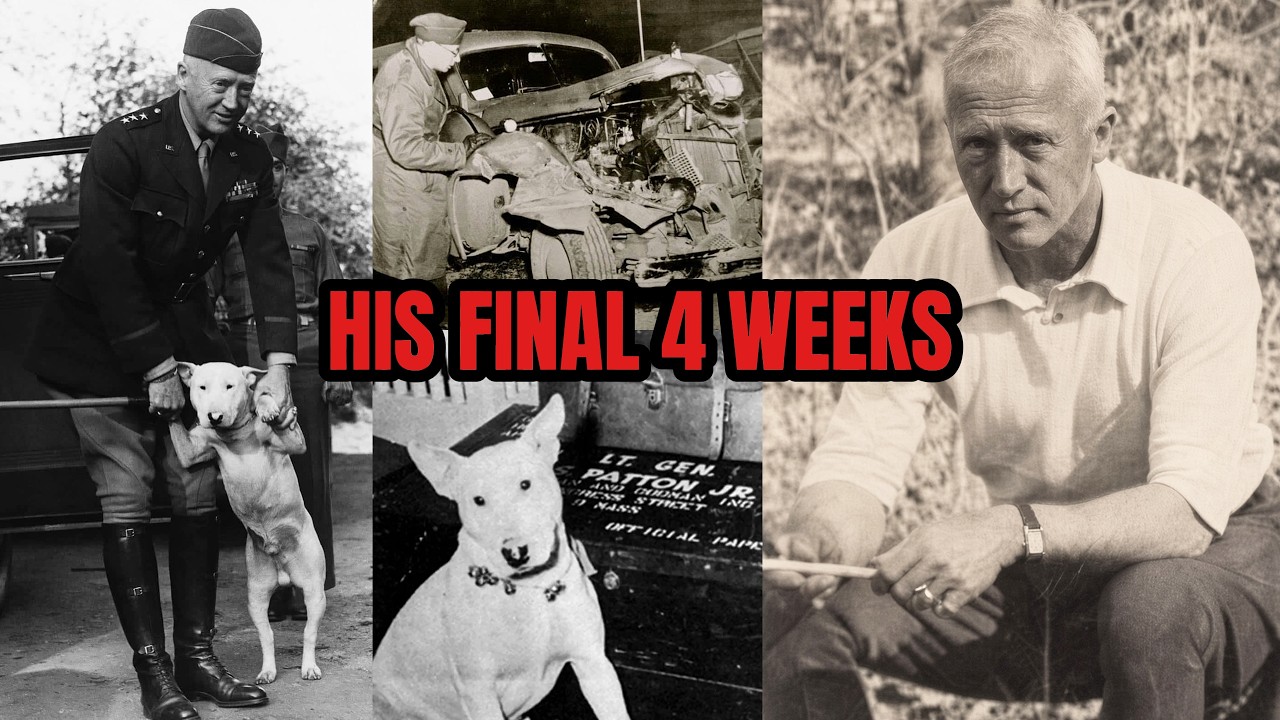
Neither did anyone else in the car with him that morning. This is the story of the final four weeks of George Patton’s life. It is not the story of his last battle, because there was no battle. There was only an ordinary autumn fading into an ordinary winter for a man who had spent his entire adult life convinced that only an extraordinary death would befit him.
By October 1945, Patton commanded the Fifteenth Army, a posting that carried his name and rank but none of the substance on which he had built his reputation. The Fifteenth Army fought no one. Its mission was to write history: compiling the official record of the European campaign for Washington’s archives, working from after-action reports, unit diaries, and interviews with the officers who had actually fought the battles the final volumes would eventually describe. For a man who had loved reading history since boyhood, the assignment at first seemed a natural fit.
He threw himself into it briefly, genuinely engaged, reviewing chapter drafts, correcting details he remembered personally, treating the entire project with the seriousness he had once brought to a real military campaign. That engagement did not last. Within weeks, Patton delegated most of the actual writing to subordinate officers and began traveling instead—short trips to a string of European cities, filling days in which there was no longer a war to organize. There was a particular cruelty buried inside the assignment itself, one few around him dared voice aloud.
The man asked to write the official history of a war he had helped win was, at the same time, told that nothing in that war required his presence any longer. In August, when Japan surrendered and the war was completely over, Patton had written something in his diary that reads, in retrospect, like the true opening line of these last months. “Another war has ended,” he wrote, “and with it, my usefulness to the world. ” He was fifty-nine years old, the most famous American field commander of the entire war, and privately convinced that the part of his life worth living had been taken from him by peace itself.
His frustrations during those weeks were not purely personal. He remained sincerely and openly opposed to aspects of the denazification policy he had once been responsible for implementing across occupied Bavaria—a controversy that had already cost him command of his beloved Third Army that October, and which continued to gnaw at him privately even after the public uproar had largely subsided. In November 1945, Patton made a decision. He would resign from the Fifteenth Army in early 1946 and return permanently to the United States.
Whether that meant full retirement or a new position stateside, he had not entirely settled in his own mind. That was a conversation he wanted to have with his wife, Beatrice, face to face, not through cables from Germany. He booked his passage home for early December: a ride on Eisenhower’s personal plane to Southampton, then a ship crossing to New York. December 10, 1945—a date he could finally see clearly on the calendar.
Close enough now to plan around. On the evening of December 8, the day before his scheduled departure, two of his closest friends in the entire army came to say goodbye at Bad Nauheim. Major General Hobart Gay, his chief of staff since North Africa, and General Geoffrey Keyes, another old friend of decades’ standing. It was meant to be a proper farewell—one last evening together before Patton boarded a plane the next day and left the European theater, practically speaking, for good.
According to multiple accounts from people around him that autumn, Patton’s mood during those last weeks was genuinely low. That kind of grim, persistent despair that does not announce itself loudly but simply lies beneath everything a man does. December 9 arrived, the morning of his actual departure. Keyes, Patton’s oldest friend, came to visit before the flight and was almost immediately summoned to headquarters on an urgent matter, leaving before he and Patton could truly talk.
Gay, who had noticed Patton’s mood sink even lower after his friend’s departure and the packing finished, suggested one last outing before the flight: a pheasant hunt near Mannheim, as they had done countless times before over two decades of friendship. Patton agreed. Private First Class Horace Woodring, his regular driver, was roused from bed early to prepare the general’s 1938 Cadillac. Sergeant Joseph Sprouse set out in a separate jeep, carrying the guns and the hunting dog.
Patton wanted to stop first, before the actual hunting, to see some Roman ruins he had intended to visit, located on the road toward Mannheim. They stopped. They looked. They returned to the car and continued on their way.
Somewhere along that stretch of road, Patton looked out at the wrecked vehicles and scattered debris that still lined the roadside—remnants of a war not yet a year ended. “How dreadful this war is,” he said, according to those who were in the car with him that morning. “Think of the waste. ”
Minutes later, at a railroad crossing on the outskirts of Mannheim, a military truck making an unexpected left turn cut directly across the Cadillac’s path.
The collision that followed happened at relatively low speed. Gay and Woodring were stunned but barely injured. Patton was thrown forward, his head striking the metal partition behind the driver’s seat. He was paralyzed almost immediately from the neck down, unable to move at all, fully conscious the entire time, bleeding from a wound on his forehead and scalp.
Woodring flagged down the first vehicle he saw on the road, which turned out to be a military ambulance. A medic aboard managed to control the bleeding before Patton was transferred to the 130th Station Hospital in Heidelberg, where he arrived about an hour after the crash. What followed was twelve days inside that hospital—the same length of time originally scheduled between that hunting trip and the ship he was to have sailed home on. Patton was able to speak throughout his hospital stay, and he talked at length with the doctors and nurses treating him, and with his wife Beatrice, who flew from the United States within days of the accident and remained at his side until his death.
There were moments at first when the doctors sincerely believed some partial recovery might be possible, with enough movement returning to the muscles controlling his breathing that plans began forming to fly him to the United States for further treatment, once his condition was stable enough to travel. When Patton was finally told plainly that he would never ride a horse again, that everything resembling his old physical life was permanently finished no matter how the rest of his recovery went, he gave a response that, by all accounts, was entirely in character. “This is a hell of a way to die,” he said. On December 20, eleven days after the accident, Patton’s condition—which had seemed fairly stable through the middle of his hospital stay—suddenly deteriorated.
Doctors gave him oxygen to help restore his breathing. An X-ray revealed the true cause: a small pulmonary embolism, a blood clot lodged in the upper right lung. On December 21, 1945, at 5:55 in the evening, George Patton died in his sleep as a result of that embolism combined with the congestive heart failure it had caused. He was sixty years old.
The news reached Eisenhower’s headquarters within hours. Eisenhower—who had personally offered Patton a seat on his own plane home just weeks earlier—issued a public statement praising Patton’s wartime record without much elaboration. A notably restrained response from a man who had known Patton since their early years together at Fort Meade, a working relationship filled with years of genuine friendship intertwined with plenty of genuine frustration. Bradley, notified separately, reportedly said little publicly either, consistent with a wartime partnership that had always been warmer in private letters than either man was prepared to say to the newspapers.
Patton had asked, before any of this happened, to be buried among the men of his Third Army, rather than having his body sent home to any family plot in the United States. His wife honored that request completely. December 24, 1945. He was laid to rest in the American Military Cemetery at Hamm, Luxembourg, surrounded by thousands of soldiers who had served under his command.
A light rain was falling. A horse followed the procession with two boots reversed in the stirrups. German prisoners of war had dug the grave itself the previous day. No formal eulogy was ever delivered over that grave.
Instead, clergymen of different faiths came forward to pray, including a group of rabbis who were still wearing the striped concentration camp clothing they had survived only months before. When a journalist later asked why they had chosen to pray for a general with a documented history of prejudiced private remarks, they explained that the speed of his army’s advance across Germany that spring had saved thousands of lives still trapped inside those same camps. His dog, Willie, a bull terrier who had accompanied him through most of the campaigns across France, Belgium, and Germany, was sent back to the United States to live out his remaining years with Patton’s wife and two daughters. The dog outlived the general by nearly a decade and died in 1955.
The retirement conversation Patton had been planning to have with Beatrice at last, face to face, never actually happened the way either of them expected. What the two of them got instead, during those twelve days in Heidelberg, was something far more painful and far more honest than any planned discussion of pensions or stateside postings. A wife sitting beside her husband’s bed while doctors worked, in real time, to determine how much of him the accident had actually left. What fills the four weeks before George Patton’s death is not combat, not strategy, not any of the things that had defined nearly every other chapter of his adult life.
It is a man slowly delegating a desk job he had lost interest in almost as soon as he began it. A difficult, pending conversation about retirement he had planned to finally have with his wife in person, face to face, for the first time in years. A farewell dinner with old friends on the night before a journey home. And a final hunting trip arranged by a man who loved him, specifically to lift his spirits before he left Europe for what both fully expected to be the last time.
He was only one day away from that trip. One day from the ship, from New York, from Beatrice, from everything the rest of his life was supposed to look like once he finally took off his uniform for good. Instead, the last four weeks of George Patton’s life turned out to be the quietest, most ordinary stretch he had lived in nearly a decade—right up until the moment it was no longer ordinary at all.
