In the summer of 1863, a captured Confederate soldier told his Union guards in Tennessee that a man could load his gun once and shoot all week long. The guards laughed at first. Then they stopped laughing. What the prisoner described was not an exaggeration born of fear but a genuine shock from the front line, and that shock climbed quickly to the top of the chain of command.
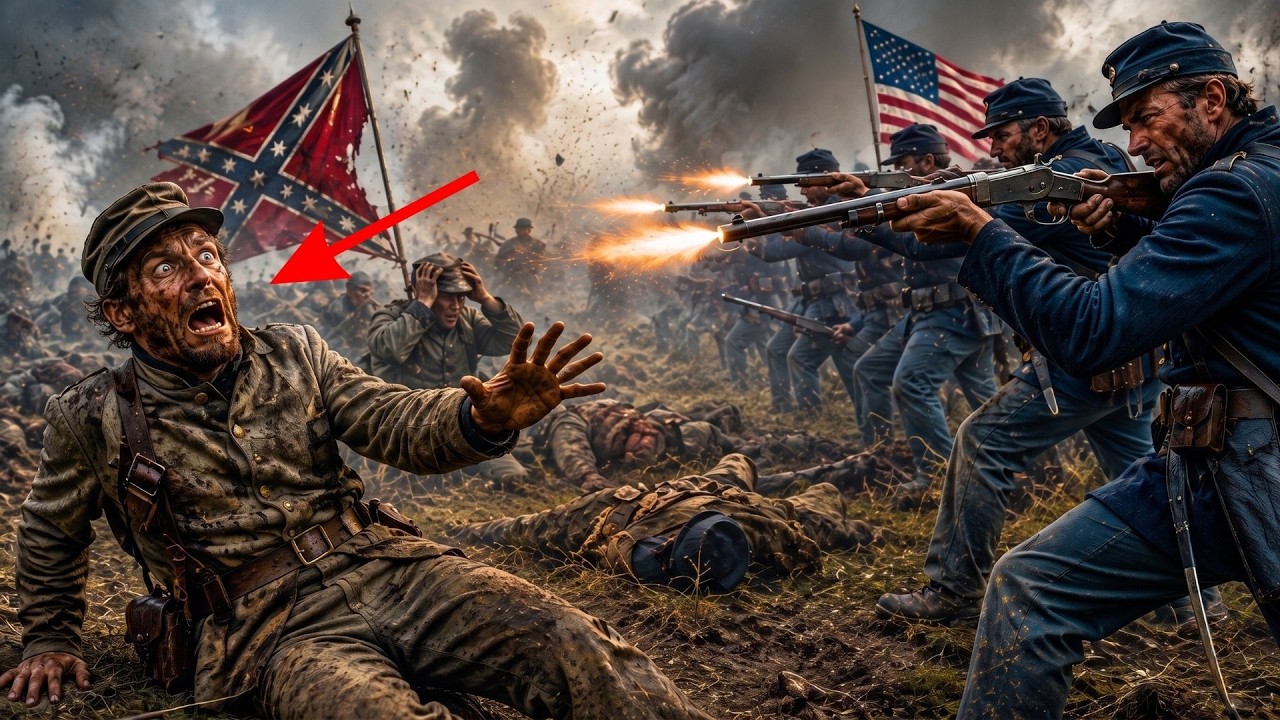
Even officers who had spent years in the line of fire found the news hard to believe when they first heard it. Yet the matter was no fairy tale. Behind that seemingly unbelievable sentence hid one of the most staggering and least known turning points of the American Civil War: a single weapon that shattered not only the tactical assumptions of a war but the most fundamental sense of security in the minds of the men fighting it. In the first two years of the war, everything that happened on the front line revolved around a single mechanical reality.
No commander positioned his men without accepting it, because no one knew any other way to fight. The standard infantry weapon was the muzzle-loading rifled musket, the Springfield Model 1861 in the North and the frequently imported British Enfield in the South. Making these weapons ready to fire required not a single motion but a successive series of steps, and each step consumed time. The soldier tore the paper cartridge with his teeth, poured the powder into the barrel, inserted the bullet, rammed both tightly down with a ramrod, half-cocked the hammer, placed the percussion cap, and only after all these steps could the gun fire again.
A well-trained, calm-headed soldier could complete this cycle three times a minute under ideal conditions. But the battlefield was never ideal. Powder smoke filled the barrel, hands trembled, comrades fell around, and the deafening sounds of artillery and musketry made even hearing commands a struggle. When all these factors combined, the actual rate of fire dropped far below the theoretical number.
And the soldiers of both sides knew it. This reloading time was not just a technical detail. It was the cornerstone that determined the entire architecture of the war. Commanders deliberately arranged their soldiers in ranks because the window of a few seconds after one rank fired, before the enemy could return fire, was tailor-made for going on the offensive or making a flanking maneuver.
Those seconds felt much longer than real time on the battlefield, but all the tactical calculations of soldiers and officers were built upon the existence of that short interval. The manuals, inherited largely from Napoleonic-era European doctrine, treated this rhythm as a fixed constant. Fire, load, fire, load. Commanders timed their assaults to it while soldiers calmed their nerves by relying on it, because they knew there would be a few seconds after firing when the enemy could not immediately retaliate.
That short window was vital psychologically as much as tactically. It gave a man in chaos something to hold onto, a predictable pattern in the midst of an otherwise terrifying and unpredictable experience. Veterans who wrote their memoirs decades after the war described this rhythm in an almost meditative language, as something the body learned even when the mind was paralyzed by fear. A soldier could feel the interval between two volleys without consciously counting, and this instinctive counting became a psychological part of surviving an experience that offered no other stability.
It was precisely this rhythm, internalized through dozens of clashes, that the repeating rifle would soon disrupt so severely that experienced soldiers used words closer to the shattering of their perception of reality than to ordinary combat fear when describing it. The weapon that changed everything was the Spencer repeating rifle, followed shortly by the Henry rifle. Both eliminated the reloading problem in a way no army’s previous experience had prepared them for. The Spencer’s tubular magazine, embedded in the stock, carried seven metallic cartridges at once.
Instead of the multi-stage process required by muzzle loading, a soldier equipped with a Spencer merely worked the lever, ejected the empty casing, and chambered a new cartridge, a process completed in a tiny fraction of a second. A trained soldier could fire between fourteen and twenty rounds a minute with the Spencer. Not three, not four. These numbers belonged to an entirely different category than anything either army was accustomed to facing.
The Henry rifle, developed by Benjamin Tyler Henry and used in smaller numbers, mostly by soldiers who bought it with their own money rather than waiting for government supply, carried sixteen cartridges in its magazine and could sustain an even higher rate of fire in the right hands. The actual technical innovation behind the revolution was the metallic cartridge. This system, where powder, primer, and bullet were brought together as a single unit rather than separately, differed radically from the paper cartridge and percussion cap duo of muzzle-loading weapons. And its importance did not stop at speed.
A soldier could reload a repeating rifle while lying on the ground without ever standing up, whereas a soldier loading a Springfield usually had to stand or at least kneel to properly seat the powder and bullet down the barrel. Troops carrying Spencers could keep firing while staying low in tall grass or behind trenches, never entering the exposed target position that the classic weapon compelled for reloading. Rain and moisture, which soaked paper cartridges and rendered a muzzle loader useless, had far less effect on sealed metallic ammunition. Every advantage magnified another, and the result was not just a faster-firing gun but a tool that radically altered what a single soldier, a company, or a regiment could do on the battlefield.
The first major stage where Confederate officers truly had to account for the weapon tactically was the Battle of Hoover’s Gap in Tennessee in June 1863. The surviving Confederate testimony from that clash reflects a state of mind close to genuine bewilderment. Colonel John Wilder had equipped his own mounted infantry brigade with Spencer repeating rifles largely on his own initiative and partly out of his own pocket, because the army bureaucracy moved too slowly for him. When his men faced off against Confederate forces defending the gap, such a continuous and dense volume of fire emerged that experienced officers on the opposing side had no tactical framework to interpret it correctly.
Confederate doctrine, built on the assumption of the reloading gap of muzzle-loading weapons, always gave experienced officers the ability to roughly estimate the size of the opposing force from the volume and pattern of the incoming fire. At Hoover’s Gap, this doctrine collapsed completely. Confederate commanders on the field systematically overestimated the size of the force facing them, in some cases by multiples of the actual number, because the only explanation their training offered was that such relentless fire could only come from a much larger unit. This misjudgment was no minor tactical detail.
It directly shaped decisions about whether to continue an attack, whether to engage reserve forces, and whether to take a position by direct assault or flanking maneuver. Wilder’s brigade held its position against a force that, by any previous tactical calculation, should have easily crushed it, and it did so with a much smaller number of men than the Confederate commanders believed they faced. Reports from Confederate soldiers who had fought at Shiloh and Stones River, real combat veterans rather than green recruits, described the fire they faced that day as something never ceasing, an experience these soldiers found mentally difficult to digest in the moment. The psychological dimension of the weapon deserves consideration apart from tactical mathematics.
The testimony left by Confederate soldiers who countered Spencer-carrying units described something akin to a true collapse of battlefield expectations rather than a simple acceptance of superior firepower. Soldiers on both sides had developed an intuitive grasp of the rhythm of an engagement through two years of combat experience. This was not a conscious calculation but an understanding based on feeling when an attack was survivable, when a charge across open ground had a chance of reaching the enemy line before the gap in fire closed. This intuition kept soldiers going in a war that would otherwise be psychologically unbearable.
It offered a private, unspoken reassurance that the most dangerous moment would be brief, followed by a silence, however short, in which they could reassess, catch their breath, and prepare for the next moment. The Spencer-carrying Union troops completely eradicated this silence. Soldiers on the receiving end had neither an emotional nor a tactical framework for a conflict that never stopped. Confederate testimony from battles against repeating rifle units repeatedly described the fire not as a series of distinct volleys but as a continuous wall.
This description reflected not just an increase in the rate of fire but the radical shattering of the mental model soldiers relied on to survive the war, psychologically and physically. The saying attributed to Confederate soldiers who faced these weapons, repeated in different variations until it became almost a legend within the Army of Tennessee, perfectly captured the disbelief: the idea of a weapon a man could load once and fire for days without ever touching again. It was clearly an exaggeration spoken to express astonishment rather than a factual reality. But exaggerations this swift and widespread usually harbor something real beneath them.
The question that naturally springs to mind is clear, and it frustrated Union Army ordnance officers and field commanders throughout the war. If this weapon was so effective, why wasn’t every Union soldier carrying one by 1864? The answer lies in a bizarre chapter of Civil War bureaucratic history, in a man named James Ripley. Ripley, who served as the chief of ordnance for the Union Army for most of the war’s opening period, harbored an almost ideological resistance to repeating weapons.
This resistance shaped procurement policy in ways that practically prolonged the war. His objections were not entirely irrational in their own context, even if history has judged him harshly. He was rightly concerned that soldiers equipped with repeating rifles would expend far more ammunition, straining an already complex supply chain that had to move bullets by wagons and trains to armies deep in enemy territory. He feared that green soldiers given a weapon capable of firing so quickly would squander ammunition wastefully instead of employing the disciplined shooting emphasized by traditional volley fire doctrine.
According to contemporaries who worked directly with him, he also fundamentally distrusted new technology. He preferred the proven Springfield over weapons that had not yet demonstrated decades of combat reliability. Whatever the mix of legitimate logistical concern and pure stubbornness, Ripley used his position to slow repeating rifle procurement for years. He rejected or delayed proposals that could have equipped far more Union infantry with weapons like the Spencer at a much earlier stage of the war.
A detail that rarely makes it into popular accounts is that Abraham Lincoln personally intervened against this resistance. Lincoln had a genuine personal curiosity about firearms and was known to test weapons personally on the White House lawn. He witnessed a demonstration of the Spencer rifle himself and was convinced of its value. He then applied direct presidential pressure to accelerate its adoption against Ripley’s institutional resistance.
Ripley was removed from his post in September 1863, and the procurement of repeating rifles accelerated significantly after that date. But the change came too late to equip more than a small fraction of the Union infantry before the war ended. The limited numbers mattered, and understanding why requires an honest look at how little Confederate soldiers actually encountered these weapons, yet how deeply those encounters shaped Southern military memory. By the end of the war, only a relatively small percentage of Union infantry carried repeating rifles, and rather than being distributed evenly throughout the army, these weapons were disproportionately concentrated in cavalry units and specially equipped mounted infantry brigades like Wilder’s.
The vast majority of Union infantry continued to carry the same muzzle-loading rifled muskets Confederate soldiers were accustomed to facing. The significance lies here: the psychological impact was concentrated in specific clashes rather than a constant feature of every battle. If anything, this intensified the shock. Soldiers accustomed to the predictable rhythm of muzzle-loading combat over dozens of engagements could suddenly find themselves, without warning, facing a Union unit that broke every rule they had internalized.
There was no way to know beforehand which units carried these weapons and which did not. The financial and logistical reality behind the limited distribution deserves explanation in its own right. Repeating rifles were much more expensive to produce than standard muzzle-loading weapons, and the ammunition they consumed came at a higher cost per bullet than simple paper cartridges, due to the more complex manufacturing process of the metallic cartridge. A Union quartermaster calculating the cost of equipping an entire army with Spencer rifles was not merely weighing tactical advantage against tactical advantage but also a federal budget and a supply chain never designed to support the rate of ammunition consumption that the weapon made possible.
Some soldiers, especially cavalrymen who had more flexibility in personal weapon procurement than infantrymen, fully understanding the advantage, bought Henry rifles with their own money rather than waiting for government delivery. This detail shows how clearly the value of the weapon was understood at the soldier level, even if institutional procurement lagged behind. One of the places where the shock of continuous fire was most definitively recorded was the Battle of Franklin in November 1864. But at that point, the weaponry was slightly different, and the story needs to be separated from the Spencer narrative.
The Union forces defending the trenches around the Carter House were not primarily equipped with repeating rifles. Most carried standard muzzle-loading weapons. But the layered, dense volume of fire they generated from fortified positions, combined with earlier encounters with cavalry carrying repeating rifles in the Tennessee campaign, had already begun to reshape Confederate infantry’s approach to any fire that seemed heavier than expected. Advancing at Franklin, Confederate soldiers, many of whom had fought against Wilder’s brigade or similar Spencer-equipped units earlier, showed a hesitation reflecting a fatigue that had learned the price of underestimating Union firepower, something that had not existed earlier in the war.
The assault at Franklin remains one of the bloodiest clashes of the war for reasons far beyond weapon technology. But the broader pattern of how confronting unexpectedly continuous Union fire over two years eroded Confederate tactical confidence forms part of the context of why direct assaults against fortified Union positions in the last two years of the war became much more costly psychologically, not just physically, than they had been in 1862 and early 1863. The cavalry clashes of 1864, particularly in the Overland Campaign and Philip Sheridan’s operations in the Shenandoah Valley, offer some of the clearest documented examples of what happened when Confederate cavalry, still largely equipped with single-shot carbines and revolvers, clashed with Union cavalry that had been significantly re-equipped with Spencer carbines by 1864. For the first three years of the war, Confederate cavalry had gained a generally well-deserved reputation for superior horsemanship and more aggressive tactical instincts, which had led to a series of humiliating defeats for Union cavalry commanders in 1862 and 1863.
This dynamic shifted noticeably when Spencer-carrying Union cavalry went into action on a massive scale. At the Battle of Yellow Tavern in May 1864, where the Confederate cavalry legend Jeb Stuart was mortally wounded, Union cavalry under Sheridan’s command dismounted and opened carbine fire with an intensity that Confederate veterans, including officers who had fought successfully against Union cavalry for years, described as fundamentally different from anything they had previously encountered from that branch. Although Stuart’s death was caused by a revolver bullet fired by a dismounted Union cavalryman, and not by a repeating rifle, it became the symbol in Confederate memory of how profoundly the balance of cavalry combat had shifted. Confederate ordnance officers were not blind to any of this.
The question of why the Confederacy never produced its own repeating weapon in significant numbers says something important about the structural gulf between the two war economies. The Confederacy simply lacked the industrial infrastructure to manufacture metallic cartridges on a large scale. Producing reliable self-contained brass or copper casings of correct dimensions required a precision manufacturing capacity that the antebellum South had never developed, because Southern industry before the war was largely oriented toward agricultural production rather than the machinery and metalworking capacity concentrated in northern cities like Hartford, Connecticut, and Springfield, Massachusetts. A few Confederate armories attempted to produce copies of captured Spencer and Henry rifles, and a Confederate design called the Morse Carbine achieved limited production with a rimfire cartridge.
But none of these efforts came close to the Union’s production volume. Union repeating rifles captured by lucky Confederate soldiers often sat unused after the limited captured ammunition ran out. Because the Confederacy had no reliable domestic source for the specific cartridges those weapons required, a Confederate soldier who captured a Spencer from a fallen or captured Union soldier essentially possessed a weapon he could use only until his captured ammunition was depleted. Afterward, the rifle turned into a heavy piece of useless metal.
There was no practical way to resupply. Confederate ordnance officers acknowledged this problem in their reports, sometimes with language close to frustration, describing captured repeating rifles as prized loot that soldiers nevertheless abandoned within weeks after the captured cartridges ran out, because carrying a gun that could no longer be fired offered no practical advantage over a standard Springfield or Enfield that could be restocked from any Confederate ordnance wagon. This was, in its own quiet way, one of the most striking indicators of how far apart the industrial bases of the two sides had grown. A Confederate soldier could literally hold proof of how advanced the enemy’s technology had become in his own hands and still be forced to abandon it because of the industrial capacity his own government lacked.
From the Battle of the Wilderness in May 1864, there is a documented example demonstrating how repeating rifles could create tactical confusion even among experienced Confederate units well accustomed to Union firepower. Advancing through the dense, tangled, wooded terrain that gave the battle its name, Confederate soldiers encountered isolated pockets of Union troops, some carrying Spencers, firing from concealed positions. The terrain was so thick that visual contact with the enemy often consisted solely of muzzle flashes rather than a clear line of sight. The continuous rate of fire coming from what Confederate officers initially assessed as small isolated Union detachments led to repeatedly overcautious advances, delayed attacks, and in at least a few documented cases, full retreats from terrain that a more accurate assessment of the actual Union force indicated Confederate troops could have taken.
The dense woods already made visual reconnaissance almost impossible, and the unfamiliar continuous gunfire turned Confederate commanders’ real-time decision-making about where the true threat was concentrated into a genuine tactical disadvantage. Confederate officers who encountered Union troops carrying repeating rifles and survived did not merely record their astonishment and move on. Many actively tried to adapt their tactics, and the record of these adaptations tells as much about Confederate military professionalism as the initial shock of the weapon’s impact. Officers began teaching their men to recognize Spencer-carrying units by specific visual and auditory cues before committing to an attack when possible, because the characteristic movement of the lever and the distinct sound profile of the metallic cartridge could sometimes be distinguished from muzzle-loading fire by an observant soldier who knew what to listen for.
Some Confederate commanders altered their reconnaissance approaches, especially in response to the Hoover’s Gap experience. They pushed reconnaissance columns further ahead and took extra time to assess true enemy strength before committing to the main assault, a change in practice that sacrificed speed for accuracy in a war where speed was often seen as a virtue in itself. These adaptations were not applied uniformly. The tactical lessons one unit learned in one battle did not automatically transfer to every other Confederate command, and the decentralized nature of Confederate military communication meant that hard-won knowledge from a clash like Hoover’s Gap sometimes never reached officers in other theaters who would face the same weapon months later without any more preparation than the first units had.
There is also evidence of a specific counter-tactic some Confederate officers developed once repeating rifles became a familiar enough threat: committing to close combat as quickly as possible, reasoning that a rapidly pressed bayonet charge could close the distance before the defending force’s ammunition advantage became decisive. Since even a Spencer’s seven-round magazine required a reloading pause when depleted, even though that pause was much faster than a muzzle-loading weapon, this tactic carried obvious risks, because closing that distance meant crossing open ground under precisely the kind of sustained fire the weapon was designed to produce. But it reflected a genuine tactical response rather than simple paralysis in the face of new technology. Confederate soldiers and officers by 1864 were actively thinking about how to fight against the enemy’s evolving arsenal, even if they lacked the industrial capacity to match it directly.
General John Bell Hood, the commander of the Army of Tennessee, who oversaw some of the costliest assaults of the war’s final two years, spoke of the changing character of Union firepower in his correspondence and postwar memoirs in language reflecting exactly this institutional recalculation. Hood, whose tactical aggressiveness had been shaped while fighting under Lee in Virginia during the earlier period of the war, against enemies who did not yet possess repeating weapons in significant numbers, approached the 1864 Tennessee campaign with an aggression that some of his own officers worried did not fully account for how much Union defensive firepower had changed since 1862. The broader pattern of Confederate commanders continuing to press direct assault tactics developed at an earlier stage of the war against firepower that far exceeded the level those tactics were originally designed to overcome constitutes one of the truly tragic subplots of the war’s final two years. The gap between Confederate tactical doctrine and the actual firepower it was asked to overcome widened steadily as the war progressed, and repeating rifles were one of the most visible, psychologically disturbing symbols of this widening gap, even in most battles where the weapon itself was not actually present on the field.
By the war’s final year, Spencer-carrying Union cavalry had become closely associated with some of the most aggressive and successful Union operations of the conflict. George Armstrong Custer’s cavalry brigade offers one of the clearest examples of how profoundly this weapon reshaped what a cavalry force could achieve against Confederate infantry and cavalry. At the Battle of Sailor’s Creek in April 1865, during the final week of Lee’s retreat toward Appomattox, Custer’s Spencer-carrying cavalry helped envelop and effectively destroy a significant portion of Lee’s already heavily depleted army, cutting off roughly a quarter of the Army of Northern Virginia’s remaining combat strength. This made Lee’s final surrender days later not merely likely but functionally inevitable.
Exhausted by days of continuous retreat and already forced to make do with severely reduced rations, Confederate soldiers captured in that clash described the volume of continuous cavalry fire they faced with an overwhelmingness that transcended mere numerical disadvantage. This description was consistent with the pattern established at Hoover’s Gap two years earlier, now reappearing at the very end of the war, executed by an army that had steadily expanded its use of the technology that had first startled Confederate officers in the summer of 1863. The road from Hoover’s Gap to Sailor’s Creek traces something much larger than the battlefield history of a single weapon. It traces the industrial and technological gap that had existed since the first day of the war, growing wider with each passing year, expressed in the concrete personal terror of the soldier facing an enemy who would not stop shooting.
The Spencer and Henry rifles did not win the Civil War alone. No single weapon ever does. But these rifles show with extraordinary clarity how a production and logistical advantage transformed into something the frontline soldier experienced not as a statistic but as real, shattering fear. What makes this story worth telling fully is what it reveals about how wars are decided at the level of individual human experience rather than the grand strategy level history books usually emphasize.
The Confederate soldiers who fought at Gettysburg, Chickamauga, and the Wilderness were not unusually cowardly men. Many had already survived clashes that would break less resolute soldiers, and their willingness to continue fighting into 1864 and 1865, when any reasonable assessment of the Confederacy’s material situation would dictate surrender, points to a level of determination that deserves recognition regardless of the cause they fought for. What the repeating rifle did was not just kill more Confederate soldiers, though it certainly did that in the specific clashes where the weapon was present in significant numbers. It introduced a genuine element of unpredictability into a battlefield experience that soldiers had spent years learning to predict.
And this unpredictability accumulated from battle to battle, turning into terror rather than ordinary combat fear: the specific terror of an enemy whose capacity you can no longer accurately gauge, who fights with a rhythm you have never encountered and cannot foresee. The story of the repeating rifle in the Civil War is ultimately the story of the chasm between industrial capacity and combat experience, and how that chasm was felt by individual soldiers long before it appeared in any casualty report or campaign summary. James Ripley’s bureaucratic resistance likely prolonged the war by keeping a proven, available technology out of the hands of Union soldiers who could have used it for years longer than they did. The Confederacy’s failure to produce a comparable weapon reflected a structural industrial weakness that no tactical brilliance or military courage could fully overcome.
Caught between these two institutional realities stood the individual Confederate soldiers who had long since proven themselves ready to face artillery and massed infantry fire without flinching, men who, starting in the summer of 1863 and continuing until the war’s final year, encountered something that shattered their hard-won confidence in what fighting should sound like, feel like, and mean. That sentence uttered by a captured soldier in the summer of 1863, the idea of loading a gun once and firing non-stop for an entire week, has survived for a century and a half. Not because it is literally true, but because beneath the exaggeration, it captured something real. Union soldiers equipped with repeating rifles had indeed found a way to eliminate the most predictable rhythm of the battlefield.
And for Confederate officers who over two years had learned to read that rhythm more fluently than any language, watching it vanish without warning or explanation on certain fields was not merely a tactical problem. It was the realization that their armies faced an enemy whose industrial capacity they could never match.
