The small dry click of the shotgun hammer carried across the clearing, and Cora Bell stepped out of the pit. She laid the shovel down beside it, the way she had laid it down 122 Sundays before, and she walked back through the pines without looking at the man on the porch. She did not look at him because she had not looked at him in 28 months, and she was not going to begin now. Behind her, William Fenwick sat in his dark linen suit with the wide-brimmed straw hat and the shotgun across his lap, and he watched her go.
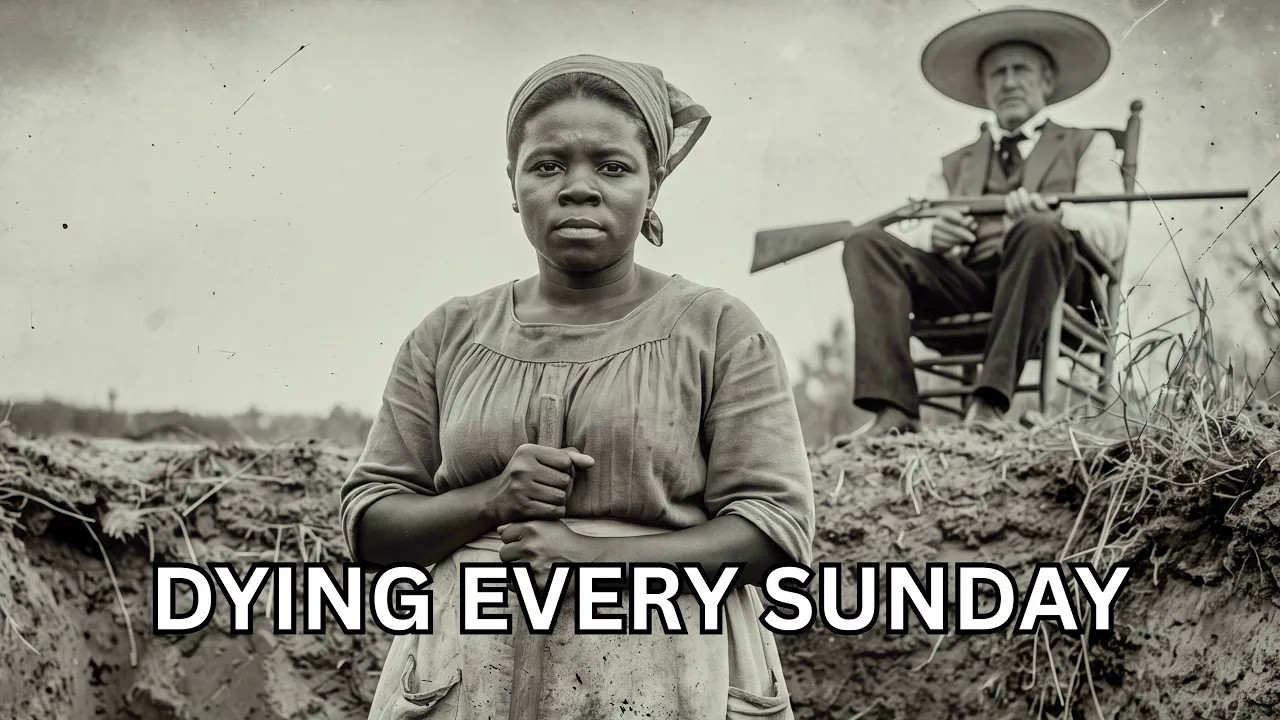
At nine o’clock exactly. On this plantation, everything happened on the clock. She was 31 years old, tall, with the long straight back of a woman who had done field work her whole life. She wore a plain gray dress washed so many times it was nearly the color of the sky above her, and her hair was wrapped in a length of blue cloth.
Her hands on the shovel had been steady all morning. Her face was not afraid and not weeping. The pit was not very deep yet, about knee-high on her after an hour of work in the pale gray light. She had been at it since first light, and she would be at it for one more hour, and then she would walk back to her cabin, and William Fenwick would go to the main house for his breakfast and read his Bible before the family went into Natchez to church.
That had been the shape of it since the fourth Sunday of December in the year of our Lord 1846. The man on the porch of the overseer’s cabin was not the overseer. The overseer was a Cajun named Jean Bordelon, and at this moment he was three hundred yards away in the main house taking coffee with the housekeeper because it was Sunday morning and the fields were quiet. The man on the porch was the owner of the plantation himself, William Fenwick, 48 years old, a member of the Adams County Agricultural Society, a vestryman of Trinity Episcopal Church in Natchez, a man who would have been greatly offended if you called him a monster to his face.
He had inherited this plantation from his father in 1837, and he owned, by the tax records of Adams County, 94 enslaved people. In the strange careful language of the Natchez slaveholding class in 1849, what he did to the woman in the pit did not qualify as monstrous. It qualified, in his own private vocabulary, as a discipline. He had not raised the shotgun in 28 months because the woman in the pit had never given him a reason to raise it.
He sat on the porch and watched her dig for two hours, and once every fifteen or twenty minutes he took out his pocket watch and checked the time. On the second Sunday of the first month, when she stopped for perhaps thirty seconds to wipe the sweat out of her eyes, he raised the shotgun a fraction of an inch off his lap, not to fire, just to remind her that he could. She did not stop to wipe her eyes again. At nine o’clock he cocked the hammer with the small dry click, and she stepped out and laid the shovel down and walked back through the pines to the slave cabins.
It had been the shape of the first Sunday, the second Sunday, and the next 122 Sundays of her life. Her name was Cora Bell. She had been enslaved on this plantation for all 31 of her years. She was born in the spring of 1818 in a slave cabin on the Fenwick place, in what was then still called the Mississippi Territory, three years before Mississippi was formally admitted as the twentieth state of the Union.
She was born in a cabin two hundred yards from where she was standing now, and she had never in her whole life been more than eleven miles from this piece of ground. She could not read. She could not write. She had no last name that any court in the state of Mississippi would recognize.
Her mother was a woman named Judith, tall and thin and quiet, with the kind of face that looked as though it had already decided which arguments in life were worth having and which were not. Judith had been brought to the Fenwick place around the year 1810, part of a coffle of 37 people that the elder Fenwick, Thomas, had purchased in Halifax County, Virginia, and marched south over eleven weeks through the Cumberland Gap, across the Tennessee River, through the Chickasaw Nation, and into the Natchez district. She had been 14 years old when she made that walk, and she had not left the Fenwick place in the 39 years that followed. Cora Bell’s father was a man named Isaac, not a large man and not a strong man, but a patient one, a careful one, a man who had grown up on the same Halifax County plantation and been walked south in the same coffle, and who had understood from the first week he laid eyes on Judith that she was the person he was going to spend the rest of his life alongside.
They did not marry in any way the state of Mississippi would have recognized, because enslaved marriages had no legal standing in that state or in any of the slave states of the American South. But in the fall of 1817, in the door of the small cabin Thomas Fenwick had given them, they took each other’s hands in front of a small handful of witnesses and told them they were from that night forward a household. A household they were for the next eleven years. Cora Bell was born the spring after, their first and only child.
The Fenwick place in the 1820s was not a large plantation. Thomas Fenwick owned around 40 enslaved people, worked a middling tract of cleared land, produced a middling crop, and lived in a plain two-story white frame house that would have looked to a Charleston visitor more like a well-off farmer’s home than a great planter’s mansion. He was not a cruel man in the way some men in that country were cruel. He did not beat his enslaved people for sport.
He did not break up families for cash. In the ugly and imperfect vocabulary of the era, he was one of the men other white men called a decent master, which meant only that he did not do the very worst of the things a man of his class and position was legally permitted to do. Cora Bell grew up in those first ten years in the small, careful daylight of that decency. She grew up with a mother and father who loved her, in a cabin that had in one corner a small wooden shelf on which Isaac had carved with a knife the letter C, the first letter of her name, which he could recognize even though he could not read anything else, because Judith had shown him what the letter looked like and he had wanted it to be on the shelf where his daughter slept.
She grew up learning from the small enslaved community around her the same things every enslaved child in the American South learned in those years: how to move quietly around white people, how to answer without volunteering, how to stand still when standing still was the safest thing she could do. And she grew up learning in particular from an old woman named Aunt Zilpa, the plantation’s midwife and healer, a woman who had come to the Fenwick place from South Carolina in the 1790s and was by the 1820s close to 80 years old. Aunt Zilpa taught Cora Bell the names of the plants of the Mississippi country: snakeroot and pennyroyal and mullein, cottonwood bark and willow leaf and the roots of the poke that had to be dug in the second year to be safe. She taught these things from the time Cora Bell could walk beside her along the edge of the canebrake with a small basket, and she taught them for the same reason old women in that country had taught them to small girls for 150 years.
Because the day was going to come when there would be no doctor and no help and only what Cora Bell carried in her own head. That first ten years ended in the summer of 1828. There was a fever that summer along the lower Mississippi. It came up out of the swamps in July and moved through the plantations like a slow, patient hand, and by the time it ran its course in early September it had killed something like a third of the enslaved population of Adams County and about a fifth of the white population.
It had killed, in the small cabin with the letter C carved on the shelf in the corner, both Judith and Isaac, within eleven days of each other. Cora Bell was ten years old. She sat by her mother’s bed for the last three days of Judith’s life, and by her father’s bed for the last five days of Isaac’s. Aunt Zilpa, herself half dead from the same fever and the only one of them who survived it, did what she could with the plants, and it was not enough for either of them.
Cora Bell buried both of her parents at the age of ten in the small enslaved burying ground at the northeast corner of the Fenwick property. She did not at that age have words for what she was doing. But she remembered, sixty and seventy years later, that on the second afternoon after her father was buried, she went back to the burying ground alone with a small piece of broken slate she had found in the yard behind the smokehouse, and she scratched in the red clay above her father’s grave the letter C. Not because it was his letter, because it was the only letter she knew how to make.
She wanted him to know, wherever he was, that she had been there. Thomas Fenwick died in the winter of 1837, not of a fever but of an ordinary heart attack at the dinner table at the age of 61, and the Fenwick place passed to his older son, William. In the winter of 1837, William Fenwick was 36 years old. He had spent the previous decade being groomed to inherit: sent to South Carolina College in Columbia, sent to Philadelphia for a year of what his father called finishing, sent to England in 1832 for a grand tour that ended, according to the private letters that survived from that trip, in a small unspecified scandal in London that his father had to send money to resolve.
By every account of the people who knew him best, he was a man of two very distinct sides. In public, at Trinity Episcopal Church, at the Agricultural Society dinners, at the balls the Natchez gentry held in the great houses along Second Creek, he was courteous, well-mannered, mildly humorous, a man who danced adequately and drank moderately and quoted the Latin poets in a way his neighbors found impressive without being showy. In private, inside the walls of his own plantation, out of the sight of any white peer, he was a different creature entirely. He drank alone.
He kept in a locked cabinet in his study a small collection of instruments whose purpose the household servants understood without ever having been told. And over the eleven years between his inheritance and the spring morning of 1849, he had developed a very particular and very private habit of using the enslaved people on his plantation for the small dark theater of his own boredom. The other planters of Adams County knew in the vague way such things were known that William Fenwick was harsh with his people. They did not know the specifics.
And the specifics they did know, a rumor about a young man sold south in 1841 with unexplained scars, a rumor about a woman found drowned in the mill pond in 1844 with her hands still tied behind her back, they did not repeat outside their own dining rooms. That too was one of the private rules of the Natchez gentry in the 1840s. What another man did inside his own plantation gates was, in the strict letter of the class code they lived by, that man’s own business. By the mid-1840s, Cora Bell was in her late 20s, a tall, thin woman with her mother’s face and her father’s patience.
She worked the cotton fields during the pick and the corn fields during the summer, and on rainy days when fieldwork was impossible, in the small candle and soap house at the back of the plantation where the household’s tallow was rendered. She was, in the accounting of William Fenwick, a good worker: steady, capable, not sickly, not troublesome. Aunt Zilpa had died in 1841 at the age of 93, and Cora Bell had inherited from her, in the small, unofficial way such things were inherited, the position of the plantation’s herbal woman. She was the one people came to when a child was fevered or a wound had gone bad.
She kept a small drying room in the back of her own cabin with bunches of pennyroyal and snakeroot and mullein hanging from the rafters. In the fall of 1846, a young enslaved woman named Delia came to her in the middle of the night. Delia was 19, had been at the Fenwick place for four years, and was married to a field hand named Reuben. She came with the small, terrible, whispered problem that nobody in the enslaved community of the Fenwick place could resolve without her.
Delia was pregnant, and the child was not Reuben’s. The child was William Fenwick’s. In the summer of 1846, William Fenwick had, in the specific, ugly, private way white slaveholders in that era exercised the powers they claimed over the women they owned, begun what he would have called, if he ever spoke of it aloud, an arrangement with the young woman. Over the course of three months he had forced her three or four or six times in the small overseer’s cabin at the edge of the clearing behind the smokehouse.
He had not asked her. He had not asked her husband. He had simply taken what the law of the state of Mississippi in 1846 told him he had the right to take. And Delia was now pregnant.
If the child was born with William Fenwick’s features on it, as everyone in the household and everyone in the quarters understood it was very likely to be born with, Delia’s life was going to be a form of dying too slow to have a name. Reuben’s life was going to be worse. And the child itself, when it was born, would be raised in a household that would treat it as evidence of a crime no one was permitted to name out loud, until such time as William Fenwick, as he had done quietly with two other such children in the previous decade, sold it south at the age of four or five to a Louisiana buyer, and the whole matter was made to disappear. Delia came in the middle of a rainy October night to Cora Bell’s cabin and asked for the plants.
Cora Bell knew the plants. Aunt Zilpa had taught her, in the last year of the old woman’s life, the specific combinations a woman in Delia’s position could take: pennyroyal in a particular concentration, brewed in a particular way, taken over a particular number of days. She could have refused. If she had refused, no one in the world would have blamed her, because helping a young woman in that condition on that plantation in that year was one of the most dangerous things an enslaved herbal woman in the state of Mississippi could do.
If Fenwick found out, if any of the field drivers found out, if the wrong overseer’s boy carried the wrong piece of gossip to the main house, the woman who had prepared the herbs would pay for it in ways the enslaved community of Adams County had 150 years of experience imagining. Cora Bell did not refuse. She prepared the herbs and sent them in a small clay jar with Delia in the dark of the same rainy October night. Delia took them over the next six days in the small pot of tea she carried with her to the fields.
On the seventh day, in the pre-dawn hour, Delia lost the pregnancy in the privy behind the enslaved women’s cabins, and buried what she had lost in a small hole she dug herself with a piece of broken hoe. By sunrise she was back in the fields. For six weeks, nothing happened. Then, in the second week of December 1846, a house servant named Miriam, who worked in the kitchen of the main house and had since the summer been quietly currying favor with the mistress of the house, Anne Fenwick, brought a small piece of information into the main kitchen.
She had noticed, she said in a low voice while helping Anne with the household accounts, that the herbal woman down in the quarters, Cora Bell, had been seen carrying jars in and out of Delia’s cabin in October, and that Delia had been sick for the better part of a week in the middle of October, and she thought the mistress ought to know. Anne Fenwick told her husband that night at dinner. William Fenwick, who had of course known perfectly well what he had done to Delia in the summer, and who had been waiting with the small, mean patience of a man interested in the outcome to see whether a child would appear, understood immediately what Miriam’s report meant. He did not confront Delia.
He did not confront Reuben. And he did not sell Cora Bell, which would have been the ordinary punishment on an ordinary plantation. He did not send her south to New Orleans. He did not put her on the block.
He decided instead to do something no other planter in Adams County had ever done, because no other planter in Adams County had the particular private appetite that William Fenwick had spent 48 years developing. He decided to make a discipline out of her. He called Jean Bordelon into his study on the second Saturday of December 1846 and told the overseer what he wanted done. On the following morning, the fourth Sunday of December 1846, Cora Bell was to be taken from her cabin at first light, walked to the small clearing behind the smokehouse, given a shovel, and told to begin digging a pit at a location William Fenwick had already marked with a stake.
She was to be told the pit was her grave. She was to be told she would dig it one Sunday morning at a time for as long as William Fenwick required her to. And she was to be told that on the Sunday William Fenwick decided the pit was deep enough, a Sunday whose date he refused to specify but which he assured her would come, she would be shot in the pit and buried in it, and the entire matter of Delia and the pennyroyal would be closed. Bordelon, who was not a squeamish man but who did have some limits, said quietly that this was, in his own private opinion, a discipline no other planter in the county was going to understand.
William Fenwick told him no other planter in the county needed to know. On the fourth Sunday of December 1846, at the first gray light of the morning, Cora Bell was walked from her cabin to the small clearing behind the smokehouse and given a shovel and told what the shovel was for. She dug for two hours that first morning. She did not weep.
She did not beg. She dug because the alternative in that moment was to be shot on the ground beside a shovel she had refused to lift. Cora Bell was 28 years old, and she had already decided in the small private country inside her own skull that she was not going to give William Fenwick the ceremony he was standing on the porch to receive. That was the first Sunday.
There would be 122 more. Every Sunday morning at first light, Bordelon or one of his sub-overseers would tap twice on Cora Bell’s cabin door, and she would rise, put on her plain gray dress, wrap her hair in the length of blue cloth, and walk out without speaking. The other enslaved people in the quarters, who all knew by the end of the first month exactly what was happening in the clearing behind the smokehouse, would not look at her as she walked past. It was not that they did not care.
It was that Cora Bell had, in a small conversation with three of the oldest women on the first Sunday she came back from the pit, asked them please, please not to make a show of it, because the moment they made a show of it, William Fenwick would have won a piece of her she was not willing to let him have. She would walk out and walk back, she said, in the same way she walked to the fields on any other morning. She would not have farewells. She would not have looks.
She carried it, she said, on her own back. They granted her that. She walked the 240 paces from her cabin to the clearing, past the smokehouse, through the small gap in the pines, into the clearing, and she saw William Fenwick on the porch of the empty overseer’s cabin with the shotgun across his lap. She did not greet him.
She did not look at him. She walked to the pit, which on the first Sunday was only a stake in the ground with a small square marked around it in flour, picked up the shovel from where Bordelon had leaned it against a pine, and began to dig. She dug for two hours without stopping for water, without stopping for rest. William Fenwick did not offer either.
At nine o’clock on the dot he cocked the hammer with the small dry click that carried across the clearing, and Cora Bell stepped out of the pit and laid the shovel down beside it and walked back through the pines to her cabin. The pit grew. By the fourth Sunday it was knee-deep at the shallow end. By the tenth Sunday, mid-February of 1847, she was standing in it up to mid-thigh.
By the twentieth, the end of April, she had to bend to get the shovel down to the bottom. By the thirtieth, the beginning of July 1847, the pit was chest-deep, and she was pulling the dirt up in stages, first onto a small platform of packed earth she had built at one end, then over the lip of the pit and into the growing pile beside it. By the end of the first year, the 52nd Sunday, the pit was, by any honest measurement, deep enough to bury her in. It was, in Bordelon’s own private notebook, which survives today in a private collection in Natchez, 6 feet 3 inches deep at the deepest point, 7 feet 2 inches long, and 31 inches wide.
It was, in short, a full, finished, standard-sized 19th-century grave. And William Fenwick, on the 52nd Sunday morning, sat on the porch with the shotgun across his lap and watched her stand in that finished grave, and he did not shoot her. He said instead, at the end of the two hours, when she was climbing out, the first sentence he had spoken to her in the clearing in the entire 52 Sundays: “Deeper next week, Cora Bell. ”
That was the moment she understood exactly what he had been doing.
He had never intended to shoot her. He had never intended, on the fourth Sunday of December 1846, to kill her at the end of it. If he had intended to kill her, he would have done it in the first week. He was a man who understood better than most that a slave who could not work was a slave who cost him money, and Cora Bell in her cabin on Sunday afternoons was as productive as any woman on the place through the rest of the week.
What he had intended, what he was on that 52nd Sunday revealing to her by saying “deeper next week,” was to make the ceremony itself the punishment. To make the digging of the grave the thing. To make her come out to the clearing every Sunday for the rest of his life, or the rest of hers, and go through the small, terrible motions of preparing her own death, on the private theory that the anticipation of the shot he was not going to fire would, week after week, month after month, year after year, do to her interior something more terrible than the shot itself would ever do. To break, in the ugly private vocabulary of his own head, not her body, because he needed her body in the fields, but the small, stubborn thing in her that had made her prepare the pennyroyal for Delia.
He wanted her to tremble in the cabin on Saturday nights. He wanted her to weep as she walked the 240 paces to the clearing. He wanted her in the pit to beg. He wanted her to hear the click of a shotgun hammer in her sleep.
He wanted her, in the end, to break slowly, week by week, in a slow, patient theater no other planter in the county would ever know about. But Cora Bell was not breaking. She was, in fact, doing something else entirely. Every Sunday in the pit, while William Fenwick sat on the porch and watched her work, she was doing two things.
The first was the thing he could see: she was digging. The second was the thing he could not see, and it was the thing that saved her life. She was not digging straight down. She was cutting the walls of the pit at a very specific, very deliberate angle.
She was leaving at the north end of the pit a small step of earth that Bordelon’s notebook would later describe in a puzzled aside as an unnecessary shelf. And she was cutting into the west wall of the pit, about 20 inches below the surface, a small horizontal groove only 3 or 4 inches deep that, from the porch of the overseer’s cabin at a distance of 22 paces, would look like nothing at all. But it was not nothing. It was a small, careful hollow cut into the wall of the pit at exactly the depth where the earth stopped being loose topsoil and started being the harder, cooler, more compact clay of the subsoil.
It was the kind of hollow that a woman with a lifetime of knowledge of Mississippi clay, knowledge learned from Aunt Zilpa in the years when the old woman had shown her which soils held water and which soils held roots and which soils were the ones country people going back generations had used for the small private storage of things they did not want other people to find, would know how to cut. And into that hollow, over the course of two years and four months, in 122 Sunday-morning digging sessions of two hours each, Cora Bell placed things. Small things. Careful things.
Things she carried out to the clearing every Sunday morning hidden in the seam of the plain gray dress that had been washed so many times it had become the color of the sky. She placed in the hollow 19 small silver coins: half dimes and dimes, mostly, a few quarters, one half dollar. She had gathered them over five years from the tips she was quietly given by white travelers passing through the plantation who came to her in the years after Aunt Zilpa’s death for herbal treatments the Natchez doctors could not or would not provide. She had hidden them one at a time in a small crack in the wall of her own cabin behind the shelf with the letter C carved on it.
She placed a folded piece of paper, given to her in the summer of 1847 by a free black waterman named Titus, who worked the small skiff that ferried supplies across the creek between the Fenwick place and the plantation next door, and who had one afternoon in late August of that year, in a moment when no one was watching, pressed the paper into Cora Bell’s hand and whispered five words: “When you are ready, come. ” The paper contained, in the careful hand of a northern abolitionist who had been passing through six weeks earlier, the name and location of a station on the Underground Railroad, a small farm in southern Ohio run by a Methodist family that could be reached from the Natchez country by a specific set of river passages that Titus had memorized. She placed a small folded piece of homespun cloth containing a lock of hair. It was her mother’s hair, cut from Judith’s head by Aunt Zilpa on the day Judith was buried in the summer of 1828 and given to Cora Bell in the last year of Aunt Zilpa’s life with the instruction: “Keep this, child.
It is all you have left of her, and one day you will want it. ” She placed a small pouch of dried pennyroyal and another of snakeroot and another of the specific root of a plant Aunt Zilpa had called long root, a plant Aunt Zilpa had told her could be brewed into a tea that, taken in a specific dose, would kill a grown man in his sleep in a way the country doctors of Adams County in 1849 would identify as a sudden weakness of the heart, because the plant left no marks on the body and no smell in the mouth and no color in the stomach that a 19th-century post-mortem examination would ever detect. And she placed a small wooden object carved by her father Isaac in the last year of his life. It was a small letter C, the same letter he had carved on the shelf above her bed, but this time on a small round disc about the size of a large coin with a hole bored through the top so a leather thong could be strung through it and it could be worn around the neck.
Isaac had made it for her in the spring of 1828, three months before he died, and Cora Bell had worn it under her dress against her skin for all 21 years since. She covered the hollow at the end of every Sunday’s digging with a small, careful facing of loose earth pressed into place with the flat of her palm, earth that from the porch at a distance of 22 paces was completely indistinguishable from the rest of the pit wall. The pit, in short, was not a grave. The pit was a bank vault.
It was a piece of infrastructure Cora Bell was building for an escape she had already, on the 53rd Sunday in the winter of 1847, made the decision to attempt. She had understood, when William Fenwick said “deeper next week,” exactly what the ceremony was. She had understood he was not going to shoot her and intended to make her come out to that clearing every Sunday morning for the rest of her natural life. And she had understood, in the same private movement of the same private mind, that if he intended to keep her alive and keep her coming out to the clearing every Sunday morning, then he was giving her a two-hour window every single week, without fail, in which she was alone in a specific location with a shovel, and no one was permitted to interfere with what she was doing.
He had, in the small, dark cruelty of his own scheme, given her exactly the conditions any escape planner in the world would have asked for. William Fenwick believed he was breaking her. Cora Bell, on the other side of that theater, was every Sunday in the exact same clearing under the exact same shotgun assembling, item by careful item, the escape kit that was going to carry her out of the state of Mississippi. The 19 coins were her money.
The folded paper was her map. The lock of hair and the wooden C were the pieces of her family she refused to leave behind. The pouches of pennyroyal and snakeroot were her medicine for the long walk north. And the long root, wrapped in a scrap of oilcloth she had taken from the candle house, was the thing that was going to make sure William Fenwick, on the morning she disappeared, did not send Jean Bordelon and a pack of hounds after her.
Because the long root, brewed into the coffee William Fenwick took every morning at six o’clock from the tray Miriam carried up to his study, was going to kill him in his chair before he could sound the alarm. By the spring of 1849, the Sunday morning when a woman in a dress the color of the sky stood in a pit up to her thigh with steady hands on a shovel and a face that would not break, the hollow in the west wall contained every single item Cora Bell needed to walk out of the state of Mississippi and never come back. She was about six weeks away from the last morning she would ever spend on the Fenwick place. She was waiting for one specific condition to be met.
She was waiting for the moon, because the escape she was planning could only be attempted on a night with no moon at all. In the spring of 1849, the next new moon was going to fall on the night of Sunday, the 22nd of April, six weeks from the morning they had started with. On Sunday morning, the 22nd of April 1849, Cora Bell walked out to the clearing behind the smokehouse for the 123rd time. She dug for two hours.
And she did, that morning, one thing she had never done on any previous Sunday. In the last 20 minutes of the two hours, she cut into the east wall of the pit, the wall opposite the hollow where her supplies were hidden, a second, larger, more obvious hollow. She did it slowly, casually, the way an experienced worker cuts an unavoidable rock face out of the way. She did it in full view of William Fenwick on the porch.
She wanted him to be looking at the east wall that morning, and not at the west wall. Because on that morning, in the last five minutes of the two-hour session, she reached into the west wall hollow and quietly, in a single unbroken motion, transferred every item in it—the coins, the paper, the lock of hair, the wooden C, the pouches of herbs, the small pouch of long root—into the seam of the plain gray dress. And when William Fenwick at nine o’clock cocked the shotgun with the small dry click that had opened and closed the ceremony of 123 Sundays, Cora Bell stepped out of the pit for the last time. She laid the shovel down.
She walked back through the pines to her cabin. She did not look back. That afternoon, she washed her Sunday dress in a bucket in the yard behind her cabin, hung it on the line, and put on her weekday dress. She visited Delia in Delia’s cabin, and the two of them sat on the front step and did not say very much, because the two of them together, over the previous two years and four months, had said everything they needed to say to each other about what was coming.
And in the last hour of daylight, she went to the small enslaved burying ground at the northeast corner of the property and stood for a long time in front of the two rough wooden markers, one for Judith and one for Isaac, that she had been visiting on Sunday evenings for 21 years. She did not weep. She did not speak. Then she walked back to her cabin and went to sleep and waited for the moon.
The moon set that night at 7:14 in the evening. By ten o’clock, the sky over the Fenwick place was as dark as a country sky in April of 1849 ever gets. At 10:30, in the pantry off the main kitchen of the main house, the housekeeper Miriam took down the tin of ground coffee that would be used in the morning for William Fenwick’s six o’clock cup, opened it, and stirred into the coffee grounds the small pouch of long root that Cora Bell had, earlier that evening, in a moment of quiet in the back kitchen when the two of them had passed each other in a doorway, pressed into her hand. Miriam did not say anything.
Cora Bell did not say anything. They had, in the small careful language of two women who had spent two and a half years watching each other and understanding each other and slowly, painfully coming to the same conclusion about what had to happen, arranged the entire piece of choreography without ever putting a word to it. At 11:00, Cora Bell left her cabin. She did not carry a lantern.
She walked the route she had walked hundreds of times in her life: down the lane between the quarters, across the pasture behind the smokehouse, past the clearing where the pit lay open under the stars, through the gap in the pines, and down the small farm track that ran west toward the creek. Everything she owned in the world was sewn into the seam of her plain gray dress. Behind her, at intervals of about 20 paces, walked two other figures. The first was Delia, 22 years old now, wife of Reuben.
Reuben was not with them. Reuben had made, in the private conversation the three of them had had in Delia’s cabin the previous week, the small painful decision that his best contribution to the plan was to stay behind and raise the alarm in the wrong direction in the morning, to give them the extra hours of head start his own quiet performance of confusion could buy. Delia had wept, and Cora Bell had held Delia’s hand, and it had been agreed. The second figure, at the back of the small procession, was a young man of 19 named Ephraim, the son of Aunt Zilpa’s oldest surviving grandchild, a woman named Hattie who had died in the fever summer of 1841.
In the fall of 1848, six months before this night, Ephraim had come to Cora Bell and said, in the plain, honest voice of a boy who had thought about a thing for a very long time before saying it: “Auntie Cora, I have watched you. I know what you are doing on Sundays. Whatever it is, I want to help. And when the day comes, I want to walk out with you.
” Cora Bell had looked at him for a long moment. She said, “Ephraim, what I am doing is going to get someone killed. Do you understand that? ” Ephraim said, “Yes, ma’am.
I understand it. And I am still telling you what I told you. ” She had taken him into the plan. The three of them walked west along the farm track for a little over a mile.
In the second hour after midnight they came to the creek that formed the western boundary of the Fenwick place. On the far side of the creek, in a small skiff pulled up onto the mud of the bank in exactly the place Cora Bell had been told in a whispered conversation two Sundays earlier to expect it, waited Titus, the free black waterman, with a lantern in the bottom of the skiff, its wick trimmed so low that from ten paces away it was almost invisible. Titus did not speak. He held out his hand.
Cora Bell handed him the folded piece of paper, the one he had given her in August of 1847 with the name of the Methodist farm in southern Ohio written on it. She looked him in the face for a long moment in the small yellow light of the lantern and said, in a voice too quiet to carry six feet: “Thank you, Titus. ” He nodded once. He said only one thing back to her: “Go, Cora Bell, and do not turn back.
” She stepped into the skiff. Delia followed. Ephraim followed. Titus pushed the skiff off the mud into the black water of the creek and turned it downstream, toward the great brown coil of the Mississippi River three miles to the south, where in the pre-dawn hours a different free black waterman in a different, larger boat was going to meet them and carry them north.
At six o’clock in the morning of Monday, the 23rd of April 1849, in the main house of the Fenwick place, William Fenwick sat down at his desk in his second-floor study, and Miriam brought him his tray with his coffee on it. He thanked her with a small, distracted nod. She left the room and closed the door quietly behind her. At 6:14 in the morning, William Fenwick lifted the cup, drank the coffee, set the cup down, opened his Bible, read three verses of the book of Amos, and in a manner the country doctor from Natchez, arriving four hours later, would describe in his written report as a sudden and complete weakness of the heart, of the kind sometimes observed in men of Mr.
Fenwick’s age and habits, slumped forward in his chair with his forehead resting on the open page of the Bible. He did not move again. By the time the alarm about Cora Bell and Delia and Ephraim was raised, because Reuben, playing his part exactly as he had promised, spent the first three hours of the morning searching the wrong parts of the plantation, and because the household was, in any case, entirely absorbed for the first six hours of the day in the sudden death of the master, the three of them were already 60 miles north on the Mississippi River, hidden in the false bottom of a cotton barge on their way to Memphis. From Memphis they went to Cairo.
From Cairo they went up the Ohio. From the Ohio they went overland to the Methodist farm in southern Ohio. From southern Ohio, over the next 14 months, they went in the slow, careful stages of the Underground Railroad in the late 1840s north through Ohio and Indiana and Michigan, to the Detroit River, to the ferry to the far side. They arrived in the small settlement of Chatham in the province of Canada West on the 11th of June 1850, all three of them alive.
Cora Bell was 32 years old. She stayed in Canada for six years, from the summer of 1850 to the fall of 1856, in the small black settlement of Chatham, working as a laundress, learning to read at the age of 34 in the small night school run out of the basement of the African Methodist Episcopal Chapel, and saving every coin she could put her hands on toward a purpose she did not yet name to anyone. Delia and Ephraim stayed with her for the first two years. Then, in the summer of 1852, Delia went east to join a small settlement of formerly enslaved people near Toronto, where she remarried and lived out a long ordinary life as a schoolteacher’s wife.
Ephraim went west to Windsor, where he took up the carpentry trade and, in 1861, joined a Union regiment recruited out of the border settlements, serving in the last year of the American Civil War as a corporal in the 102nd United States Colored Troops. He came out of the war alive and came back to Chatham to see Cora Bell in the summer of 1866. The two of them sat on the porch of her small rented house and did not say very much, because the two of them together had said everything they needed to say to each other on a Sunday afternoon in April of 1849, and everything else was just the shape of the long good lives they had been given the chance to build. In the fall of 1856, Cora Bell moved to the United States, to Cass County in the southwestern corner of Michigan, to the small settlement of Calvin Township, a place that had been since the 1830s one of the most important black settlements in the American North, home to more than a thousand formerly enslaved people who had built farms and schools and churches on ground the local Quakers had helped them acquire.
In the winter of 1856 she bought 40 acres of farmland at the edge of Calvin Township from a Quaker farmer named Josiah Chandler, who sold it to her for $19 an acre, payable in installments over ten years at zero interest, because that was the kind of arrangement the Quakers of Cass County were quietly known for making with the fugitives who came into their country. In the spring of 1859 she married a man named Solomon Bell, a formerly enslaved carpenter from North Carolina who had come north on the Underground Railroad in 1849 and had, in the ten years between his arrival and his meeting with Cora Bell, built himself into one of the most respected craftsmen in the township. She took his last name, because in the small careful arithmetic of the world she had come into, a black woman with a legal husband and a legal last name was a black woman who could not so easily be sent back. From that spring forward, she was Cora Bell.
It was the name she would carry for the remaining 60 years of her life. She and Solomon had four children: three sons and a daughter. The daughter, born in the fall of 1861, was named Judith Zilpa Bell, after Cora Bell’s mother and after the old woman who had taught her the plants in the swamp. All four children lived to adulthood.
Three lived into their 80s. The daughter Judith Zilpa lived to 1954. Cora Bell worked the farm with Solomon for 29 years, growing corn and wheat, and in the small, careful garden behind the farmhouse, exactly the same medicinal plants she had learned from Aunt Zilpa in the swamps of Adams County half a century before. She became in the small black community of Cass County exactly what her teacher had been in the small enslaved community of the Fenwick place: the person people came to when a child was fevered, when a wound had gone bad, when a woman was in a labor that had lasted too long, when the country doctor from the county seat could not or would not come.
Over the 43 years she practiced her herbal midwifery in Cass County, she delivered more than 600 babies. She lost, in her own personal count kept in a small notebook Solomon had bound for her in leather in 1867, only 14 of them. She never charged a fee. If a family had money, they gave what they could.
If they had no money, they gave a chicken or a bushel of corn or a promise. She kept on a small shelf in the parlor of the farmhouse, a shelf Solomon had carved for her in the first year of their marriage, and on which, in careful chiseled letters, he had cut the single letter C, because she had told him on the first night they spent together in the house the story of what her father Isaac had carved on the shelf of the cabin she was born in, a small metal box containing every letter of thanks she had ever received. By the time she died in 1919, there were 371 letters in the box. Solomon died in 1885 of pneumonia at the age of 63.
Cora Bell was 67. She lived in the farmhouse he had built for her for another 34 years, growing old in a rocking chair on the front porch in the summer and in a chair by the wood stove in the winter, with grandchildren running in and out of the kitchen door and a small, careful garden of medicinal plants at the edge of the yard. She never left Michigan again. She never went south of the Ohio River in the whole of her adult life after 1850.
She never, in the 70 years between the night on the creek in Adams County and the winter she died in Cass County, spoke the name William Fenwick out loud to any human being. In the last week of her life, in January of 1919, while a storm moved across the Michigan farm country outside, she said to her granddaughter Ruth, 29 years old and sitting by her bed: “Child, I want you to write something down. I want you to write it down slowly, and I want you to write it in your own hand, and I want you to keep it in the leather box on the parlor shelf, and I do not want you to show it to anyone until after I am gone. Do you understand?
” Ruth said she understood. Cora Bell then dictated, in a careful voice that took the better part of four afternoons to complete, the full account of what had happened at the Fenwick place: from the rainy October night in 1846 when Delia came to her cabin, to the last morning at the pit, to the coffee in Miriam’s kitchen, to the skiff on the creek, to the arrival in Chatham in the summer of 1850. She told Ruth everything. She did not soften any of it.
She did not apologize for any of it, because she was 101 years old and had, over the previous 70 years, made her private peace with God about all of it. At the end of the fourth afternoon, when Ruth had put the pen down and was looking at her grandmother in the small dim light of the winter room, Cora Bell said one last sentence: “That man made me dig my own grave every Sunday for three years, child. He thought I would be the one who fell into it. In the end, I walked around it.
And he was the one who went in. ”
She died three days later, on the 14th of January 1919, at the age of 101. She was buried in the small cemetery of the African Methodist Episcopal Church in Calvin Township next to Solomon. Her stone reads: Cora Bell, 1818 to 1919.
Wife, mother, healer. She walked around it. Ruth Bell Coleman kept the dictated account in the leather box on the parlor shelf exactly as her grandmother had asked, for the next 52 years. She showed it in 1971 to a young historian named Sarah Reynolds, who had come to Cass County researching the medical practices of 19th-century black midwives.
Reynolds spent the next four years cross-checking every fact in the account against every surviving record she could find: the Adams County property records, the 1849 Trinity Episcopal Church death registry for William Fenwick, the shipping manifests of the Mississippi River packet boats for April and May of 1849, the settlement records of Chatham and Cass County, the pension file of Corporal Ephraim Taylor of the 102nd USCT. She confirmed, to a degree of historical certainty that professional historians rarely reach on any story from the antebellum South, that every detail Cora Bell had dictated to her granddaughter in January of 1919 was true. Reynolds published her findings in 1975 in a small academic monograph titled One Grave a Week: The Cora Bell Testimony and the Underground Railroad in Cass County, Michigan. It is not a famous book.
It has been checked out of the University of Michigan library exactly 41 times since 1976. But it is there. It exists. The pit itself, the shallow rectangular depression 6 feet 3 inches deep in a clearing behind the site of the old Fenwick smokehouse, was still detectable in the red Mississippi clay of Adams County as late as 1974, when Sarah Reynolds visited the site to do her fieldwork.
It has since been plowed over, and the land is now a soybean field, and there is no marker on the ground where Cora Bell stood for 123 Sunday mornings, building the escape her master thought was a grave. But she stood there. She stood there in 1846 and 1847 and 1848 and 1849. She stood in a plain gray dress that had been washed the color of the sky.
She stood with steady hands on a shovel and a face that would not break. And she outlived him. She outlived him by 70 years. She outlived the plantation and the county and the entire generation of white men in Adams County who had known his name.
She outlived the American Civil War and the Emancipation Proclamation and Reconstruction and the rise of Jim Crow and the First World War. And by the time she died on a farm in southern Michigan in the winter of 1919, there was not one human being left on the earth, outside of her own family and Delia’s and Ephraim’s, who remembered William Fenwick’s face. In 123 Sundays, the man who owned her did not one time say her name.
She carried it with her, walked around the grave he had made for her, and carried it all the way to the end of a life he never got to touch.
