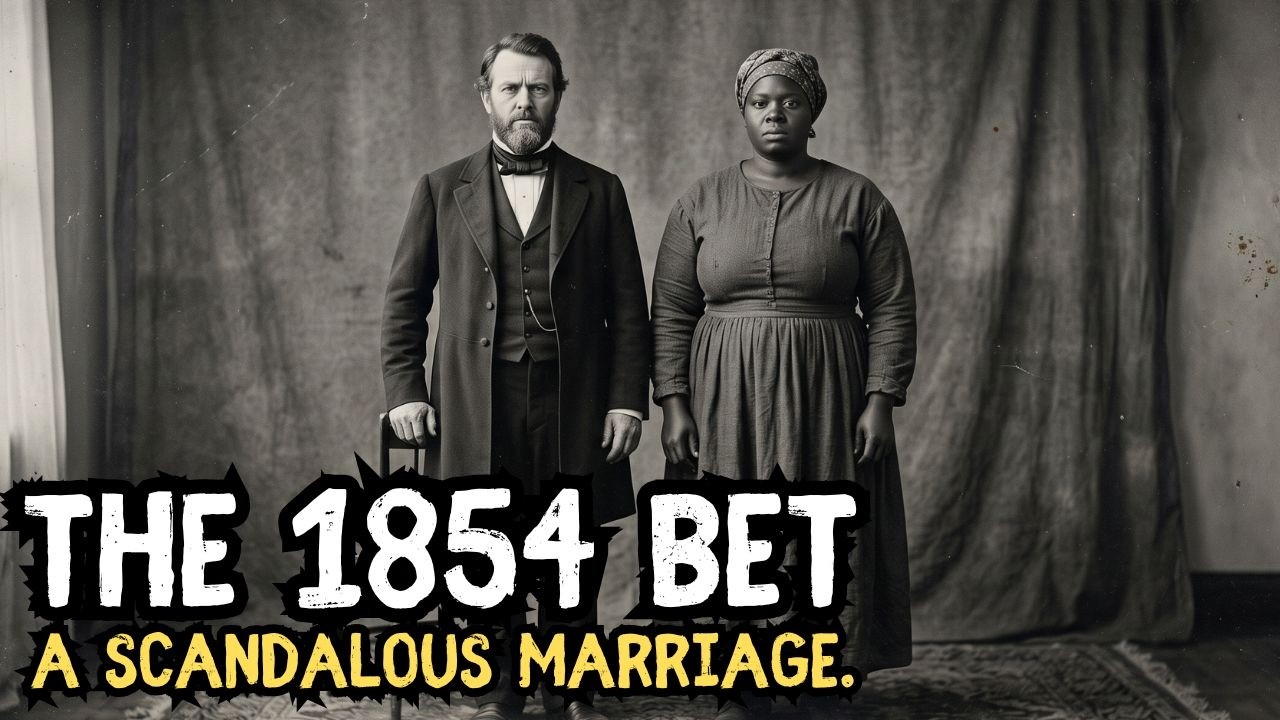
The marriage certificate still survives in the Louisiana state archives, yellowed and fragile, bearing the names of Jeremiah Aldridge and Celeste, recorded simply as property beneath his signature. What makes the document so disturbing is not merely the grotesque nature of the union between a plantation owner and his enslaved cook, but the thirteen mysterious deaths that followed in the months after their wedding ceremony in March 1854. Local newspapers from that period hint at a conspiracy so elaborate and cruel that authorities buried the investigation entirely to shield some of Louisiana’s most prominent families. The truth behind this forced marriage exposes a web of betrayal, revenge, and systematic torture that shocked even the violence-hardened antebellum South.
The events that led to that unholy marriage began fifteen years earlier in the murky backwaters of the Mississippi Delta, where fortunes were made in human flesh and blood money flowed as freely as the muddy river itself. Jeremiah Aldridge was not born into the plantation aristocracy that defined Louisiana society in the 1840s. The son of a failed tobacco farmer from Kentucky, he arrived in New Orleans in 1839 carrying nothing but burning ambition and a willingness to engage in business that more established gentlemen would not touch. The slave trade, while legal, carried a certain social stigma among the old Creole families who preferred to maintain the fiction that their wealth came from sugar and cotton alone.
During the sweltering summer of 1840, Aldridge formed his partnership with Marcus Devoe and Samuel Rochelle, two men whose desperation matched his own ruthless ambition. Devoe, the youngest son of a declining sugar baron, needed money to rescue his family’s crumbling plantation from creditors. Rochelle, a former ship captain who had lost everything to yellow fever and bad investments, possessed invaluable knowledge of the illegal slave routes from Cuba and the Caribbean islands. Together they established the Delta Trading Company, operating from a warehouse on the outskirts of New Orleans where questions were not asked about the source of their merchandise.
While legitimate slave traders dealt in documented property with clear titles, Aldridge’s operation specialized in what they euphemistically called recovery services. They purchased enslaved people who had escaped from failed plantations, bought kidnapped free blacks from corrupt bounty hunters, and most lucratively, smuggled fresh captives from illegal ships that still crossed the Atlantic despite the official ban on international slave trading. For three years the partnership flourished. They reinvested their profits into legitimate businesses, buying respectability alongside property.
Devoe saved his family’s plantation and expanded it into one of the most productive sugar operations in St. Charles Parish. Rochelle purchased a fleet of riverboats and became a respected shipping magnate. Aldridge himself acquired Willowbrook Plantation, a modest but profitable cotton operation about forty miles upriver from New Orleans, complete with a grand colonial mansion that announced his arrival into Louisiana’s planter elite.
But success bred carelessness. In the spring of 1843, word reached them that federal marshals were investigating illegal slave trading operations along the Gulf Coast. Someone had been asking questions about their business, examining shipping records, and worst of all, interviewing some of their former merchandise who had managed to escape or gain freedom. The three partners met in emergency session in Aldridge’s new study at Willowbrook.
Devoe, always the most nervous of the three, suggested they dissolve the partnership immediately and destroy all records. Rochelle, with his sailor’s pragmatism, argued for shifting their assets offshore and waiting for the investigation to pass. But Aldridge had a different solution entirely. He would murder both men and stage the scene to suggest they had killed each other in a dispute over money.
The murders took place on a humid evening in June 1843 at the warehouse that had served as their base of operations. Aldridge arrived early, concealing a loaded pistol in his coat and a razor-sharp skinning knife in his boot. When his partners arrived, they found him seated at their usual planning table with an expensive bottle of whiskey and three glasses arranged between stacks of ledgers. As the evening wore on, Aldridge steered the discussion toward their accumulated wealth, specifically the location of their cash reserves.
It was Rochelle who first sensed something was wrong, picking up on subtle changes in Aldridge’s demeanor. When Rochelle suggested postponing the meeting and reconvening the following day with lawyers present, Aldridge knew his window was closing. Aldridge drew his pistol and fired directly into Devoe’s chest before the younger man could react. But Rochelle, despite being caught off guard, proved more resilient than Aldridge had anticipated.
The former sea captain overturned the heavy table between them and lunged forward with a broken whiskey bottle, slashing at Aldridge’s face and opening a deep gash across his left cheek that would leave a permanent scar. What followed was a desperate struggle lasting nearly ten minutes. In the end, it was Rochelle’s age that betrayed him. At fifty-three, he could not match the younger man’s strength.
Aldridge finally drove the blade deep into Rochelle’s stomach, twisting it upward toward his heart. But even as Rochelle died, he managed to gasp out words that would haunt Aldridge for the rest of his life. “My son knows everything. He’ll come for you.
When he’s old enough, he’ll make you pay. ”
At the time, Aldridge dismissed these as the delusional ravings of a dying man. He had no idea that Marcus Devoe’s younger brother, Philip, had been secretly documenting their illegal activities, or that Samuel Rochelle’s seventeen-year-old son, Henry, possessed detailed knowledge of every transaction, every contact, and every crime the Delta Trading Company had committed. Aldridge spent the next four hours methodically arranging the crime scene to support his planned story.
He positioned Devoe’s body to suggest the man had been shot while reaching for a weapon, then placed Rochelle nearby with a bloody knife in his hand and defensive wounds implying a struggle. He scattered money around the room to suggest a dispute over finances, damaged the office safe to imply a robbery gone wrong, and even inflicted additional wounds on his own hands and arms to support his claim of being an innocent bystander. The false witnesses performed exactly as paid. A corrupt dock worker claimed he had heard shouting from the warehouse followed by gunshots.
The New Orleans police, overwhelmed by more pressing crimes, accepted Aldridge’s version of events with minimal investigation. The official report concluded that Devoe and Rochelle had killed each other in a business dispute. Within a week, the warehouse was demolished as planned, destroying any remaining physical evidence of the partnership’s illegal activities. With his partners dead and their assets suddenly available, Aldridge moved quickly to consolidate his newfound wealth.
Over the following months he systematically emptied every account, safe deposit box, and hidden cache of cash belonging to his murdered partners, estimating the total value at nearly forty thousand dollars, a fortune worth over a million in today’s currency. But Aldridge had made a fatal miscalculation. In his obsessive focus on immediate threats, he had completely overlooked the families of the men he had murdered. Philip Devoe was twenty-two years old when his brother was murdered, and he possessed a calculating intelligence that made him far more dangerous than Aldridge ever imagined.
As Marcus’s closest confidant and unofficial business manager, Philip had maintained detailed records of every Delta Trading Company transaction, including coded ledgers documenting their illegal slave purchases, shipping manifests from prohibited Caribbean routes, and most damning of all, correspondence with corrupt officials who had facilitated their operations. When news of Marcus’s death reached him, his first reaction was not grief but cold, calculating fury. The official story made no sense to anyone who actually knew the three partners. Within days of the funeral, Philip began his own investigation, discovering that the crime scene had been carefully staged and that Aldridge had begun accessing his murdered partners’ financial assets within hours of their deaths.
Henry Rochelle was conducting his own investigation from a very different angle. At twenty-four, Samuel’s son possessed his father’s maritime connections but combined them with a formal education in law and business. Henry had spent years working in New Orleans banks, building relationships with clerks and officials who could provide information that Philip’s more direct approach might miss. His investigation revealed the true scope of Aldridge’s theft, documenting how the murderer had systematically looted every asset belonging to the partnership.
But what made Henry truly dangerous was his deep understanding of how Louisiana’s financial and legal systems actually functioned. Rather than seeking immediate justice through the corrupt court system, Henry began developing a plan to systematically dismantle Aldridge’s financial foundation. The two young men met for the first time in the fall of 1844 at a discreet restaurant in the French Quarter. Neither expected how perfectly their different skills would complement each other, or how completely their shared desire for justice would consume the next decade of their lives.
By the spring of 1845 they had transformed their individual quests into something far more sophisticated: a carefully coordinated conspiracy designed to destroy Jeremiah Aldridge through the same methods he had used to murder their relatives. Betrayal, financial manipulation, and ultimately violence disguised as legitimate business. The first phase focused on infiltrating Aldridge’s social and business networks. Philip, using his family’s connections, began frequenting the same gentlemen’s clubs and social events where Aldridge was establishing himself as a respectable planter.
Within months he had positioned himself as one of Aldridge’s casual acquaintances. Meanwhile, Henry was using his banking connections to trace every aspect of Aldridge’s financial empire. He discovered that the plantation owner’s apparent wealth was built on a foundation of risky investments, leveraged loans, and business ventures that generated impressive short-term profits but created long-term liabilities. Most crucially, Henry learned that Aldridge had developed a serious gambling problem, regularly losing thousands of dollars in high-stakes poker games and horse racing bets funded through increasingly desperate borrowing against his plantation’s future crops.
By 1848, Henry had secured employment with the First National Bank of New Orleans, the institution that held the primary mortgage on Willowbrook Plantation. From this position he was able to subtly manipulate Aldridge’s credit arrangements, ensuring that loan renewals came with slightly higher interest rates and that payment schedules were structured to create cash flow problems during critical planting seasons. Simultaneously, Philip had cultivated relationships with several of New Orleans’ most notorious gambling operators. Through carefully placed bribes and promises of future favors, he arranged for Aldridge to be invited to increasingly expensive games where the other players were secretly working together to ensure the plantation owner would lose far more than he could afford.
By 1851, their efforts were showing results. Aldridge’s debts had grown to nearly thirty thousand dollars, and the interest payments alone were consuming most of his plantation’s annual profits. He had been forced to sell several parcels of land to cover gambling losses, and rumors were circulating that Willowbrook Plantation was in serious financial trouble. More importantly, Aldridge’s personality was beginning to show the strain.
He had become short-tempered, suspicious of his neighbors’ motives, and increasingly desperate in his search for new sources of income. It was Henry who conceived the idea of using Aldridge’s own enslaved people as instruments of his destruction. Rather than inciting an actual uprising, Henry suggested a more subtle approach. They would use Aldridge’s marriage to one of his own enslaved people as the ultimate humiliation, a public degradation that would destroy his social standing while leaving him legally powerless to escape the consequences.
The selection of Celeste as the instrument of Aldridge’s final humiliation was not random. Philip and Henry had spent months studying every person who lived and worked at Willowbrook Plantation. At thirty-eight years old, Celeste was indeed a large woman, but what made her invaluable was her intelligence, her complete loyalty to her own survival, and most importantly, her absolute hatred for Jeremiah Aldridge. Her hatred had deep roots.
Celeste had been purchased by Aldridge in 1847 from a failed plantation in Mississippi, where she had been separated from her husband and three children, who were sold to different owners in different states. The separation was not economically necessary. Aldridge could have afforded to purchase her entire family, but he had chosen to buy only Celeste because he needed an experienced cook and saw no profit in acquiring what he dismissively called unnecessary mouths to feed. When Celeste had begged him to at least purchase her youngest child, a ten-year-old daughter, Aldridge had laughed and told her he was running a plantation, not an orphanage.
For seven years she had endured the daily humiliation of preparing elaborate meals for the man who had destroyed her family. She had watched him entertain guests with stories of his business successes, knowing his wealth had been built on stolen money and murdered partners. More importantly, she had gradually accumulated detailed knowledge of Aldridge’s daily routines, personal habits, and growing paranoia. Approaching Celeste required delicate handling.
Neither Philip nor Henry could risk direct contact with an enslaved person on Aldridge’s property. Instead they used intermediaries, free people of color who worked in New Orleans markets and had legitimate reasons for occasional visits to rural plantations. Through these contacts they established communication with Celeste, initially offering small amounts of money in exchange for information. What they discovered exceeded their expectations.
Celeste not only possessed detailed knowledge of her owner’s vulnerabilities, but she had been conducting her own subtle campaign of psychological warfare against him for years, deliberately over-salting his food to aggravate his stomach problems and spreading rumors among the other enslaved people about his financial troubles. When Philip and Henry finally revealed their true identities and their plans, Celeste’s response was immediate and unequivocal. She would do whatever was necessary to help them destroy the man who had murdered their relatives and ruined her own life, on the condition that her cooperation be rewarded with freedom and safe passage to Canada. The final details of their plan took shape over several months.
Aldridge would be pushed into complete financial ruin through a series of manipulated gambling losses and called loans, leaving him vulnerable to an offer he could not refuse: marry Celeste in a legal ceremony or face immediate death at the hands of his creditors. The marriage would destroy his social standing and provide Philip and Henry with legal access to his property through their control of his wife. Most importantly, it would place Celeste in a position where she could gradually poison Aldridge over several months, causing him to suffer the same slow, agonizing death that their murdered relatives had experienced. The opportunity came in early 1854 when Henry learned that Aldridge was planning to attend a high-stakes gambling tournament in New Orleans, hoping to win enough money to save his plantation from foreclosure.
The February evening when Aldridge arrived was particularly humid and oppressive, with fog rolling off the Mississippi River. He entered the den carrying a leather satchel containing eight thousand dollars, nearly every liquid asset he had managed to scrape together through the sale of slaves, equipment, and personal property. What he did not know was that Philip and Henry had been carefully orchestrating this moment for months, ensuring that every other player at the high-stakes table would be working together to strip him of his remaining wealth. The game was five-card stud poker, played with stakes that started at five hundred dollars per hand.
Aldridge initially experienced moderate success, winning enough smaller pots to believe his luck might finally be changing. But as the stakes increased and the alcohol flowed, he began making increasingly reckless bets. By midnight he had lost more than half his stake, but he continued playing with the desperate intensity of a man who understood that this was literally his last chance to save himself from complete ruin. The final hand began just after two in the morning.
Aldridge was dealt what appeared to be a strong hand, a pair of kings showing with the possibility of a full house. Confident this was his moment, he pushed his remaining three thousand dollars into the center of the table. But the other players had been dealt even stronger hands, and more importantly, they had been coordinating their bets. When the cards were finally revealed, Aldridge’s pair of kings lost to a full house.
As the reality of his complete financial destruction began to sink in, Aldridge sat frozen at the empty table. The stranger who had won the final hand remained seated across from him. After several minutes of oppressive silence, the stranger finally spoke, his voice carrying a slight French accent that seemed familiar. “Mr.
Aldridge, I believe we need to discuss your outstanding obligations. ” It was at this moment that Philip Devoe stepped out of the shadows near the warehouse entrance, his face illuminated by the flickering gaslight in a way that made his resemblance to his murdered brother unmistakably clear. “You look like you’ve seen a ghost, Jeremiah. My name is Philip Devoe.
And I believe you knew my older brother Marcus quite well. ”
Henry Rochelle emerged from another corner of the warehouse. “My father Samuel always said you were clever, Mr. Aldridge.
Clever enough to murder two men and steal their life’s work, but apparently not clever enough to realize that dead men sometimes leave behind sons who remember their fathers’ stories and never forget their fathers’ killers. ” Philip and Henry had built a case that would not only prove his guilt in any court of law, but would also implicate dozens of other prominent Louisiana citizens. “The question now,” Philip continued, “is what we intend to do with this information. We could turn it over to federal authorities, or we could arrange for certain parties in New Orleans to learn that you’ve been operating under false pretenses for over a decade.
I suspect that either approach would result in your death, probably preceded by considerable unpleasantness. ”
“There is, however, one alternative,” Philip said, his voice taking on a tone of mock consideration. “One way you might be permitted to continue breathing, at least for a while longer. It would require a certain sacrifice of dignity on your part.
” Henry smiled with the cold satisfaction of a man about to reveal the culmination of years of careful planning. “You’re going to marry one of your slaves, Jeremiah. Publicly, legally, and permanently. You’re going to stand before God and Louisiana society and take your cook, Celeste, as your lawful wedded wife.
”
The suggestion was so grotesque, so completely beyond the boundaries of acceptable behavior in antebellum Louisiana society, that Aldridge initially could not process what he was hearing. Marriage between a white plantation owner and an enslaved person was legal suicide, social annihilation, and personal humiliation on a scale that would make death seem merciful by comparison. Philip explained that a minister in Natchitoches Parish, heavily in debt to certain gambling establishments, had agreed to perform a completely legal ceremony. “The beauty of this arrangement, Mr.
Aldridge, is that it gives you a choice. You can refuse our generous offer and face immediate consequences for your crimes. Or you can accept temporary humiliation in exchange for continued life. ” When Aldridge asked how long the arrangement would last, Philip and Henry exchanged a look.
“For the rest of your natural life, Mr. Aldridge. Marriage is a sacred bond, after all. Though, given your age and apparent health problems, we suspect your natural life might not extend quite as long as you might hope.
”
Aldridge signed the marriage contract with hands that shook so violently he could barely hold the document steady. The terms were simple and absolute. He would marry Celeste in a legal ceremony, live with her as husband and wife, and provide for her welfare as he would any spouse. In exchange, his creditors would refrain from immediate collection of his debts.
“Welcome to the family, brother-in-law,” Philip said as he collected the signed contract. The morning of March 15th, 1854, dawned gray and oppressive. Aldridge had not slept since returning from New Orleans. Celeste had been informed of the arrangement through intermediaries, though she pretended surprise when Aldridge awkwardly attempted to explain the situation during breakfast.
When he finished his pathetic explanation, she simply nodded and said, “Yes, Master Aldridge, I understand. I’ll prepare myself for the ceremony. ” The calm acceptance in her voice terrified him more than anger or resistance would have. Throughout the day, neighbors and acquaintances arrived at Willowbrook Plantation, drawn by invitations that Philip and Henry had sent in Aldridge’s name.
The guests were told they were witnessing a remarkable demonstration of Christian charity as their neighbor had decided to honor one of his most faithful servants by offering her the protection and dignity of marriage. Most arrived expecting to see some sort of elaborate joke. What they found instead was a properly organized wedding ceremony complete with decorations, refreshments, and a nervous groom who seemed genuinely committed to the bizarre proceedings. Aldridge had dressed in his finest clothes and played his role with the desperate conviction of a man who understood that his survival depended on a convincing performance.
Celeste appeared for the ceremony dressed in a simple but elegant gown, carrying herself with a dignity and composure that impressed even the most skeptical guests. The minister from Natchitoches Parish performed the ceremony with professional efficiency. When he pronounced them husband and wife and instructed Aldridge to kiss his bride, the plantation owner’s face went pale, but Celeste steadied him with surprising gentleness, rising on her toes to meet his lips in a brief chaste kiss that sealed their legal union. As the guests departed, Aldridge found himself alone with his new wife.
Celeste moved through the house with the confidence of someone who understood that the power dynamic had shifted permanently. When Aldridge attempted to protest one of her decisions, she fixed him with a stare containing years of accumulated hatred and quietly said, “We’re married now, Jeremiah. Husband and wife, partners. I think it’s time we started acting like it, don’t you?
”
The first month of marriage passed with deceptive normality. But Aldridge was beginning to notice subtle changes in his daily routine. His breakfast coffee had developed a slightly bitter aftertaste. His evening meals left him feeling vaguely nauseated and unusually tired.
Most disturbingly, he had begun experiencing headaches and episodes of dizziness. His suspicions were confirmed during a conversation with Dr. Hamilton Warren, Willowbrook’s long-time physician, who had come to examine Aldridge after he collapsed during a business meeting. The doctor’s preliminary examination revealed symptoms consistent with chronic poisoning, specifically the gradual accumulation of toxic substances that were slowly destroying his digestive system and neurological functions.
“Your condition is quite serious, Mr. Aldridge,” Dr. Warren explained. “The symptoms suggest prolonged exposure to arsenic or a similar metallic poison.
Without immediate treatment and removal from the source of contamination, the condition is invariably fatal. ”
But confronting Celeste directly would be both dangerous and pointless. She was protected by her legal status as his wife, her apparent innocence, and most importantly, her connections to the two men who controlled every aspect of his continued existence. Instead, Aldridge began taking elaborate precautions.
He started preparing his own meals in secret, avoided drinking anything Celeste had prepared, and began sleeping in a locked guest room. These defensive measures provided temporary relief, but they also created new problems. Neighbors who visited began commenting on his gaunt appearance and nervous behavior. Celeste played her role in this psychological campaign with masterful skill, responding to guests’ concerns about her husband’s behavior with the kind of patient worry a devoted wife might show for a beloved spouse.
His refusal to eat her cooking looked like irrational fear rather than intelligent caution. His attempts to explain the situation to Dr. Warren and other trusted associates were dismissed as the ravings of a man driven insane by financial stress and social humiliation. The truth about his situation was revealed to Aldridge in the most cruel and methodical way possible during a dinner party that Celeste had organized to celebrate their three-month wedding anniversary.
When the guests arrived, Celeste announced a special surprise: a bottle of wine that had supposedly been aging in the plantation cellar, which she wanted to open as a symbolic toast to their future together. The wine was presented with great ceremony, opened in front of all the guests to demonstrate it had not been tampered with, and poured into glasses that had been cleaned in full view of everyone present. When a toast to their marriage and their hopes for many more years together was proposed, Aldridge found himself unable to refuse without appearing completely insane to his assembled neighbors. As he raised the glass to his lips, Aldridge caught sight of his wife’s eyes across the dinner table.
For just a moment her mask of devoted affection slipped, and he saw the cold satisfaction of someone about to achieve a long-anticipated victory. The effects began within minutes of consuming the wine. Aldridge experienced severe stomach cramps followed by difficulty breathing and a sensation of burning in his throat and chest. As he collapsed at the dinner table, the assembled guests assumed they were witnessing the final breakdown of a man who had been slowly losing his mind.
Dr. Warren immediately began examining Aldridge, but his efforts were hampered by what appeared to be hysterical interference from Celeste, who threw herself across her husband’s body, sobbing and begging the doctor to save him while simultaneously making it impossible for Warren to provide effective medical treatment. But as Aldridge lay dying on his own dining room floor, Celeste leaned close to his ear and whispered words that revealed the true scope of the conspiracy. “Marcus Devoe was my cousin, Jeremiah.
Samuel Rochelle was my uncle by marriage. I’ve been working with Philip and Henry since 1845, waiting for the perfect opportunity to watch you die the way you made them die, slowly, painfully, and completely alone. ”
Jeremiah Aldridge died at 9:30 p. m.
on June 18th, 1854, surrounded by neighbors who believed he had suffered a stroke or heart attack brought on by months of mental instability. Dr. Warren’s official cause of death was listed as natural causes associated with prolonged nervous exhaustion. The funeral was well-attended, with Celeste playing the role of grieving widow with such conviction that several prominent ladies from neighboring plantations offered to help her manage Willowbrook Plantation during her period of mourning.
No one suspected that the tearful woman at the graveside was actually celebrating the successful completion of the most elaborate murder plot in Louisiana history. As Aldridge’s legal heir, Celeste inherited Willowbrook Plantation along with all its debts and obligations. Within a month of the funeral, she had signed documents transferring ownership of the plantation to Philip and Henry in exchange for forgiveness of the outstanding debts. She then disappeared from Louisiana entirely, presumably heading north with enough money to start a new life as a free woman.
The official records raised no suspicions among Louisiana authorities, who were dealing with far more pressing concerns as the nation moved inexorably toward civil war. But among certain families in New Orleans and the surrounding parishes, a different version of the story circulated quietly for generations, speaking of a conspiracy so elaborate and patient that it had taken eleven years to reach completion, and a justice so perfectly calibrated that the punishment had matched the crime in both duration and suffering. Philip Devoe and Henry Rochelle had achieved something remarkable in the context of antebellum southern society. They had successfully prosecuted a murder case that no court would have touched, executed a death sentence that no judge would have imposed, and done it all through methods that left no evidence of their involvement.
Rather than selling Willowbrook Plantation for profit, they converted it into a refuge for freed slaves and escaped bondspeople, creating exactly the kind of humanitarian institution that would have horrified the man who had built his fortune on human trafficking. The plantation house that had once entertained Louisiana’s elite became a station on the Underground Railroad, helping enslaved people reach freedom in the northern states and Canada. They had used their enemy’s own property to continue the fight against the institution that had made him wealthy, turning his legacy into a weapon against everything he had represented. Most importantly, the manner of his death had been designed to ensure that no one would remember him as anything more than a failed plantation owner who had made poor financial decisions and married unwisely.
He had been deleted from Louisiana history as thoroughly as if he had never existed at all.
