In Cambridge, England, in 1979, a converted bacon smokehouse off King’s Parade held a prototype no bigger than a hardback novel. A plastic wedge, open at the back and soldered together on a bench, it ran on a chip made in America called the Z80. The engineer who built it, Jim Westwood, had wired it to a scattering of memory components, already knowing he could do it next time with half as many parts. In the doorway stood Clive Sinclair, a 39-year-old former journalist turned electronics obsessive.
In his jacket pocket was a check for £10,000—the severance payment from Sinclair Radionics, the company he had founded with fifty borrowed pounds in 1961 and which the British government had just finished dismantling around him. He had no company left to run. He had an engineer, a prototype, and the conviction that whoever could make a computer cheap enough to arrive by Royal Mail in an ordinary British home would have an entire country waiting. Within four years, the words “Sir Clive” would appear in every national newspaper.
Within six, he would unveil his second great miniaturization to a laughing press. Within seven, he would sell the computer division that had put a machine on five million kitchen tables for five million pounds. The prototype in Westwood’s hands was called the ZX80. In eighteen months, a second version would teach a nation of children how to code.
In thirty-six, a rubber-keyed cousin would sit beside it on the shelf, and the two of them would make Clive Sinclair the first consumer electronics knight in Britain since the war. The question was how the smallest, cheapest personal computer in the world turned one man into Sir Clive and then destroyed him. Clive Sinclair was born on July 30th, 1940, into a Britain still under air raid. His father was a mechanical engineer; his grandfather had been a naval architect.
Three generations of his family had measured, cut, and welded in workshops that smelled of oil and solder. The boy grew up believing that no electronic problem could be solved better than by subtracting components until only the essential ones remained. He never went to university. At eighteen, with a soldering iron and a measured IQ of 159, he began selling miniature electronic kits by mail order.
In 1959, a publisher commissioned him to write constructor books—small, cheap paperbacks explaining how to assemble working circuits from posted components. He wrote thirteen of them in three years. The British electronics hobby market ran on those books, read by schoolboys and RAF servicemen. In July 1961, in Cambridge, he spent his borrowed fifty pounds on a company called Sinclair Radionics Limited.
For a decade, the business ran on amplifier kits and transistor radios posted out of a Cambridge workshop, undercutting every competitor. By May 1971, turnover was £563,000. By 1975, it was £6. 3 million.
In 1972, Sinclair launched the Executive, the world’s first slimline pocket calculator, roughly nine millimeters thick, running on hearing aid batteries. It cost £79. 95 and sold because nothing else looked like it. It earned the company about £1.
8 million in profit and taught Clive Sinclair the lesson that would eventually kill him: subtract pennies, win markets; subtract more pennies, win bigger markets. He did not know the lesson had a floor. The floor was called the Black Watch, launched in August 1975 at £17. 95 as a kit, £24.
95 assembled—a digital wristwatch at a price no competitor could match. It had problems with the chip, the plastic case, the battery life measured in days, and, most damagingly, its timekeeping accuracy. Sinclair Radionics posted its first annual loss. The Microvision pocket television, launched in January 1977, left 12,000 units unsold.
The Labour government intervened, the National Enterprise Board buying a 43% stake in April 1976 and raising it to 73% by July 1977. The government installed its own management. Clive Sinclair became an employee in his own corridor. In July 1979, he resigned, took his £10,000, and walked out of the company he had built.
He did not retire. A former employee, Chris Curry, had already set up a lifeboat company in Cambridge in July 1977 called Science of Cambridge Limited. It had shipped a simple single-board computer called the MK14 in June 1978, proving there was a British market for a microprocessor bought by post. Clive Sinclair got into the lifeboat.
Science of Cambridge was renamed Sinclair Computers, then Sinclair Research Limited. The most important decision of his career was the refusal to retire at 39. He walked into the Cambridge workshop that was already running, told the engineer in it to build the cheapest home computer anyone had ever shipped, and let Jim Westwood do the rest. In May 1979, Westwood produced the prototype.
On January 29th, 1980, Sinclair Research launched it as the ZX80. The price was £79. 95 as a kit, £99. 95 ready-built.
The advertising line read: “The first personal computer for under £100. ” It had one kilobyte of static RAM, four kilobytes of ROM containing Sinclair BASIC, a blue membrane keyboard with no moving parts, no sound, RF output to a television set, and cassette storage for programs loaded off an ordinary tape recorder. The whole machine was built from standard chips—nothing exotic, just a shrewd selection anyone could buy by the thousand. The ZX80 sold roughly 50,000 units before being discontinued in 1981.
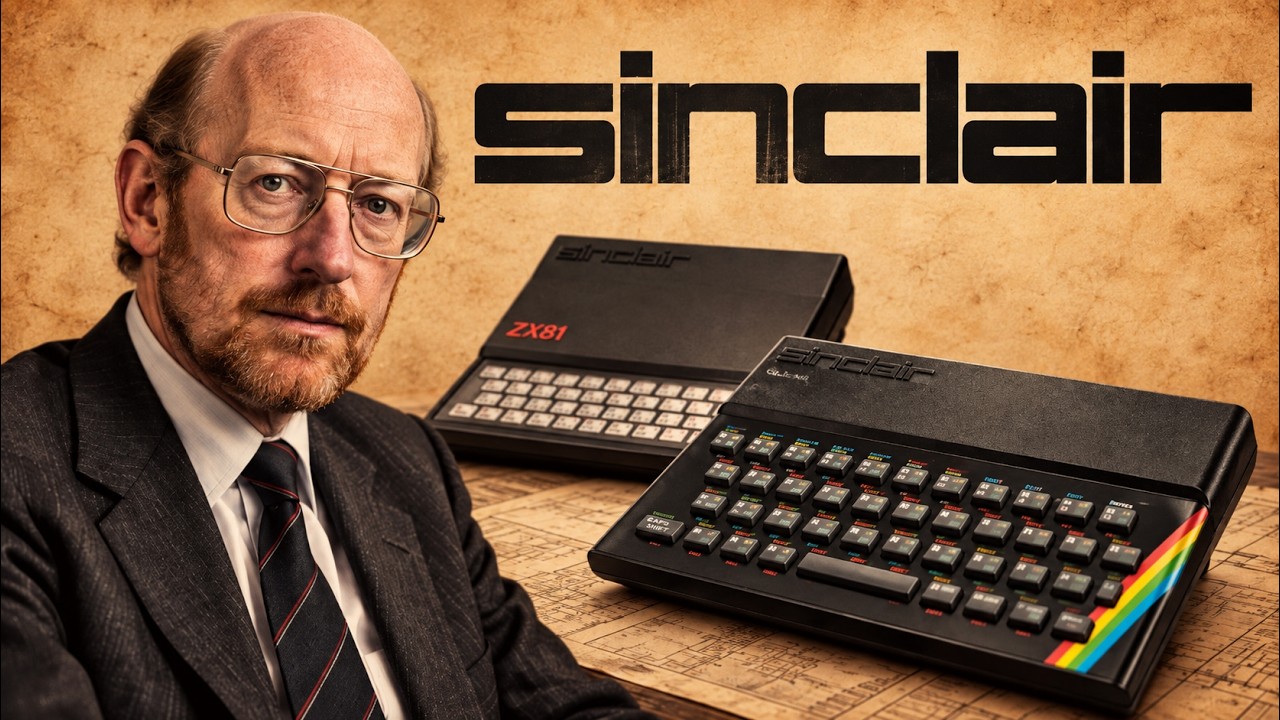
Buyers wrote checks, posted them to Cambridge, and waited six to eight weeks for a cardboard box. Clive Sinclair had already quietly told Jim Westwood what to do next: collapse eighteen chips into one. Fourteen months later, Westwood’s team did precisely that, cutting the manufacturing cost roughly in half. The ZX81 launched on March 5th, 1981 at £49.
95 as a kit and £69. 95 ready-built. Its engineering miracle was the uncommitted logic array, a gate array fabricated by Ferranti in England that cost a fraction of a dedicated chip to tool. Clive Sinclair told a reporter: “The ZX81 had four chips when our nearest competitor in this respect, the TRS80, had 44.
Those four chips are what made £49. 95 arithmetically possible. ” The machine began rolling off a production line in Dundee, Scotland, where Timex, hungry for consumer electronics work after losing watch contracts to cheaper Asian manufacturers, assembled them at a price no other factory could match. By March 1982, Sinclair had moved 250,000 ZX-81s globally.
It was discontinued in 1984, having sold over 1. 5 million units. A generation of British game programmers learned to code on it. On April 23rd, 1982, in the Churchill Hotel in London, Sinclair Research unveiled the machine that would define British bedrooms for a decade: the ZX Spectrum, £125 for the 16K model, £175 for the 48K model.
Richard Altwasser designed the semicustom ULA that gave it color, sound, and video output on a single chip. Steve Vickers wrote the Sinclair BASIC interpreter and system firmware, compressing an entire usable programming environment into 16 kilobytes of ROM. Rick Dickinson designed the flat enclosure with the rounded sides and the rainbow stripe—and the keyboard. The keyboard became the most famously bad in computer history: sixty keys of gray rubber on a plastic base, described by users as feeling like dead flesh.
It shipped on five million machines because the users did not care. They had color, sound, and a programmable computer under the television for £125, a week’s wages. By 1984, over 3,500 games had been released for the machine. Companies that would define the global games industry—Ocean, Imagine, Code Masters, Ultimate Play the Game—were being founded in flats above high-street shops.
But in the same Cambridge offices, Sir Clive Sinclair, as he was from the birthday honors list of 1983, was already looking elsewhere. He had approved internal funding for a project outside computing: a plastic three-wheeled electric vehicle. In 1984, Sinclair Research launched the Sinclair QL, aimed at the business market. It shipped with twin microdrive tape loops which chewed up tapes and lost data.
It arrived late and was torn apart on reliability grounds. The engineers who had been with him since the ZX-80 watched their founder go from a man obsessed with the Spectrum ULA to a man obsessed with the gear ratio on a plastic trike. He had learned that ruthless subtraction wins at the low end of consumer electronics. He had not learned that subtraction has a floor—wherever the user has to sit, drive, or trust the product with their safety.
On January 10th, 1985, in Alexandra Palace in London, Sir Clive Sinclair walked onto a press stage and showed the British Motoring Press his next £49. 95 moment. The press laughed. The Sinclair C5 was a low-slung, open, white plastic three-wheeled vehicle, battery under the seat, steering column between the driver’s knees, pedals because the battery could not climb a British hill.
Launch price was £399. Manufactured at the Hoover washing machine plant in Merthyr Tydfil, South Wales, projected first-year sales were 100,000 units. Actual sales were roughly 4,000 to 12,000. The Welsh workers who assembled it were laid off within seven months.
The British consumer declined a vehicle that required pedaling uphill in the rain while being overtaken by lorries. By August 1985, production stopped. Sinclair Vehicles entered receivership by October. The seven months in which the C5 lived and died were the seven months in which he lost control of the computer business.
Robert Maxwell’s Pergamon Press announced a £12 million acquisition of Sinclair Research in June 1985, then walked away in August. On April 7th, 1986, Sir Clive Sinclair sold the bulk of Sinclair Research—the Spectrum, the ZX81, the brand name, the inventory—to Alan Sugar at Amstrad for £5 million. Amstrad re-engineered the Spectrum and kept it in production until 1992. The brand lived.
The company that built it did not. Sinclair did not lose the home computer war. He won it, then walked away from the battlefield to try to sell Britain a plastic trike. He had built an empire on a theory of ruthless subtraction, made it work on amplifiers, calculators, the ZX-81, and the ZX Spectrum—and then tried to make it work on a vehicle a human being had to sit inside in traffic and weather.
The subtraction religion did not transfer. By 1990, Sinclair Research employed three people. Jim Westwood stayed in Cambridge electronics. Rick Dickinson left when the Amstrad deal closed.
Sir Clive Sinclair died in London on September 16th, 2021, aged 81, after more than a decade of cancer. The machines did not die. Enthusiasts were still booting original ZX-81s on kitchen tables in 2026, and the platform officially discontinued in 1992 is still receiving new software releases in Z80 assembly. In 2017, a project called the Spectrum Next launched on Kickstarter with Rick Dickinson contributing to the industrial design shortly before his death in April 2018.
The third Spectrum Next Kickstarter in 2023 hit its £250,000 funding target in roughly seven minutes and raised close to £1. 5 million. The backers were almost without exception the children the original Spectrum had taught to code, now in their forties and fifties, running the companies that run the modern world. A kitchen table in a house in Britain in late 2026 holds a working ZX-81 next to a Spectrum Next in a case Rick Dickinson shaped before he died.
The person sitting at the table is in their fifties and writes software for a living. They learned to code on the small black wedge their parents could just about afford for Christmas in 1981. The empire that put the box through the letterbox is gone. The engineers are mostly gone.
Sir Clive is gone. What remains is the machine itself, still booting, still teaching, still humming on a kitchen table forty-five years later.
