In February 1676, war parties of the Wampanoag and their allies swept through the English settlements of western Massachusetts. In the town of Lancaster, the home of Mary Rowlandson, a minister’s wife, was among those attacked. She was taken captive along with her children. During the assault, her youngest daughter was shot and died in her arms.
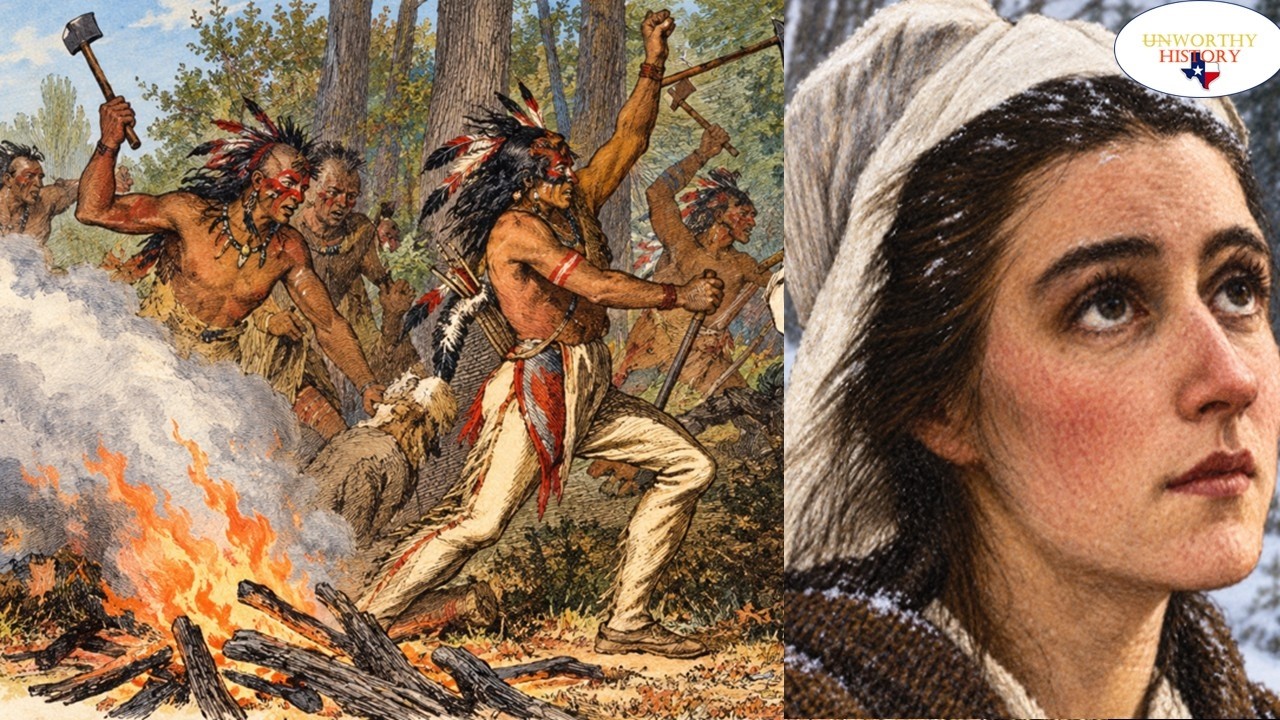
Her son and older daughter were also taken, though she was rarely allowed to see them. By late spring, Mary had been a prisoner for more than two months, moving with her captors through the wilderness of New England during King Philip’s War, the conflict named for the Wampanoag leader Metacom, known to the English as King Philip. Her account of those months, published in 1682 as The Sovereignty and Goodness of God, became one of the first bestsellers in America, widely read by English colonists and in England alike. The final weeks of her captivity were a time of exhausting travel, near starvation, and the gathering hope of release.
As the group prepared to leave the woods toward the towns of the Massachusetts Bay, Mary had little to eat. She carried in her pocket a few crumbs of cake given to her daughter on the day of their capture. By then it had gone bad and turned as hard as flint, but when she felt faint she put a piece in her mouth and found strength. The group killed a deer that carried a fawn, and she was given a piece of the young animal, so tender that the bones could be eaten.
She found it delicious. They traveled under rain that night, but the Indians quickly built a bark shelter, and she slept dry while many of them stayed out in the weather. In the morning they boiled the deer’s blood in the stomach and ate it, though she could not. Still, she later recalled, they were often kind to her.
During the fifteenth remove, she received no food for support, and the journey wore her down. They reached the Baquaug River again and camped nearby for several days. The Indians gave her bits of tobacco and salt, which she traded for food. Hunger made her reckless.
When she was given something hot, she burned her mouth badly and yet did the same thing again soon after. Even when she had enough to eat, she remained unsatisfied, a condition she recognized in the Scripture, You eat but are not satisfied. At the sixteen remove, the party waited at the river. The water reached her knees, and the current was so swift and cold she feared it would weaken her completely.
She stumbled and staggered, and the Indians laughed at her. But she crossed safely, and afterward sat down to put on her stockings and shoes, weeping, her heart full of sorrow. She rose and continued with them. A messenger then arrived with word that she was to go to Wachuset, her master’s place.
A letter had come from the colonial council about the ransom of captives, and another message would follow within fourteen days. Before this news, her heart had been so heavy she could barely speak or walk. Now it felt light enough to run. They went only a mile that night and stayed two days.
A group of about thirty Indians on horseback came to them, and for a moment she thought they were English, for they wore English clothing with hats and white neckties. But when they came closer, the difference between the faces of Christians and the appearance of those heathens brought her spirits down again. The seventeenth remove was more comfortable in hope than in strength. She was given a load to carry and her strength failed.
At night they reached an Indian town, and Mary was exhausted. She entered a wigwam where an Indian boiled horses’ legs for broth. She asked him for some of the water or broth. He gave her a spoonful of samp, a kind of corn meal, telling her to take as much broth as she wanted.
She mixed the samp with hot water, drank it, and regained strength. He also gave her a piece of small intestine, which she roasted on the coals. For a time, she felt revived. The next leg of the journey was hard.
Along the way she saw an Englishman lying dead and stripped. They reached another Indian town where four English captives were held, including her sister. She went to see her, and found her as well as could be expected. She wanted to stay the night with her, but the sister’s captors would not allow it.
In another tent, a woman boiled horses’ legs. She gave Mary a small piece, and one to an English child. Mary ate her piece quickly, but the child could not chew the tough meat and sucked at it helplessly. She took the piece from the child and ate it too, finding it delicious, though at another time it would have been revolting.
When she returned to her master’s tent, she was told she had brought shame upon him by begging. If she did it again, they said, they would knock her on the head until she died. She answered that knocking her on the head was better than letting her starve. They set out for Wachuset, but the journey stretched into three days without rest.
Finally, exhausted, she saw the hills of Wachuset in the distance. They crossed a large swamp, with mud and water up to the knees. She nearly gave out, but when she could go no further, Philip himself, King Philip, came to her, took her by the hand, and said she would soon be a mistress again. She asked if he was in earnest.
He said yes, and that she would soon return to her master, who had been away three weeks. They reached Wachuset, where her master was waiting. He asked when she had last washed. She told him she had not washed in a month.
He brought water himself, told her to wash, gave her a mirror to see herself, and ordered his wife to feed her. She gave Mary a dish of beans and meat and a small piece of cake. For the first time in her captivity, Mary felt her strength return. Her master had three wives.
One was an old woman, with whom he was then staying. Another was Wettimore, a proud and harsh woman, who spent much of her day adorning herself with powder, paint, necklaces, earrings, and bracelets, and whose work consisted mostly of making wampum belts. The third was young and had borne him two children. When Wettimore’s servant came to take Mary away, she began to cry.
The old woman comforted her, telling her she could come for food and sleep in her tent. That night the old woman laid a mat under her and covered her with a good garment. It was the first time such care had been shown her. Mary understood why Wettimore did not want her to go: serving the old woman might cost Wettimore both her service and her ransom.
Mary was not only glad for the kindness but took hope that her deliverance was near. Tobias and Peter, two Indians, arrived with a second message from the council. Even though they were Indians, Mary shook their hands and wept. They told her her husband and friends were well but sorrowful.
They brought her two biscuits and a pound of tobacco. She distributed the tobacco quickly. When it was gone, one of the men demanded more, then threatened to smash her husband’s head if he came, even as others said a hundred unarmed men would be safe among them. The chiefs then called Mary before them.
They asked how much her husband would pay for her ransom. She was in a difficult position. If she named too little, she feared the matter would be delayed. If too much, she did not know where the money would come from.
She said twenty pounds, asking them to accept less. They would not listen, and sent word to Boston that she would be ransomed for twenty pounds. During this time, Mary witnessed the rituals and character of the praying Indians, those who had adopted Christianity. One refused to eat horseflesh until another convinced him from the Bible that in famine it was lawful.
Another betrayed his father to the English to save himself. One wore a necklace made of Christian fingers. Another carried out a ceremony before the battles at Sudbury. In that rite, a man knelt on a deerskin in a circle of others who knelt and struck the ground with their hands and sticks, murmuring.
A man with guns stood outside, was called in, sang with them, and spoke while they responded. Whatever they believed, they went to Sudbury expecting victory. They returned saying they had killed two captains and near a hundred men and brought an English prisoner to confirm the slaughter. Yet they returned without joy, like dogs that had lost their ears.
They lost only five or six men, but from that time, Mary observed, they began to fall quickly and continued to decline throughout the summer until their ruin was complete. After the Sudbury raid, the Indians moved to avoid being discovered. They built a large wigwam that could hold a hundred people in preparation for a great day of dancing. They said the governor would be so angry over Sudbury that he would send no one for the captives, which grieved her.
Her sister, nearby, begged her master to let her visit, but he forced her to turn back in the rain, and Mary did not see her again until both were free. On a Saturday afternoon, John Hoar, sent by the council and accompanied by Tom and Peter, arrived with a third message. As he approached, the Indians ordered Mary to sit still, then fired their guns over, under, and before his horse, forcing him this way and that to show what they could do. She feared they had killed him.
When she was finally allowed to meet him, he told her her husband and friends were well and would be glad to see her. Her husband sent her a pound of tobacco, which she sold for nine shillings. She asked if she could go home with Mr. Hoar.
One after another, the Indians refused, and they went to sleep with that answer. In the morning, Mr. Hoar invited the chiefs to dinner, but the provisions he had brought had been stolen during the night. Mary saw God’s power in this, for many hungry Indians were gathered with only Mr.
Hoar and herself among the English, yet they did not strike them on the head and take what they had. Instead, they seemed ashamed and blamed some bad Indians. That night, her master came out of the wigwam and sent James Printer to tell Mr. Hoar that he would allow Mary to go home in the morning if he would give him half a pint of liquor.
Mr. Hoar called Tom and Peter and asked them to witness the promise. The master made the promise and got the liquor. Philip, aware of what was happening, called Mary and asked what she would give him for good news and a good word.
She said she would give anything she had. He asked for two coats, twenty shillings in money, half a bushel of seed corn, and some tobacco. She thanked him. That night her master, now drunk, called for Mr.
Hoar, offered him the drink, called him a good man, then a rogue who deserved hanging. He was the first Indian she had seen drunk in all her time among them. His wife fled from him and escaped, and by God’s mercy the night passed without further trouble. On Tuesday morning, the chiefs held their general council.
All agreed she should return except Philip, who did not attend. Some asked her to send them bread, others tobacco, and many shook her hand and offered her a hat and a scarf to wear on the way. No one raised a hand or word against her. So God answered her prayer.
She left her children behind in the wilderness, and the thought of it kept her from sleep for three nights. One Indian offered to flee with his wife and take her home, but she refused, wanting to wait for God’s timing and go home quietly. At sunset, she, Mr. Hoar, and the two Indians reached Lancaster.
It was a solemn sight. There she had lived happily among relatives and neighbors, and now she saw no Christian and no house standing. They stayed that night at a farm that still stood, sleeping on straw. In the morning they went to Concord, where she was overjoyed to see many Christians together, some of them her neighbors.
There she met her brother and her sister’s husband, who asked her if she knew where his wife was. He had helped bury her without knowing it. She had been killed near their home. They went on to Boston that day, where she met her husband again.
But the thought of their children, one dead and one somewhere unknown, tempered their joy. The twenty pounds of her ransom had been gathered by the gentry of Boston and Mrs. Usher. They were received by Thomas Shepard of Charlestown, who took them into his home for eleven weeks.
In the following week, the governor and council sent again to the Indians, and her sister and Mrs. Kettle were returned. News came that her son Joseph had reached Major Waldron’s quarters. They went to Portsmouth, where the major said he could not get him for less than seven pounds, which good people there had paid.
Her nephew was ransomed for four pounds. Then word came that her daughter was on her way to Providence. The Indians brought her as far as they could, and she walked for three days with almost nothing to eat but water and green berries. When they were no longer willing or able to carry her, Providence people took her in, and then wagons carrying supplies to the English army brought her to Dorchester, where her parents received her safely.
The Indians had said they would not release her for less than twenty pounds, but God returned her without cost. After the family was reunited, the South Church in Boston provided them a house. They stayed nearly three quarters of a year. Friends in Boston and England supplied their needs, and soon their home was furnished.
Mary reflected that she had seen the utter ruin of this world. In one hour she had health and wealth and wanted nothing; in the next she had sickness, wounds, and death, possessing nothing but sorrow and affliction. But she had been restored. During her captivity, she later wrote, she had been in the midst of lions and bears that feared neither God nor man nor devil, yet not one of them had offered her the slightest dishonor in word or deed.
She gave thanks to God, who had delivered her from the hand of the enemy and brought her and her family safely out of the wilderness.
