In the spring of 1903, a Philadelphia maritime lawyer named Cornelius Ashford Farnham received a letter that would pull him from his orderly life into a world of decaying grandeur and unresolved debts. The letter came from the probate court of Georgetown County, South Carolina, and it informed him that he was now the legal owner of nearly two thousand acres of rice land along the Black River, including three farmhouses and various outbuildings. The property had passed to him through a chain of inheritance after the death of Octavius Farnham, the last male heir of the family line, who had died without legitimate heirs the previous September. Cornelius had been raised in Philadelphia, the son of a youngest son who had been sent north to study medicine and had never returned south except through increasingly rare letters.
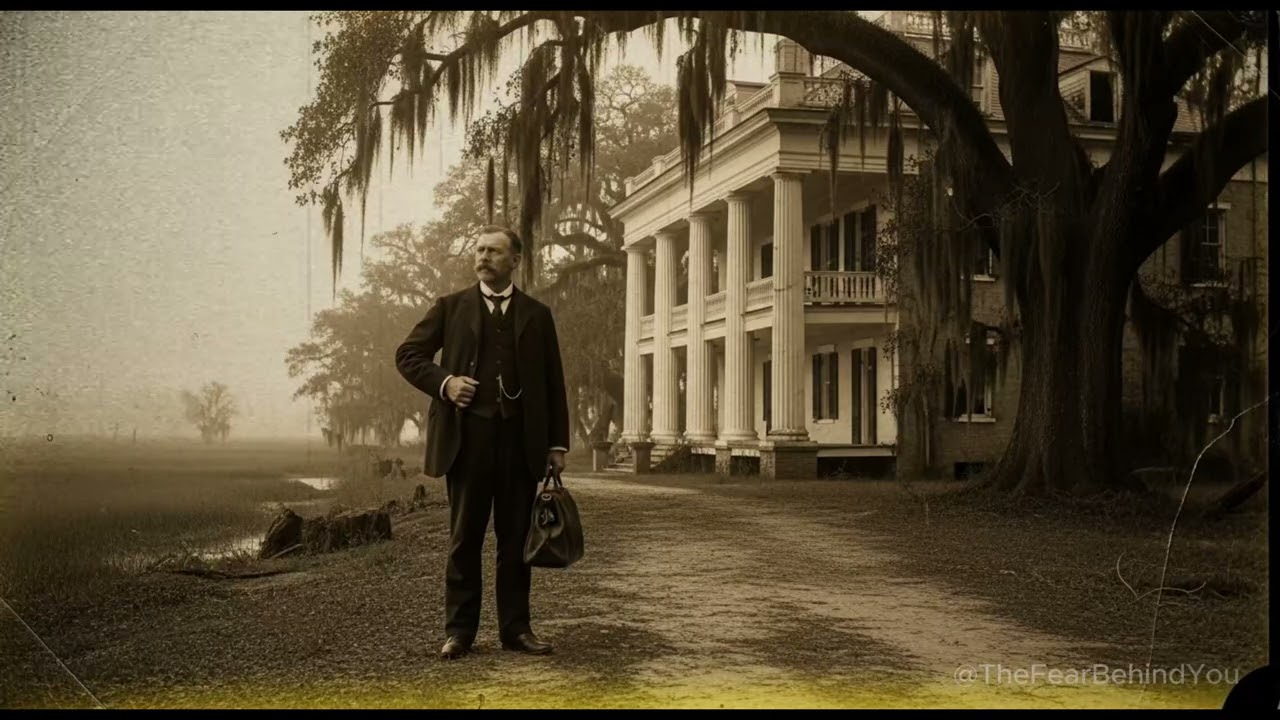
His father had died in the winter of 1901, and Cornelius had felt little at the loss. The man had been a distant figure, more a memory than a presence. Now, this letter told him that his father had been the last surviving male heir to the Farnham plantation, and that Cornelius himself was the sole inheritor of the entire estate. The plantation, known as Ashwater, had been built in 1798 by Hadrian Farnham, a man described in surviving letters as violent in temper and wild in ambition.
Hadrian had carved the rice fields from the swamp with the labor of enslaved Africans, many of whom had been purchased specifically for the task. The work was brutally hard, requiring workers to stand for hours in knee-deep water infested with snakes and alligators, digging canals and building dikes by hand, tending fields that bred malaria and yellow fever. Hadrian built the main house to rival the great homes of the Low Country, a three-story structure of cypress and hard pine with wide verandas overlooking the river. It took five years to build, and the cost in money and human life was extraordinary.
By 1850, the Georgetown County region produced more rice than anywhere else in North America, and the families who controlled the fields were among the richest on the continent. But by the turn of the century, that golden age had faded. Competition from Louisiana and Arkansas, hurricanes, and the loss of the enslaved workforce had strangled the rice culture. The great plantations were in irreversible decline, their dikes crumbling, their fields returning to swamp.
Cornelius arrived in Georgetown in late March 1903, traveling by train to Charleston and then by steamer along the coast. The journey took nearly a week, and by the time he reached the small port town, he was exhausted and disoriented by the subtropical heat. Georgetown was a town caught between two worlds. The rice plantations that had once made it wealthy were decaying, but the timber industry was rising, and sawmills were appearing along the rivers.
The town had about four thousand residents, a mix of white merchants and professionals, black workers and farmers, and a small but tenacious class of former planter families clinging to what remained of their gentility. At dinner on his first evening, Cornelius was approached by a lawyer named Bertram Pinckney, who had handled some of Octavius Farnham’s affairs. Pinckney was a heavy man in his sixties with a carefully neutral expression, the look of someone who had spent decades keeping other people’s secrets. Over dinner, he gave Cornelius a frank summary of the estate.
The farm had not produced rice in over a decade. The main house, though structurally sound, was in poor repair and would require significant investment to make habitable. There were debts owed to the Georgetown Rice Milling Company, to various merchants in town, and to the county itself for unpaid taxes. The total exceeded ten thousand dollars, a considerable sum.
But what Pinckney said at the end of their conversation affected Cornelius more deeply. He leaned forward and lowered his voice. He said he had practiced law in the county for thirty-five years and had never encountered an estate like the one Cornelius had inherited. He urged him to consider selling it without even seeing it, at any price he could get.
When Cornelius asked why, Pinckney struggled for words. Finally he said only that some inheritances come with obligations not recorded in any deed, and some properties have claims that no court can settle. Cornelius dismissed the warning as rural superstition. He was a man of logic, contracts, and evidence.
He would see the property himself and make his own decision. The next morning, Cornelius hired a local man named Boiet Singleton to guide him to the Farnham property. Boiet was a black man in his fifties who had worked on various plantations throughout the county. According to a court testimony he gave years later, Boiet initially refused the job when he heard where Cornelius wanted to go.
It took a promise of triple the usual wages to change his mind. Before they departed, Boiet made Cornelius wait while he visited a small shop on Cannon Street and returned with several items that he placed in a leather pouch he hung around his neck. When Cornelius asked what they were, Boiet said simply that they were things his mother had given him, things for traveling through difficult lands. The journey took most of the day.
They traveled by wagon over rough roads through pine forests and cypress swamps, crossing several creeks over wooden bridges that groaned under their weight. The landscape grew wilder as they progressed, cultivated fields giving way to tangled brush, orderly rows of pines surrendering to natural forest chaos. Boiet spoke little during the trip, answering Cornelius’s questions about the property with curt words and evasions. But as they approached the final stretch of road, he offered one piece of advice.
When they arrived, he said, Cornelius should do what he needed to do during daylight. Inspect the buildings, walk the land, count the acres. But when the sun began to set, he should return to the gate where Boiet would be waiting. He should not stay after dark, and he should not approach the fields after the light was gone.
When Cornelius asked why, Boiet only shook his head. There are things you cannot explain to people who have not seen them, he said. You will understand soon enough, or you will never understand. Either way, I have told you what I know.
When they arrived at Ashwater in the late afternoon, the sun was already beginning to set over the rice fields, casting long shadows across the neglected landscape. The main house stood on a slight rise about fifty yards from the river, in a state of considerable decay. Many windows lacked glass, verandas sagged under accumulated debris, but the structure itself seemed sound. The outbuildings were in worse condition, especially the rice mill, which appeared to have collapsed entirely on its eastern side.
The fields themselves were largely overgrown, the dikes broken in many places, the canal gates rusty and closed. Cornelius wrote in his travel journal that there was something about the place he found difficult to describe. The air was heavy with humidity and the smell of the swamp, but there was something else, a feeling of being watched from all directions at once. Boiet refused to enter the property with him.
He remained at the gate, promising to return in the morning, and nothing Cornelius said could persuade him otherwise. He asked only that Cornelius keep his lantern burning all night and avoid looking at the fields after dark. When Cornelius asked why, he would not elaborate. Cornelius spent that first night in the main house, in a second-floor room that appeared to have been Octavius’s bedroom.
He slept poorly, waking several times to sounds he attributed to the old house settling, creaking floorboards, distant thumps that seemed to come from below. At one point, around midnight, he heard what sounded like footsteps on the veranda beneath his window. He went to look but saw nothing except the empty boards and the darkness outside. When he returned to bed, the footsteps resumed, going back and forth in a rhythm that seemed almost deliberate.
In the morning, he found something that disturbed him more than the noises. On the desk in the room where he had slept, he discovered a journal that had belonged to Octavius. It was a simple leather-bound volume with yellowed pages filled with small, precise handwriting. Cornelius spent most of his second day reading it, and what he found there began to change his understanding of what he had inherited.
Octavius’s journal spanned nearly thirty years, from 1872 to 1902. The early entries were ordinary, discussing farm management, the difficulty of finding reliable workers, the declining harvests of the rice fields. But around 1885, the entries began to take on a different character. Octavius wrote that he was beginning to understand what his grandfather had meant about the fields.
He wrote that the fields were not merely passive recipients of their labor. They remembered, they accumulated. Every drop of sweat, every cry of exhaustion, every moment of suffering that had occurred during their creation had been absorbed by the soil. The rice that grew there drew its sustenance from more than just water and sunlight.
These observations became more frequent and more intense over the years. Octavius began documenting what he called phenomena in the fields. Moments when the still water rippled without wind, when rice stalks bent in directions that defied the tidal currents. He wrote about sounds that came from the fields at night, sounds like human voices, but too distant and distorted to understand.
In 1893, he documented an experience that seemed to be a turning point in his relationship with the property. He was walking along one of the dikes at dusk when he saw something standing in the water between the rice stalks. At first he thought it was a heron, tall and still, but as he watched, the figure turned toward him, and he realized it was not a bird at all. It had human form but no substance, just a suggestion of a shape, as if someone had drawn an outline of a person in the air and then forgotten to fill it in.
It stood there for about thirty seconds watching him, and he understood that it was waiting for something. Then it simply faded like mist dissolving in sunlight. The last entry in Octavius’s journal was dated three days before his death. It read simply that he would ask them directly that night.
If he did not return, whoever read this should know that he had gone voluntarily, and that the fields had only taken what had always been theirs. Cornelius was disturbed by these writings, but he was also a rational man, a lawyer accustomed to dealing with facts and evidence. He attributed Octavius’s journal entries to the isolation and eccentricity that often afflicts people who live alone for long periods in remote places. He decided to proceed with his plans to assess the property and determine whether it could be made profitable again.
Over the following weeks, he hired workers from Georgetown to help him survey the estate. He walked the boundaries, examined the condition of the dikes and canal gates, and took detailed notes on the repairs needed. He also began inventorying the contents of the various buildings, cataloging furniture, tools, and documents that had accumulated over generations. The workers he hired were reluctant from the start.
They arrived each morning in groups of three or four, never alone, and refused to work in certain areas of the property. The rice fields were off-limits after the afternoon. The observation platform, they would not enter at all. When Cornelius pressed them for explanations, they offered only vague references to bad land and restless spirits.
One worker, an elderly man named Jeremiah Gadston, was more forthright than the others. He told Cornelius that his grandmother had been born on the Farnham plantation and had worked there before the war. She had told him stories about the place, stories passed down through generations of workers. Jeremiah said his grandmother told him that the old master who built the place had made a bargain, not with God or the devil, but with the land itself.
He wanted the fields to produce, and produce they did, more than any other farm in the county. But the land wanted payment, and the only payment it would accept was suffering. Every crop that came out of those fields cost someone their life. Not always quickly, not always obviously, but always inevitably.
When Cornelius asked what happened to his grandmother, Jeremiah’s expression darkened. She died here, in the fields during harvest season, he said. They said it was fever, but my grandfather said something else. He said she laid down in the water one evening and did not get up.
He said she looked peaceful, as if she had finally finished paying what she owed. During his inventory of the property, Cornelius discovered records in the observation platform that Hadrian had converted from a storehouse into what he called his watch point. The structure was a small one-room building on a slight rise overlooking the rice fields. Inside, Cornelius found a chair, a small table, and a telescope mounted on a tripod facing the fields.
But in a locked cabinet against the back wall, he found something else, a collection of documents dating back to the earliest days of the plantation, records that seemed to have been hidden from the official family papers. These documents told a story that had never been recorded in any public archive. Hadrian Farnham had kept a separate register from the official plantation records, documenting every worker who had died on the property. The register ran from 1799 to 1830 and contained hundreds of entries.
Each entry followed a similar format, name, date, location on the plantation, brief description of circumstances. But what made this register different from similar records found elsewhere was the level of detail Hadrian included. He did not just record names and dates. He recorded the circumstances of each death, the location, and something else, something Cornelius found deeply disturbing when he first read the texts of these documents.
For each death, Hadrian noted what he called the disposition. This was not a reference to the burial of the deceased, though that information was also included. Rather, it seemed to be a description of something Hadrian believed he had observed in the moments following each death. A kind of transition or absorption.
The field took him was a phrase that appeared frequently. The water rose to receive her. The soil opened and accepted him. Hadrian wrote as if the deaths of these workers were not merely tragic losses of life but transactions, payments made to the land in exchange for its productivity.
There were also maps in the cabinet, hand-drawn diagrams of the rice fields with notes indicating the locations of specific deaths. The maps showed that the deaths were not randomly distributed across the plantation but concentrated in certain areas, areas Hadrian had circled and labeled with words like active, receptive, and saturated. Cornelius was horrified by these documents. But he was also curious, curious in the way a lawyer is curious when he discovers evidence of a crime long past the statute of limitations.
He began spending more time in the observation platform, reading Hadrian’s notes and trying to understand the thinking behind them. During this period, Cornelius began to notice things he could not explain. The workers he had hired from Georgetown refused to stay on the property after dark. They arrived at dawn and left before evening, regardless of how much work remained.
When Cornelius pressed them for reasons, they offered excuses about their families and other obligations, but he could see the fear in their eyes, how they avoided looking toward the rice fields, the speed with which they gathered their tools to leave each evening. In early April, Cornelius began to notice sounds at night that he could not attribute to the settling of the house. They came from the direction of the fields, low and rhythmic, like voices chanting in a language he could not distinguish. He wrote that the sound seemed to move from one part of the fields to another, as if whoever was making it was circling the property.
He also began to notice changes in himself. His sleep was disturbed, but he felt more than that. He felt a persistent pull toward the fields, a desire to go out into them that grew stronger with each passing day. He found himself standing at the windows of the main house, staring at the abandoned rice fields, unable to remember how he had gotten there or how long he had been watching.
The pull was physical as much as mental. His feet wanted to move toward the fields. His hands wanted to open the door. Only by conscious effort could he resist the urge, and that effort grew harder with each passing day.
On the tenth of April, Cornelius wrote that he had dreamed he was standing in the fields with water up to his knees. Around him were figures standing still as rice stalks, watching him with what he could only describe as patience. They did not speak, but he understood what they wanted. They wanted him to join them.
They wanted him to take his place among them. When he woke, his feet were muddy and swamp grass was caught in the hem of his nightshirt. He had no memory of leaving the house. This was the first of several incidents in which Cornelius found evidence that he had been walking to the fields in his sleep.
The episodes increased in frequency over the following weeks, and he began taking precautions, locking his bedroom door and placing furniture against it to prevent himself from getting out. On the seventeenth of April, Cornelius made a decision that would prove fateful. He decided to explore the rice fields at night, consciously and deliberately, to confront whatever was causing the sounds he had been hearing and to prove to himself that there was nothing supernatural about the property he had inherited. He waited until late after dark, until the moon had risen and cast enough light for him to see.
Then he took a lantern and walked to the edge of the fields. What he experienced there is described in a single long entry in his journal, written clearly in haste, with words crossed out and sentences incomplete. He walked to the first canal gate and stood listening. The sounds he had heard from the house were clearer here, though still indistinct.
They seemed to come from deep within the fields, from the area where the rice stalks were tallest and densest. He followed a path along one of the dikes, holding his lantern high. The dike was unstable in places, eroded by years of neglect, and he had to test each step before putting his full weight on it. The water on both sides was black and still, reflecting the moonlight in scattered fragments.
As he walked, he became aware of movement in that water, ripples spreading outward from an invisible source. He told himself it was fish, or perhaps a small alligator disturbed by his presence. But the ripples did not behave like those made by animals. They moved toward him, converging on the section of dike where he stood.
He stopped walking. The sounds stopped too. The silence that followed was absolute, broken only by his own breathing and a distant call of a night bird. Then he saw them.
They were not solid, not in any way he could adequately describe. They were more like impressions in the air, shapes that absorbed the moonlight rather than reflected it. They rose from the water one by one, dozens of them, hundreds of them, standing in the fields as if they had always been there and he had only failed to notice them. They did not move toward him.
They made no threatening gestures. They only stood there watching and waiting, and he understood with a certainty that transcended all rational thought that these were the workers whose deaths Hadrian had recorded in his register. These were the people whose lives this land had taken, whose suffering the soil and water had absorbed. They wanted something from him.
He could feel it, a pressure on his mind, a demand he could not fully articulate. The pressure grew until he thought his skull would split from its weight. He turned and ran, rushing along the dike toward the main house, his lantern swinging wildly and casting erratic shadows. He nearly fell into the water twice, grabbing at rotted posts and clumps of swamp grass at the last moment.
Behind him, he could hear the sounds returning, the chanting growing louder and more insistent. He did not sleep that night. He sat in the parlor with every lamp burning, listening to the sounds from the fields, which seemed louder than before. They continued until dawn, fading with the rising sun as if they had never been.
In the morning, Cornelius made a decision. He would leave this place. He would return to Georgetown, contact a broker, and sell the property for whatever price he could get. Some debts were not worth paying.
Some inheritances were not worth claiming. But Cornelius did not leave. His journal continued for three more weeks. During that time, something changed in him.
The entries became shorter and more scattered. He wrote about the difficulty of leaving, how he would pack his bags and walk toward the road only to find himself back at the main house with no memory of returning. He wrote about the sounds from the fields growing more intense, and about how they had begun to take on a quality he could almost understand, as if they were turning into words in a language he was on the verge of learning. On the thirtieth of April, Cornelius wrote that he had calculated the debt as best he could using Hadrian’s formula.
For every acre of productive land, one life is owed per generation. The Farnhams had controlled nearly two thousand acres at the height of their operations. The debt was staggering, incomprehensible, and with each generation that failed to pay, the debt compounded, growing larger and more insistent. The voices from the fields were not asking.
They were demanding. The final entry in Cornelius’s journal was dated the ninth of May, 1903. It was brief and contained the same strange surrender that had marked Octavius’s final words. He wrote that he now understood why they called it Ashwater.
Ash is what remains after fire has consumed everything else, he wrote. The water carries it away, spreads it through the fields, feeds it to the roots. We become part of what we have taken. We repay what was borrowed.
Tonight I go to the fields. I will stand where my grandfather stood, and his grandfather before him. I will pay what is owed. Cornelius Farnham was never seen again.
His disappearance was reported to the Georgetown County Sheriff’s Office in late May, when the workers he had hired noticed that he had not appeared to pay their wages for several weeks. A search of the property found his belongings still in the main house. His travel journal on the desk, his bags packed by the front door, and his personal journal discovered in the observation platform along with Hadrian’s register and the other documents he had uncovered. The sheriff at the time, a man named Hobart Jives, conducted a thorough investigation.
He interviewed the workers, examined the property, and searched the rice fields as best he could given their overgrown and waterlogged condition. No body was ever found. No evidence of foul play was discovered. The official conclusion was that Cornelius had likely suffered an accident while exploring the property at night, perhaps falling into one of the flooded fields and drowning.
The report suggested that his body had been carried away by tidal currents or consumed by alligators. But the documents found in the Georgetown County archives included something that was never included in the official report. It was a statement given by one of the workers, a man named Isaac Guyard, recorded by Sheriff Jives but apparently considered too fanciful to be included in the final account. Isaac claimed that on the night of the ninth of May, he had been passing near the Farnham property on his way home from a hunting trip.
He said he saw lights moving in the rice fields, dozens of them, arranged in patterns that seemed deliberate. He said he heard something, a sound he described as like singing but strange, as if many voices were trying to become one voice. Isaac said he watched from the road for several minutes, frozen with fear, and then claimed that the lights gathered at a single point near the center of the fields. There was a flash of brilliance, too bright to look at directly.
When his vision cleared, the lights were gone and the fields were still. Sheriff Jives asked Isaac whether he had seen anyone in the fields. Isaac replied that he had not seen anyone exactly, but that he had seen something. A shape standing at the center of that gathering.
A shape that looked like a man but was fading, becoming part of the light around it. He went voluntarily, Isaac said. I could tell from his posture, his arms outstretched, as if he was waiting for an embrace, as if he was finally paying the price for something that was owed. The Farnham property remained in legal limbo for years after Cornelius’s disappearance.
His wife, Margaret, who had remained in Philadelphia, initially refused to believe he was dead and spent considerable sums hiring investigators to search for him. She traveled to Georgetown twice herself but never visited the property, refusing even to look in its direction when it was pointed out from town. When she finally accepted the reality of her loss, she wanted nothing more to do with the South Carolina property. The estate was eventually sold at auction to settle its outstanding debts, purchased by a timber company that had no interest in growing rice.
The main house at Ashwater stood empty for decades, slowly succumbing to neglect and the swamp creeping toward it. By the 1920s, it had completely collapsed, leaving only the foundation and some rotting timber. The observation platform lasted longer, perhaps because of its elevated position, but it too eventually fell to hurricanes and time. The rice fields themselves reverted to swamp, the dikes crumbled, the canal gates rusted shut, and the manicured landscape disappeared under a wilderness of brambles and weeds.
Today, the Farnham property is indistinguishable from the surrounding wetlands, accessible only by boat and with great difficulty. But the story did not end with the collapse of the buildings or the abandonment of the land. In 1931, the timber company hired a surveyor named Peyton Rawlins to assess the value of the former Farnham property. Rawlins spent several days on the land, camping in a tent near the river and preparing detailed maps of the terrain.
His survey notes contained observations that echoed what Cornelius had documented decades earlier. Rawlins wrote about sounds he heard at night, about a feeling of being watched, about an inexplicable reluctance to enter certain areas of the former rice fields. He also documented something no previous account had mentioned. The discovery of objects in the swamp that should not have been there.
At several locations, Rawlins found personal items that appeared to date from different periods of the plantation’s history. A pocket watch from the 1840s. A woman’s brooch from the 1860s. A pair of reading glasses whose design suggested they dated from the early twentieth century.
The pocket watch was eventually identified as belonging to Leander Farnham, who had been committed to the asylum in 1867. The glasses matched the description of those worn by Octavius Farnham in the only known photograph of him. The brooch was never identified, but its style suggested it had belonged to a wealthy woman, perhaps one of the Farnham wives whose names appeared in family records but whose fates were never clearly documented. Rawlins also found something else, something he documented in a separate notebook kept for his own records rather than for the company.
In a clearing near where the observation platform had once stood, he found a circle of stones arranged in a pattern he did not recognize. At the center of the circle was a depression in the ground, a shallow pit about three feet in diameter and one foot deep. The pit contained nothing but water, black water that Rawlins described as unnaturally still, refusing to reflect even the direct sunlight. He tried to measure its depth with a surveyor’s rod but found that the rod encountered no bottom, sinking deeper and deeper until he feared losing it entirely.
Rawlins did not complete his survey. His notes end abruptly on the third day of his work with a single sentence. I am leaving this place and will not return. Some land should not be measured or owned.
Some debts cannot be calculated. The timber company accepted his incomplete survey without comment. The property was never developed. It passed through several other hands over the decades.
Each owner seemed to lose interest or encounter difficulties that prevented them from doing anything with the land. In 1956, a Charleston developer named Whitfield Poinsett announced plans to drain the former rice fields and build a hunting lodge on the property. His plans were detailed in several articles in the Georgetown Times, complete with architectural drawings and projected timelines. Construction never began.
Whitfield died of a sudden illness only two weeks after announcing the plans. His death certificate attributed the cause to heart failure. But a letter he wrote to his brother in the days before his death suggests a more complicated story. Whitfield wrote that he had been dreaming, dreams of standing in dark water, hands reaching up from below, voices asking him what he intended to pay for what he would take.
He woke each morning more exhausted than when he had gone to bed. He was beginning to wonder whether some places should not be disturbed, and whether some accounts should not be settled. The property eventually passed to the state of South Carolina as part of a larger conservation effort in the 1970s. It is now part of a wildlife management area that encompasses much of the former rice fields along the Black River.
Access is ostensibly restricted for environmental protection, but those who have attempted to visit report that park rangers are unusually insistent on keeping people away from certain areas. When one researcher tried to visit the site, he was turned back at the access road by a ranger who told him that the area he was trying to reach was closed due to unstable ground conditions. When pressed for more information, the ranger became evasive, telling him only that people who entered that part of the preserve sometimes had difficulty finding their way back. The land there has its own ideas about who belongs to it, the ranger said, and nothing more.
The question that remains, the question that haunts those who have studied this case, is what truly happened to Cornelius Farnham and those who came before him. Was he a victim of his own imagination, driven to a desperate act by isolation and the power of suggestion in his predecessor’s writings? Did he simply wander into the flooded fields one night and drown, as the official report suggested? Or was there something more to the story, something that rational minds refuse to accept but the evidence continues to point toward?
The plantation was built, as were all the rice plantations of the Low Country, through the labor and suffering of enslaved people. Hundreds of workers died during the creation and maintenance of the fields. Their lives were measured only by the productivity they achieved. Their deaths were recorded as property losses rather than human losses.
This is documented historical fact. What is less certain, but what the evidence suggests, is that something happened to those deaths, to the energy of all that suffering and loss. The rice fields absorbed it, retained it, accumulated it over generations. The soil became saturated with the residue of human suffering in a way that is not fully understood and cannot be easily measured.
And that residue, that accumulated debt, demanded payment. Hadrian Farnham felt this. His register with its strange notations about dispositions suggests he understood the bargain he was engaged in, even if he could not articulate it in terms we recognize. Octavius Farnham understood it too, in his own way, spending decades trying to learn the language of the fields.
Cornelius came to the property as an heir, someone who had done nothing to accumulate this debt but who was nonetheless responsible for it. The land did not distinguish between those who had created the debt and those who had merely inherited it. The claim was on the name, on the bloodline, on the connection to the suffering that had built the place. And in the end, Cornelius chose to pay what was owed.
Or perhaps the choice was made for him in ways we cannot understand. This is not a satisfactory explanation. It raises more questions than it answers and asks us to accept premises that violate our understanding of how the world works. But the world contains more than our perceptions can easily absorb.
Some places carry their history in a way that differs from others. Some debts persist beyond the lives of those who incurred them. The former Farnham plantation still stands today, returned to wetland, indistinguishable from the swamp that surrounds it. The rice fields are gone, the dikes have vanished, the drainage gates have rotted away.
The main house, the observation platform, and all the physical structures that once stood on the property have completely disappeared, leaving no trace visible from the surface. But if you travel there, if you navigate the channels and creeks that wind through that part of the Black River, you may notice something. On certain nights, especially when the moon is full and the tides are changing, lights appear in that section of the swamp. They move in patterns that seem deliberate, gathering and dispersing, circling around areas where no visible trace remains.
And if you listen carefully amid the sound of the water and the calls of night birds, you may hear something else. A rhythm like voices chanting. A melody that almost turns into words but never quite does. A sound that seems to be asking a question, or perhaps demanding an answer.
What do you owe for what you have taken? What will you pay for what you inherit? These are questions the land itself seems to ask, questions it has been asking for centuries and will continue to ask long after we are gone. Cornelius Farnham arrived at his inheritance expecting to claim it.
In the end, it seems, his inheritance claimed him.
