The little girl sat in the lower right corner of the frame, partially out of view, her head tilted down, her small hands moving over something in her lap. Everyone else in the room stayed perfectly still, frozen for the long exposure the 1870s camera required. She alone was blurred, caught in motion. For 150 years, that was all anyone saw.
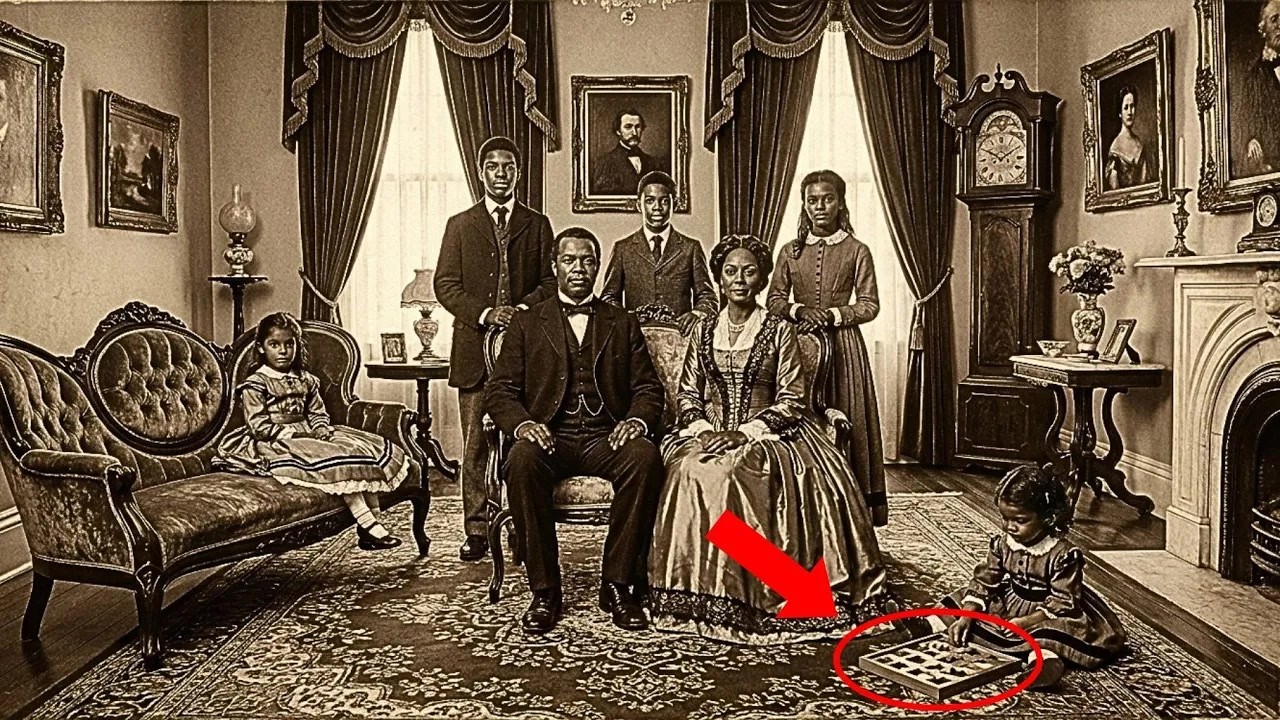
An ordinary family portrait, seven people in their finest clothes, posed in an elegant Victorian parlor somewhere in Mississippi in 1873. The kind of image you passed in a museum without a second thought. In November 2023, an estate lawyer’s office in Philadelphia processed the belongings of a woman who had died at 103 years old. Among her possessions was an unmarked envelope containing a single daguerreotype.
The artifacts that reached Dr. Marcus Reed, professor of African-American history at Georgetown University, arrived through channels like this all the time. When he opened the envelope on a gray Tuesday morning, he had no way of knowing he was holding evidence of one of the most dangerous secrets of the Reconstruction era. The photograph was in remarkable condition.
Seven people, a black family, dated May 1873, taken at J. Thompson Studio in Natchez, Mississippi. What caught Marcus’s attention first was not the people. It was the room.
Velvet curtains framed tall windows. An ornate grandfather clock stood in the corner. Persian rugs covered polished wooden floors. Oil paintings hung on walls covered in expensive Victorian wallpaper.
The furniture alone would have cost more than most families earned in a year. A black family with this level of wealth in Mississippi in 1873, only eight years after the Civil War, in the heart of the former Confederacy, was not just rare. It was almost impossible. Marcus began his standard documentation.
He photographed the image from multiple angles, noted the studio mark, searched for identifying information. The adults stood with dignified posture. Three teenagers lined up behind them, formal and serious. Two younger children sat on an elaborate settee.
Then he noticed the seventh person. In the lower right corner, partially out of frame, sat a little girl, no more than three or four years old. Unlike everyone else, she was moving, her head tilted downward, her attention absorbed by something in her lap. Marcus leaned closer.
In her hands lay an object, flat, rectangular, perhaps eight or nine inches across. He could just make out patterns on its surface. Shapes. Symbols.
Carefully arranged pieces. He reached for his high-resolution scanner. What he was about to discover would keep him awake for three days straight. In historical photograph analysis, the devil lives in the details.
A shadow, a reflection, an object barely visible in the background. These tiny elements can reveal truths the subjects never intended to preserve. Marcus ran the daguerreotype through his laboratory-grade scanner at 1200 DPI. Twenty minutes later, the file loaded on his computer.
He zoomed in on the child. Her face came into focus, round cheeks, hair pulled back with a ribbon, a small hand reaching down toward the object in her lap. He increased the magnification. Two hundred percent.
Three hundred. The object began to reveal itself. Light-colored wood, possibly pine or maple, worn smooth by small hands. The surface was divided into sections, interlocking pieces like a puzzle.
But these were not the simple shapes meant to teach children about animals or letters. Each piece bore something carved into its surface. Deliberate markings. At 400 percent magnification, Marcus stopped breathing.
Carved into the wooden pieces with meticulous precision were five-pointed stars, crosses of different sizes, wavy parallel lines, small circles connected by straight lines, triangular markers. And something else, tiny letters or numbers, too small to read even at this magnification, scattered throughout the design. Marcus had spent fifteen years studying Underground Railroad coding systems. He knew what he was looking at.
His hand trembled as he reached for his reference materials, a thick binder filled with documented examples of the symbolic language used by conductors and freedom seekers in the 1850s and 1860s. He flipped through page after page, comparing the symbols carved into the wooden puzzle with the verified codes used to mark safe houses, indicate danger, show routes north. They matched. Perfectly.
But that was impossible. The Underground Railroad had ceased operations in 1865 when the Thirteenth Amendment was ratified. By 1873, slavery was over. The network of safe houses and secret routes that had guided thousands to freedom had been disbanded.
So why was a black family in Mississippi in 1873 in possession of what appeared to be an active navigation tool for escaped slaves? Marcus grabbed his phone and dialed his colleague at Howard University, Dr. Patricia Foster, one of the nation’s leading experts on Reconstruction-era resistance movements. She had spent twenty years documenting the violence, oppression, and systematic re-enslavement of black Americans in the decades following the Civil War.
When Marcus called her at midnight with urgency in his voice, she knew he had found something significant. “Patricia, drop everything. I need you in my office now. ”
Patricia arrived at Georgetown’s history department at seven the next morning carrying two banker’s boxes of archival documents and a laptop loaded with databases most historians did not even know existed.
Marcus met her at the door looking like he had not slept. “Show me,” she said simply. He led her to his office, where the enhanced image filled a large monitor on the wall. Patricia set down her boxes and stepped closer to the screen.
It took her less than thirty seconds. “That’s a map,” she said quietly. Her voice carried absolute certainty. “Those are safe house markers, river crossings, church sanctuaries.
” She pointed to specific symbols on the wooden puzzle. “This star pattern here, five points with a cross in the center, that’s the code for sanctuary available, clergy protection. And these wavy lines with dots, those indicate ferry crossings where operators could be bribed or trusted. ”
She turned to Marcus, her expression grave.
“Where did you get this? ”
“Estate sale, Philadelphia. The woman who owned it died at 103. No living relatives.
” Marcus pulled up his preliminary research. “I spent all night trying to identify the family. The photographer’s mark says Natchez, Mississippi, May 1873. ”
Patricia’s eyes widened.
“Natchez? ”
She moved to the boxes she had brought and began pulling out files. “Marcus, do you know what was happening in Mississippi in 1873? Black codes.
Convict leasing. Vagrancy laws. ”
The state was essentially re-enslaving freed people through legal loopholes. If you were black and unemployed, you could be arrested for vagrancy.
If you could not pay the fine, and they made sure you could not, you were leased to plantations as convict labor. Between 1870 and 1875, over ten thousand black people in Mississippi were arrested under these laws. Most never came home. Marcus stared at the photograph on the screen.
“So the Underground Railroad didn’t stop? ”
“It couldn’t stop,” Patricia said. “The war ended, but the fight for freedom never did. ”
Names are everything in historical investigation.
They unlock census records, property deeds, court documents, newspaper archives. They transform anonymous faces into real people with real stories. Patricia opened her laptop and connected to the Library of Congress digital archives, cross-referencing the photographer’s studio information with census data from Natchez in the 1870s. J.
Thompson’s studio had operated in Natchez from 1868 to 1881, specializing in formal portraits for wealthy families. His client list was predominantly white planters and merchants. But, Patricia noted, scrolling through records, he had photographed several prominent black families during Reconstruction. That alone told them something important.
To afford a formal portrait at Thompson’s studio cost about fifteen dollars, equivalent to roughly four hundred dollars today. For a black family to have that kind of disposable income in Mississippi in 1873, they had to be extraordinary. Patricia switched databases, pulling up property tax records from Adams County, where Natchez is located. She filtered by race, year, and property value.
The list was shockingly short. “There,” she said, pointing at the screen. “Thomas and Elizabeth Preston owned a two-story brick home on Commerce Street, assessed value $3,200. They also owned a dry goods store on Main Street.
” She clicked another link. “They had accounts with three different banks. That’s not just wealthy, Marcus. That’s powerful.
”
Marcus ran a parallel search on his own computer, looking for mentions of the Preston name in historical newspapers from the period. The Natchez Democrat, the Natchez Courier, the New Orleans Times. What he found made his stomach tighten. “Patricia, look at this.
”
On the screen was an article from the Natchez Democrat, dated August 1873, three months after the photograph was taken. The headline read, “Negro merchants home raided, weapons seized. ” The article was brief, written with the casual racism typical of the era, but the details were clear. On the night of August 14th, a group of white citizens, led by a deputy sheriff, had raided the home of Thomas Preston, claiming they had received reports of illegal weapons being stored on the property.
No weapons were found. But the message had been sent. “They were being watched,” Patricia whispered. “The photograph wasn’t taken in secret.
It was taken in defiance. ”
To understand why the Preston family would risk everything to operate an underground network in 1873, you first had to understand the system they were fighting. Slavery had not ended with the Thirteenth Amendment. It had evolved.
Patricia stood and walked to the whiteboard mounted on Marcus’s office wall. She uncapped a marker and began writing dates, connecting them with arrows. Most people believed slavery ended on January 1st, 1863, with the Emancipation Proclamation, or December 6th, 1865, when the Thirteenth Amendment was ratified. But the amendment contained twenty-seven words that changed everything.
She wrote them out: “Neither slavery nor involuntary servitude, except as punishment for crime, shall exist within the United States. ”
“Except as punishment for crime,” Marcus read aloud. The loophole. Southern states immediately exploited it.
They passed black codes, laws specifically designed to criminalize black life. Vagrancy. Loitering. Being unemployed.
Breaking a labor contract. Even insulting gestures could get you arrested. Once arrested, you would be fined an amount you could not possibly pay. Then the state would lease you to plantations, railroads, mines, factories.
The businesses paid the state. You worked for free. And unlike slavery before the war, there was no incentive to keep you alive and healthy. You were temporary.
Disposable. Marcus examined the documents Patricia spread across his desk. One was a ledger from a Mississippi cotton plantation dated 1872. It listed names, all black men, alongside numbers indicating days worked and causes of death.
Exhaustion. Dysentery. Pneumonia. Shot while attempting escape.
The average survival time was less than seven months. “In Mississippi alone,” Patricia continued, “between 1870 and 1880, over fifteen thousand people were caught in the system. Families were destroyed. Children grew up never knowing their fathers.
Women were left with no means of support and were often arrested themselves for vagrancy. ”
She turned back to the photograph of the Preston family. “Now look at this image again. This family somehow escaped that system.
They built wealth. They created safety. And judging by that map in that little girl’s hands, they were helping others escape, too. ”
Marcus stared at the photograph with new eyes.
They were not just survivors. They were resistance fighters, operating in plain sight in the middle of enemy territory. Marcus and Patricia spent the next six hours meticulously documenting every symbol visible on the wooden puzzle. Using photo enhancement software, Marcus isolated each carved marking, catalogued it, and compared it against known Underground Railroad coding systems from the 1850s and 1860s.
“The symbols are consistent with traditional codes,” he said, pointing at his screen. “But the geography is different. These aren’t routes leading to Canada. Look at the directional indicators.
”
Patricia studied the arrangement. The puzzle pieces, when fitted together properly, formed a rough map of what appeared to be a fifty-mile radius. Wavy lines indicated rivers, likely the Mississippi and its tributaries. Small circles marked towns or settlements.
Scattered throughout were the stars, crosses, and geometric shapes indicating safe locations. “They’re not running people to Canada,” Patricia said slowly, realization dawning. “They’re running them to cities. Memphis.
St. Louis. New Orleans. Places where they could disappear into established black communities.
”
Marcus pulled up a historical map of Mississippi from 1873 and overlaid it next to the enhanced photograph of the puzzle. He began matching landmarks. “This large triangle here, that could be the confluence where the Homochitto River meets the Mississippi. And these three stars in a row,” he zoomed in on a modern map, “that’s the exact distance between three churches that still exist in Natchez today.
All of them were established black congregations in the 1860s. ”
Patricia was making notes rapidly. “The system makes sense now. Convict leasing victims were held on plantations and in work camps.
The Preston network wasn’t smuggling people across state lines. They were extracting them from forced labor sites and hiding them in cities where they could get new identities, new papers, new lives. ”
“But how? ” Marcus asked.
“These camps were guarded. Escape attempts were punishable by death. ”
Patricia pointed to another symbol on the map, a small square with an X through it. “This marking.
I’ve seen it in other documents. It indicates a bribed official. Someone on the inside. ”
They exchanged a long look.
“The Prestons weren’t working alone,” Marcus said. “This was a network. Multiple families. Possibly dozens of people, all risking everything.
”
“And all hidden from history,” Patricia added. “Until now. ”
To understand the specific context of Natchez in 1873, Marcus and Patricia needed local records. Patricia contacted a colleague at the University of Mississippi who specialized in Reconstruction history.
Dr. James Whitmore arrived two days later with an archive of materials that had never been digitized. Tucked inside a leather portfolio were handwritten letters, property records, and something particularly valuable: a diary kept by a white merchant who had lived two blocks from the Prestons’ store. “This diary is fascinating,” Dr.
Whitmore said, carefully turning the brittle pages. “The author, a man named Charles Dutton, wrote daily entries from 1871 to 1876. He mentions the Prestons repeatedly, and his tone is conflicted. ”
He opened to a page marked with a paper clip and read aloud: “May 18th, 1873.
Purchased fabric from Preston’s store today. The negro proprietor, Thomas, conducted business with the same dignity as any white merchant. His wife, Elizabeth, keeps immaculate records. Their success is both impressive and unsettling.
One wonders how they accumulated such wealth in so short a time. ”
“That’s the same month the photograph was taken,” Marcus said. Dr. Whitmore flipped ahead several pages.
“August 20th, 1873. There was a disturbance at the Preston home last night. Sheriff Clayton led a group of men on some pretense of searching for weapons. Nothing was found.
Thomas Preston stood on his porch and watched them search, never saying a word, never showing fear. I admit I felt ashamed watching it. These are law-abiding citizens being harassed for the crime of prosperity. ”
Patricia examined the diary more closely.
“This Charles Dutton, whose side was he on? ”
“That’s unclear,” Dr. Whitmore admitted. “His writings suggest he was uncomfortable with the violence against black citizens, but he never actively intervened.
He observed. He documented. But he didn’t act. ”
Marcus returned to the photograph on the screen.
When this picture was taken in May, the Preston family already knew they were being watched. They knew the danger they were in. And yet they still posed for this portrait with that map visible in their daughter’s hands. “It wasn’t carelessness,” Patricia said quietly.
“It was courage. They were documenting their resistance. They wanted someone, someday, to know what they did. ”
Using the Preston family name, Patricia dived deeper into census records and church registries.
She found the family listed in the 1870 census. Thomas Preston, age 38, merchant. Elizabeth Preston, age 35, homemaker. Three older children: William, 16; Josephine, 14; and Henry, 12.
And two younger children: Clara, 7, and Ruth, 3. “Ruth,” Patricia said, pointing at the name. “Born in 1870. She’d be four years old in the photograph.
That’s our girl. ”
Marcus studied the enhanced image of the child. She was so small. Why would they give a four-year-old something so dangerous?
“Maybe they didn’t give it to her,” Patricia suggested. “Maybe it was always meant to look exactly like what it appears to be. A child’s puzzle. Something innocent that could be left out in the open without raising suspicion.
”
Dr. Whitmore found another relevant entry in the diary. “June 3rd, 1873. Saw the Preston child, the youngest daughter, playing in their garden today.
She had a wooden toy that seemed to captivate her completely. When I commented on it to my wife, she remarked that Elizabeth Preston had mentioned teaching her children through educational toys. Perhaps that is how these Negroes achieve such refinement. ”
The puzzle was seen by neighbors.
It was visible, public, and no one suspected what it really was. Patricia pulled up birth and death records, tracking the Preston children through the decades. William moved to Chicago in 1895. Josephine married and moved to Memphis in 1890.
Henry died in 1889 of pneumonia. Clara married a railroad worker and settled in St. Louis. And Ruth?
“This is strange,” Patricia said, frowning at her screen. “Ruth Preston appears in the 1880 census, still living with her parents in Natchez, but after that, nothing. No marriage record. No death certificate.
She just disappears from official records. ”
“People don’t just vanish. ”
“They do,” Patricia said quietly, “if they need to. If they’re running from something.
Or if they’re part of something so secret that they have to erase themselves from history to survive. ”
August 14th, 1873. Three months after the photograph was taken, the safety the Preston family had carefully constructed came crashing down. Dr.
Whitmore found the official report of the raid in the Adams County Sheriff’s records. The document was brief, clinical, written to justify the violation of the Prestons’ home. But between the lines, a different story emerged. The raid was led by Deputy Sheriff Robert Clayton, accompanied by six men identified as concerned citizens.
They arrived at the Preston home at approximately ten o’clock at night, claiming they had received information about illegal weapons being stored on the property. But here was what was interesting. Three days before the raid, a man named Jacob Henderson had been arrested for vagrancy in Adams County. He was sentenced to six months’ labor at Fairview Plantation.
Marcus and Patricia exchanged glances. “Fairview Plantation is marked on the map,” Marcus said, pointing to one of the symbols on the puzzle. “That circle with the cross inside it. ”
“Exactly,” Dr.
Whitmore confirmed. “According to plantation records I found, Jacob Henderson escaped from Fairview on August 12th, two days before the raid on the Preston house. He was never recaptured. ”
The pieces fell into place.
The Prestons had helped Henderson escape. Someone had informed the authorities. The raid was retaliation, a warning, an attempt to find evidence of the network’s activities. But the raiders found nothing.
No weapons. No hidden rooms. No evidence of harboring escaped convicts. Thomas Preston stood on his porch and watched in silence as strangers ransacked his elegant home, tearing through closets, emptying drawers, looking for proof of crimes he had absolutely committed but hidden too well for them to find.
“The map,” Patricia said suddenly. “Where was the map during the raid? ”
They returned to the photograph, studying the little girl with the wooden puzzle. “Ruth was four years old,” Marcus said slowly.
“Too young to be suspicious. Too innocent to question. If anyone asked what she was playing with, her parents could truthfully say it was just a toy. ”
“The perfect hiding place,” Patricia added.
“Right out in the open, in the hands of a child. ”
The raid failed. The Preston family survived. And somewhere in the night of August 12th, 1873, Jacob Henderson started a new life in a northern city, guided by a map hidden in plain sight.
The story of the Preston family and their coded map did not end in 1873. It echoed forward through generations. Marcus and Patricia spent three more months researching, verifying, cross-referencing every detail. They discovered that the Preston network operated for at least seven years, from approximately 1870 to 1877, when federal troops withdrew from the South and Reconstruction officially ended.
During that time, based on fragmentary records and coded references in letters, they estimated the network helped between 150 and 200 people escape convict leasing. The coded puzzle was likely one of several tools the Prestons used. Patricia found references in church records to educational materials being distributed to black families throughout the region, possibly other maps disguised as children’s toys, primers, or games. Thomas Preston died in 1891, still operating his store in Natchez.
Elizabeth lived until 1903. Of their children, only Ruth’s fate remained mysterious. The last confirmed record of her was from 1879, when she would have been nine years old. “I think she took the network underground,” Patricia theorized.
“As Reconstruction collapsed and violence increased, someone had to carry on the work. It couldn’t be the parents. They were too visible, too watched. But a young woman traveling alone could move freely, could carry messages, could maintain the connections.
”
They would never know for certain. But the photograph told them enough. In December 2023, Marcus and Patricia presented their findings at the American Historical Association conference. The photograph was projected on a large screen, and for the first time, hundreds of historians saw what that little girl had been holding in her hands.
The room fell silent as Patricia explained the symbols, the dates, the context. When she finished, the applause lasted for three full minutes. The photograph is now housed at the Smithsonian National Museum of African American History and Culture in Washington, D. C.
Visitors stop in front of it daily, studying the elegant parlor, the dignified family, and especially the small girl in the corner playing with her wooden puzzle. Next to the photograph, a placard reads: “The Preston family, Natchez, Mississippi, 1873. Underground Railroad operators. When freedom was stolen through law, they built new roads to return it.
”
The little girl stares out from history, clutching her secret. For 150 years, no one knew what she was protecting. Now, finally, the world understands. The fight for freedom never ended.
It just went underground. And sometimes, the most dangerous weapons look like children’s toys.
