The room on the second floor of the brownstone on 139th Street was quiet in the way that powerful rooms are quiet. Not empty, not still—quiet the way a chessboard is quiet between moves, everything in place, everything meaning something. Three men sat along the wall without speaking. They had learned long ago that in this room, silence was not weakness.
It was respect. Ellsworth “Bumpy” Johnson sat in his leather chair by the window, one leg crossed over the other, a cup of tea beside him. He was reading Marcus Aurelius, the worn copy he had carried since 1931, the spine cracked in four places, the margins filled with his own small, precise handwriting. A man who read Marcus Aurelius in a room like this understood that power without philosophy was just violence waiting to collapse.
A young man named Curtis came through the door quietly. Twenty-two years old, he had worked for Bumpy for three years and had learned in that time that nothing surprised this man. He crossed the room, leaned down, and spoke near Bumpy’s ear. “There’s a reporter, Mr.
Johnson. New York Tribune. White man named Sullivan. Been pulling records on you for three weeks.
His editor wants a full exposé, front page, Sunday edition. ”
The three men along the wall exchanged glances. One shifted in his seat, another straightened, the way men do when they can smell a storm coming upstream. They watched Bumpy the way you watch a river after heavy rain, waiting to see what the current carries.
Bumpy did not look up from his book. He reached for his tea, lifted it slowly, took one sip, set it down with the same unhurried precision he applied to everything. Then he closed Marcus Aurelius, smoothed the cover with his palm, and placed it on the table. He looked out the window at Lenox Avenue, still breathing at this hour, jazz leaking from Smalls Paradise half a block down, men laughing outside the barbershop.
Harlem doing what Harlem always did—living loudly and beautifully against every force that tried to silence it. Then he smiled. Not the polite smile he gave strangers. Not the hard smile he gave enemies.
Something else entirely—the quiet, private smile of a man who has just been handed exactly what he was waiting for. “Sullivan,” he said, tasting the name. “Tribune man. ”
“Yes, sir.
He’s thorough. Arrest records, financial estimates, witness statements. The whole picture. Or what he thinks is the whole picture.
”
Bumpy nodded once, slowly, the way a man nods when information confirms what he already knew. The three men along the wall were still watching. The tension in the room was the kind you could press your finger into. “Don’t touch him,” Bumpy said.
Curtis blinked. “Sir? ”
“You heard me. Don’t follow him.
Don’t warn him off. Don’t send anyone near him. Don’t touch a single thing about that man’s life. ” He paused, looking out the window.
“Let him come to Harlem when he’s ready. Because he will come. That kind always does. They need to see it with their own eyes before they can write what they think they already know.
”
Raymond, the oldest man in the room, the one who had been with Bumpy since before Alcatraz, leaned forward slightly. “And when he comes? ”
Bumpy looked at Raymond with an expression that was patient, the way deep water is patient. “When he comes, we let Harlem do what Harlem always does.
” He opened his book again. “Tell the truth. ”
The room settled. Curtis nodded and left.
Bumpy returned to Marcus Aurelius as if the conversation had never happened, as if a reporter three weeks into building a case against him was nothing more than a minor interruption between paragraphs. What no one in that room said out loud, but every man understood, was this: Bumpy Johnson had not survived twenty-four years, two federal prisons, and the full machinery of the New York City Police Department by reacting to threats. He survived by seeing further down the board than anyone else. And right now he could already see something that Michael Sullivan, sitting alone in Brooklyn with a burning cigarette and a thick file, could not see at all.
The reporter thought he was hunting. He had no idea he was already being guided. —
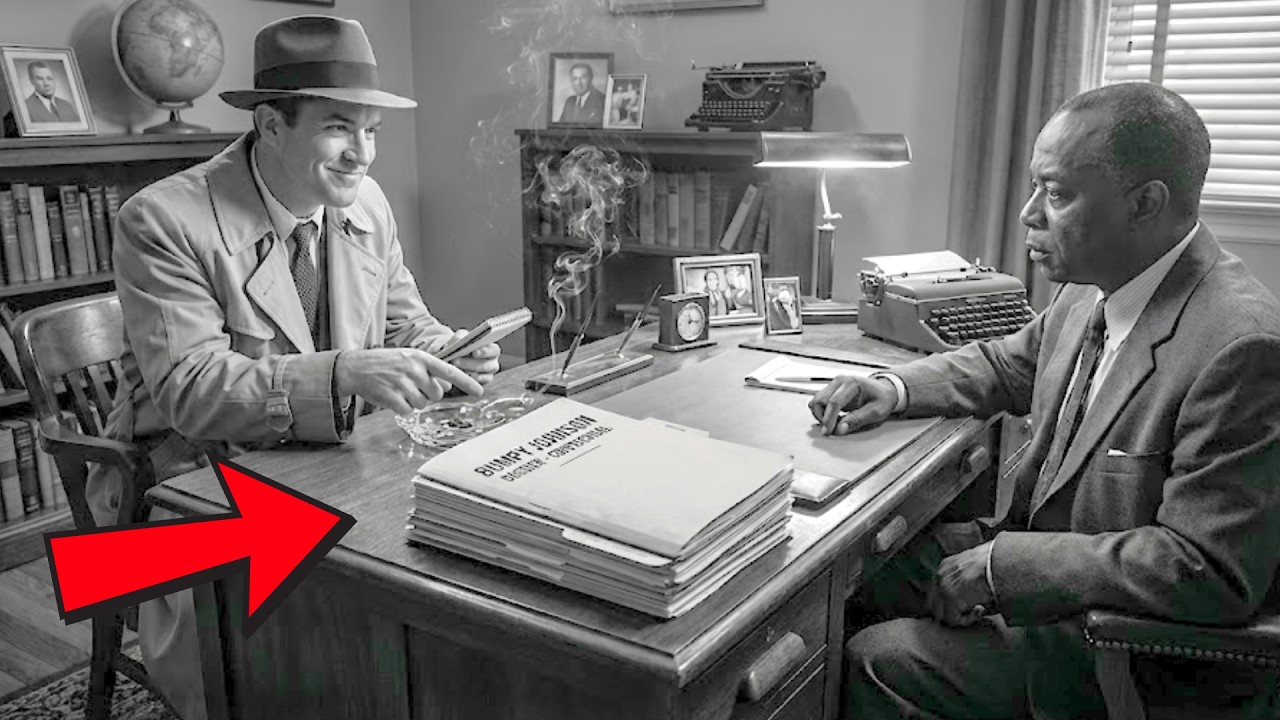
Fourteen blocks south and a world away, the ninth floor of the New York Tribune smelled like cold coffee and the particular desperation of men who build their lives around deadlines. Michael Sullivan sat at his desk at 11:15 that same night, jacket off, sleeves rolled to the elbow, a cigarette burning itself down in the ashtray because he kept forgetting to smoke it.
In front of him lay the file—thick, heavy, the kind of file that takes weeks to build and minutes to destroy a man with. Sullivan was thirty-six years old, Irish, Brooklyn-born, the son of a dock worker who had scraped and borrowed his way into a house in Flatbush and sent his boy to school with the specific ferocity of a man who understood exactly what education meant when you started from nothing. Sullivan had been a journalist for twelve years, a crime reporter for eight, and in those eight years he had written stories that sent three men to prison, ended two political careers, and built him a reputation he kept sharper than any award on his desk. He was good at this.
He knew he was good at this. The meeting with James Crawford had lasted eleven minutes. Crawford was sixty-two, editor of the Tribune for thirty years, a man who had survived every trend in journalism by trusting exactly two things: instinct and circulation numbers. He had called Sullivan into his office at four in the afternoon, pointed at a chair, and spoken the way he always spoke, like a man who had decided long ago that everything important could be said in two sentences if you chose them carefully.
“Bumpy Johnson. Harlem. I want the full story. Criminal operation, illegal gambling, organized crime connections.
Front page Sunday. ”
Sullivan had nodded. Standard. He had done fifteen stories like this.
Then Crawford leaned forward, and his voice dropped into a register Sullivan had heard only twice before, both times right before something consequential happened. “Everyone in this city thinks that man is some kind of Robin Hood. A hero. A protector of his people.
” Crawford’s jaw tightened. “I want you to show them what he actually is. Show them the crimes. Show them the money.
Show them the truth underneath all that legend. ”
He paused long enough to make the next sentence land with its full weight. “Bring me the real Bumpy Johnson—or don’t come back to this office. ”
It was not a threat, exactly.
It was something more precise: a test. Both men knew it. Both men knew Sullivan had never failed a test like this in eight years. Over the next three weeks, Sullivan built the file with the methodical thoroughness that was his professional signature.
Court documents going back to 1924. Police reports from three precincts. Financial estimates from two federal agencies. Arrest records—robbery, assault, weapons charges, conspiracy.
Time served in Sing Sing and Alcatraz, federal institutions from New York to California. Documented connections to the Genovese family, the Lucchese family. Names, dates, dollar amounts that locked together into a clean, irrefutable picture. The numbers alone were extraordinary.
The Harlem numbers racket—the policy game, illegal three-digit betting that ran through the neighborhood like a second currency—generated an estimated $50,000 a week, roughly $2. 5 million annually in today’s money. Bumpy Johnson controlled the largest share of it. His personal cut, by police estimates, sat somewhere between $500,000 and $700,000 a year.
For context, the average Harlem family earned less than $2,000 annually. On paper, it was airtight. On paper, Bumpy Johnson was exactly what the file said: a career criminal who had built an illegal empire on the poverty and desperation of his own community, who had evaded justice for two decades through intimidation and political connections, who needed to be exposed in print the way all such men needed to be exposed—clearly, completely, without sympathy. Sullivan lit a fresh cigarette and looked at the file and felt the clean, uncomplicated satisfaction of a man who knows what his story is before he writes it.
He had the structure. He had the facts. He had the quotes from police commissioners and federal prosecutors on the record, names attached. No room for ambiguity.
All he needed was one more thing: ground truth. The human faces behind the statistics. He decided to go to Harlem. He told himself it was due diligence.
He told himself it was thoroughness, the extra step that separated good journalism from great journalism. He told himself he was going to find the victims, the people whose lives had been diminished by Bumpy Johnson’s operation, and give them a voice in the story. What he did not tell himself, because he did not yet know it was true, was this: going to Harlem was going to be the most disorienting professional experience of his life. —
October 14th, 2:30 in the afternoon.
Sullivan came up out of the subway at 125th Street into the full sound and light of Harlem on a Wednesday in October, and the neighborhood hit him all at once. Sound first—jazz bleeding from three directions simultaneously, from clubs and windows and open doors, overlapping into something that was less music and more atmosphere. Then smell—food, coffee, the particular autumn density of a neighborhood where everything happens close together and nothing goes to waste. Then the people.
This was what stopped Sullivan most completely. The streets were alive in the middle of a Wednesday afternoon in ways he had not expected. Barberhops with customers spilling onto the sidewalk. Women in good clothes doing ordinary errands with a dignity that had nothing to prove to anyone.
Men at corners in conversation so animated it looked like argument from a distance and sounded like laughter up close. Children everywhere. Life layered and loud and completely unapologetic about itself. Sullivan walked down Lenox Avenue with the careful observation of a man trained to notice what does not fit.
What he noticed first was what was missing. He had covered organized crime neighborhoods before—Genovese territory in East Harlem, Lucchese blocks in the Bronx. He knew exactly what streets looked like when a criminal operation controlled them from above. Businesses with windows repaired too many times.
Shopkeepers who did not meet your eyes. A particular tightness in the way people moved, a compressed watchfulness in their bodies, the unconscious physical knowledge of people who have learned that danger can come from any direction, including the direction of the people who are supposed to protect them. Harlem did not look like that. Harlem looked like something Sullivan did not have a professional vocabulary for.
He opened his notebook and wrote a single word that surprised him when he saw it on the page: *Community. *
He stood on the corner and looked at what he had written and felt the first thread of unease. He started knocking on doors. He had a list of names—people identified by police as operating in the orbit of the numbers racket, people who should, by any reasonable theory of how organized crime works, be living under the pressure of Bumpy Johnson’s operation.
A woman who ran a beauty supply store. A man with a small printing business. A family operating a laundry on 132nd Street. Every conversation followed the same pattern.
Sullivan would introduce himself, explain the story, ask about Bumpy Johnson. There would be a pause—not the frightened pause of people afraid to speak, but a different kind entirely: the pause of people deciding how much patience to extend to someone who clearly did not understand the question he was asking. Then came some version of the same answer, delivered with the same flat, matter-of-fact clarity. “Mr.
Johnson, he takes care of people. ”
“Bumpy never hurt anyone in this neighborhood. ”
“I don’t know what you’ve been told, but whatever it is, it isn’t what happens here. ”
Sullivan pressed harder.
He asked about protection payments, about intimidation, about the mechanism by which a man controlling half a million dollars a year in illegal gambling kept an entire neighborhood compliant. He got patience in return—the particular patience of people who have explained something many times to people who arrived already knowing the answer. “You want to find someone afraid of Bumpy Johnson? ” one man said, leaning against the wall outside a barbershop on 128th Street, arms folded, looking at Sullivan with an expression that was not hostile but was very far from warm.
“You’re going to have a long walk, friend, because that person doesn’t live in Harlem. ”
By six in the evening, Sullivan had thirty pages of notes and not one line that matched the file on his desk. No fear. No victims.
No evidence of the exploitation that should, by every model he had ever used to understand how criminal operations function, be visible and documented and findable. Instead, everywhere he looked—loyalty. Deliberate, clear-eyed, chosen loyalty. He stayed another hour.
He walked more blocks. He talked to a woman running a small restaurant, a retired postal worker, a teenage boy doing homework on a stoop in the October chill. Same answer, different words, over and over. Sullivan got back on the subway and stared at his notebook the entire ride home.
He admitted to himself, quietly, alone in the moving train, that the story he had come to report was not the story that existed in Harlem. He did not yet know what story did exist. He only knew that his certainty—which had been absolute three weeks ago and solid as recently as yesterday—was developing something it had never developed before in eight years of professional certainty. A crack.
—
October 15th, he went back. He told himself he was being thorough. He told himself he was looking for the evidence he had missed. Both things were true, and neither was the complete truth.
The complete truth was that Harlem had gotten under his skin the way very few things had in twelve years of journalism, and he could not write the story he had while the thing he had felt walking those streets was still unresolved in him. By early afternoon he had more notes, more conversations, more of the same answer delivered in more different ways. He was crossing 131st Street, heading toward the subway, moving through the ordinary density of a busy Harlem block, when he felt a hand near his jacket pocket—there and gone in half a second, absorbed back into the crowd before he could turn completely around. He reached into his pocket.
An envelope. White, sealed, no name on the outside. Sullivan stepped to the side of the sidewalk, pressed his back against the wall of a hardware store, and opened it. Inside was a photograph.
He looked at it for a long moment. Then the meaning fully arrived in his understanding, and something in his chest went very still. The photograph showed a man alone at a desk in a large room, typewriter in front of him, file folder open, papers spread across the surface. The room was the ninth floor of the Tribune building.
The man was Sullivan himself, photographed from outside, through the window, from the street below. Sometime after midnight the previous night, when he had believed completely that he was alone. He turned the photograph over. On the back, three sentences in a careful, precise hand:
*You are writing the wrong story.
Come see me before you publish. E. J. S.
*
Sullivan stood on 131st Street in the October afternoon with the photograph in one hand and the open envelope in the other, and something happened that had not happened to him in eight years of standing in difficult situations with difficult information. He did not know what to do next. His hands were steady. Twelve years of training kept his hands steady.
But underneath the steadiness, the architecture of certainty he had spent three weeks building was doing something it had never done before. It was shifting. This was not how men like Bumpy Johnson responded to exposure. They warned you.
They applied pressure through intermediaries. They made you understand through channels you could not quite trace that the story was not worth the cost. They worked from the sides and from below and from directions you could not fully see. They did not photograph you through your own office window and send handwritten invitations to a meeting—unless they were not afraid of the story.
Unless they wanted the story, or a different version of it. Unless the man Sullivan had spent three weeks dismantling in a file folder was operating according to a logic that the file, for all its precision, had not come close to capturing. Sullivan looked at the photograph one more time. Lenox Avenue moved around him in every direction—people, sound, October light coming in at a low angle between the buildings.
He put the photograph back in the envelope, put the envelope in his inside jacket pocket against his chest. He could go home and write the story from the file. It was a good story. It was factually true.
It would run Sunday. It would probably win something. Crawford would be satisfied. Sullivan’s career would be exactly where it was before—solid, respected, moving in the right direction.
He could do that. It was the safe choice, the professional choice, the choice that required nothing from him except competence, which he had in abundance. But a man who controlled the largest criminal operation in Harlem had just reached across every wall between them and sent not a warning, but an invitation. And there was only one reason a man like that would do something like that.
He was not afraid of being exposed. He was afraid of being misunderstood. In the space between those two fears was something that Sullivan, standing on a Harlem sidewalk with a photograph of himself pressed against his chest, suddenly needed to find more than he needed the safety of the story he already had. He hailed a cab going downtown, went home to Brooklyn, sat at his desk until past midnight with his notes spread out and the photograph face-up beside his typewriter, and made the decision that would change everything he thought he knew about crime, about justice, about the city he had lived in his entire life.
He was going to meet Bumpy Johnson face to face. Not because the file was wrong, but because something the file had never thought to ask was the only question that actually mattered now. The most powerful man in Harlem had seen Sullivan coming from three weeks away. Had watched him work.
Had let him walk those streets and talk to those people and fill thirty pages of notes that contradicted everything. And then, at the exact right moment, had reached out and said, “Come see me. ”
That was not the move of a man running from anything. That was the move of a man who had already decided how this ends.
And Michael Sullivan, crime reporter, eight years of certainty behind him, realized with a clarity that was almost physical: he was not the one who had been hunting this story. He had been the one being drawn toward it. —
October 16th, 1948, nine o’clock at night. The young man who came to collect Sullivan was waiting outside the barbershop on Lenox Avenue, exactly as the message had said he would be.
Twenty years old, maybe twenty-one, well-dressed in a way that suggested deliberateness rather than wealth—pressed shirt, good shoes. The careful presentation of someone who understood that appearance was its own form of communication. He did not introduce himself. He simply said, “Mr.
Sullivan, follow me. ” And turned and walked. Sullivan followed because that was the only direction left. They walked three blocks, past Smalls Paradise, past the Apollo, past the ordinary nighttime life of Harlem moving around them in every direction.
Sullivan had his notebook in his jacket pocket and the photograph from yesterday pressed against his chest. He noticed things the way he always noticed things—the route, the turns, the way the young man walked with the unhurried confidence of someone who had made this walk many times and had never once needed to look over his shoulder. They stopped at a brownstone on 139th Street. Quiet block, residential, nothing announcing itself.
The young man knocked three times, paused, then twice. The door opened from the inside. The room Sullivan entered was not what he had expected. It was not the headquarters of a criminal operation.
It was not designed to intimidate or impress. It was simply a well-kept room. Hardwood floors. Artwork on the walls that someone had chosen because they actually looked at it.
A bookshelf along one entire wall filled with books that had been read—spines bent and broken in the particular way that only happens when a book has been carried and opened many times. The room said something about the man who inhabited it, and what it said was more unsettling to Sullivan than anything the file on his desk had managed to say. It said: *This man thinks. *
They went to the second floor, a study smaller than the room below, a single lamp burning on the desk.
There, in a chair angled toward a low table, sat Ellsworth Bumpy Johnson—not at a desk, not standing, not arranged in any posture of authority. He was bent slightly forward over a chessboard, moving a piece with two fingers, studying the resulting position with the focused attention of a man solving a problem that interested him. He did not look up when Sullivan entered. Sullivan stood.
The young man who had brought him disappeared back down the stairs without a word. The room was very quiet except for the faint sound of the street below and the small, precise sound of a chess piece being lifted and sat down again. Bumpy studied the board for another ten seconds. Then, without looking up, he spoke.
“How many steps did it take you to get here, Mr. Sullivan? ”
Sullivan paused. “From the barbershop?
Three blocks. ”
“Maybe that’s not what I mean. ” Bumpy finally looked up, and his eyes were the most alert eyes Sullivan had seen in a long time—the eyes of someone who is always processing more than the conversation in front of him. “I mean, from the moment your editor gave you this assignment, how many steps did you take to get to this room tonight?
”
Sullivan did not answer immediately, because he understood suddenly that the question was not small talk. “I know every step,” Bumpy said, his voice even, almost gentle. “Every person you spoke to, every door you knocked on, every note you wrote in that notebook you’re about to reach for. ” He sat back in his chair.
“I know what you found, and I know what you think it means. ” He gestured to the chair across from him. “Sit down, Mr. Sullivan.
Put the notebook away. We’ll get to that. ”
It was not a threat. Sullivan understood that immediately and completely.
It was something more precise than a threat. It was a declaration of the actual terms of the room, stated clearly at the beginning so that no one would waste time pretending otherwise. Sullivan sat. He left the notebook in his pocket, and for the first time since Crawford had pointed at a chair and given him this assignment, he was not certain he was the one asking the questions.
That uncertainty was about to deepen considerably. —
What Sullivan had prepared for was an interview. A subject who would deflect or justify or perform innocence, and Sullivan would apply the careful pressure of a man who had the facts, who had the file, who knew what the evidence showed. He had done this thirty times.
The subject talks around the edges. The reporter finds the center. The story writes itself. What happened instead was something Sullivan had never experienced in twelve years of journalism.
Bumpy Johnson leaned forward, laced his fingers together, and began asking Sullivan questions. Not hostile questions. Not the probing, calculating questions of a man trying to find leverage. Genuine questions, delivered with a curiosity that seemed, impossibly, to be exactly what it appeared to be.
“Your father. What did he do? ”
Sullivan blinked. “He worked the docks.
Brooklyn. Hard work. ”
“Yes. Did he own a home?
”
“He did. Flatbush. Took him twelve years to save for it. Bank loan.
He got one eventually. Took a few tries, but yes. ”
Bumpy nodded slowly. “And when he had the house, he could send you to school.
And school gave you a career. And the career gave you a desk at the Tribune and a file folder with my name on it. ” He paused. “That’s the American dream, Mr.
Sullivan. Twelve years of hard work, a bank loan, a house, a son with a future. Does that sound right? ”
Sullivan said nothing, because it sounded exactly right, and he could already feel, somewhere in the part of his mind that was faster than his conscious understanding, that the next sentence was going to be the most important sentence of the conversation.
“Now,” Bumpy said, without blinking, “change one thing. Make your father’s skin the same color as mine. ”
The room went completely still. Sullivan opened his mouth, then closed it, because he started to tell the story and the story immediately broke—not at the edges, not in the minor details, but at its very foundation.
The dock work was still there. The twelve years of saving were still there. The dream was still there. But the bank loan was not there.
And without the bank loan, the house in Flatbush was not there. And without the house, the school was not there. And without the school, the career was not there. And without the career, the desk at the Tribune and the file folder were not there.
The whole structure collapsed at the second sentence. Sullivan sat in the chair across from Bumpy Johnson and said nothing for a long moment, because there was nothing to say that was both true and adequate. “The file you’re carrying,” Bumpy said, “tells you what I do. It tells you very precisely what I do.
What it doesn’t tell you is why. And without the why, Mr. Sullivan, you don’t have a story. You have a charge sheet.
”
He stood, walked to the window, looked down at 139th Street. “I built something illegal because the legal version was closed. Not difficult. Not inconvenient.
Closed permanently by design. ” He turned back. “Now, you came here to interview me. Go ahead.
”
But Sullivan’s notebook stayed in his pocket, because the man standing at the window had just done something no subject in twelve years of interviews had ever done. He had made Sullivan question not the facts of his story but the entire framework through which he had been reading them. And a reporter whose framework has just been broken is not ready to ask questions. He is still trying to understand what happened to his certainty.
That was when Bumpy walked to his desk, opened the bottom drawer, and changed everything. He placed a folder on the table between them. Not a thin folder, not a summary. A folder as thick as the one Sullivan had spent three weeks building—thicker, in fact—and assembled with a precision that was immediately obviously the work of someone who had been collecting this information not for weeks, but for years.
“Open it,” Bumpy said. Sullivan opened it. The first pages were bank records. Not Bumpy’s bank records, but records of loan applications.
Dozens of them. Names, dates, credit scores, collateral offered, reasons for denial. The credit scores were good. The collateral was real.
The reasons for denial, in case after case, came down to a single variable that had nothing to do with creditworthiness and everything to do with the address on the application and the photograph attached to it. Sullivan turned pages. The pattern did not waver. It was not occasional.
It was not the result of individual prejudice at individual banks. It was systematic, consistent, documented across fifteen institutions over twenty years. Then the next section: landlord records. Buildings in Harlem where the same units rented for three times what comparable units rented for in white neighborhoods four miles away.
Names of landlords, names of buildings, dates, dollar amounts, complaints filed and ignored. Then police records. Not arrest records, but the other kind. Incident reports filed by Harlem residents that had been closed without investigation.
Businesses that had been targeted by extortion from outside the neighborhood, had reported it, and had received no response. Sullivan recognized some of the organization names in those reports. They were the same organizations the file on his desk connected to Bumpy Johnson as evidence of his criminal network. He turned to the final pages and stopped.
It was a list. Names, institutions, dollar amounts, dates. Sullivan read the first name, then the second, then the third. By the fourth name, he understood what he was looking at: a record of payments made to city officials, police commanders, and media figures by a coalition of real estate and financial interests that had a direct stake in keeping Harlem exactly as it was—contained, underserved, and invisible to the institutions that were supposed to serve it.
He turned to the last page. The name was there in the same clean typeface as all the others: James Crawford, New York Tribune. Three payments across four years from a real estate holding company that Sullivan recognized immediately, because it was one of the largest landlords in Harlem. Sullivan looked at the name for a long time—long enough that the silence in the room became a different kind of silence, not the silence of waiting but the silence of a man whose understanding of his own situation has just been fundamentally revised.
Crawford had not given him this assignment because he wanted the truth about Bumpy Johnson. Crawford had given him this assignment because a story that framed Bumpy Johnson as a predator served the interests of the people who were paying Crawford to look away from the actual predators. Sullivan had spent three weeks building a case, and the case was real and the facts were accurate, and the entire exercise had been designed from the beginning to point in the wrong direction. “The people in that file,” Bumpy said from across the room, his voice quiet and even, “are not afraid of your story about me, Mr.
Sullivan. They are counting on it. ”
Sullivan closed the folder. He did not speak for a moment.
When he did, his voice was steady, because twelve years had made his voice always steady, even when nothing else was. “How long have you been building this? ”
“Long enough,” Bumpy said. “Long enough to know that the file doesn’t matter if it never sees daylight.
Long enough to know that I am not the right person to publish it. ”
—
The conversation shifted after that—quieter, slower. The way conversations shift when the largest things have already been said and what remains is something more human and harder to prepare for. Bumpy sat back down.
He was quiet for a moment in a way that was different from his earlier silences. Those had been controlled, strategic—the silences of a man who chooses when to speak because he understands that silence is its own form of language. This one was different. This one cost him something.
“I want to tell you about a girl,” he said. “Her name was Sarah Mitchell. ”
Sullivan had his notebook out now, finally, pen in hand. But he did not write yet.
He just listened. “Eight years old. Lived on 128th Street. Smart child.
The kind of smart that teachers notice. The kind that makes you think about what she might become. Her father worked the docks. Her mother cleaned houses downtown.
Between them, thirty dollars a week, maybe a little more in good weeks. In the winter of 1945, Sarah got sick. Pneumonia. Bad, the kind that moves fast in children.
Her parents took her to Harlem Hospital. The doctor was honest with them. The child needed penicillin. Fifty dollars for the full treatment.
And without it, the outcome was not certain. ”
He stopped, looked at his hands for a moment. “Fifty dollars. Her father went to his foreman and asked for an advance.
The foreman said no. Her mother went to the church. The collection that month was twelve dollars. The pastor gave them every cent.
They went to a bank. The bank looked at the address on the application and said no before they finished the sentence. ”
Bumpy’s voice had changed. Not broken, not emotional in any way Sullivan could easily name, but different.
Quieter. Carrying something heavy. “Sarah died on a Wednesday, February 14th, 1945. The cause of death on the certificate said pneumonia.
The real cause of death was fifty dollars and a system that decided her life was not worth that much. ”
He reached into the desk drawer and took out a photograph. Small, worn at the edges, handled many times. He placed it on the table between them and did not take his hand off it for a moment.
Sullivan looked at the photograph. A little girl in a school uniform, eight years old, smiling—the specific wide smile of a child who has not yet learned to perform happiness, who is simply happy. He did not write anything. He looked at the photograph and felt something move in him that was not professional and was not strategic and was simply human.
“I was at a jazz club that night,” Bumpy said. “Someone told me about it. I didn’t know the family. Had never met them.
I went to their apartment two days later. ” He took the photograph back, held it carefully. “The father was sitting at the kitchen table, just sitting, looking at nothing. I gave him an envelope—money for the funeral, for the medical bills they’d accumulated, for food.
He looked at me for a long time. Then he said, ‘Where were you three days ago? ’”
Bumpy looked at Sullivan directly. “I had no answer, because he was right.
I was three days too late. And three days too late for a child is everything. ”
He put the photograph back in the drawer with the same careful deliberateness with which he did everything. And something about watching him with the tenderness of the gesture—the way he placed it like it was something that deserved to be placed gently—told Sullivan more about this man than the entire file on his desk had managed to convey.
“After Sarah, I started a fund. Anonymous. No names attached to mine. Any family in Harlem facing a medical emergency they cannot cover, the fund pays.
In three years: forty-seven families. Forty-seven people alive because of money that came from illegal gambling. ” He looked at Sullivan steadily. “You tell me if that money is dirty.
”
Sullivan did not answer. He was looking at the closed drawer where the photograph had gone. He was thinking about a father sitting at a kitchen table looking at nothing. He was thinking about the word that had appeared in his notebook on his first day in Harlem, the word he had not known how to account for.
*Community. *
This was what it meant. Not sentiment. Not mythology.
This was the specific, practical, costly work of a man filling a gap that the system had not left by accident but had constructed deliberately, and had then refused for decades to close. Sullivan stood. He picked up his notebook. He looked at Bumpy Johnson across the table and understood, with a completeness that surprised him, that he had been wrong about what kind of story this was.
Not wrong about the facts. Wrong about what the facts meant, which was a more fundamental error. He reached for his jacket. “Mr.
Sullivan. ” Bumpy’s voice was calm, precise—the strategic voice again, not the voice that had spoken about Sarah Mitchell, but the one that saw further down the board than anyone else in the room. “Sit down for one more minute. ”
Sullivan stopped.
Did not sit, but stopped. “Your story,” Bumpy said. “The real one, the one you now understand you need to write. It will be the most important thing you have published in your career.
It will also be the most dangerous. ” He paused, letting that land. “Crawford will read it before it prints. You know that.
And now you know why Crawford will not allow it to print. He has too much to lose. The moment that story reaches his desk, it disappears. And everything you found, everything you now understand, disappears with it.
”
Sullivan turned around slowly. “What are you saying? ”
Bumpy looked at him with an expression that was not triumphant and was not manipulative. It was simply the expression of a man who has thought about something for a long time and arrived at the only logical conclusion.
“I’m saying you have the truth. ” He placed one hand on the folder between them. “And I have the proof of why the truth will be buried if you try to publish it the ordinary way. ” He slid the folder across the table toward Sullivan.
“You need each other, Mr. Sullivan. Your story needs my evidence to survive, and my evidence needs your story to matter. A white reporter from Brooklyn and a black numbers man from Harlem.
The two people this city would least expect to be sitting in the same room for the same reason. ”
Sullivan looked at the folder, then at Bumpy, then at the folder again. “You planned this,” Sullivan said. It was not an accusation.
It was recognition. “I planned for the possibility,” Bumpy said. “There’s a difference. I planned for the possibility that if the right reporter came to Harlem with the right kind of honesty—the kind that is willing to be wrong about what it already knows—then something could be done that neither of us could do alone.
” He met Sullivan’s eyes. “Are you that reporter? ”
The room was very quiet. The street below had softened to its late-night register.
Fewer voices, music further away, the city settling into itself. Sullivan stood with the folder in his hand and twelve years of professional identity on one side and the photograph of an eight-year-old girl in a closed drawer on the other. He picked up the folder, put it under his arm, looked at Bumpy Johnson one last time. Neither man said anything.
There was nothing left to say that the room had not already said. Sullivan walked down the stairs, through the quiet ground floor, out onto 139th Street into the October night. He stood on the sidewalk for a moment, the folder under his arm, the cold air of midnight Harlem around him, and understood that he had walked into that brownstone as one kind of journalist and was walking out as another. He had come to expose a man.
He was leaving with the evidence to expose a system. The question followed him all the way home to Brooklyn, sat across from him on the empty subway car, and was still burning when he finally sat down at his desk at nearly one in the morning and placed the folder beside his typewriter. The question had two edges, both of them sharp. If he published the real story, he would lose his job, his career, possibly more.
Crawford would see to that. The people in that folder would see to that. Everything Michael Sullivan had spent twelve years building could be gone by Monday morning. But if he did not publish it—if he wrote the safe story, the clean story, the story the file supported and Crawford wanted and the system had engineered him to write—then someone else would pay the price.
Not Sullivan. Someone in Harlem. Someone without a file folder or a typewriter or a press credential. Someone whose only protection against a system designed to ignore them was a man running an illegal gambling operation from a brownstone on 139th Street.
Sullivan looked at his typewriter, then at the folder, then at the blank page he had rolled in three hours ago and had not yet touched. The question was not really about courage. It was about something simpler and harder than courage. It was about who gets to decide which truth is worth telling, and who pays the cost when the wrong decision is made.
He picked up his pen. He began to write. Not the story he had come to Harlem to write. The other one.
The one that had been waiting for him since the moment Bumpy Johnson smiled at a piece of news that should have frightened him and said, simply, let him come. —
October 19th, 1948, 7:45 in the morning. Sullivan had not slept. He had typed through the night, stopping only to refill his coffee and reread what he had written with the specific ruthlessness of a man who knows that what he is putting on paper matters in a way that most things he has written have not.
By the time the first gray light came through his Brooklyn window, he had four thousand words and a sealed envelope. Crawford’s office was on the corner of the ninth floor, glass on two sides. Sullivan knocked once and entered without waiting. Crawford was already at his desk, jacket on, the particular alert stillness of a man who has been in an office since before anyone else arrived.
He looked up when Sullivan came in, and something in his expression suggested he had been expecting this conversation. If not today, then very soon. Sullivan placed the article on the desk. Four thousand words, clean pages, his name at the top.
Then, beside it, without a word, he placed the sealed envelope. Crawford looked at both. He picked up the article first, the way a man reaches for the thing he thinks he already understands before turning to the thing he does not. He read in silence.
Sullivan stood. He did not sit, because sitting would have suggested he was waiting for permission, and he was not waiting for permission. He was delivering a fact. Crawford read for eight minutes.
Sullivan watched his face move through several expressions: the professional editor’s neutral focus at the beginning, then something tightening around the eyes in the middle, then a stillness at the end that was not the stillness of a man who has finished reading. It was the stillness of a man who has understood something he would have preferred not to understand. Crawford set the article down. He looked at the sealed envelope, picked it up, opened it, unfolded the single page inside, and read it.
The color left his face the way color leaves a face when the body understands something before the mind has finished processing it—gradually, then completely. The silence lasted a long time. “What do you want? ” Crawford said.
His voice was even, professional—the voice of a man who has survived thirty years in this business by never letting a room see him lose his footing, even when he has lost it. Sullivan looked at him across the desk. “Front page. Sunday edition.
Not one word changed. If I run this, you run it,” Sullivan said, “because it is true. Because you are an editor, and that is what editors do with things that are true. ” He paused.
“And because the alternative has consequences that neither of us wants to spend the rest of our careers managing. ”
The silence that followed was a different kind of silence. Not the silence of shock, but the silence of a man doing arithmetic, running numbers, calculating the distance between two unpleasant outcomes and deciding which one is further from the cliff edge. Crawford looked at the page in his hand one more time.
Then he set it down on top of the article, very carefully—the gesture of a man placing something in a specific location so that he will always know exactly where it is. “Sunday,” he said. “Front page. My editor’s note goes with it.
”
“Fair enough,” Sullivan said, and walked out. —
The article ran on Sunday, October 19th, 1948, under a headline that Sullivan had written himself and that Crawford had not changed: *The King of Harlem: A Criminal the System Made. *
It opened with Sarah Mitchell. Eight years old.
February 14th, 1945. Fifty dollars. A system that said no. It laid out Bumpy Johnson’s crimes with complete precision and without apology—the numbers racket, the money, the arrests, the two decades of operating outside the law.
And then it did something that almost no crime story published in an American newspaper in 1948 had done. It asked *why*. Not rhetorically, not as a literary device, but as a genuine, documented, evidenced question that the reporting had earned the right to ask. Harlem read it and wept.
Churches passed copies hand to hand. The Tribune received more letters that week than it had received in response to any single article in fifteen years. Some called Sullivan a hero. Some called him a criminal sympathizer.
Some called him the first journalist who had bothered to look at their neighborhood and see it as it actually was, rather than as the city preferred to imagine it. Civil rights leaders quoted the article in speeches. Police commissioners called it dangerous propaganda. Three United States senators received copies in their mail from constituents who had underlined specific paragraphs.
Sullivan received the Pulitzer Prize the following spring—not for defending Bumpy Johnson, the citation was careful to note, but for illuminating the systems that make men like Bumpy Johnson not merely possible but inevitable. Crawford resigned six months after the article ran. Quietly, citing personal reasons. The real estate holding company whose name appeared in the sealed envelope dissolved its New York operations within the year.
Neither event was publicly connected to the article. Everyone who needed to understand the connection understood it. Three weeks after publication, a letter arrived at the Tribune with no return address, postmarked Harlem. Sullivan opened it at his desk.
Inside, one sentence in the same careful, precise handwriting he had seen on the back of a photograph two weeks earlier:
*Thank you for seeing the whole picture. E. J. J.
*
Sullivan framed it. He kept it on the wall above his desk for the rest of his career, next to the Pulitzer citation, so that every morning when he sat down to write he could see both things at once: the recognition the institution had given him, and the acknowledgement from the man who had trusted him to tell the truth when the easier path was right there, safe and well lit, waiting to be taken. —
July 7th, 1968, twenty years later. Sullivan was fifty-six years old, gray at the temples, with the kind of tired that comes not from age but from two decades of paying attention to things that most people prefer not to see.
He stood on the street outside the church on 139th Street and watched Harlem say goodbye to Ellsworth Bumpy Johnson. The crowd stretched for two blocks. Not a crowd of criminals. Not a crowd of loyalists who had no choice but to appear.
But a crowd of the specific, ordinary, irreplaceable people who make up the actual texture of a neighborhood. Doctors. Women who had raised children in Harlem apartments for forty years. Men who had worked the same jobs their entire lives.
Children who had come because their parents told them this was a moment that mattered and they should be present for it. Teachers. Business owners. A retired police officer Sullivan recognized from a conversation twenty years ago, standing near the back with his hat in his hands.
Sullivan stood among them and looked at the church and thought about a room on the second floor of a brownstone where a man had played chess alone at nine o’clock at night and asked him how many steps it had taken to get there. He thought about a folder full of evidence that a system had built against itself, assembled over years by a man who understood power well enough to document it. He thought about a photograph of an eight-year-old girl placed in a drawer with the careful tenderness of a man who had decided that particular weight was his to carry. This was not a criminal’s funeral.
This was the funeral of a man who had looked at the gap between what his city promised and what it delivered, and had decided—not naively, not without cost, not without doing things the law correctly identified as wrong—to fill that gap with whatever he had available, which happened to be intelligence, discipline, and the particular kind of courage that does not announce itself because it is too busy working. A reporter standing nearby recognized Sullivan and moved closer, notebook out. “Mr. Sullivan, any comment on Bumpy Johnson’s legacy?
”
Sullivan thought about what to say for a moment. Then he said the only thing that was both true and sufficient. “I came to Harlem in 1948 to expose a villain. I found something more complicated.
A man shaped by injustice who used the only tools available to him to push back against it. Was he a criminal? Yes. That is not in dispute.
But the more important question was never what Bumpy Johnson was. It was why Harlem needed him more than it needed the people who were supposed to protect it. ”
The reporter wrote it down. Sullivan looked back at the church.
The question that stayed with him, the one he turned over that entire afternoon and still had not finished turning over when he sat alone that evening in his apartment on the other side of the city, was the one that had no answer. Not because the answer was unknowable, but because the answer required imagining a world that had not been built—a version of America that had made different decisions at every level, in its banks, its courthouses, its police precincts, its schools—and asking what a man like Ellsworth Bumpy Johnson would have become inside that world. A lawyer, maybe. A doctor.
An architect of systems rather than a dismantler of them. A man whose name appeared in newspapers for reasons that required no explanation and no apology. A man whose gifts—and they were extraordinary gifts, Sullivan had understood that from the first ten minutes in that room—had been allowed to build something that lasted longer than one man’s life and served more people than one neighborhood. The system had not allowed that.
The system had looked at Bumpy Johnson and seen a threat to be contained rather than a force to be cultivated. And so it had contained him, and in containing him had made him exactly what it feared, and then had pointed at what he became as evidence that the containment had been necessary all along. That was the real crime in the story. Not the numbers racket.
Not the illegal gambling. Not the arrests that stacked up in a file folder on a ninth-floor desk. The real crime was a system so committed to its own architecture that it would rather produce a Bumpy Johnson than admit the architecture was wrong. Sullivan never stopped asking that question.
It was still the most important question journalism had given him in fifty years of questions. Not *what did this man do*, but *who could this man have been if the world he was born into had been willing to find out*.
