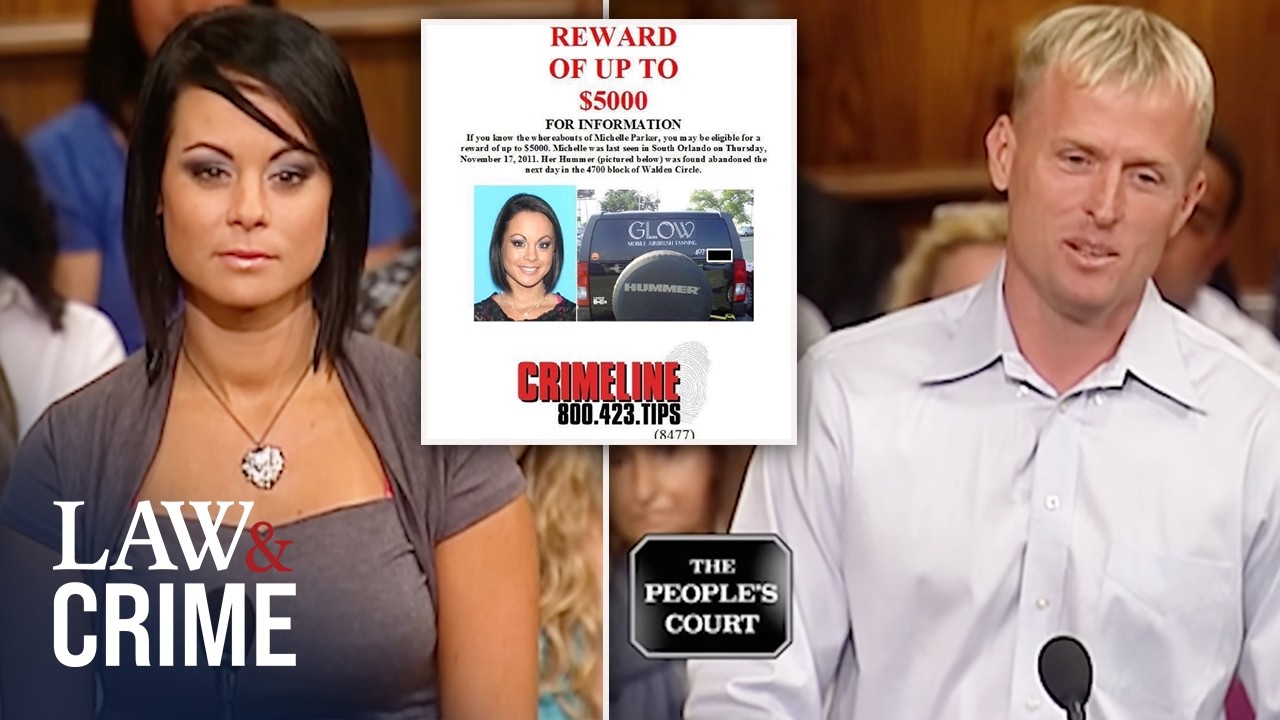
On November 17, 2011, Michelle Parker dropped her three-year-old twins off at their father’s apartment in Orlando and drove away. She was never seen alive again. For nearly fifteen years, her family waited for someone to be held accountable. Then, this week, police arrested Dale Wayne Smith Jr.
, her ex-fiancé and the father of those twins, and charged him with her murder. Brad and Gail Parker, Michelle’s father and stepmother, learned about the arrest the same way everyone else did: through a police news conference. They had spent a decade and a half hoping for this moment, and it still landed like a shock. “It’s kind of you try not to think that, because you wouldn’t want to think that somebody that loved somebody that had children with somebody would go that far,” Brad said.
At Smith’s first court appearance, his attorney announced that he had read through the 46-page affidavit police assembled for the case. The document remains sealed, so the public has not seen what evidence investigators relied on. Smith’s attorney said his client maintains his innocence. The case was national news when Michelle vanished.
Her vehicle was found, but what happened to her, where she went, and what became of her body have always remained a mystery. Police say they believe they have finally cracked it. Michelle Parker was 33 years old on the day she disappeared. She had gone to Smith’s apartment to drop off their twins, and surveillance cameras captured her arrival.
Smith was 40 at the time. He was the last known person to see or hear from her. That same day, an episode of The People’s Court featuring the couple aired on national television. The episode was titled “The Missing Ring,” and it is still available on YouTube, about twenty minutes long.
The dispute behind it was an engagement ring Smith said Parker had thrown during an argument at a Hard Rock hotel, a ring that was never found. He wanted $5,000 for it. According to the episode, the couple started dating in 2006. Their relationship was on again, off again, but they got back together, and in 2010 Smith bought the ring and proposed.
Parker said yes. Then the engagement fell apart. During the fight at the Hard Rock, Parker threw the ring, and it vanished over a balcony into the hotel atrium. “Somebody might got a $5,000 ring,” Brad Parker later noted.
On the show, Michelle alleged that Smith had cheated on her repeatedly during their relationship. She claimed that at one point during their time together, she came home to find seven women in the house. The judge split the blame and ordered Parker to pay half the ring’s value. Smith was not satisfied; he felt she should be responsible for the entire amount.
Brad Parker said the family had no idea Michelle was going on the show. “She didn’t tell us at all,” he said. The way he understood it, Smith was taking her to real court over the ring. Going on The People’s Court meant the expenses were covered, and Michelle did not have money to pay for the ring.
So she agreed to appear. But the experience changed things between them. “When the judge is making you feel like a fool, and then the whole world’s going to see this, you can’t go back with this person,” Brad said. “You can’t have all this go on and say all these things about your roller coaster ride relationship, and then go back again.
”
The episode aired on November 17. On that same day, Michelle Parker disappeared. Her brother texted her asking where she was. Her cell phone texted back the word “Waterford,” an area of Orlando.
But police said the location data from that phone placed her closer to Smith’s apartment, which was not in Waterford. Shortly after, the phone stopped transmitting. Divers later found the device under a bridge, in the water. Just before 9:00 p.
m. that evening, cameras spotted Parker’s SUV driving through Orlando. Its identifying stickers were gone. The next day, the vehicle was found in the parking lot of an abandoned apartment building.
Parker herself was gone. Police considered Smith a suspect from the beginning, but they never arrested him. He had custody of the couple’s children, and Michelle’s parents claimed over the years that he never let them see their grandchildren. In 2020, the family’s wrongful death lawsuit against Smith was voluntarily dismissed.
In 2023, police searched Smith’s house for remains. They found nothing. Then, this week, police took Smith into custody at his workplace. At the news conference announcing the arrest, Orlando police explained what had changed.
“Over the past year, we expanded our investigative team looking into this case and took a fresh focused look at all of the evidence,” they said. “We re-examined testimony and conflicting statements made by the suspect and used advanced and digital forensics to uncover and analyze additional evidence. This case never stopped being a priority. ”
They would not say specifically what the evidence showed.
But they said advancements in technology, particularly digital forensics, allowed them to interpret data from 2011 in a new way. “Some of that information revealed more detailed location data and communications between devices that they used back then,” police said. Michelle’s father and stepmother had their own theories about what happened that day. “Michelle told us he was smacking her around.
That’s the first thing, man. You don’t hit my daughter,” Brad said. He believed The People’s Court appearance was the final break. “There she is, right in the public view being filmed, and you can still see it,” he said.
“The embarrassment of that. People would leave and the judges are like, why are you guys still going back and forth with each other? And then Michelle said, ‘I’m done. ’ So at the end of the day, she couldn’t be swayed anymore.
”
Brad’s speculation was blunt. “He tried to see if she would come around and give in, and she said no, I’m done. And he, his narcissistic, controlling personality said, well, if I can’t have you, nobody will. And took her out of the picture.
”
Smith’s attorney, who has represented him since 2011, spoke with Law & Crime’s Vinnie Politan about the sealed affidavit. He said a lot of the evidence involved text messages between Michelle and Dale. “Obviously these text messages don’t show them having the most healthy relationship, but there’s nothing in there that shows that there was any premeditation to commit murder or any intent to commit murder,” he said. “It just shows what we saw in The People’s Court, the two of them would get under each other’s skin.
”
When asked whether the evidence placed Smith near Michelle’s discarded phone or her truck spotted at 8:55 that night, the attorney said police have “different times when her phone was being looked at, the direction where she was at and stuff, but as far as where her vehicle was at, no, at the time when it was discarded. ” He acknowledged the timeline was detailed but said “a lot of it wasn’t anything that is new to me. It’s not something that I didn’t know 15 years ago when I got onto the case. ”
The Parkers said Smith would not help them during the search for Michelle.
“He wouldn’t talk to us,” Brad said. Before everything happened, the families had been on friendly terms. Smith’s father was a roofer and had come to the Parker house to look at their roof. When investigators raided the father’s house and he was upset, Brad reached out to him to ask if there was anything he wanted to express.
“He hung up the phone on me,” Brad said. “He was nasty. His own things happened to him, just like these things happened to us. But I was trying to be respectful and not judgmental, and he hung up on me.
”
Brad described his relationship with Smith before the disappearance as zero. At the twins’ third birthday party, Smith arrived with the children and left within the hour. “He wasn’t feeling welcome,” Brad said. “He already had ups and downs with Michelle, but he was the father.
” Smith was withdrawn, did not open up, and communicated poorly. “No friendly, loving dovey kind of situation,” Brad said. Michelle’s family also struggled with the loss in ways that went beyond the search. “She was the glue that kept us all together with both sides of the family spending time, you know, Christmases, Thanksgivings,” Gail Parker said.
“When she was gone, it was November 17th of 2011. Thanksgiving was right after that. Blew that out of the water. Christmas blew that out of the water.
New Year’s blew that out of the water. And then her birthday is January 20th. So you got four occasions right after the other that totally got destroyed. ”
Gail remembered Michelle with a stepmother’s pride.
“She treated me like I was just her parent. She never talked back to me. She never disrespected me. And this is the kind of person she was.
So many friends. ” Then she added, simply: “The good die young. And Michelle was good. ”
Brad Parker said he is frustrated with the Orlando Police Department, a frustration he acknowledged openly.
The arrest is a step in the right direction, but he still wants to know what happened to his daughter and where she is. He also noted that the family has been kept away from Michelle’s twins for fifteen years. The children were three years old when their mother went missing. Dale Smith has had full custody the entire time.
Retired NYPD Detective David Sarnie weighed in on how the case could have moved forward after so long. When he started as a detective, he said, “We were typing on typewriters. ” Technology available in 2007 to 2011 did not change dramatically, but digital forensics has since opened new possibilities. Investigators used to get only call detail records.
Now they can do geofencing warrants and ping phones to track locations. “Technology has allowed this case to move forward more so than it would have been in 2011,” Sarnie said. “Unfortunately, when you have circumstantial evidence and it’s not enough to bring you probable cause, which in this case it seemed not to be at that time, they couldn’t make the arrest. ”
Sarnie explained that the wrongful death suit could have helped the investigation.
Smith would have been deposed and asked questions under oath. Inconsistencies between his statements in 2011 and his later testimony could be significant. “So, if he says I’m at place A, and the next time he speaks he’s in place B, what evidence do we have to refute that? ” Sarnie asked.
The technology available now helps investigators confirm or refute those claims and build a timeline. The retired detective also addressed the reality of cold cases. Murder cases have no statute of limitations, and they get passed down to new detectives over the years. “You need a new fresh set of eyes,” he said.
He credited the detectives and analysts who found movement in this case. “They didn’t have it in 2011. I don’t think they had it in 2014. It took about a year.
They started moving within the last year or so. They got something, some technological advancement helped them move this case along. ”
Sarnie noted that Smith never left Orlando. He could have moved anywhere, but he stayed, and police knew where he worked because that is where he was arrested.
The detective also questioned the Orlando police chief’s comment that the department could now look at older cases because the homicide rate had dropped. “I don’t like that answer, but I will understand it, because when you’re busy, something’s pulled by the wayside,” he said. “This case was such a high profile case, especially in Orlando, that this never went off the radar particularly. It just didn’t have the time or the technology available to do anything more.
”
There is still no body. No DNA has been linked publicly. The defense will argue there is no proof. But the prosecutor’s office determined there was enough evidence to make the arrest.
As Sarnie put it, cops make arrests based on probable cause; a prosecutor’s presumption is that the case can be prosecuted beyond a reasonable doubt. “That seems to be what’s going on here,” he said. “The arrest is a big part of this,” Chris Stewart noted. “Dale Smith is maintaining his innocence according to his attorney.
We don’t know his side of the story. ” In 2011, Smith’s attorney told the Today show that the timeline just didn’t match up, that it wasn’t possible for him to have done this. The sealed affidavit and the digital evidence that was revisited may change that. “To keep a secret like this for fifteen years, and you have your family and your girls,” Sarnie reflected.
“Those twins have been in his custody, in his care and control for fifteen years. And somehow none of it, he’s never alluded anything, nothing has come out of it. But this is the unusual thing. Maybe that’s the reason why.
He felt so comfortable, he felt he did nothing wrong. Whatever it is, I don’t know. But there’s enough evidence to support an arrest. But from arrest to prosecution, that can always change.
”
Smith remains in jail without bond, accused of second-degree murder. His attorney said his client maintains his innocence. The affidavit remains sealed, and the full picture of what police found is still unknown. For Brad and Gail Parker, the arrest is finally a step forward, but the search for answers is not over.
“You think when it happened that there’s so many people that came out of the woodwork to try to search for her,” Brad said. “It’s like you figure we’re going to find her any minute. We’re just going to find her any minute. And then now it’s fifteen years later.
”
