The wind had shifted sometime in the night. He felt it first in his bones, the way he always felt weather coming, but this was different. The sound was what woke him, a long, low, woody groan, like a tree bending slowly past its breaking point, and then silence. He sat upright in the corner of the cabin where he had been sleeping for three nights, the rifle across his knees, and listened.
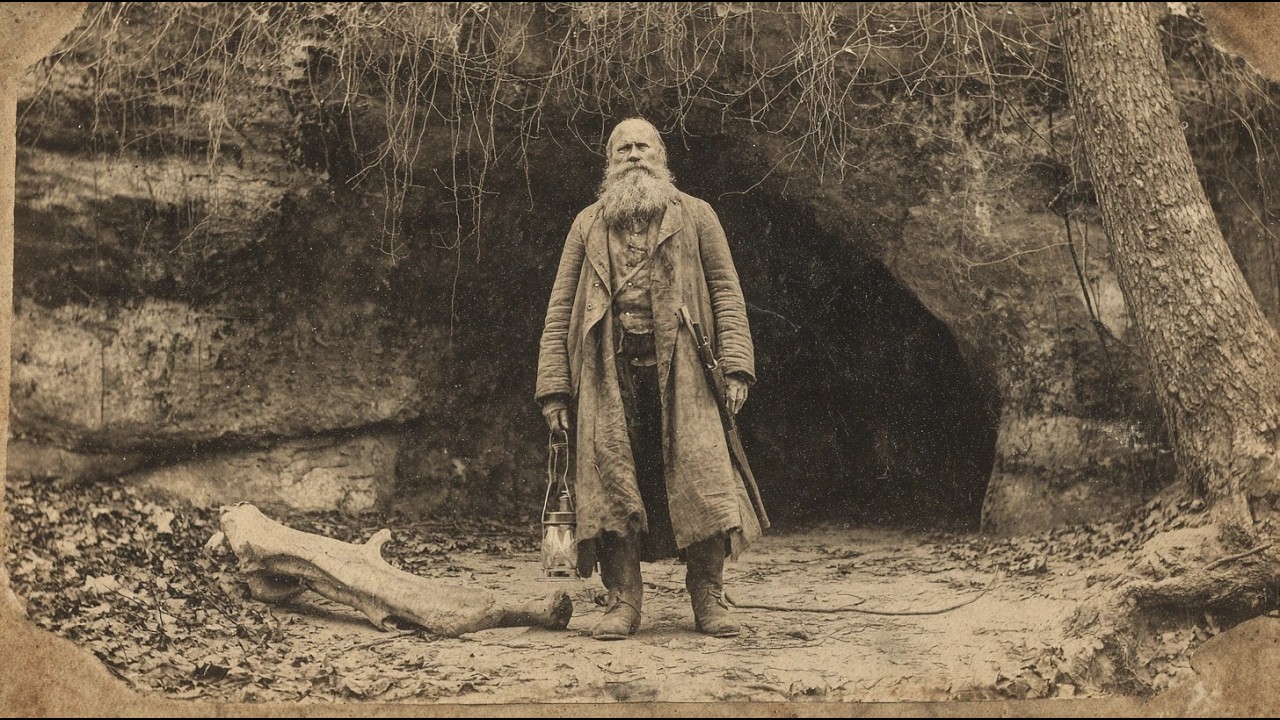
Nothing came. Nothing moved. But in the darkness, he knew something was out there on the ridge above his cabin, and he knew it was watching. Obadiah Renshaw was a trapper, 46 years old, a tall man built lean as a fence rail, his face weathered into something that looked carved rather than grown.
He lived alone in a one-room cabin of white oak and river stone, twelve miles from the nearest road and twenty-three miles from Hollow Leaf, the small town where he went only when he needed sugar, salt, lamp oil, and lead. He had a Jersey cow named Bess and an old half-hound named Pirate, and he spoke to both of them more than he spoke to any human being. He had made peace with silence. He knew the silence of the woods the way a sailor knows the silence of the open sea.
It had started in late September. On the morning of September 28th, 1873, he was running his trap line along the upper fork of a creek called Sallow Branch, a stretch of country he had worked for nineteen years. He knew every stump, every blowdown, every place a beaver might dam. He could have walked it in the dark with no moon and not put a foot wrong.
And on that morning, he found a print in the soft mud beside the creek that he could not name. It was deep, deeper than a bear, but it wasn’t a bear. A bear has five toes and a wide pad. This print had four.
Long, narrow toes splayed wide, with what looked like the gouge of a claw at the tip of each one. The whole impression was about the length of his forearm. He set down his rifle, knelt, and measured it with his belt. Twenty-one inches long, eleven inches across at the widest.
He sat back on his heels and looked up the creek, then down it, and the back of his neck went cold in a way that had nothing to do with the morning. He found no other prints. Just the one. As if whatever had made it had stepped down out of the air, set its weight into the mud, and stepped back into the air again.
He went home that day without checking his traps. On the walk back along the high side of the ridge, he felt for the first time in nineteen years of trapping that country that he was being watched. Not stalked. He knew what being stalked felt like; a panther had stalked him once in 1858.
This was different. This was the feeling of a man standing across a room from you, perfectly still, not coming closer, just looking. That night he wrote in his journal by the light of a tallow candle. He chose his words carefully.
“I have seen a print today which I cannot account for. I do not know what made it and the not knowing has put a weight in my chest that I have not carried since my father died. ”
Three days later, on October 1st, he came home at dusk to find his cabin door standing open. He had latched it that morning.
He approached the cabin sideways, like a hunter approaching a wounded animal. Nothing inside was missing. Nothing was moved. But the air in the cabin smelled wrong.
It smelled like an animal had been there, but not any animal he recognized. A deep, rank, oily smell, like wet fur left to mildew, and underneath it, something sweeter. He wrote that it reminded him of the way a deer carcass smells on the second day, when the meat is just beginning to turn. He searched twice by lamplight.
Nothing. He stepped outside and found Bess in the lean-to, but she would not come out. She stood at the back against the far wall, head down, breathing hard, the whites of her eyes showing. When he laid his hand on her flank, she trembled under his hand the way no animal he had ever owned had trembled.
Pirate lay flat by the stove, his one good eye on the door. The dog did not get up. He slept that night with the rifle across his knees. Around what he judged to be three in the morning, he heard the sound from the ridge: the long, low, woody groan, and then silence.
In the morning he found three of the split oak rounds from his woodpile moved. Not knocked over. Lifted carefully off the top of the stack and set upright on the ground beside it, in a perfect line. Each one was heavy, the way oak is heavy.
No wind did that. No animal did that. He set the round back where it had been, in its perfect upright spot, because moving it felt like an answer he didn’t want to give to a question he didn’t yet understand. For the next ten days, nothing else happened.
He kept to the cabin. He cleaned his rifle three times in a week, which was twice more than he ever cleaned it. By the second week of October, he had begun to talk himself out of what he had seen. A man can talk himself out of almost anything, given enough days.
By the third week, he had stopped keeping a regular trap line. He went out with his rifle and a long knife, looking for something, though he wouldn’t have been able to tell you what. On October 18th, he found the bone. He had followed Sallow Branch farther up than he had ever gone, past the swampy bottom, into a high hollow where the creek narrowed to a thin silver thread between two long ridges.
His grandfather had told him there were old caves up there, long dry. The hollow felt different. The trees grew farther apart. The ground between them was bare in a way that felt swept rather than empty.
There was no birdsong. The creek itself was wrong. The water was moving; he could see the small swirls around the stones. But the water made no sound.
He knelt and listened. Nothing. He found the cave a little after noon, set into the base of a limestone bluff, half hidden behind a curtain of dead grapevine. The mouth was narrow, maybe four feet across, but it widened inside.
He stood in front of it for a long while. The ground in front of the cave mouth was bare. No tracks. No droppings.
No bones. Animals leave a story. This cave had no story. He lit his brass lantern, ducked under the curtain of dead vines, and stepped into the dark.
The cave widened at once. The floor was dry and dusty and even, almost as if it had been swept. The air inside was cold and dry and still. He walked maybe forty feet when the lantern light fell on it.
A bone, lying near the back wall. Just one. It was so large that for a moment his mind refused to take it in. It was a femur, a thighbone.
He paced its length, standing it on end. It came up to the middle of his chest, and Obadiah Renshaw was a tall man. The ball joint at one end was the size of a pumpkin. It was not the legbone of any animal he had ever seen or read about or heard tell of from any hunter, trapper, naturalist, or Indian elder in his entire life.
There were no other bones. Just the one, lying alone in the dust. He did not touch it. He stood looking at it for a long time, and then he became aware that the bone was not where it had originally lain.
It was clean. There was no dust on it. The floor around it was dust, but the bone itself was clean. Something had moved it.
Something had set it there. He raised the lantern and saw the passage continuing deeper into the hill. He took half a step toward it, then stopped. In the dust of the floor between him and the dark, the lantern caught a faint line.
A drag mark, as if something had been pulled slowly across the floor from the deeper dark to where the bone now lay. The bone had not walked itself out of the dark. Something had brought it. He left the cave faster than he came in.
He did not run; he walked at the brisk pace of a man who has decided to be elsewhere very soon. When he stepped back into the light, the sky had changed. A heavy ceiling of slate gray cloud had come in from the north. And on the bare ground in front of the cave mouth, where there had been no tracks at all when he arrived, there were now three prints.
Each one identical to the one he had found by Sallow Branch three weeks before. Twenty-one inches long, eleven inches across. They were arranged not in a line of travel, but in a triangle with the cave mouth at its center. As if something had stood at three points around the cave while he was inside it, and waited.
He wrote in his journal for two hours that night. The last paragraph was different. “I do not believe this is an animal of any kind I have known,” he wrote. “I do not believe the bone is recent.
I believe it was placed there a long time ago by hands not unlike a man’s, but greater. And I believe whatever moved it and moved my woodpile is not the same thing whose bone now lies in that cave. The bone is dead. The thing that moves it is not.
I will not go back. I will not go back. I will not go back. ” He underlined that last sentence three times.
The ink is gouged into the paper. The pen broke at the end of the third line. There are two accounts of what happened to Obadiah Renshaw between October 18th and November 3rd, 1873. The account he wrote himself in his journal, and the account the man who came looking for him gave to the deputy sheriff in Hollow Leaf two weeks later.
They do not match. In the journal, the entries continue almost daily. He kept the door bolted. He slept little.
On the night of October 22nd, he heard something walk across the roof of his cabin. Not run. Walk, slowly, deliberately, from one end to the other. He counted the steps.
“There were 11 steps from one end of the roof to the other and the cabin is 14 ft long,” he wrote, “which means the stride was a handsbreadth more than a foot. ” It did not come down. The sound simply ended. On the morning of October 23rd, he found Bess dry.
She had given him milk every morning for seven years. That morning she gave him nothing. He wrote that her udder was slack and cold, as if she had not held milk in days, though he had taken half a pail from her at sunset the night before. She looked at him with eyes that were, he wrote, “the eyes of a creature that had given up.
”
On October 24th, he walked out to the grave of his wife Rosaline, who had died of a fever in the winter of 1864 while a snowstorm closed the trail for nine days, and whom he had buried in the spring, in a clearing he could see from his front step. The air around the grave was warm. He laid his hand on the stone he had set there nine years before, and the stone was warm to the touch, though the day was cold. “I do not know if she is restless,” he wrote.
“I will not ask the question I want to ask because I’m afraid of who would answer it. ”
On October 25th, the smell came back inside the cabin. He found nothing missing, but on his table, in the thin layer of flour dust where he had been kneading hardtack the day before, there was a mark. A single mark, the print of one finger.
The finger had been the length of a man’s whole hand from wrist to tip. He scraped the flour off the table and buried the hardtack in the woods. On October 26th, he found a place on the south side of the clearing where the leaves had been pressed flat, as if something heavy had stood there for a long time watching the cabin. He measured the area with a length of twine.
Whatever had stood there had been at least ten feet across at the base. On October 27th, Pirate would not leave the cabin. He lay under the cot and shook. Obadiah wrote, “He is the bravest creature I have ever owned.
I have seen him stand to a sow bear with cubs and not move a step and tonight he will not put his head out the door. He knows something I do not and I do not believe he is wrong. ”
On October 28th, the dreams began. Every night he dreamed of the cave.
In the dream he walked back into it, and the bone was on the floor, and then in the next dream there were two bones, and then three, and then four. In the dream of November 1st, the cave floor was full of bones, all of them the wrong size, all of them clean, all of them arranged, not piled, arranged like pieces of a puzzle being slowly assembled. In the dream there were footsteps behind him, coming into the cave. He never turned around.
He always woke up before he had to. On the morning of November 2nd, he found Pirate dead at the foot of the cot. There was no mark on the dog, no wound, no blood. The dog had simply stopped.
Obadiah wrote that the dog’s one good eye was open and pointing at the door. He buried the dog behind the cabin, and when he came back inside he wrote one line. “The woods are quieter today than they have ever been,” he wrote, “and I do not think I am the one keeping them quiet anymore. ”
A second entry that evening was added in a hand less steady than his usual hand.
In the lean-to, the door had been closed, and he had not closed it. Bess turned her head and looked at him, and he wrote that he did not believe she knew him. “Her eyes had no recognition in them,” he wrote. “They were the eyes of a creature looking at a stranger.
”
The last entry in the journal is dated November 3rd, 1873. It is short. “The dreams have stopped. The smell is gone.
The woods today are quiet and it is the wrong kind of quiet. I am going to walk to the ridge above the cabin to see what is there. If I do not return by dusk, whoever finds this, do not look for me. Burn the journal.
Burn the cabin. Leave the cave alone. The thing that walks does not want to be known. ”
Fourteen days later, on November 17th, a fur buyer named Augustus Pell rode out from Hollow Leaf to the cabin, as he did every November to buy Obadiah’s autumn furs.
He found the cabin shut up, the door bolted from the inside, no smoke from the chimney. He shouted for an hour. He saw no tracks of any kind, human or animal, in the snow that had fallen the week before. The snow around the cabin was unbroken.
Pell broke down the door. Inside the cabin was empty. The journal was on the table, open, the candle burned down to a stub of black wax. The rifle was on its peg.
There was no sign of struggle. But the door had been bolted from the inside. In the lean-to, Bess was lying dead on the straw, peaceful, her head turned toward the door. She had been dead, by his judgment, for perhaps three days.
In the corner of the lean-to he found a single feather, longer than his forearm, dark gray, the quill thicker than his thumb. He had never seen a feather like it before. He walked north, up the ridge above the cabin. He found a single set of footprints in the snow.
They began in the middle of a clearing, with no tracks leading to them. They were Obadiah Renshaw’s boot prints, recognizable by the heel cleat he had hammered in himself in a star pattern. The prints walked in a straight line for forty yards. Then, halfway through the forty-first yard, they stopped.
Not faded, not covered up. Stopped. The left boot print was complete. The right boot print, the one that should have come next, was only the heel and the back half of the sole.
The toe and the front half were not there. As if Obadiah Renshaw, in mid-stride, had stepped down with his right foot onto something that wasn’t snow, and the front half of his boot had gone into it, and the rest of him had followed. Pell stood there in the snow in the silence. He later said he did not hear a single living thing.
Not a chickadee, not a squirrel, not the wind. He stood there for the better part of an hour, and not one creature of the woods made a sound. Then he walked back down to the cabin, closed the door behind him, and rode the twenty-three miles back to Hollow Leaf with the journal in his coat pocket, his hand pressed flat against it like a man pressing his hand against a wound. The deputy sheriff rode out two days later with three other men.
Fresh snow had covered the ridge. There were no prints to be found. The journal was taken into evidence and transferred to the office of the county clerk in the town of Marrowford, where it sat in a locked drawer for sixty-one years. In the spring of 1874, a hunting party out of Hollow Leaf went up Sallow Branch looking for a missing horse.
Five men: Augustus Pell, a country doctor named Eustace Merrowby, a blacksmith named Jeremiah Tindall, a freight clerk named Wilbur Sneed, and a guide named Pleasant Haliburton, who knew every fold of the ridge country between the White River and the Buffalo. They found the cave, but the curtain of dead grapevine was gone. The vines themselves were gone. The cave was empty.
Not just of the bone, of everything. The dust on the floor had been swept clean, as if a wind had passed through. The drag mark was gone. In the back of the cave, on the floor where Obadiah had said the bone lay, there was a single depression in the stone itself, the shape of a long oval, as if something heavy had rested there for a long time.
Around it, in a wide circle, three smaller depressions, the shape of feet. Each one twenty-one inches long, eleven inches across. Merrowby, the doctor, was a careful man. He had brought a small thermometer in his medical bag.
He wrote in his journal that night that as the five men climbed into the high hollow, the temperature had dropped from 48 degrees at nine o’clock to 31 degrees at eleven. The horses had refused to enter the hollow and had to be tied at the lower end. He knelt and laid his hand inside one of the foot-shaped depressions. “The rock was warm,” he wrote, “warmer than the rock around it.
Not hot, warm the way a chair is warm in the moment after a man has stood up out of it. I do not know how to account for this observation. I am setting it down because I observed it. I make no claim about it.
”
As the five of them stood there, Pleasant Haliburton heard, very faintly, somewhere deeper in the cave, a sound he could not name. He said it was not a footstep and not a breath. It was a small, dry, careful sound, as of something setting an object down on stone, just once, and then nothing. He turned and walked out of the cave without speaking.
The other four followed. None of them ever went back to that hollow. By the 1880s, no trapper would set a line on Sallow Branch above the swampy bottom. By 1900, the trail up the hollow had grown over and disappeared.
By 1940, when the last of the men who knew the story had died, the cave’s location had been forgotten. The journal survived the county courthouse fire of 1934 because it had been borrowed three weeks earlier by a writer for a regional newspaper who never returned it. The writer died in 1948 and left his papers to a niece in Missouri. She kept the box in her attic for thirty years.
When she died in 1979, her grandson sold the contents to a small antiquarian dealer in St. Louis, who kept the journal in a glass case until his own death in 2001, when his stock was scattered at auction. The county records in Marrowford list Obadiah Renshaw to this day as a missing person. Status unresolved.
The hollow is there. The ridges are there. The creek is there. The cave is not.
Whether it has been walked past, whether the curtain of dead grapevine hangs again across the mouth and the floor is dust again and a bone lies again upon the dust and something stands in a triangle around the entrance and waits, no one knows. Obadiah Renshaw asked whoever found his journal to burn it. It was not burned.
The journal is kept in a wooden box, in a drawer, and on certain nights, when the wind is high, the question remains whether the thing that walks in those hollows knows that someone has read its story, and whether it cares, and whether it is patient enough to wait the way it waited at the cave mouth, the way it waited on the ridge above the cabin, for the next man who is foolish enough or curious enough to walk in.
