By the mid-1980s, a quiet revolution was taking place in the American family. For the first time in history, most households had two parents working. Divorce rates had hit an all-time peak. Commutes were stretching longer, suburbs were sprawling farther from jobs, and by 1984, American families were spending forty cents of every food dollar on meals eaten away from home.
That wasn’t a temporary trend. It was a new way of life. And at the center of that life sat a metal box on a post and a window in the side of a fast-food restaurant. The drive-thru had existed since the late 1940s.
In-N-Out Burger opened the first one in Baldwin Park, California, in 1948—a tiny stand with a two-way speaker box that Harry Snyder had built in his garage after work. But the big chains hadn’t caught on for decades. McDonald’s didn’t open its first drive-thru until 1975. Burger King did the same year.
By the 1980s, though, it exploded. Chains were reporting that half of their daily sales were coming through the drive-thru window. The drive-thru wasn’t a convenience anymore. It was the way America ate.
And everything about it—the menus, the food, the packaging, even the cars people drove—was shaped by that little window. If you pulled up to a drive-thru in 1985, the first thing you saw was the menu board. It looked nothing like what you’d see today. No screens, no animated images, no rotating promotions.
Just a backlit plastic sign with maybe fifteen or twenty items listed in simple text. Burgers, fries, shakes, drinks, a fish sandwich. That was about it. And here’s the thing most people under forty don’t know: there were no combo meals.
No number one, no number five, no “would you like to make that a meal? ” You ordered each item separately. A burger, then fries, then a drink. You built your own meal every single time.
The modern combo meal—the thing everyone now takes for granted—didn’t exist until a single McDonald’s employee in northern California dreamed it up around 1990. The entire 1980s drive-thru ran without it. Then there were the prices. In 1981, a Big Mac cost a dollar thirty.
A basic cheeseburger was around fifty cents. A Happy Meal, which had only been rolled out nationwide in 1979, came with a hamburger or cheeseburger, fries, a drink, cookies, and a toy. All of it for about a dollar fifty. You could feed a family of four for under five dollars.
Today, a single Big Mac averages close to six bucks, and in some cities it’s pushing eight. Even adjusted for inflation, that 1981 Big Mac should only cost about five dollars and twenty cents today. The gap between what inflation says it should cost and what it actually costs says something, and it’s not comfortable. But the prices were only half the story, because the food itself—the actual stuff in the bag—was different too.
If you ate McDonald’s in the 1980s, you remember the containers, not the wrappers. Your Big Mac came in a Styrofoam clamshell, a hinged box that snapped shut and kept everything warm and contained. Your Chicken McNuggets, introduced in 1983 and an instant sensation, came in their own little Styrofoam box. Your hot apple pie came in a cardboard sleeve.
Everything had its own housing. It wasn’t just wrapping; it felt like packaging. It felt like your food mattered enough to have a proper home. McDonald’s didn’t switch to paper wrapping until the late 1980s, after a growing wave of complaints about polystyrene foam and its impact on the environment.
That switch changed the experience more than most people realize. The clamshell wasn’t just a container—it was a ritual. You popped it open, the steam hit you, and the smell filled the car. For a kid in the backseat, that little white box was a treasure chest.
And the fries. If you’ve ever heard someone say McDonald’s fries used to taste better, they’re not being nostalgic. They’re being accurate. In the 1980s, McDonald’s cooked its fries in beef tallow—actual animal fat.
That’s what gave them the deep, rich, almost savory flavor that people still talk about decades later. In 1990, the chain switched to vegetable oil under pressure from health advocates. The recipe changed. The flavor changed.
The fries you get today are, chemically speaking, a completely different product from the ones your parents ate in 1985. People aren’t imagining it. They’re remembering something real. And then there were the McNuggets.
Here’s a detail that changes how you think about the whole drive-thru: the Chicken McNugget wasn’t just invented for McDonald’s—it was invented for the car. The chain needed a chicken product that was boneless, bite-sized, dippable, and impossible to make a mess with behind the wheel. The drive-thru didn’t just serve the food; it dictated what the food became. The menu didn’t shape the window.
The window shaped the menu. The car was changing too. Before the 1980s, most cars in America didn’t have cup holders. Think about that.
You pulled through a drive-thru, ordered a Coke, and had nowhere to put it. It sat between your legs. It sat on the seat. You held it while you drove.
That was just how it was. By the mid-1980s, cup holders were standard in nearly every American car, and many historians credit the drive-thru for that change. The explosion of drive-thru dining created a demand that Detroit had to answer. Flat-folding glove box doors came around the same time—another surface for your food.
The drive-thru didn’t just fit into the American car. It redesigned it. That cup holder sitting in your car right now exists because of a window in the side of a fast-food restaurant forty years ago. The actual physical experience of using that window was nothing like today.
You pulled up to a metal post with a speaker and a microphone. No screen, no order confirmation, no little display showing what you just said. You leaned out your window and talked into a box. The voice that came back was tinny, crackly, and half the time unintelligible.
You repeated yourself. They repeated themselves. Sometimes a kid ran out with a pad and pen because the speaker was broken again. It was clunky and imperfect and completely human.
Then you drove around to the window. One window, not two. There was no first window for paying and second window for pickup. One window.
One person. They took your money. They handed you your food. They looked you in the eye.
Maybe they said, “Have a good night. ” Maybe you said, “Thanks. ” And that was it. The whole transaction in a single human moment.
Dave Thomas’s daughter, the founder of Wendy’s, remembered that in the early days, customers had so much trouble hearing the speakers that she’d have to run outside and take orders with a pen and pad. That’s how it started. Not with algorithms—with a girl and a notepad and a parking lot. The 1980s drive-thru was slow by today’s standards.
It was inefficient. The speakers were terrible. But it had something the modern version has systematically engineered out. It had a pace that felt like real life.
Today, drive-thrus account for seventy percent of McDonald’s total revenue in the United States. The drive-thru didn’t just win—it became the entire business model. And in the process, everything that made it feel like something—the simplicity, the human pace, the low prices, the warmth of the real exchange—got optimized out of existence. The average McDonald’s drive-thru order is now fulfilled in under three minutes and thirty seconds, and corporate wants it faster.
Some chains have two windows. Some have three. Taco Bell opened a four-lane drive-thru in 2022. Wendy’s, White Castle, and Carl’s Jr.
are testing AI assistants to take your order. No human voice at all. Just an algorithm in a speaker box. But here’s the part nobody talks about.
For all the speed, customer satisfaction with drive-thrus has been declining for years. Orders are faster, but they’re wrong more often. The voice is clearer, but it’s not a person anymore. The menus have sixty items, and somehow nobody can find what they want.
We optimized every measurable thing about the drive-thru and made the unmeasurable things worse. That dollar-fifty Big Mac is six dollars now. That five-dollar family meal is thirty. That simple menu board with fifteen items has been replaced by a digital screen that changes based on the time of day, the weather, and what an algorithm thinks you’re most likely to buy.
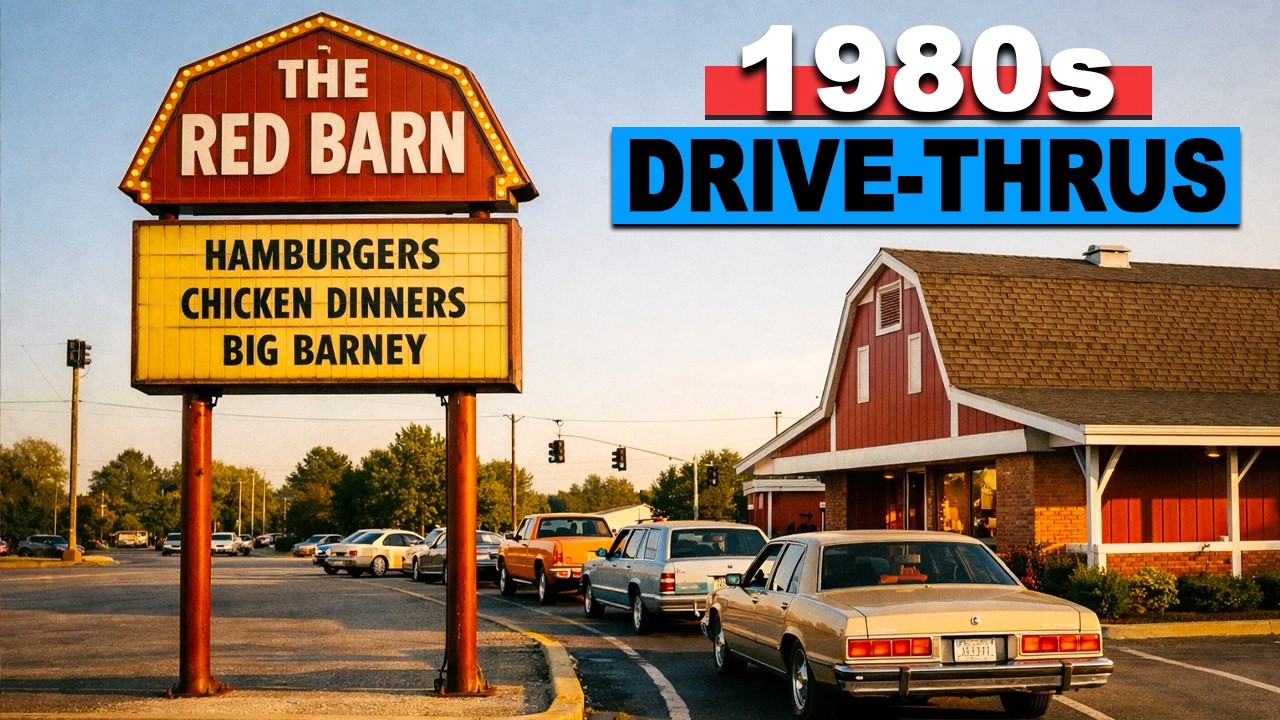
And the little places, the ones that gave the 1980s its character, are mostly gone. Red Barn was one of them. Barn-shaped restaurants with bright red paint, self-service salad bars before salad bars were a thing. Over four hundred locations at their peak.
They couldn’t compete with the big chains and filed for bankruptcy in 1986. Most of the buildings got bulldozed or converted into something else. But there’s a restaurant in Racine, Wisconsin, called The Farm that recreates the old Red Barn menu. Same food, similar decor.
People drive hours to eat there. Not because the food is extraordinary—because the memory is. Maybe that’s the thing. Maybe we’re not really missing the drive-thru.
Maybe we’re missing the world that came with it. The prices that let a young family breathe. The simplicity of a fifteen-item menu when nobody was trying to upsell you. The feeling that the person on the other side of that window was a neighbor, not a metric.
A Friday night that cost four dollars and felt like everything. The 1980s drive-thru wasn’t perfect. The speaker boxes were awful. The food wasn’t exactly healthy.
The Styrofoam probably shouldn’t have happened. And the fries, well, they were cooked in beef fat, which explains a lot about both why they tasted so good and why they probably shouldn’t have. But it was ours. It was simple and cheap and human.
A moment when the American car, the American family, and a warm paper bag all fit together without anyone trying to optimize it.
