When the American investigator laid six photographs on the table and asked Colonel Ernst Weber to point to the SS prisoner hiding among ordinary German captives, Weber looked at every face, folded his hands, and refused to choose. General Eisenhower stood in the room and understood the stakes: one wrong identification could send an innocent man to trial, yet silence might allow a wanted officer to disappear before the camp moved at dawn. In April 1945, Colonel Ernst Weber and more than three hundred German prisoners were held inside a temporary Allied camp near Kassel, where American intelligence teams separated ordinary soldiers from men suspected of serving in SS units. Weber had commanded an army transport battalion and was used as an interpreter because he spoke clear English.
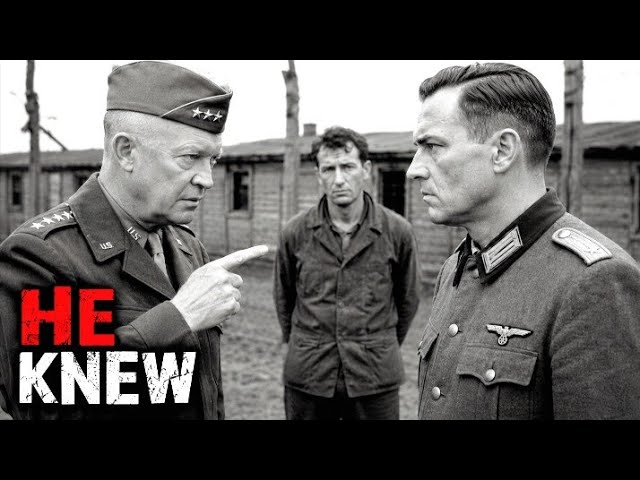
Captain Daniel Morris entered the records hut with six photographs taken from damaged German files. One showed an SS officer named Heinrich Krantz, wanted for questioning about prisoners who had vanished during the retreat. But the picture was blurred, and several men in the camp had similar features. Morris placed six prisoners beside the wall and asked Weber to identify Krantz.
Weber studied each face, then refused to point to anyone. He explained that the photograph was too poor and that choosing by resemblance alone could condemn the wrong man. The refusal angered Lieutenant Harris, who had spent two days searching barracks for hidden insignia and false papers. He accused Weber of protecting an SS comrade and ordered guards to separate the six men until a stronger identification could be made.
Before the prisoners were moved, one of them dropped a cigarette tin. Inside, investigators found a railway key, two civilian ration cards, and a strip of paper carrying the number of a freight wagon scheduled to leave the camp before dawn. Morris searched the transport records and discovered that the wagon had been listed as empty medical freight. The signature authorizing its departure belonged to an American clerk who had gone home sick that morning and denied signing anything.
General Dwight D. Eisenhower arrived at the camp during an inspection of prisoner processing. Morris showed him the photographs, the railway key, and Weber’s refusal, expecting permission to force an immediate identification. Eisenhower instead asked Weber what evidence would make him speak.
Weber pointed to the ears and left hand in Krantz’s old photograph, explaining that a shell wound had shortened two fingers and that the officer always carried a scar behind his right ear. The six prisoners were examined individually, but none had the damaged hand described by Weber. One man had deliberately cut his hair high enough to reveal a fresh bandage behind his ear, yet beneath it investigators found only a small burn. Eisenhower ordered the six men returned to normal custody and stopped the freight wagon from leaving.
When soldiers opened it, they found civilian clothes, forged release papers, and enough food for several men to travel for days without military supply points. A final search of the wagon uncovered a hidden compartment containing an SS identity card bearing Krantz’s name, but a photograph of someone else. Eisenhower closed the file, looked at Weber, and said the camp was no longer searching for one face, because someone had built a system capable of giving the wanted officer another identity. That evening, he canceled every release based on the compromised clerk’s paperwork and ordered fingerprints taken from all men connected to the freight detail.
Weber’s refusal had turned from an act of suspected loyalty into the first obstacle the false identity plan had failed to cross. The next morning, military police compared fingerprints from the freight wagon with cards collected from the camp intake files. Three prints belonged to prisoners already listed as transferred, which meant someone had returned to the camp under different names after officially leaving it. Eisenhower ordered Morris to reconstruct every transfer from the previous ten days.
Weber helped match German unit numbers to real formations, and he noticed that several men described as cooks or drivers had service records containing gaps during the final months of the war. One file belonged to Sergeant Otto Klein, a quiet prisoner assigned to the camp laundry. His photograph looked nothing like Krantz. Yet his fingerprint card had been replaced by a clean duplicate without the original ink smudges made at capture.
Morris brought Klein to the records hut and asked him to place his hand on a fresh fingerprint sheet. Klein complied, but Weber noticed that the man’s left little finger bent normally, unlike Krantz’s damaged hand, proving again that appearance and paperwork were being mixed deliberately. During the comparison, a camp orderly entered with coffee and slipped a folded note beneath Klein’s cup. Harris saw the movement, closed the door, and recovered a message ordering Klein to report to the infirmary at sunset under the name Paul Richter.
The infirmary register showed that Richter was a real prisoner suffering from pneumonia in another compound thirty miles away. Someone had copied his medical details closely enough to create a believable transfer request for a healthy man at Kassel. Eisenhower allowed the false appointment to continue under surveillance. At sunset, Klein entered the infirmary while Morris watched from an adjoining room, and a civilian ambulance arrived carrying two men with Allied medical passes.
The driver handed the nurse a sealed order requesting Richter’s immediate transfer. Before the vehicle could leave, military police opened its rear doors and found an empty stretcher, civilian shoes, and a suitcase containing three sets of German identity documents. The second man in the ambulance ran through the dispensary and climbed over a rear wall. Weber recognized his voice when he shouted at the driver, identifying him not as Krantz, but as Major Faulk, a former staff officer who had handled personnel records for Krantz’s unit.
Faulk escaped into the nearby woods, but the suitcase remained. One document carried Weber’s own photograph attached to another prisoner’s name, and another carried Klein’s photograph under the identity of a dead railway worker. Klein finally admitted that men inside the camp had offered him early release if he surrendered his real identity card. He had never seen Krantz clearly, because all instructions came through Faulk, an American-speaking intermediary who knew the camp’s medical routines.
Eisenhower ordered the hospital transfer system frozen and sent patrols after Faulk. The escalation now threatened hundreds of legitimate medical movements, while the real SS prisoner could still be somewhere inside the camp wearing a name that belonged to a man who had never met him. Freezing the medical transfers created an immediate problem when the camp infirmary reported that two prisoners with severe infections needed surgery at an Allied hospital. Their paperwork could no longer be trusted, and every delay increased the danger to men who had nothing to do with the false identity network.
Eisenhower ordered Morris to build temporary identity packets using photographs, fingerprints, scars, and witness statements. Weber helped verify one patient from his former division, but the second man, named Franz Bauer, appeared in no unit roster that survived the retreat. Bauer was too weak to answer more than a few questions, so Harris searched his belongings and found a silver cigarette case engraved with different initials. Inside the lid was a small photograph of three SS officers, one of whom matched the damaged hand and ear Weber had described.
Morris brought Weber to the infirmary and asked whether Bauer was Krantz. Weber examined the patient’s hands and shook his head, then identified the cigarette case as an object he had once seen in Faulk’s office rather than proof of the sick man’s identity. The answer delayed Bauer’s surgery again, and several prisoners accused Weber of caring more about protecting Germans than saving a dying man. One group blocked him outside the infirmary and demanded that he name someone simply so the Americans would reopen transfers.
Before guards separated them, Bauer’s condition worsened, and the camp doctor ordered immediate movement without waiting for the investigation. Eisenhower approved the exception and sent Morris inside the ambulance with a sealed fingerprint packet. At the hospital, surgeons discovered an old abdominal scar that matched a German medical record under the name Wilhelm Hahn. Hahn had been listed as killed in 1944, meaning Bauer was using a dead soldier’s identity long before he entered American custody.
When he recovered from surgery, Hahn admitted that Faulk had supplied the name during Germany’s collapse. He said the false identity was not created to hide SS membership, but to protect him from Krantz, whom he had seen executing a German clerk who refused to destroy transport records. Hahn provided the location of a ruined school where the surviving records had been hidden. Morris, Weber, and military police reached the site and found a metal dispatch box beneath the collapsed staircase containing personnel photographs and handwritten movement orders.
The files identified Krantz clearly, but the photograph was two years old and showed him before facial injuries from a vehicle accident. A medical note recorded reconstructive surgery to his nose and jaw, explaining why the camp photographs had failed. More importantly, the movement orders named three soldiers who had witnessed Krantz’s actions, including Hahn and two men currently scheduled for transfer from Kassel. Someone had been moving witnesses out under false names before investigators connected them.
Eisenhower canceled those two transfers and placed the witnesses under protection. But the consequence was severe. The false paper system had already reached another Allied camp, and one witness listed in the dispatch box had disappeared from custody three days earlier. The search for one SS officer had become a race to recover living witnesses before the same network erased them.
Weber’s refusal to guess had saved innocent men from identification, but it had cost investigators precious time they could no longer recover. The major reversal began when the recovered school records were compared with the camp’s original intake photographs. A clerk noticed that one prisoner had been photographed twice under different numbers, once with a beard and once clean-shaven. Both images showed the same shortened fingers on the left hand.
The man was not among the six prisoners Morris had first shown Weber. He was registered as Karl Neumann, a middle-aged railway mechanic who had spent the previous week repairing camp boilers under American supervision and had never been placed in the suspect group. Harris rushed to the maintenance yard, but Neumann’s workbench stood empty, and his tools were arranged as if he had left for lunch. A guard remembered seeing him enter the records building carrying a toolbox shortly before the medical transfer freeze began.
Eisenhower ordered the records building cleared and searched. Behind a removable panel near the heating pipes, military police found genuine intake cards taken from prisoners, replacement photographs, and a bottle of chemical solution used to lift ink from official forms. Weber examined Neumann’s first capture photograph and immediately identified the damaged hand, but he still refused to call the man Krantz until the scar behind the ear could be confirmed. Eisenhower accepted the condition and ordered patrols to locate him without announcing the suspected identity.
A railway worker reported that a German mechanic had boarded a maintenance locomotive heading toward a supply junction. Morris took a Jeep team to the next crossing, while Weber studied the recovered papers and noticed that one forged pass listed a destination called Depot 17. Depot 17 was not a prisoner facility, but an Allied document storage warehouse holding captured German archives. Krantz had not been trying only to escape.
He was moving toward the records that could prove who he was and what his unit had done. Eisenhower redirected guards to the warehouse and allowed the maintenance locomotive to enter the yard. Krantz stepped down wearing work clothes and presented a repair order for a damaged furnace, unaware that the regular staff had already been replaced. He entered the archive room with a toolbox and removed two folders from a shelf marked with his former unit number.
Morris closed the door behind him while Weber watched through the glass panel and saw the man reach behind his right ear when challenged. During the search, the cap was removed and an old surgical scar appeared exactly where Weber had described it. Krantz’s left glove was then taken off, revealing the missing finger joints that had never appeared on the altered intake file. The identity was confirmed by physical evidence, fingerprints recovered from the school dispatch box, and his attempt to remove the unit folders.
Weber had never been protecting Krantz. He had been refusing to turn resemblance into proof while the real man moved freely under a harmless mechanic’s identity. The recovered archive also revealed that Faulk had altered prisoner files before surrender and then continued the substitutions after capture by bribing a civilian translator. Military police arrested the translator at the Kassel station with unused photographs and blank medical forms.
Eisenhower ordered all six original suspects formally cleared of the SS identification and returned their correct records. The reversal changed the entire investigation, because the officer accused of silence had been the only man insisting on a standard of evidence strong enough to expose the deception instead of helping it succeed. Krantz was moved to a guarded interrogation center while investigators reopened every file connected to Faulk and the civilian translator. Eisenhower ordered the review completed before any prisoners from Kassel were transferred, because one surviving false identity could rebuild the same route elsewhere.
The first review uncovered seventeen altered cards, but most belonged to ordinary soldiers who had paid for earlier release rather than hidden SS officers. Morris separated fraud from suspected war crimes so that the entire camp would not be treated as one conspiracy. Faulk was captured near a farm after a local policeman recognized the ambulance description circulated through the district. In his coat, officers found a notebook listing payments, false names, and the locations of three document caches.
One cache contained the missing witness from the school records, alive inside a cellar where Faulk had kept him under a civilian name. The man identified Krantz from service photographs and described the German clerk’s killing, providing testimony independent of Weber. A second cache held letters stolen from prisoners and used to learn family details needed for convincing false identities. Clerks began returning the letters to their owners while recording which files had been compromised.
The third location contained an American typewriter, stolen seals, and a ledger naming the civilian translator as the person who supplied Allied schedules. The evidence allowed military police to close the administrative side of the network without relying on confessions from prisoners. Eisenhower then reopened medical transfers under a new system requiring fingerprints and photographs to travel with each patient. Hahn was returned to the Kassel infirmary after surgery under his real name, and the two protected witnesses were moved separately with verified escorts.
Krantz’s preliminary hearing took place in a requisitioned courthouse, where Weber was called to identify him formally. This time Weber described the hand injury, the ear scar, the old unit records, and the circumstances in which he had known the officer before capture. The six men from the original lineup were brought in only to have written corrections attached to their files. One had nearly been transferred as an SS suspect because of a facial resemblance, and Morris personally removed the temporary notation in front of him.
Krantz attempted to claim that Weber had delayed the search deliberately to help him escape. Eisenhower’s investigators answered with the timeline showing that Weber had provided the exact physical details on the first day, while American officials had initially relied on the blurred photograph instead. The hearing transferred Krantz for further investigation on the witness evidence and recovered records, while Faulk and the translator faced separate charges for falsifying documents and obstructing Allied custody. Weber received no reward and remained a German prisoner subject to his own review.
Before the next transfer left Kassel, Morris placed six photographs on Weber’s table again. This time only to show that each man had been restored to his proper identity. Weber checked the papers, then watched the verified prisoners board different vehicles under their real names. Eisenhower signed the final procedural order requiring positive evidence before hidden unit classifications could be entered into a prisoner’s permanent file.
The decision could not undo the days lost during the search, but it made the central result irreversible. Krantz would face investigation as himself, and no innocent prisoner would carry his name in his place. Weeks later, Weber was transferred from Kassel with his own file sealed beneath the new verification rules. Before the truck left, Morris returned the blurred photograph that had started the search, now stamped as insufficient identification evidence.
Weber folded it once and placed it beside his prisoner card. Across the yard, Krantz departed under guard with his real name fixed to the case against him, while the six men once placed beside the wall carried corrected records instead of another man’s crimes.
