Helicopters beat the air over River Forest, Illinois, as federal agents surrounded a house that was never supposed to attract this kind of attention. Inside, they moved from room to room, photographing everything, searching for any trace of a man who had vanished into thin air. The man they were looking for was Michael Volpe, and the house they were searching belonged to Anthony “Tony” Accardo, one of the most powerful figures in the history of the Chicago Outfit. Volpe had discovered a burglary at Accardo’s home, had testified before a federal grand jury about it, and then had walked out of his own house one morning and never returned.
The search of Accardo’s home on Ashland Avenue in the late 1970s was the culmination of a chain of events that began with a break-in and ended with a series of corpses, a missing witness, and a federal investigation that reached directly into the heart of the mob boss’s private world. Born in Chicago in 1906 to Italian immigrants, Accardo entered the city’s criminal underworld during the era of Al Capone and Prohibition. He gained a reputation as a powerful enforcer and became known as “Joe Batters,” a nickname tied to his skill with a baseball bat. But as he aged, Accardo became something entirely different from the flashy gangsters who had come before him.
Capone reveled in the spotlight; Accardo understood its danger. Capone’s wealth, fame, and lifestyle made him one of the most famous criminals in America, and eventually federal prosecutors brought him down on tax evasion charges. Accardo absorbed the lesson: real power is not seen. By the 1940s, he had risen to the highest ranks of the Chicago Outfit.
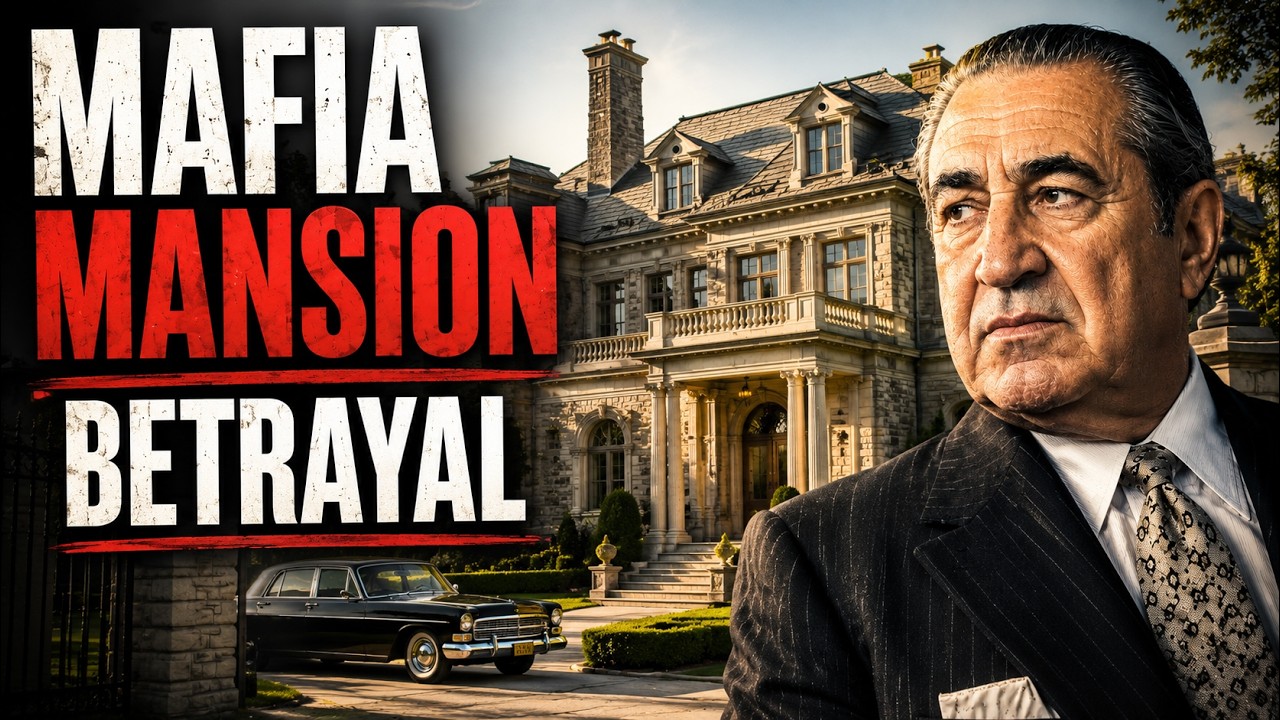
His influence lasted for decades as the organization expanded into gambling and other illegal enterprises. But there was one part of Accardo’s life that was hard to hide: his mansion. In the 1950s, Accardo lived at 915 Franklin Street in River Forest, Illinois. The property had originally been built for wealthy businessman William Grunow, owner of a radio manufacturing company.
It was enormous, containing roughly 22 rooms and six bedrooms, along with an indoor swimming pool, two bowling lanes, and a billiard room. A pipe organ added another level of luxury. Outside, manicured gardens were surrounded by an iron fence that provided Accardo with privacy from the street. For a man who increasingly preferred to operate out of the public eye, the mansion was an extraordinary statement.
And investigators noticed. Accardo’s money attracted government scrutiny, and this massive property raised an obvious question: how was he financing all of this? The house that demonstrated his success also risked becoming evidence of a lifestyle that was hard to explain. So Accardo did something remarkably logical: he left.
During the 1960s, he moved out of his sprawling Franklin Street estate. Eventually, he was living in another house on Ashland Avenue in River Forest. It was still comfortable, but far less lavish than his previous mansion. Accardo seemed to have learned that displaying wealth could be dangerous.
But hiding it did not mean people forgot it existed. By the late 1970s, Accardo was no longer a young gangster. He was an older man whose name had been associated with the Chicago Outfit for decades. He had watched other gangsters go to prison, watched others die, and he had survived.
Then, in January 1978, Accardo and his wife traveled to California. When they returned to River Forest, Michael Volpe, the caretaker of Accardo’s property, arrived at the house. Something was wrong. The house had been burglarized.
Someone had entered Tony Accardo’s private residence and gone through his belongings. Volpe called Accardo. Accardo returned to Illinois, but what happened next was strange. The police were not called immediately.
For any ordinary homeowner, that would have seemed odd. For Tony Accardo, investigators would soon wonder if the burglary was being handled in a different way. Because within days, men connected to the world of Chicago burglaries began turning up dead. Suddenly, whatever had been stolen from Accardo’s home seemed almost irrelevant.
The true cost of the burglary was just beginning to show. The first bodies changed everything. Federal court records would later describe how people identified by the government as known burglars began turning up dead across the Chicago area, shortly after the burglary. The timing was impossible for investigators to ignore.
One of them was Bernard Ryan, who was linked to the burglary crew investigators believed was involved in the break-in at Accardo’s home. Less than two weeks after the burglary, his body was found inside a Lincoln Continental in Stone Park, Illinois. Then there was Vincent Moretti, a convicted burglar who was also killed. His body was violently beaten.
The list continued. The break-in at Accardo’s home was beginning to look less like a robbery and more like the first chapter of a gangland purge. Investigators believed the members of the burglary crew were being eliminated, but proving responsibility was far more difficult. For Accardo, the burglary represented more than just stolen property.
His influence depended partly on his reputation. Someone had entered his own home while he was away. If there were no consequences, what would that say about one of the most feared organized crime figures in Chicago? Investigators began examining the stolen goods and where they had ended up.
Among the stolen items were cufflinks that became important to the investigation, as authorities tried to link members of the burglary crew to the break-in. But while investigators were trying to reconstruct the details of the burglary, another man was emerging more and more prominently: Michael Volpe. He was the man who had discovered the break-in. He knew Accardo’s home.
He knew what he had seen, and he had spoken to Accardo after discovering the burglary. A federal grand jury investigating the case called Volpe to testify. He appeared, but remained subject to further questioning. Then Volpe disappeared.
According to federal court records, he left his house heading to his usual place of work: Accardo’s home. He never arrived. Now investigators had something far more serious on their hands. The man who had discovered the burglary and appeared before a federal grand jury had vanished.
The FBI requested permission to search Accardo’s home on Ashland Avenue for evidence related to Volpe’s disappearance. Agents eventually entered the house, photographed the rooms, searched for Volpe’s personal belongings, examined the waste incinerator, and combed the home for any clues that might explain what had happened to the missing man. Then they reached a safe in the basement. Inside, they found two pistols and a large amount of money, estimated at around $275,000 in 1978.
It was an enormous sum of cash discovered inside a private residence, but even that did not give investigators the easy breakthrough they had hoped for. The government would eventually face a legal battle over whether it had the right to keep the money—Accardo wanted it back. And despite everything surrounding the investigation, proving that the money itself was connected to a specific crime was another challenge entirely. It embodied the fundamental problem authorities had faced with Accardo for years: they could get close, investigate, search.
They could find large sums of money. But connecting Tony Accardo personally to the crimes committed around him was something else altogether. As federal investigators searched his home, one question remained unanswered: what happened to Michael Volpe? The disappearance of Michael Volpe became one of the most unsettling mysteries of the entire case.
The maintenance man who had discovered the burglary had testified before a grand jury and then vanished. But investigators never found the simple chain of evidence that would have led them directly from the burglary through the murders to Tony Accardo. This was the story of Accardo’s life. He survived by distancing himself from the crimes associated with the organization that surrounded him.
He had been arrested and investigated again and again. He faced charges related to tax evasion. He appeared before government committees. His money was scrutinized.
His house was searched by federal agents. Yet Accardo survived, time and again, the fate of many other famous American gangsters. Even his previous conviction for tax evasion was eventually overturned. The contrast with Al Capone was remarkable.
Capone became a celebrity. His face was everywhere. His lifestyle was part of his legend, and he ended up in federal prison. Accardo chose a different path, staying out of the spotlight.
Even his decision to leave his Franklin Street mansion seemed to reflect this direction. The luxurious home was a symbol of success, but it was also a burden. Twenty-two rooms, an indoor pool, private bowling lanes—these were hard to reconcile with the image of an ordinary businessman. So the mansion disappeared from Accardo’s life, but his power remained.
That is what makes the 1978 burglary so revealing. The burglars did not need to enter the massive Franklin Street mansion; they entered the quieter home Accardo had chosen later. They still thought there was something worth stealing, and they were right. When federal agents later searched that house, they found around $275,000 in the basement safe alone.
But whatever the burglars expected when they entered the property, they could not have predicted what happened next. Men connected to the burglary were killed. Michael Volpe disappeared. Federal investigators raided River Forest.
The break-in became part of the legend surrounding one of the most prominent figures of the Chicago Outfit. There was one more unusual detail. The mansion’s bathroom reportedly contained a bathtub carved from Mexican onyx, fitted with gold-plated fixtures. It was the kind of luxury befitting royalty more than a man trying to convince authorities that his financial situation was normal.
The property had cost a fortune to build. William Grunow, its original owner, had made his wealth from manufacturing radios during the early years of American broadcasting. When Accardo settled into the property, he inherited a home built in an era when wealthy industrialists constructed houses specifically to announce their status. Now that same house belonged to a man accused of sitting at the top of Chicago’s organized crime hierarchy.
Accardo used it as a powerful man’s home. Gatherings were held there; his associates visited. Behind the iron fence, the swimming pool, bowling lanes, and enormous rooms created a private world isolated from the streets outside. But privacy and secrecy are not the same thing.
Neighbors could see the property. Investigators knew where Accardo lived, and government officials could compare the lifestyle behind those gates with the income he officially declared. For Accardo, that became an impending danger. The mansion might protect him from curious strangers, but it could not protect him from the tax authorities.
Yet the mansion remained a testament to the moment Accardo revealed to the world just how successful he had become. And the burglary remained part of a darker story. The men who broke into his home in 1978 may have thought they were robbing a wealthy elderly man, but the break-in was followed by bloodshed, a disappearance, and a federal investigation that reached into the depths of Accardo’s private world. The house was supposed to hide his life, but for brief moments it did the opposite, opening the door for America to catch a glimpse into the world of “The Big Tuna.
”
Accardo lived 14 more years. By that time, the criminal world he had helped build was fading. He had started his career in the era of Al Capone and Prohibition. He lived long enough to witness organized crime transformed by decades of federal investigations.
And unlike so many around him, he reached old age. In May 1992, Tony Accardo died at the age of 86 after suffering from serious heart and respiratory illnesses. His family was at his side. There was no killer waiting outside for him.
There was no final armed confrontation. There was no prison cell. For a man whose name had been linked to organized crime in Chicago for more than half a century, the end was remarkably ordinary.
