On August 1, 2026, a man knelt in the dry grass outside Spokane, Washington, struck a match, and set in motion a disaster that would burn or damage 833 structures and displace tens of thousands of people. He had studied serial arsonists. He had tracked weather forecasts for weeks. He chose that Saturday because the National Weather Service had issued the first particularly dangerous situation fire warning in Washington state history, and he wanted the wind.
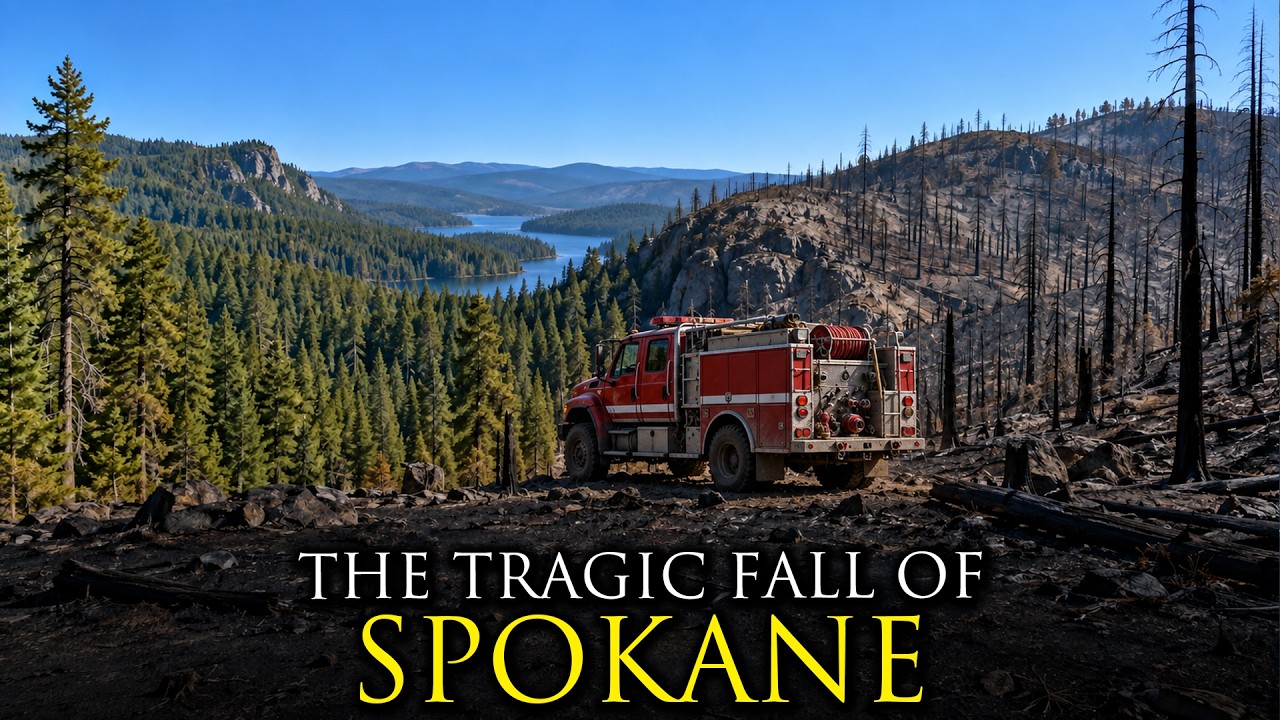
Sixty-five thousand people fled their homes. Rebuilding costs were projected to exceed one billion dollars. But Spokane had burned before, almost to the exact same date. On August 4, 1889, fire destroyed the city’s entire downtown.
And what the city did after that first fire is the reason the second one hurt so badly. The Great Spokane Fire began around six o’clock on a dry Sunday evening in 1889, when the city was still called Spokane Falls. It was a boomtown of nearly 20,000 people riding a wave of mining wealth from the Coeur d’Alene Mountains across the Idaho border. Silver and lead poured through the railroads.
The Northern Pacific had arrived six years earlier and transformed a cluster of sawmills at a waterfall into a genuine commercial city with banks, hotels, an opera house, and competing newspapers. The downtown was a patchwork of wooden buildings packed tight together, with dry rubbish piled in the gaps between them. Forty-seven fire hydrants served the whole town. The fire department was one hundred volunteers spread across twelve stations.
No one knows exactly what sparked it. Theories ranged from a grease fire in a lunchroom near the Northern Pacific depot to a curling iron heated over a kerosene lamp to a spark from a passing locomotive. The summer had been blistering hot and dry. Wildfire smoke from the Coeur d’Alene Mountains had hung over the city for days.
When the fire broke out, the water system had no pressure because of a faulty pump station. The man in charge of the waterworks, Rola A. Jones, was initially blamed. Newspapers reported he had gone fishing, leaving the system in the hands of an incompetent.
The story was false. City leaders later exonerated him, but the damage to his reputation was done, and the false tale was repeated in histories of the fire for decades. When fire companies arrived, the hydrants gave them nothing. They tried dynamiting buildings to create firebreaks, but the flames jumped every gap the dynamite blew open.
The fire began generating its own weather, a firestorm that created its own wind and pulled oxygen toward itself. Within hours, the fire consumed thirty-two blocks, virtually the entire commercial core. Every bank burned. All but one hotel and all but one newspaper were destroyed.
The single fatality was George I. Davis, who either jumped or fell from his lodging at the Arlington Hotel and later died at Sacred Heart Hospital. The nuns at Sacred Heart served meals to the newly homeless. Property losses ran between five and ten million dollars, a staggering figure for a city that had barely existed a decade earlier.
Then something remarkable happened. Spokane did not die. News of the fire spread nationwide, and the dramatic story of a booming young city destroyed by flames drew an outpouring of aid. Seattle sent fifteen thousand dollars.
Portland sent food. Tents, bedding, and clothing arrived by train from cities across the country, so much that relief supplies far exceeded actual need. Several city councilmen and a police officer were later indicted for carting wagonloads of provisions home for themselves. Even the recovery had its scandals.
Within weeks, Spokane decided to rebuild bigger, grander, and in materials that would not burn. Insurance adjusters flooded in. Dutch investors put heavy capital into reconstruction. By the end of 1889, the city’s board of trade estimated five hundred buildings were under construction, most in solid brick or stone, rising three to seven stories.
Architects arrived to work on essentially a blank canvas, an entire downtown to design from scratch, funded by the mining fortunes that kept flowing out of the Coeur d’Alene district. The post-fire land turned out to be worth more than before the fire because much of what burned had been rickety and obsolete. Spokane Falls dropped the word Falls from its name in 1891. The new city rose in terracotta and granite, announcing itself as a place built to last.
Grand hotels appeared. The Davenport Hotel, which opened in 1914, became one of the most celebrated hotels west of the Mississippi, with a lobby designed to make cattle ranchers and silver miners feel they had arrived somewhere civilized. In a sense, the great fire of 1889 was the best thing that ever happened to downtown Spokane. It forced the city to upgrade everything: the architecture, the fire department, the electric alarm system, the building codes.
Wooden structures were banned near the new commercial district. A professional paid fire department with horse-drawn equipment replaced the hundred volunteers. Spokane learned the lesson fire was supposed to teach. But the lesson applied to downtown, and downtown is not where the next fire would come.
Over the following century, Spokane grew the way most American cities grew, outward. The population climbed past one hundred thousand, then past two hundred thousand. The downtown stayed solid, but the real growth happened at the edges. Suburbs spread across the basalt plateaus and pine-studded hills north and west of the city.
Neighborhoods with names like Indian Trail, Five Mile Prairie, and Suncrest pushed into the surrounding landscape of dry grasslands, scattered ponderosa forests, and shrubby ravines. These were pleasant places to live, with views, big lots, good school districts, and the feeling of being close to nature. Riverside State Park, over fourteen thousand acres along the Spokane River, bordered some of these neighborhoods directly. You could walk from your garage into state parkland in minutes.
That proximity was part of the appeal. That proximity was also the problem. Fire researchers call this the wildland-urban interface, the zone where houses and wildland vegetation meet. Across the American West, it has been the fastest-growing type of land use for decades.
As of 2020, more than 44 million homes sat in the WUI across the contiguous United States, and thirty-nine percent of all new residential construction was going up in these high-risk areas. In Spokane County, the growth was especially visible on the north and west sides, where subdivisions crept up bluffs into areas thick with dry fuel. Decades of fire suppression meant dead fuel had accumulated instead of being cleared by the periodic low-severity burns the landscape had evolved to expect. The first major warning came in August 2023.
On the eighteenth of that month, two wildfires erupted in Spokane County almost simultaneously. The Gray Fire, caused by sparks from a faulty outdoor light owned by Inland Power and Light, ignited west of Medical Lake and made a seven-mile run of destruction to the east, burning with terrifying speed through residential streets. It crossed Interstate 90, burned more than ten thousand acres, and leveled 240 homes. An eighty-six-year-old man named Carl Grub died.
That same day, the Oregon Fire tore through more than ten thousand acres near Elk in northern Spokane County, destroying 384 structures and killing a forty-nine-year-old named Alex Brown. Two fires, two deaths, more than seven hundred structures in a single Friday. It was at the time the worst wildfire disaster in the region’s modern memory. Spokane County began talking urgently about wildfire mitigation, defensible space, and building codes for fire-prone areas.
Officials acknowledged what fire researchers had been saying for years: the WUI around Spokane was growing, the climate was drying, and the question was not whether another catastrophic fire would come, but when. In the spring of 2025 and again in April 2026, the city organized practice wildfire evacuation drills in high-risk neighborhoods. Multiple city agencies participated. Residents learned evacuation routes, congestion points were identified, and the new Alert Spokane notification system was tested.
The drills were a genuine attempt to prepare for exactly what was about to happen. By late July 2026, Washington was deep into one of the worst fire seasons in more than thirty years. Over a thousand fires had scorched more than 425,000 acres. A heat dome sat over the western United States, baking the land.
Spokane’s winter snowpack had been record low. The vegetation around the city was kindling. On the morning of Friday, July 31, 2026, the National Weather Service office in Spokane issued a red flag warning for the following day. But this was not an ordinary red flag.
For the first time in Washington state history, the NWS attached a particularly dangerous situation designation, a rarely used flag normally reserved for the most extreme tornado risks in the central plains. A dry cold front would sweep through eastern Washington with sustained winds of twenty to thirty miles per hour and gusts up to fifty. Temperatures were expected in the upper eighties, humidity dropping into the low twenties. Any fire that started would run.
Governor Bob Ferguson declared a state of emergency at noon on Saturday before a single flame had ignited. The Washington National Guard mobilized. Warnings went out across Spokane: don’t mow your lawn, don’t drive with chains dangling, don’t do anything that might throw a spark. One person in Spokane paid very close attention to the forecast, but not because he wanted to prevent a fire.
Aaron Forest Fasciani, thirty-seven years old, had a history most of his neighbors knew nothing about. In October 2010, at twenty-one, he had shot and killed his adoptive father during an argument about washing dishes in their Mesa, Arizona home. He then turned the gun on himself but survived. He pleaded guilty to manslaughter and aggravated assault in 2012 and was sentenced to twelve years in prison.
He was released in 2020 and discharged from probation in early 2024. At some point he moved to Spokane. Investigators would later say Fasciani started setting fires in the summer of 2025. Small ones at first.
He was questioned about arson-related behavior but never charged. By his own account, he set more than twenty-five fires in just over a year. He told detectives afterward that he found fire powerful and beautiful, and believed things that went through fire experienced a kind of rebirth. He studied for this.
Court documents describe a man who researched the methodology of John Leonard Orr, a notorious California serial arsonist who had been a fire captain, a man who set fires in order to be the one who responded to them. Fasciani purchased materials to construct a time-delay ignition device using notebook paper, matches, a cigarette, and a rubber band. He carried marijuana and cigarettes specifically as a rehearsed cover story if anyone questioned why he had a lighter. For approximately two weeks before August 1, Fasciani planned his fire.
He monitored weather forecasts, looking for a day with high winds, low humidity, and high heat. When the NWS issued the particularly dangerous situation warning, he knew the day had arrived. That Saturday morning, he left his apartment early because he expected the wind to pick up around eleven. He walked to a spot near Old Trails Road and West Euclid Road on the western edge of Spokane.
He knew there was grass that would catch easily, then young trees behind it, then larger trees, a fuel ladder that would carry the fire upward and outward. He knew the wind would push it northeast. He stood there, according to his own account, arguing with himself about whether to do it. Then he knelt in the dry grass and struck his match.
The Old Trails fire ignited just before noon. A man named Paul Child, a grandfather who lived less than half a mile away, noticed a bald man in a green shirt and backpack behaving strangely near the tree line, kneeling, nervous, out of place. Minutes later his daughter said there was a fire. Child ran outside and saw a plume of smoke rising from the exact spot where the stranger had been kneeling.
He flagged down a police officer and described the man. Within an hour, deputies detained someone matching the description about a mile and a half from the origin point. They found waterproof matches and a butane lighter in his fanny pack, but they released him. First responders were overwhelmed.
The fire moved faster than anyone could believe. Driven by sustained winds of thirty-three miles per hour gusting to forty-four, with eighty-six-degree heat and humidity in the low twenties, the fire raced northeast from the West Plains into Riverside State Park. Embers sailed through the air and dropped into new fuel hundreds of yards away, creating spot fires faster than crews could chase them. Then the fire did something the 1889 fire never did.
It jumped the Spokane River. The river that had once been the natural boundary between wildland and city, the river that had given the city its name, its identity, its reason for existing, was no longer wide enough or wet enough to stop a fire in a drought year. The flames raced up the slopes and tore into the neighborhoods of Indian Trail and Five Mile Prairie. Walls of flame consumed homes.
Homes exploded. Trees became torches. Loud blasts rang through the smoke as propane tanks and gas lines detonated. In some blocks, one side of the street burned completely while the other remained untouched.
By Saturday evening, nearly half of Spokane’s neighborhoods had either been evacuated or were under threat of evacuation. The Spokane Convention Center became an overnight shelter for more than four hundred displaced families. Mayor Lisa Brown described it as the worst natural disaster the region had faced. But the Old Trails fire was not alone.
Two more fires ignited the same day. The Autumn Lane fire erupted in the Suncrest area south of the city and became the largest of the three, burning nearly 5,800 acres. The Fairview fire struck near the community of Mead to the north, consuming about a thousand acres. Together, the three blazes were designated the Spokane Complex Fire.
By Sunday evening, they had burned more than 7,700 acres with zero percent containment. More than 65,000 people in a city of about 230,000 were under evacuation orders. The fires became the top firefighting priority in the United States. On Monday, August 3, investigators determined the origin point of the Old Trails fire.
It was exactly where Paul Child had seen a stranger kneeling in the grass two days earlier. Body camera footage from the Saturday encounter gave them a face. A SWAT team arrested Fasciani at his apartment around five that evening without incident. He was charged with first-degree arson.
During his first interview with detectives, Fasciani denied involvement for roughly an hour and a half. Then he broke. He described in detail his planning and execution of the Old Trails fire. He had chosen that specific location because he knew it was going to get bad.
He acknowledged that if confronted by police, his original plan had been to pull a knife and try to provoke officers into shooting him. Instead, when they found him Saturday, he chose to feign innocence. He also confessed to twenty-five other fires over the previous year. On Thursday, August 6, prosecutors added four more counts of first-degree arson.
His bail was raised to two million dollars. His defense attorney requested a mental competency evaluation. The judge approved it. The Spokane Area Fires burned a combined total of roughly 9,900 acres and destroyed or damaged an estimated 833 structures, most of them homes.
Fire suppression costs alone topped twenty-five million dollars. The county assessor’s office projected rebuilding would exceed one billion dollars, making it the most expensive wildfire damage in Washington state history. Firefighters poured in from more than twenty states and one hundred jurisdictions. Over two thousand personnel were assigned at peak deployment.
All evacuation orders were lifted on August 11. No one died. In a fire of this scale, in a metropolitan area of 230,000 people, with winds like those and zero percent containment for days, that is remarkable. Officials credited the spring evacuation drills, the ones that had found the congestion points and tested the notification systems, with helping the response move faster when the real thing arrived.
Based on lessons from those drills, National Guard and State Guard troops along with police officers were deployed to threatened areas on the morning of August 1 before the first ignition, spreading evacuation notices in person, directing traffic away from danger, and opening shelters outside the fire zones. But the absence of fatalities does not erase what was lost. Entire blocks of Indian Trail were reduced to concrete foundations and scorched metal. Returning residents described a war zone.
Cars melted into shapes that no longer looked like cars. A boat twisted by heat into something unrecognizable. Pets that never came home. A woman carried her burned dog from the wreckage of her home, still searching for other pets she could not find.
In the days after the fire, conspiracy theories erupted online. Some blamed tech companies trying to clear land for data centers. Others blamed coordinated groups of arsonists. There was no evidence for any of it.
A fire ecology professor bristled at calling the fires a natural disaster at all, preferring environmental disaster. Nothing about these fires was natural, he argued. They started unnaturally. They spread under conditions that were anomalous and driven by drought.
There is a dark symmetry to what fire has done to Spokane. In 1889, the fire came from inside the city, from the densest, most built-up part of town. The lesson Spokane drew was to build the downtown in fireproof materials and create a professional fire department. That lesson worked.
The downtown has not burned since. But the city grew outward past the fireproof core, past the river, into terrain that was never going to be fireproof. The danger did not come from the density of the buildings. It came from the closeness of the grass.
After the great fire of 1889, Spokane rebuilt so aggressively that by the end of that year the land was worth more than it had been before the fire. The destruction cleared the way for something better. That is exactly what Aaron Fasciani said he believed about fire, that it creates rebirth, that what burns can come back stronger. Whether Spokane’s burned neighborhoods will come back at all remains an open question.
Rebuilding a downtown commercial district with insurance money and mining wealth in 1889 was one thing. The land was actually worth more after the fire because the wooden shacks it replaced had outlived their usefulness. Rebuilding eight hundred suburban homes in 2026, with insurance complications, building code revisions, wildfire risk reassessments, and the knowledge that the conditions that caused this fire are becoming more common, is something else entirely. The land is not worth more now.
It is worth less. It has been reclassified in the minds of every insurer and every buyer as exactly what it always was: wildland-urban interface where fire can come at any time. Aaron Fasciani sits in the Spokane County Jail on a two-million-dollar bond awaiting a mental competency evaluation. He faces five counts of first-degree arson.
He confessed to twenty-five fires in a year. He told detectives that fire was powerful and beautiful, that it brought rebirth. His defense attorney has not entered a plea. The Spokane River still runs through the middle of the city the way it always has.
It powered the sawmills that built the first wooden town. It marked the edge of the 1889 fire’s reach. For more than a century, it was a natural boundary, a line that fire could not cross.
On August 1, 2026, the fire crossed it.
