The boy was gone by morning. His bed was found cold, the sheets scattered with black feathers pressed into the fabric as though stitched there by invisible hands. There were no footprints, no broken doors, no blood. Only the quiet mocking trace of feathers leading to the edge of the forest, where the crows perched in silent ranks, not moving, not leaving, as if waiting for the villagers to understand.
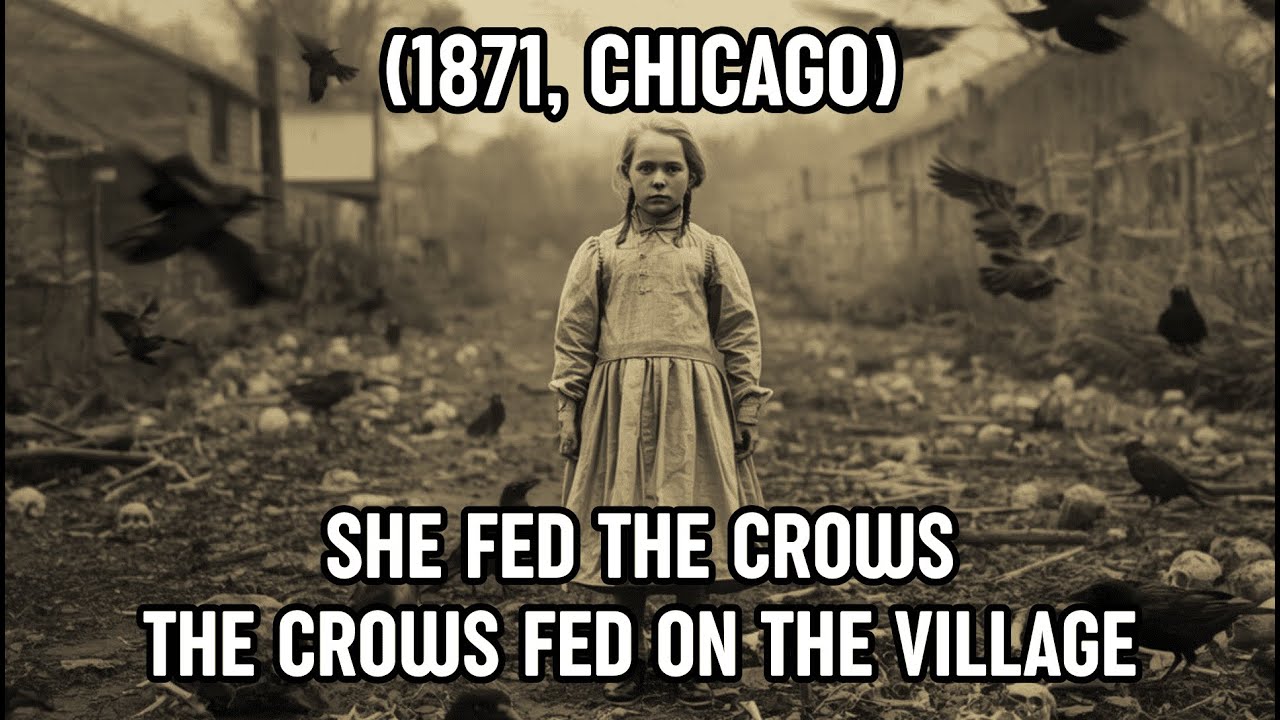
The miller’s boy had been taken, and everyone in the village knew who had taken him. The girl called Mara, the one who fed the crows, had finally crossed the line they had all feared she would cross since the day she first scattered seeds by the well. This was the year 1871, and Chicago had already been branded by fire, by ash, and by a silence that crept into its streets after the great burning. Yet what most never spoke of was not the fire itself, but what was whispered in the smaller villages surrounding the city, the places not mapped, not recorded, places erased with deliberate care.
For in one such village lived a girl, no more than twelve winters old, and she was known only for one thing. She fed the crows. At first it seemed harmless. Children often leave scraps of bread, tossing crusts toward the black wings that gather above barns and fields.
But what unsettled the elders was not the feeding itself. It was the way the birds listened, the way they waited for her, the way they did not scatter when others approached, the way they would tilt their heads and fix their glassy eyes on her lips as though awaiting orders, as though each morsel she tossed was not food but command. The girl was called Mara by some. Others said her name was a thing best left unsaid.
For even in daylight she carried an aura of dusk, pale as chalk, her hair the color of burned wheat. Her voice rarely rose above a whisper, but it was always heard, even across distance, as if the air bent to carry her words. She would sit by the village well at dawn, scatter seeds, and dozens of crows would descend, their black shapes blotting out the weak morning sun, their wings so many they turned day into something resembling storm. Soon the villagers began to notice oddities.
A child’s lost toy retrieved by crows and left on the doorstep. A drunkard’s spilled coin purse returned. Yet a man who insulted the girl was found in his field the next morning, face torn, eyes pecked hollow, the ground littered with black feathers. Though no one saw the attack, everyone knew.
Everyone whispered that Mara had only smiled the night before, and the birds had listened. The elders tried to intervene. They brought her before the chapel, demanded she stop, demanded she renounce the crows. Yet when the bells rang that Sunday, the sound was drowned beneath a storm of wings, hundreds of crows circling, blotting the sky, their cries louder than prayer.
And when the priest raised his hand against her, a crow landed on the altar itself, staring, unblinking, unafraid, as though declaring war on heaven. That was the beginning, the moment the village crossed into silence. For soon there would be no bells, no sermons, no voices, only the endless sound of wings and the slow covering of earth in black beaks and bones. After that Sunday, the village was not the same.
Men who once strutted through the square with authority now lowered their heads, avoiding both the girl and the crows. Women whispered her name only in kitchens with shutters drawn tight. Children who once mocked her pale skin now clung to their mothers, afraid to even meet her gaze. The village had shifted, not by fire or plague or famine, but by a single child and the endless hunger of black wings.
Each dawn Mara could be seen walking barefoot along the muddy lanes, her hands cupped with grain, seeds, or sometimes scraps of raw meat, always trailed by a following of crows. Not just dozens now, but hundreds. The air thick with their cries, their shadows stretching over rooftops, the sound of their wings replacing the sound of wind. And where she passed, silence fell, as though the village itself held its breath.
The animals were the first to vanish. Goats dragged into the woods by swarming wings. Chickens devoured within seconds. Even dogs whimpering beneath porches were not safe.
The villagers told themselves it was just nature. Yet when one farmer slaughtered a hog and tried to chase the crows away, the next day his barn was filled with carcasses of black birds, each one mangled, broken, but their bodies spelling something in crude lines across the straw. Letters too jagged for the farmer to deny. His own name.
Fear spread, not in waves, but in roots, sinking deep into every household. Doors were barred at dusk, lanterns extinguished early. No one dared leave food uncovered. No one dared speak too loud.
For the black eyes of crows watched from every chimney, every fence post, every dead tree. The village became a prison of its own silence, with Mara as its quiet warden. Some swore she had no family, no mother or father, only an old crone who had taken her in when she was an infant. But when the crone died suddenly one winter night, her body found hollowed out as though the marrow itself had been stripped, Mara did not cry.
She only stood by the grave, scattering seed into the open earth, and the crows filled the cemetery, covering the mound in wings as though burying her caretaker themselves. What unnerved the villagers most was not that she commanded them, but that she seemed to grow from them, as if every day she became less a girl and more a shadow stitched into the swarm. Her eyes darkening, her voice thinning into a pitch that cut like a crow’s call, until the line between her and them blurred. The villagers whispered that perhaps she was not feeding the crows, but that the crows were feeding her.
It began without warning, on a night colder than it should have been for early autumn. The mist hung heavy over the marshes and the moon was shrouded in a veil of cloud. The village bell tolled midnight, though no one had touched the rope. And when the villagers opened their shutters, they saw only black shapes shifting like waves above their fields, a tide of wings circling and circling until the sound was deafening, like storms crashing, but with no rain, only the endless cawing of beaks.
The next morning, the Miller’s boy was gone. The boy’s mother screamed, tearing at her hair, demanding that the priest do something. Yet when he raised his hand to bless the ground, a crow dropped from the sky and landed on his shoulder, staring into his eyes until the man fell silent, trembling, his words caught in his throat, his prayer left unfinished. No one dared ask him again.
That evening, more birds gathered. Thousands now, blackening the sky until day seemed like dusk, their eyes glinting like wet stones. And Mara walked calmly among them, her small frame swallowed in the sea of wings, her lips moving as though whispering to them. Though no villager could hear the words, the crows answered her in unison, a roar of sound that rattled window panes and shook dust from rafters.
By the third day, whispers spread that the boy had not simply vanished, that he was being fed to them slowly, that Mara had offered him as meat for her companions, that the crows did not just eat flesh, they carried away the soul, feather by feather, until nothing remained to be found. And when some brave men considered storming Mara’s shack, they returned to find their tools rusted overnight, their axes cracked, their ropes frayed, as if some unseen hand had aged them a hundred years in a single night. The miller himself went mad with grief, shouting in the square that he would burn the girl and her birds. But before anyone could stop him, he fell to the ground, his chest rising once, then still, his mouth filled with feathers that poured out like smoke.
Not a single drop of blood, just the black proof of who had claimed him. And no villager doubted after that that the crows had chosen. By the fourth week, the ground itself began to change. The soil, once fertile and soft, turned hard and brittle, cracking like sunbaked clay, though no drought had struck the land.
When the farmers dug into it, their shovels struck not stone, but something hollow, a sound that carried through the air like brittle wood snapping. And when they pulled the earth away, they uncovered bones. Thousands of them, piled so deep that no one could say how long they had been buried there. Not animal bones, not the remains of cattle or deer, but human, small and brittle, tiny rib cages bent inward, skulls no bigger than apples.
The villagers gasped, crossing themselves, for these were children’s bones. So many that the earth itself seemed made of them, their jaws open as if still screaming, their fingers curled as if reaching for something that had never come. And in that moment, every man and woman realized the land beneath their feet had been wrong for longer than they had lived upon it. Mara stood at the edge of the field when they found the pit, her black eyes fixed on the pale remains, and the crows filled the air above her, silent now, wings stretched wide, not a single caw, as though they too were paying respect to what had been uncovered.
The villagers demanded answers of the priest. Yet he gave none. His lips trembling, his eyes fixed not on the bones but on Mara, who seemed untouched by fear, as if she had known this secret her whole life. That night the villagers gathered in the square, torches lit, debating what should be done.
Some said the girl must be burned before the entire town was swallowed. Others whispered she was not a girl at all, but a vessel, a walking promise made long before their time, and that if she was harmed, the crows would not simply take one or two lives. They would strip the entire village down to marrow. When dawn came, the fields were covered in feathers thick as snow, and every door was marked with black smears.
Not of ash, not of tar, but of something warm and sticky that smelled of copper. The butcher recognized it first, for it was blood, though no body had been found. The villagers woke to find their livestock untouched, their stores still full. And yet every shadow seemed deeper.
Every whisper of wings carried a threat. And Mara’s shack, where the girl should have been, stood empty, the door swinging open in the wind. Inside, only one thing left behind. A small pile of bones arranged into the shape of a bird.
The season of harvest came, but no wheat rose from the soil. No corn pushed through the cracked earth. The fields were barren, save for the black shapes that had taken them. Crows by the thousands nesting where stalks should have stood.
The villagers tried to drive them away with fire, with dogs, with iron. But every torch was smothered by wings. Every hound dragged screaming into the swarm. Every tool left slick with something that should have been blood, but was thicker, darker, a tar-like substance that clung to the skin and would not wash off.
The priest declared it a curse, yet dared not speak whose curse it might be. And when the elders pressed him, he admitted in a shaking voice that the girl had not been baptized, that her name was not in the parish book, that perhaps she had never been born to begin with, but merely appeared one autumn, clutching a bird with broken wings, smiling at those who feared her most. They asked where she had gone, yet no one had seen her leave. And still every night a figure was glimpsed at the edge of the fields, walking through the rows that no longer grew.
Black hair, wild, pale arms outstretched, birds clinging to her like children clinging to their mother. The villagers grew desperate, rationing food, fighting among themselves for scraps. Yet every morning they found something left on their doorsteps. Not gifts, but warnings.
Bones polished white, arranged in strange spirals. Feathers dripping with blood nailed to their doors. And once, a severed hand, the flesh gnawed down to tendon and bone, clutching tightly a corn cob that had grown black as coal. One man, braver than the rest, claimed he would hunt Mara down and end it.
He went into the fields at dusk with a rifle on his back. His wife begged him not to go, but he laughed, saying no little girl would frighten him. He did not return. In the morning, his house was filled with feathers.
The bed where his wife had slept was smothered, and when they pulled the bedding back, they found only her teeth scattered like kernels across the sheets, the rest of her gone. The crows were no longer just birds now. Their eyes glowed faintly in the dark, and their wings seemed too wide for their bodies. Villagers swore they spoke in whispers when the wind was strong, voices weaving together like a choir.
Not words, not language, but something older, something that reached inside the ear and made the heart slow down, as though the body itself remembered what it meant, though the mind could not. It was then that the oldest woman in the village, a widow who had outlived three husbands and most of her children, spoke of something she had never dared to say aloud. She told them that she had seen Mara’s mother long ago, before the girl was born, standing at the crossroads under a blood red moon, whispering into the night, while a circle of crows sat around her feet, silent as if listening. She had been swollen with child then, her belly round, and the widow swore she had seen her press her hands into the dirt, cut her palm open, and let the blood soak into the ground.
She said she had felt the earth shudder beneath her feet, as though something deep below had stirred. When Mara was born, she said, it was not in the house, not in a bed, but in the fields themselves, in the hollow of a scarecrow. The mother vanished soon after, leaving the girl to be raised by no one. And yet somehow she always had food, always had shelter, though no one remembered giving her anything.
“She is the child of the crows,” the widow whispered. “And now, with the harvest gone and the fields black, the child was only calling her family home. ”
Some dismissed the widow’s tale, saying her mind had gone soft with age. But others could not ignore the truth in her eyes, the way her hands trembled when she described what she saw, and the way her voice faltered when she said the earth had moved like a body taking a breath.
Yet the people did nothing. They were caught between terror and disbelief, unwilling to confront the girl, unwilling to leave the land their fathers had plowed. That night, the widow’s house was torn open. The roof collapsed beneath the weight of the crows.
Neighbors ran to help, but when they entered, they found the rooms empty. No furniture, no clothes, no firewood, nothing but feathers, black and damp as if soaked in blood. And in the center of the floor, a rocking chair moving back and forth, though no one sat in it. On the seat, a single crow’s skull carved with lines too intricate for any hand in the village, the grooves burned into the bone as if seared there by fire.
The next morning the widow was seen again, not alive, but perched on the church steeple, her body wrapped in wings, her face frozen in a silent scream, her eyes hollowed out and filled with feathers. When the wind blew, she swayed like a banner, and every crow in the fields turned its head at once, as if bowing to her. By now the village was unraveling. Doors barred, shutters nailed shut, families whispering prayers over meals they could not eat.
Yet none dared to go to Mara’s house. It was not even called a house anymore, only the crow’s roost, the center of their torment. A priest was summoned, a man of iron faith, who had buried plague victims, driven out thieves, and even exorcised a child once in another town. But when he reached the edge of Mara’s gate, he stopped, his cassock trembling in the wind, his rosary clutched so tight his knuckles cracked white.
He stood there for a long time, staring at the broken door, the splintered windows, the roof that seemed alive with feathers shifting in the shadows. He lifted his cross and spoke the words of protection. But the crows did not scatter. Instead, they parted silently, leaving the path open, as if they were expecting him, welcoming him.
That was when the priest’s face drained of color. He dropped his cross, turned on his heel, and fled. No sermon, no blessing, only silence. He never again set foot in that village.
Word spread fast. The holy man himself would not enter. And from that moment, no one pretended it was just bad luck or sickness. The widow’s tale gained flesh in their minds.
Mara was not merely a girl. She was something else, born of bargain and shadow, a being the church would not fight. That night the bells of the church rang, though no hand touched them. Each toll low and heavy, like the breath of a grave.
People stumbled into the street, clutching their ears. For the sound was not pure, but broken, like bones grinding. And with each chime, crows fell from the sky, not dead, but alive, landing in neat rows along rooftops, fences, and cartwheels, filling every surface until the village itself seemed feathered in black. At the twelfth toll, the doors of Mara’s house creaked open, though no one had touched them.
Inside it was nothing but darkness. Not the kind cast by night, but the kind that eats the edges of sight, the kind that breathes. And from within came the faint sound of a girl’s laughter, sweet, high, and wrong, like a lullaby sung over graves. The people did not approach.
They dared not. But from their windows, they saw shapes moving in that darkness, shapes too large to belong to a child. The next dawn should have been bright, a mercy after the night of broken bells and circling wings. Yet the sun rose dim, smothered behind a haze of ash gray feathers drifting across the sky.
The farmers who ventured out into the fields never made it back. When their wives and sons searched for them, they found boots abandoned in the furrows, hats still damp with sweat, and furrows torn wider, as if hundreds of beaks had clawed the soil apart. The cornstalks bent low, heavy not with fruit, but with bones dangling like ornaments. By midday, the crows moved in columns.
Not as birds should, not wild or scattered, but in grim procession. They dragged with them pieces of flesh, a calf’s leg, the arm of a man whose sleeve was still buttoned. They dropped these offerings at the edge of the square, one by one, as though feeding something unseen. The villagers watched from their doors, trembling, for no bird broke formation.
No bird fought the other for meat. They behaved as soldiers carrying tribute, and in their glassy eyes there was purpose. Mara appeared then, standing barefoot in the muck of the square, her thin dress clinging like wet paper, her hair blackened with soot and feather dust. She raised her arms, and the procession stopped.
Hundreds of black wings folding in eerie unison. Silence held. Then the girl opened her mouth wider than a child’s mouth should stretch, and the birds began pushing the flesh forward, one strip at a time, into her waiting hands, into her lips. And the sound that followed was not chewing, but the wet tearing of many beaks, as though her throat itself had grown feathers inside.
The villagers gagged behind their shutters. Mothers held their children’s faces to their chests, but none dared run, for running meant the sky would notice. And when Mara was finished, when her lips dripped with red and her eyes rolled back as though filled with someone else’s vision, the crows rose as one, blackening the sky, blotting out what little light remained. The square was empty, save for bones gnawed white and clean, laid in perfect spirals at her feet.
That spiral grew with each passing day, a pattern the villagers could not ignore. The spiral was not random. It had meaning, though none would speak it. A design etched in bones and crow droppings, a sigil older than their church, older than the priest’s abandoned faith.
And always at the center of it, barefoot Mara, smiling faintly as though she knew exactly how the world would end. As night fell over Chicago that spring, the wind carried with it a scent no one could name, sharp, metallic, and sweet at once, drifting down alleys and across rooftops until the entire settlement seemed coated in it. The crows did not sleep. They perched in the belfries, in the gables, in the trees that had survived the frost.
Hundreds of them, their eyes glinting like molten pitch, watching, always watching. And Mara moved among them, her bare feet leaving prints in dust and ash, her hands raised, murmuring words that no tongue in Chicago should know. Then, as the clock struck midnight in the abandoned square, the crows took flight all at once, a black wave that blotted out stars and moon alike. The wind rose with them, a roaring that rattled windows and shook shutters.
People clung to one another, hearts hammering against ribs as the birds descended in perfect order, not upon the ground, but upon the rooftops, each one landing in pairs, three, dozens, until the city seemed to breathe with their wings. And Mara’s voice rose above the roar, chanting, calling, commanding. And in that voice, the villagers understood something that terrified them more than their own shadows. She was not a child.
She was a conduit, a vessel for something older, something patient, something that had waited beneath the cobblestones and the clay for decades, centuries perhaps. And now it had woken, awakened by the girl with cold black eyes who fed it, nurtured it, and spoke to it as if it were kin. When the crows lifted their wings once more, the air seemed to thicken, pressing against the chest, and windows fogged as though the world itself were holding its breath. Some claimed they saw shapes falling from the sky, not birds, but human silhouettes, shadows of men and women they knew, twisted in midair as though stitched by an unseen hand, landing in alleys, in fountains, in the streets, bones cracking on cobblestones.
Yet no one moved to help, for to help was to acknowledge, and to acknowledge was to be claimed. And the crows circled, watching the reaction of the living, judging them, marking them, as if the entire village were a play thing in some design older than their memory. By dawn, the square was empty again, the shadows gone, the crows perched silently, observing the few who dared emerge. And Mara stood in the center, untouched, untouchable.
A thin smear of red across her lips, her eyes glassy but awake, the air vibrating with a promise no one could name. But all felt it. The night had not ended. It had only begun.
The morning after the sky fell, Chicago’s streets were quieter than any winter could have made them. A hollow silence that pressed against walls and crept into the hearths of every home. Mothers huddled over children who had not slept. Men stared at their tools as if they might bite.
And in the distance the crows lingered, black sentinels perched on every tower and chimney, their eyes glinting with a knowledge no human could claim, their presence a reminder that the night had left a mark deeper than any wound. Inside the homes, whispers began, at first fragmented, broken sentences carried on breath and candle smoke. Neighbors speaking of sightings that could not be explained, of shadows moving against the walls though the rooms were empty, of children crying for unseen shapes and doors that swung open on their own, hinges groaning as if in warning. And always, always, a sense of being observed, not by men, but by countless black eyes, measuring, judging, remembering.
Mara did not enter these homes. Yet she was there in every story, a ghost before the living could name her, a shadow in the corner of each hearth, the soft clatter of feathers behind closed doors, as if she had multiplied herself into the very air they breathed. Her whispers carried on the wind, repeating words no one dared to translate, a language older than the city itself, a cadence that made stomachs twist and knees buckle in unspoken fear. By midday, some of the villagers began to disappear, leaving behind only a chair turned askew, a handkerchief damp with something not water, a faint trail of feathers leading from the door to nowhere.
The stories grew darker with each passing hour, mothers swearing their sons had spoken to the birds in their sleep, fathers claiming their wives had vanished while fetching bread, neighbors blaming one another in terrified murmurs. But all agreed silently on one thing. Mara commanded the unseen, and the crows obeyed. Even the priest who had fled days earlier returned to the church.
But he did not pray. He did not speak. He only knelt, clutching a book with pages worn thin, muttering fragments of scripture that seemed to sicken the air. For the crows had taken interest in him, too, their beady eyes following every motion.
And when he dared to rise, he found feathers lining the altar, black and slick, as though some ritual had already begun in his absence. And the wind outside whispered the first true warning. What feeds the girl does not tire, and what she calls is not merely a child’s play. By evening, the streets of Chicago had become a labyrinth of unease.
Every cobblestone a reminder that the world above was no longer safe, and those who ventured out swore the pavement itself seemed alive, cracking beneath their steps as if breathing, shifting subtly to reveal glimpses of what lay beneath. Fragments of bone glinting like ivory in the dim light. Small hands, teeth, the hollow eye sockets of creatures long forgotten. And no one could explain why these bones were scattered in patterns, spirals and lines, almost as if mapped by some unseen hand.
Mara walked among them barefoot, leaving prints that traced her movement across the chaos. Her eyes distant, observing something invisible, her hands sometimes reaching down to touch the soil, gathering fragments and pressing them into her palms, murmuring, whispering secrets only the wind could carry. The crows followed closely, diving and swooping in a disciplined dance, black wings catching the amber glow of lanterns, scattering shadows that danced like specters across the walls, the entire city turning into a stage for some grotesque ritual. Neighbors dared not speak, yet through cracked doors and shuttered windows whispers spread.
Rumors that the girl could see through the very stones, that she knew what had been buried under their feet for decades, perhaps centuries. Secrets of Chicago that the city itself wished forgotten. And with each revelation the crows multiplied, hundreds merging into thousands. Their cries, a chorus of accusation, echoing through alleyways, bouncing off brick and timber, until the sound became a living thing, vibrating in the chests of those who listened too long.
Some brave or foolish souls attempted to follow her, tracing her movements through back streets and abandoned warehouses, only to find the path of bones ending abruptly, as if the earth had swallowed them whole, leaving nothing but silence and the lingering scent of iron and rot. And each time they returned home, they discovered new traces. Feathers pressed into the cracks of their floors, blood faintly staining the thresholds, and a sense that the city itself was watching, not just through walls, but through the very ground beneath their feet. By nightfall, it became impossible to ignore.
The spiral of bones, the discipline of the birds, the presence of the girl who fed them, all spoke of something far older than Chicago. A power that had slumbered beneath the city and was now awakening, patient, relentless, and hungry. And the wind carried a single unavoidable truth. Those who had seen too much would not survive the night unmarked.
As darkness thickened over Chicago, one alley in the North District became a corridor of dread, narrow and twisting, lined with brick walls blackened by soot and the smoke of factories long abandoned. There the whispers began, soft at first, almost drowned by the distant tolling of church bells, but growing louder with each step. A murmur that wound through the air like smoke, weaving promises and threats, secrets and names, repeating things no one should have known. And the crows watched from above, perched on ledges and chimneys, their eyes glinting with an unnatural intelligence.
Waiting. Mara moved through the alley, small and swift, a shadow among shadows, her black dress brushing the walls as though absorbing the darkness. The whispers followed her, not from the birds, but from the bricks themselves, murmuring fragments of past lives, of crimes that had gone unpunished, of children who had vanished without a trace, their names etched into the very mortar. She paused, listening, tilting her head as though responding to the voices only she could understand.
Those who had dared to follow her earlier spoke later of a sensation that had rooted them to the spot, as though the alley itself had gripped their ankles, pressing them into the cobblestones, filling their lungs with the chill of the earth, while unseen hands brushed against their skin, leaving faint scratches that burned like fire and a scent of iron and decay that lingered for days. And the crows circled above, calling out, their cries weaving into the whispers, a song that made even the bravest hearts falter. The wind twisted suddenly, carrying with it a faint scratching, a clatter that seemed like bones dragged across stone, growing nearer, coming from behind walls and beneath doors. And in that moment, those who had lingered in the alley saw the shadows twist, forming shapes that were not quite human, not quite bird, as if the city itself had decided to take form.
At the center stood Mara, eyes wide, lips moving in silent chant. And the crows responded, diving in unison, a black storm of wings and claws, their cries echoing against walls as though amplifying some unseen power. By the time the first hints of moonlight reached the alley, the whispers had subsided. The shapes had vanished, and the air had cleared.
Yet everyone who had been there knew the truth, carved into their minds like an iron brand. The alley remembered. The alley judged. And the girl with the crows had awoken something that would not sleep again.
At the heart of Chicago, the old clock tower loomed over the district like a silent sentinel, its hands frozen at midnight, though time outside marched on relentlessly. Within its hollowed walls, a darkness had taken residence, thick and heavy, pressing against the ears and chest of anyone foolish enough to enter. From the shadows, faint scratching echoed, as though claws had traced unseen symbols into the wooden beams, symbols that pulsed with a rhythm matching the thrum of the city itself, a rhythm older than any man could name. Mara ascended the spiral staircase, barefoot and unhurried, her fingers brushing the stone, tracing the grooves carved by long-forgotten builders.
Each step seemed to stretch time, the air thickening until every breath was a struggle. Yet she moved with certainty, her eyes reflecting the flicker of lanterns. The crows followed, their wings beating softly against the narrow shaft, their cries subdued, a silent chorus that accompanied the cadence of her ascent. Inside the clock mechanism, she paused, hands reaching for the gears, running along them as though listening to a language only the machinery and she could speak.
The crows landed one by one, perching on the beams, their eyes fixed on the girl, their presence magnifying the sense that something in this tower had waited for her, had known she would come. Their collective gaze felt as if it could peel the soul from a body in a single instant. Below, the streets were empty. Yet whispers traveled upward, brushing against the stone like wind over dry leaves.
Fragments of forgotten tales carried from the district to the tower, speaking of vanished workers, of children taken from their homes in the dead of night, of a power hidden in the clock tower, one that marked those who were to be claimed. And all of it converged here, with Mara, the girl who fed the crows, standing at the center of something neither human law nor church could understand, something that had existed before the city and would linger long after. As she touched the final gear, the clock shuddered, releasing a low hum that resonated through the city. The crows lifted in a sudden frenzy, their cries tearing through the night, a call and response that stretched into eternity.
And somewhere deep within the structure, hidden beneath floorboards and rusted panels, bones rattled as if waking from slumber. And Mara whispered a single word, barely audible over the storm of wings. “Awaken. ”
At dawn, the old market district of Chicago breathed a hollow, uneasy quiet.
The usual clamor replaced by a pall of mist that curled along cobblestones and through open stalls, turning familiar sights into grotesque silhouettes. As merchants reluctantly set out their wares, they noticed the impossible. Black feathers strewn among crates of vegetables, among sacks of grain, the unmistakable imprint of something unnatural, as if the crows had visited during the night, leaving silent warnings for those who dared glance too closely. Mara moved through the aisles with a purpose only she understood.
Her eyes scanning the crowd, noting subtle gestures, whispered exchanges, the flicker of fear behind otherwise stoic faces. The crows followed overhead, dipping low, circling as though pointing to secrets buried beneath the stalls and beneath the very city streets, their calls slicing through the fog like knives, carrying messages no one could decipher but her. The merchants whispered nervously, for in the early hours small items went missing. Silver coins, pieces of jewelry, even pieces of food.
And when they turned to complain, there was no one to accuse, no footprints to follow, only the lingering scent of iron and the flutter of feathers, and a sense that the girl who fed the crows had passed, leaving a trail of unease that would not dissipate, even under the harsh light of day. In the shadows, Mara paused, her gaze drawn to a corner where the market floor had shifted. Cobblestones loosened as if by unseen hands, revealing a cavity beneath, just wide enough to glimpse the tops of what seemed to be small skeletal remains, twisted and piled in patterns that mirrored the circling birds overhead. She knelt, murmuring words that caused the crows to swoop closer, their wings whipping the mist into frenzy, a signal, a chant, a communion that tethered her to the forgotten city beneath their feet.
Those who observed from a distance felt it, the pull of something ancient, a presence that made hearts pound and knuckles white, a force older than the market, older than the city itself. And as the sun rose higher, revealing a world that seemed normal again, the knowledge remained, lodged like a shard of ice in the minds of those who had glimpsed the truth. That Chicago’s foundations were not made of stone alone, but of secrets, of bones, of whispers too dark to speak. And that the girl with her birds had unlocked a doorway that should have stayed forever sealed.
Night fell again over the North District, bringing with it an unnatural chill that seeped through brick and mortar, through coats and scarves, through skin and bone. Somewhere in a narrow alley, a single lantern flickered against the fog, its flame dancing like a heartbeat. From it came a soft, almost imperceptible hum, a vibration that seemed to pulse in time with the crows perched above, their silhouettes sharp against the dim glow, watching, waiting. Mara approached the lantern with deliberate slowness, each step echoing against walls slick with grime and soot.
As she drew closer, the hum grew into a rhythm, a cadence that resonated deep in her chest, filling her with a dread and an understanding she could not name. The shadows along the walls began to twist and stretch, forming shapes that hinted at faces, at eyes, at mouths frozen in silent screams, yet shifting, alive, refusing definition. The crows reacted instantly, lifting into the air, their wings creating a torrent of sound, their cries a chorus that harmonized with the hum. Mara extended a hand toward the lantern, her fingers brushing the glass, feeling warmth that should not exist.
In that instant, the air shifted, thickened, carrying with it whispers in a language she only partially understood. Fragments of names, places, and warnings that seemed both immediate and eternal. From the corners of the alley, faint movements stirred, shadows sliding along the walls, brushing her dress, brushing her hair, leaving cold trails that burned. Yet she remained rooted by the knowledge that this was no mere trick of light or imagination, but a crossing point, a place where the living and the hidden past converged, and where the girl with the crows could speak directly to the city’s memory, unfiltered, untamed, unyielding.
When the lantern finally dimmed, casting long, quivering shadows, Mara stepped back, feeling the weight of eyes upon her, unseen yet unmistakable. In the silence that followed, only the rustle of feathers and the occasional soft caw of a crow remained, a reminder that the alley remembered everything. That the city’s secrets were alive. And that the girl who fed the crows had not merely observed the darkness.
She had awakened it, and it would not rest until the last truth was revealed, buried, or consumed. In the days that followed, whispers spread through the streets like smoke from a funeral pyre. Murmurs of children who had gone missing, vanishing without trace, their absence noted only when parents returned home to empty beds and chairs pushed back from supper tables. The crows, ever watchful, gathered in unprecedented numbers, perching atop rooftops, chimneys, and scaffolds, their black eyes reflecting the city’s fear.
And something in their gaze seemed to hint that they knew more than any living soul dared to imagine. Mara watched from the shadows, noting the patterns, the way the birds hovered near certain streets, certain homes, their wings beating like drums in a silent ritual. She traced the missing children’s last known paths, the alleys, the empty lots, the warehouses long abandoned, places that smelled of rot and old soot. And with each discovery, a strange certainty settled over her, that the children were not lost, not truly, but had crossed a threshold unseen, guided by the same forces that answered only to her, that spoke only through black feathers.
Parents began leaving notes, small scraps of paper pinned to doors, begging the heavens for their return. But none came. In the marketplaces, in churches, in the dimly lit workshops, talk turned to dark thoughts, to superstitions, to blame. A collective unease grew, tightening around the city like a noose.
Yet Mara moved freely, unnoticed, her small hands brushing over feathers she collected from the ground, whispers from the crows feeding her knowledge, secrets that even the police dared not follow. At night, the children appeared in her dreams, faces pale and solemn, eyes wide and unblinking, pointing toward the river, the clock tower, the shadows that clung to Chicago like a second skin. In the dreams their voices were clear, though no words passed their lips, and they beckoned her deeper into alleys that existed only between buildings, streets that only appeared in the periphery of vision, places where the air smelled of damp stone and old blood. And she knew the crows had led them, that they had guided the innocents into realms humans were not meant to enter.
By the third week, the city began to notice the pattern, the rhythm, the impossible coincidence of missing children and feathered witnesses. Some dared to speak aloud of curses, of witches, of bargains struck with powers that slept beneath Chicago’s foundations. Yet none could name the girl, the one who fed the crows, the one whose small presence had shifted the balance of reality. And in the shadows, Mara smiled, knowing that the children were alive in ways the living could not comprehend, and that the truth she held was a dangerous one, capable of tearing a city’s soul apart.
As the river churned through Chicago, its waters blackened by soot and shadow, Mara found herself drawn to the banks, where the city’s refuse met the current, the tang of iron and rot hanging thick in the cold air. Beneath the surface, she glimpsed movement. Subtle ripples that did not obey wind or tide, shapes that slipped beneath the water with unnatural grace. The crows swooped low, their cries urgent, guiding her gaze toward what the living were not meant to see.
Along the river’s edge, twisted remnants of human life appeared. Fragments of bone and clothing caught in driftwood, evidence of things long thought lost or erased. Mara knelt, her hands brushing against the muck, feeling the cold teeth of history bite into her skin. She realized that the river was not merely water and waste, but a repository of secrets, a grave that swallowed the city’s sins, a living archive that remembered every crime, every whisper, every shadow of forgotten souls.
The crows circled higher, their wings creating a frenzy of wind and mist, their calls carrying across the water, a language older than the city itself. And Mara heard it, the cadence of their messages forming a pattern, a story of the girl, of the missing children, of the deals struck in silence, of the bones that were never found. She understood with chilling clarity that the river itself was complicit, a participant in a design too vast for any single human mind to grasp, a witness to the darkness that crept through the streets and alleys. Fishermen and scavengers began whispering of bodies that disappeared when eyes were turned, of currents that carried more than water, of shadows beneath the surface that mirrored their fears.
The city trembled with unease, though the cause remained unseen, unspoken, denied, for no official record could capture the reality of what the river held. Mara moved among the docks like a ghost, her presence unnoticed, her hands steady as she traced the water’s edge, the currents, the patterns that guided her closer to the final revelation, closer to the heart of the darkness that had consumed a village and now gnawed at the city’s foundations. By nightfall, the lanterns along the river flickered, their light weak against the oppressive mist. Mara felt the weight of centuries pressing down, the combined gaze of crows, the river, the missing children, and the city itself, all tethered to her small, deliberate steps.
She knew that the girl who fed the crows had chosen this place as her theater, her altar, and that soon the boundaries between what was living and what was buried would fracture, spilling truths that could never be ignored or contained. The night descended over Chicago like a shroud, thick and suffocating, and the city seemed to hold its breath, unaware that it teetered on the edge of revelation. Mara moved through the empty streets, the crows shadowing her steps, their wings brushing against chimneys and rooftops, their eyes reflecting the flickering gas lights, guiding her to the abandoned square at the heart of the old district, where the air carried the stench of decay and the whisper of things long buried. In the square, the ground was littered with feathers and remnants of the missing, small tokens left by the crows.
Each piece a message, a map, a warning. Mara knelt, letting her fingers trace the patterns in the dirt, the bones arranged in deliberate shapes, circles and spirals that no living person could decipher. Yet each was a story, a secret, a fragment of the forbidden history that the city had tried to bury beneath brick and soot. A history that now demanded acknowledgment.
The children emerged from shadow and mist, pale-faced and silent, their eyes wide with a strange understanding, their bodies guided by unseen hands, by the crows that circled overhead. Mara felt the pulse of the city, the heartbeat of its sins and lies. She realized that the girl who fed the crows was not merely a child, but a conduit, a bridge between worlds, a keeper of truths too dangerous for ordinary minds. And the villagers, long vanished into whispers and bones, were present in ways that defied comprehension.
As the clock tower struck midnight, the crows landed, hundreds of them, forming a canopy of black wings over the square, their cries merging into a singular oppressive chorus. Mara understood the final lesson, that power and knowledge came at a cost, that those who saw too much could never return to ignorance, and that the city itself was complicit, a living entity shaped and scarred by what had been hidden, by what had been fed to the birds, by the secrets no one dared speak. With a final glance at the children, now calm and still, and the crows, now silent and watchful, Mara stepped back, the chill of the night pressing into her bones. She knew that the story of the girl, the children, and the village buried in beaks and bones would live on in shadows, in whispers, in the dark corners of Chicago that no map could show.
Those who sought the truth would find it only at the edge of fear, where history and horror intertwined, and some secrets were meant to remain, feeding the darkness forever more. Mara’s heart pounded like a drum in her chest, each step sinking into the soft, treacherous ground. The crows flitted ahead as if urging her onward, their calls a chorus of warning and instruction. The shadows of the trees lengthened and twisted into grotesque shapes, and the air smelled of damp earth, decay, and smoke long extinguished.
She stumbled upon a small clearing where the remnants of old buildings lay half swallowed by the forest, blackened timbers jutting from the ground like broken teeth. The snow had melted into a gray sludge that clung to her shoes. She bent down, and her fingers traced patterns in the mud, noticing fragments of clothing, buttons, shards of pottery, and bones too small to be anything but human. The realization clawed at her.
The crows gathered in a tight circle above, wings beating, their cries shrill and urgent. In that moment she understood the forest had been keeping a secret. One the city would never acknowledge. One the authorities would deny.
A village buried in silence and shadows, swept from memory, yet remembered by those who flew above, eyes black as night, witnesses to the unspeakable. She felt a cold hand of understanding grip her. The bones whispered stories of families torn apart, of children vanished without trace, of adults who vanished into the night, leaving only whispers and caws behind. Though she had always felt the pull of the crows, had always known their intelligence, their persistence, she could not have imagined this.
The scale, the cruelty hidden beneath the city streets she had walked without notice, without fear. Now the whispers of the dead entwined with the calls of the living birds, the crows circling closer, landing lightly upon fallen beams, inspecting her, acknowledging her presence, approving perhaps. She realized the burden she carried. That knowledge alone made her different and dangerous, a keeper of what should never have been unearthed, and yet necessary.
For someone had to witness. Someone had to remember, even if the memory would haunt her forever. And in that haunting, in that terror, she understood that the village, the bones, the crows were bound together, a cycle unbroken, a record of human darkness that refused to be buried. No matter the snow, no matter the silence.
Mara stepped carefully among the ruins, each broken timber and scattered fragment of bone a reminder that what she had stumbled upon was more than just forgotten history. It was a warning. The crows hovered above in an unbroken swirl, their cries weaving a tapestry of sound that pressed against her mind. As she moved deeper into the clearing, she noticed signs of recent disturbance.
Footprints half hidden in the mud, dragged earth where something had been shifted, a faint metallic scent that made her stomach turn. She crouched to examine a cluster of blackened feathers, the edges streaked with rust-colored stains, and realized with a cold certainty that the bones were not all ancient. The forest had not only preserved them, but had continued its work quietly, deliberately, long after the city believed the past forgotten. A sense of eyes upon her made her shiver.
Though the crows had been her guides, their presence now felt heavier, weighty, almost accusing. She followed the trail of unease to a shallow depression hidden by undergrowth. There, half buried, a tiny hand protruded. The fingers curled as if clutching some last secret.
The crows descended, circling low, their cries urgent, piercing, echoing off the skeletal remnants of walls. Mara’s breath caught. She had never seen death like this, not in the streets of Chicago, not in any story whispered in the evenings. The forest seemed to lean inward, pressing its darkness around her.
In that darkness she saw shapes moving, fleeting shadows that could have been tricks of light, or the restless spirits of the lost. The crows landed beside her, one perched on the fallen beam at her side, its beady eye fixed upon her as if saying, “You must know. You must remember. ” In that moment, the weight of what she carried became unbearable, a knowledge that could not be shared, a horror that would follow her like a shadow.
The whispers of the dead entwined with the calls of the living birds, and she realized that she too had become a part of the cycle, the keeper of the forgotten village, bound to the crows, bound to the bones, tasked with remembering what the world had chosen to forget. The air seemed to shiver around her, as though the forest itself acknowledged the gravity of her discovery. Mara knew with a clarity that burned through her fear that nothing in Chicago would ever feel the same. That the streets, the buildings, the people were merely a thin veneer over something older, darker.
And that the crows, ever watchful, had always known. Mara knelt in the mud, the cold seeping through her clothes, her hands brushing against fragments of what had once been lives. The crows’ wings beat around her, a living shadow, a chorus of judgment and guidance. She noticed markings on the timber, crude symbols carved long ago, circles, lines, something resembling eyes staring into her very soul.
The realization struck her that these were not mere children’s carvings, but warnings, messages left by those who had witnessed the horrors before her. The footprints she had seen earlier led to a mound partially hidden by underbrush. As she cleared the debris, a shudder ran down her spine. The mound gave way to reveal a shallow pit.
The bones within were arranged unnaturally, a deliberate pattern, a macabre mosaic of human remains, fingers intertwined, skulls tilted in silent accusation. She gasped. The crows descended upon the pit, their beaks tapping against the earth, a rhythm she felt rather than heard. It was as if they were speaking in a language older than words, older than memory, warning her, guiding her, revealing that the village had been punished for something unspeakable, something the city above had buried with convenient forgetfulness.
Her fingers traced a pattern among the bones, and she realized it was not random, but a sequence, a story of betrayal, of fear, of desperation, of those who had taken what was not theirs, of promises broken and lives extinguished to cover the truth. The crows’ cries sharpened as if urging her to understand. A sense of presence pressed at the edge of her perception. Not animal, not human, something in between.
A consciousness that lingered in the shadows. She looked up and for the first time noticed the sky above the clearing. The clouds moving unnaturally, twisting, forming shapes that mirrored the pattern below, a reflection of the hidden reality, a confirmation of the secret she had uncovered. The forest seemed to breathe around her, the air thick with memory and malice.
In that moment she knew that what she had found was not merely a village erased from maps, but a warning from history itself, a record of what happens when fear and corruption fester unchecked. And the crows, vigilant and eternal, had kept the secret alive, ensuring that someone someday would bear witness. And that witness was her. Bound to the crows, bound to the bones, tethered to the truth that no man would willingly confront.
The crows began to move as one, wings slicing through the gray light, forming a canopy above Mara, a living ceiling of darkness. She felt their gaze pierce through her, weighing her purpose, questioning her resolve. Then she saw it, a shadow shifting at the edge of the clearing. Not quite human, yet not animal.
It lingered, watching, silent, and the hairs on her neck stood on end. The forest seemed to pulse in rhythm with the beating of the birds’ wings, as if the very earth was alive and aware of her intrusion. A whisper slithered through the trees, or perhaps it was the wind carrying syllables she could barely grasp, warning her of what lay ahead. Mara’s hands trembled as she reached toward the shadow, compelled by curiosity, by something older than fear.
The crows circled lower, their cries intensifying, and she realized that they were guiding her, leading her toward a truth the city above had long buried. The shadow shifted closer, revealing glimpses of a figure draped in tattered garments, its face hidden beneath a hood of black. The air around it thickened, pressing into her chest, making each breath a labor. Yet she felt no immediate threat, only inevitability.
The figure extended its hand, not in malice, but in beckoning, urging her to look closer, to understand. As she stepped forward, the forest floor gave way to a series of stone markers, half buried, etched with symbols identical to those carved on the timber earlier. A path, a history, a record left by those who had suffered and died in silence. The crows landed upon the markers one by one, tapping with their beaks, guiding her attention.
She saw it then, a series of dates, names, and cryptic annotations, a ledger of secrets, of transgressions, of lives sacrificed to protect some greater, darker truth. The figure remained silent, its presence commanding, almost regal, yet terrifying in its stillness. Mara understood that this was no ordinary spirit, no simple memory of the dead, but a guardian, a sentinel of forbidden knowledge. And the crows, eternal witnesses, were its messengers.
Their cries now intelligible in her mind, fragments of warnings, fragments of truths, urging her to remember, to record, to survive. As the wind shifted, carrying a metallic scent that hinted at more recent horrors, Mara felt the weight of responsibility press upon her. She was not just an observer. She had become a participant, a keeper of the knowledge no city official, no historian, no priest dared confront.
The forest, alive with its watchers, acknowledged her as one of its own, a reluctant bearer of truths, a girl tethered to crows and shadows, to bones and secrets, a witness who could not turn away. Mara followed the crows deeper into the clearing, the shadows stretching unnaturally, as if the forest itself were bending toward her, each step pressing her further into a story that no living soul had been meant to witness. Then she noticed it. An abandoned structure half collapsed, hidden beneath tangled vines and rotting timbers, its doorway yawning like a mouth ready to swallow secrets.
The crows perched along the eaves, their black eyes reflecting a knowing intelligence. They called her forward with a chorus of clicks and whispers, urging her through the threshold. Inside, the air was thick with dust and decay, the scent of wood long dead and soil disturbed recently, as if someone had walked these floors in secret. Her footsteps echoed, small sounds swallowed by the oppressive silence.
Against the far wall, a series of crude murals painted in ochre and crimson depicted figures in contorted poses, hands outstretched toward the sky, faces twisted in silent screams. The crows circled above, their shadows aligning perfectly with the painted figures, animating them, granting them life in some grotesque mimicry. She reached out to touch the mural, and the paint was not entirely dry. Faint brush strokes trembling beneath her fingers.
A recent hand had been here. Suddenly she realized the truth. These were not relics of a long-forgotten village. These were instructions, warnings, a map of rituals, of transgressions committed in secret.
Her heart hammered as the crows tapped insistently, directing her gaze to a corner where a pile of personal items lay. Shoes, scarves, trinkets, all belonging to people she recognized from the city above. Missing children. Vanished merchants.
A woman whose face had haunted the morning papers for weeks. Each item marked with symbols she had seen before on the timber, on the stones, a connecting thread of malevolence and purpose. The guardian shadow stepped closer, lifting its hood just enough for her to glimpse eyes that burned with an unearthly fire, conveying understanding, conveying warning, conveying accusation. The crows’ cries escalated, filling the building with an overwhelming presence, and Mara felt the weight of her discoveries press into her chest.
The realization that the horror of her village was not contained in the past, that its dark rituals had migrated, had adapted, and now touched the city above. In that instant, the wind shifted, carrying a whisper of voices long silenced, a warning that the same fate that had consumed the village could spread if left unchecked. She trembled. The crows fluttered closer, enveloping her in darkness and knowledge, and she knew she could not leave this place unheeded.
She had become part of the story, tethered to the crows, to the bones, to the forbidden truth that no city official or historian dared confront. As she stepped back into the forest, the structure behind her seemed to sigh, a living entity, aware that its secrets had been partially unveiled. The crows followed, vigilant, relentless. Their cries a reminder that the darkness was patient, and that it was watching.
The crows did not rest that night. Their shadows pressed against the walls of her small attic room, wings tapping on the glass as if impatient with human slowness. Mara could hear them whisper, fragments of sentences, names, warnings that threaded together like a tapestry of the city’s unseen corruption. She lay awake, shivering beneath the thin blanket, the moonlight slipping through the shutters, illuminating the outlines of each feathered watcher.
Then one landed on her window sill, closer than any bird had dared before, its beak inches from her face. She felt the words sharp, urgent, impossible to ignore, etched into her mind without sound. Warning her of men in power. Merchants who dealt in more than coin.
Aldermen who buried debts and bodies with equal ease. Priests who blessed sins under the cover of midnight. All the while, the crows circled, a living network of eyes and memory, teaching her, reminding her that she could not remain passive, that to witness was to be responsible. The air grew colder, carrying with it a metallic tang, a reminder that death was near, that it had not abandoned the city, only waited, hiding behind official seals and polite conversation.
Mara’s heart raced as she scribbled frantic notes in a leather-bound journal she had kept hidden, recording the birds’ warnings, the names, the locations, the patterns she discerned. Every word a lifeline, a map of impending horrors. The crows tapped insistently on her window as if pushing her to look further, to understand more, to see what lay beneath the surface of familiar streets. She peered through the narrow crack in the shutter and saw them.
Men in dark coats moving with unnatural precision, delivering parcels, exchanging objects that glinted too sharply in the lamplight, their faces obscured, yet familiar to her through rumors, through what the crows had revealed. She realized the pattern. The disappearances, the rituals, the whispered threats were not random. They were organized, deliberate, a system maintained in secret, reinforced by fear.
The crows’ cries crescendoed, echoing through the room, blending with the wind outside, forming an unintelligible, urgent language that nonetheless conveyed clarity. She understood then that she had been chosen, not by chance, but by design, to see what no one else would, to remember what had been erased. The shadow of the guardian figure lingered at the edge of her vision, a silent specter observing, approving, guiding, reminding her that the knowledge she carried was both a weapon and a burden. As the city slept unaware, oblivious to the invisible horrors threading through its streets, Mara resolved that she would act, that she would follow the crows’ guidance, and that the darkness, patient and eternal, would not claim her entirely.
Not yet. For she had begun to learn its language, to hear its rhythm, to become part of the network of watchers that spanned both village and city, tied together by beaks, bones, and secrets too dangerous to name aloud. At dawn, Mara slipped into the narrow alleyways of Chicago, the crows guiding her with low, deliberate cries, their wings brushing against the fog-laden morning air. She followed their path to an abandoned warehouse, its windows shattered, doors hanging from rusted hinges.
The smell of decay thick, suffocating. Inside, the remnants of ritual. Symbols etched into the floorboards, candles long extinguished but blackened wax still warm to the touch, faint scratches on walls that suggested struggle. In the corner, a collection of personal items, the same kind she had seen in the forest.
Shoes, hats, trinkets, each marked with a sigil she recognized from the murals in the village. Her stomach turned as she realized these were not offerings, but records. Each object a testament to the victims who had disappeared quietly, erased from public memory, yet memorialized by those who watched. The crows perched above, wings tucked, their eyes glittering like dark jewels.
She could hear whispers again, a low hum of voices, distorted, echoing from the shadows, naming names, revealing connections between prominent citizens, corrupt officials, men of influence, all entangled in a network of secrets, abuses, and death. The more she looked, the more she understood that the disappearances were systematic, a reflection of the same forces that had consumed her village, transplanted to the city, adapting, thriving under the guise of law and commerce. Then she saw it. An old ledger hidden beneath a loose floorboard, pages yellowed and brittle, but ink still legible, listing dates, locations, and symbols corresponding to the victims.
Her fingers trembled as she turned each page, realizing that she held proof of horrors no one was meant to see. A catalog of the city’s darkest truths, carefully curated over decades. The crows stirred, taking flight within the warehouse, circling her head, their calls urgent, directing her gaze to a map pinned against the wall. Lines and markings she instinctively understood.
Pathways through streets, safe houses, locations where the unseen rituals had been performed. It dawned on her that the city itself was a living organism of secrecy, feeding on silence and fear. Her heart ached with the knowledge that she could never unsee this, could never walk the streets as an ordinary girl again. For she had become a witness, a recorder, a participant in the delicate balance between those who hid in shadows and those who watched from above.
As the morning light pierced through the broken panes, casting jagged patterns across the floor, she vowed to follow the crows’ guidance, to uncover the full extent of the corruption, and to leave traces for those who might come after, those brave enough to follow the whispers of beaks and bones. She understood with chilling clarity that the darkness she had seen in the village was not confined to memory. It had spread. It had evolved.
And it would continue to grow unless she intervened. As night fell over the city, a suffocating darkness settled in, and Mara moved cautiously through the narrow back streets, the crows circling above in ominous patterns, their cries low and warning, guiding her to an alley where shadows seemed unnaturally thick, swallowing light and sound. Then she saw them. Figures cloaked in black, faces obscured, moving with a precision that made her pulse hammer.
Men who had clearly been watching, waiting for any sign of intrusion. Instinctively she ducked behind a stack of barrels, heart racing, clutching the ledger like a talisman. The crows swooped down, wings beating like thunder, startling the figures, forcing them to split. She seized the moment, darting across the alley, feet splashing in the shallow icy water of the drainage.
But the men pursued, their shouts echoing off the brick walls, demanding she stop, demanding she surrender. Mara knew that if they caught her, the secrets, the ledger, the map would be lost. Perhaps forever. Then, as she turned a corner, she felt a rush of wind and the unmistakable presence of the crows above, diving between her and her pursuers, wings striking, feathers hitting faces and shoulders, their cries deafening, creating confusion, disarray.
In that moment, she ran faster than she had ever run, propelled by fear, adrenaline, and the knowledge that the birds were allies, not simply creatures of the air. She stumbled into a narrow doorway, collapsing behind a stack of crates, gasping, trembling, the shadows of the city seeming to twist around her, alive with intention. The crows perched just outside, keeping watch, their dark eyes unwavering. She realized that this was only the beginning.
The forces she had uncovered were ruthless, those who controlled these secrets would not yield easily, and she had entered a web of power and deception far beyond her understanding. Yet within that fear there was clarity, a sense of purpose, the knowledge that the ledger, the crows, her own intuition were tools that could expose what others sought to bury. As she caught her breath, she traced her fingers over the worn pages, the names, the dates, the symbols, each one a key to a puzzle no ordinary person could comprehend. She vowed, even as the sounds of pursuit faded, that she would not falter.
She would continue. She would follow the crows wherever they led, through alleyways, rooftops, hidden rooms, until the entire network of corruption was mapped, understood, and revealed. The city would know, even if it hated her for it, that the darkness it harbored was not untouchable. That someone had seen, someone had recorded, and someone would act.
The crows’ cries carried into the night, a chorus of vigilance, warning, and unrelenting purpose, as if promising that she would never be alone in this fight. The following night, guided by the crows’ ceaseless cries, Mara found herself in the bowels of the city, beneath crumbling tenements and forgotten streets, a labyrinth of tunnels where the air was damp and thick with mildew, the faint echo of dripping water punctuating the silence. Hidden behind a rusted grate, she discovered a stairwell descending into a chamber no one had entered for decades. Its walls were lined with murals, grotesque and intricate, depicting rituals, sacrifices, and shadowy figures that resembled both men and beasts.
In the center of the chamber, a pit yawned into darkness, filled with bones, small, large, human, and animal, intertwined with feathers, shards of metal, and tattered remnants of clothing. Each item marked with symbols identical to those she had seen in the ledger. Her stomach churned as the realization hit. This was the culmination, the apex of what had claimed her village.
The final repository of horrors hidden beneath the city, preserved meticulously, a record of cruelty and power stretching back decades, perhaps centuries. As she stepped closer, the crows descended silently, perching along the walls, their eyes reflecting the dim candlelight, their presence a strange comfort, guardians in a world gone mad. She noticed a set of small doors partially ajar with a staircase leading further down into a darkness that seemed alive, pulsating with a rhythm she could feel in her chest. When she opened the doors fully, the chamber revealed itself.
Walls slick with moisture, symbols painted in ochre and charcoal, the floor covered in the detritus of ritual, bones, feathers, and personal items cataloged with obsessive precision. At the far end, an altar worn by time, scarred by knives, engraved with a symbol she recognized from her grandmother’s tales. A mark of old powers, hidden societies, and promises broken in blood. The crows’ cries rose into a crescendo, urging her closer, their wings brushing her shoulders as if guiding her hands.
She knew instinctively that the answers she sought were here, in this chamber beneath the city that thrived above. She began to catalog, to examine, to understand, tracing the bones and symbols, connecting the ledger to the objects before her, realizing that the web of secrets extended further than her village, stretching into powerful families, city officials, men who traded wealth for death. The ritual, the sacrifices, the careful hiding of truth, had been maintained for generations, feeding the city’s unseen heart. As she stepped back, absorbing the magnitude, she understood the terrifying responsibility that now rested on her shoulders.
She had seen. She had recorded. And she could not unsee. The crows settled around her, silent, watching, a living testament that she was no longer alone, that she was part of something older, darker, and infinitely more dangerous than she had ever imagined.
Mara stood in the heart of the chamber, the ledger clutched to her chest, the crows perched silently around her, their black eyes reflecting the flickering candlelight. The weight of centuries pressed down, heavy and unrelenting, as she pieced together the full horror. The village she had grown up in was never ordinary. Ravenbrook, Chicago, her home, it had been marked, a node in a network of power, sacrifice, and silence.
The children who vanished, the women who disappeared, the whispers of plague and fire, all carefully orchestrated, hidden beneath layers of normalcy. As she traced the bones, the feathers, the artifacts, she saw faces she knew. Neighbors, merchants, villagers, their lives claimed, cataloged, their deaths feeding a mechanism of fear and control that had endured unseen for decades. A chill ran through her, not merely from the cold dampness of the chamber, but from the realization that those above, the men who walked in daylight, the families who traded smiles and greetings, were complicit.
Unaware perhaps, but dependent, sustaining a system too monstrous to name. She saw her own family’s mark on it. Ancestors entwined in secrecy and power, their hands in the machinery that had swallowed lives. Yet the ledger, the symbols, the crows were a line of resistance, a way to observe, record, and eventually expose.
She felt a grim clarity, the knowledge that she had become a keeper of forbidden truths. And with that clarity came fear. Fear that the wrong people, the unseen guardians of this dark order, could strike at any moment. The air thickened, the chamber itself alive with intent.
But she also felt resolve. A determination that the history, the patterns, the sacrifices would not be buried again. She knew she must leave, carry the ledger, follow the crows above the city streets, back into the night, back to the world of light. When she emerged, the wind greeted her, carrying the scent of rain, the cries of the crows slicing through the fog.
She realized that Chicago, the city bustling with life, was a facade, a veneer that hid unspeakable truths beneath. As she glanced back at the entrance, the shadows within seemed to watch, judging, acknowledging, and she felt the weight of responsibility settle, a mantle she could not shed. The crows took flight, circling her, a living reminder that the world was not as it seemed, that history forbidden and macabre waited in the shadows. As she walked into the misty streets, the ledger secure, the secrets alive in her hands, she understood finally that some truths were meant to terrify, to awaken, to demand vigilance.
And that she, a girl who fed the crows, would forever be bound to the darkness she had uncovered. The voices of the lost whispered in her ears, guiding her, warning her. A chorus of beaks and bones carrying the weight of the past into a future that would never forget.
