The cellar door had three padlocks, not one, and that was the first thing Deputy Marcus Webb noticed as he rounded the side of the farmhouse. He had asked to use the outhouse, nothing more, a courtesy during what was supposed to be a routine visit. But now he stood frozen, staring at heavy chains wrapped around iron handles, at wood splintered and clawed from the inside as if something had been desperately trying to scratch its way out. He walked back into the house pale and said nothing, but a subtle gesture to Sheriff Benjamin Crawford was enough.
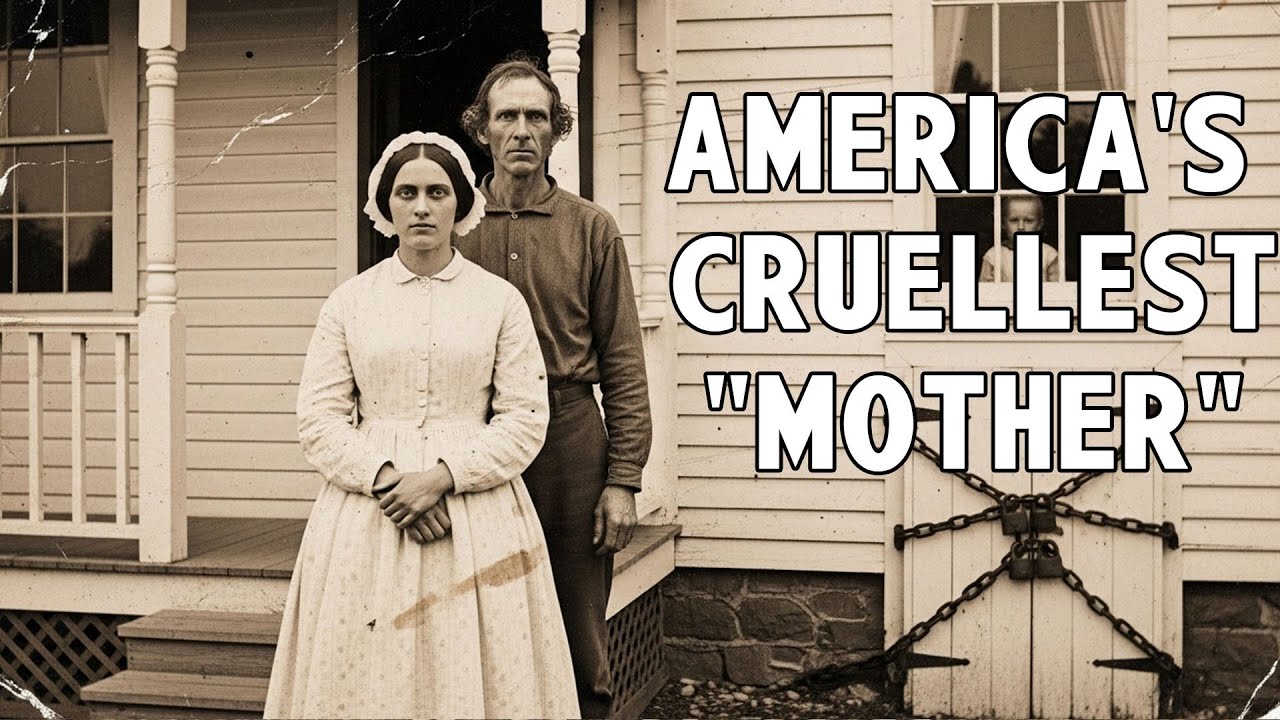
The atmosphere shifted from cordial to confrontational, and Crawford turned to the woman who had greeted them so warmly moments before. “Ma’am,” he said, his eyes fixed on hers, “I’ll need you to show us the cellar. ”
The transformation was chilling. The mask of the gentle, charitable woman dissolved in a second, replaced by raw, feral panic.
Her face blanched, her hands trembled, and she began stammering excuses. The cellar was unsafe. It was filled with black mold and collapsing supports. A place of storage, nothing more.
The children were forbidden from going down there. There was nothing to see. Her desperation was no longer a performance, it was the authentic terror of a creature whose lair was about to be breached. And then, as if on cue, a sound came from directly beneath their feet.
Faint, muffled by thick wooden floorboards and earth, but unmistakable. A child’s cry, followed by a weak, desperate plea for help. Twenty years of meticulously crafted lies evaporated in that moment. Crawford and Webb drew their pistols, went outside, and used a pry bar from their saddlebags to shatter the locks.
As the heavy door swung open, a wave of stench washed over them, the concentrated odor of human misery so powerful it made them gag. They descended the stone steps, lanterns cutting through the oppressive darkness, and walked into a scene that would forever redefine their understanding of human evil. The main chamber of the basement was far larger than the house above it, a cavern of hand-laid stone designed for one purpose: to contain human beings. And it was full.
Chained to iron rings drilled into the walls were 47 children. Their ankles were locked in heavy iron shackles, the chains just long enough to allow them to sit or lie down on the damp, filth-strewn floor, but not long enough to reach one another. They were specters, skeletal figures in rags, their bodies covered in sores and scars. But it was their eyes that broke the two lawmen.
They were the eyes of old souls trapped in the bodies of children, devoid of light, of hope, of anything but a profound and bottomless emptiness. After that first weak cry for help, they fell silent, staring at the intruders with a terrifying passivity, as if witnessing a dream they didn’t believe could be real. Deputy Webb, a father of four young children, stumbled back up the stairs and was violently sick in the yard. In smaller adjoining chambers, they found the instruments of the system.
One room served as a punishment chamber, containing a set of stocks and other restraining devices. Another was a crude infirmary. And in a third, they found the heart of the operation: a set of meticulously kept ledgers. Written in neat, elegant script were the names, ages, and dates of arrival for every child who had ever entered the basement.
The records went back to 1812. But as Crawford scanned the lists, a chilling question emerged. The ledgers detailed the arrival of over 90 children over the past 22 years. Forty-seven were here.
Where were the others? The answer lay deeper within the labyrinth. At the back of the main chamber, hidden behind a loose section of stone wall, was a narrow, suffocatingly tight passage. Forced to crawl on their hands and knees, their lanterns casting dancing, monstrous shadows on the earthen walls, Crawford and Webb followed the tunnel for about 15 feet until it opened into another, smaller chamber.
The air here was different, thick with the smell of lime and damp earth, and something else: the cloying sweetness of decay. As they raised their lanterns, the light fell upon an uneven floor, pockmarked with dozens of small, shallow depressions. It was a graveyard. Using their hands and a small shovel retrieved from the barn, they began to dig.
Just inches below the surface, they found the small, fragile bones of a child, and then another, and another. The remains of at least 36 children were buried here, their bodies hastily covered with quicklime to accelerate decomposition and mask the odor. Some of the skeletons showed signs of malnutrition or disease, but others bore the unmistakable marks of violence: skulls fractured by a heavy blow, bones broken and poorly healed. The ledgers now took on a horrifying new meaning.
Next to some of the names were chillingly simple notations: failed to thrive, resistant to training, expired. To understand how this horror had festered in the heart of a close-knit American community for more than two decades, one had to understand the world that concealed it. Virginia in 1834 was a land of deep contradictions, a society obsessed with appearances, where a family’s reputation was their most valuable currency. The community of Millbrook in Henrico County, a peaceful, God-fearing settlement of around 50 families, revolved around the church, the general store, and the rhythms of the tobacco harvest.
It was a place where everyone knew everyone else’s business, or so they thought. The Sullivan property sat on the edge of this world, a 200-acre farm that seemed utterly unremarkable. The white clapboard farmhouse with its welcoming wraparound porch was a picture of pastoral tranquility. A red barn, a chicken coop, a smokehouse.
The very image of the American dream. Ezra Sullivan, a man who had inherited a small fortune, bought the land in 1809 and almost immediately began a series of unusual construction projects, hiring local laborers for what he called an expansion of the root cellar. He paid generously in cash and made a simple yet strange request: each crew was to work only on their assigned section, never to see the full scope of the project. Over the years, they dug deeper and wider, laying stone and mortar, creating a subterranean space that extended far beyond the footprint of the house above.
None of them ever knew what they were truly building. They were simply well-paid hands, constructing a prison one stone at a time. The real architect of the horror, however, was not Ezra. It was his wife.
Constance Sullivan arrived in Millbrook in 1811, a bride of 22. The community saw a handsome, soft-spoken woman with dark, intelligent eyes. She dressed modestly, attended church services when her fragile health permitted, and cultivated a reputation for quiet charity. This persona was her greatest weapon, a shield of respectability that deflected all suspicion and disarmed all curiosity.
When neighbors asked why they never had children of their own, Constance would offer a sad, knowing smile and explain that God had given them a different purpose. She told the local pastor, Reverend Matthews, and the owner of the general store, Thomas Henderson, that she and Ezra had taken on the solemn duty of caring for orphan children from her extended family back in Pennsylvania. It was a temporary arrangement, she’d explain, a safe harbor for these traumatized souls until proper permanent homes could be found. The story was perfect.
In an era of high mortality rates, orphans were a common and tragic feature of society. The community saw the Sullivans not as strange or reclusive, but as saints bearing a heavy Christian burden with quiet dignity. Mrs. Henderson would sometimes catch a fleeting glimpse of a small, pale face peering out from the back of the Sullivan wagon on supply days.
The children never spoke, their eyes wide with a fear that was mistaken for shyness. “They are still grieving,” Constance would explain in her gentle, melodic voice. “The world has been cruel to them. They need time and silence to heal.
”
Every two weeks, she would visit Henderson’s General Store with a long, detailed list and a heavy purse, purchasing flour, cornmeal, salt pork, and molasses in quantities that seemed absurd for a childless couple. When Thomas Henderson once commented on the volume, she simply smiled sadly and reminded him of her growing family of unfortunate souls. She also bought unusual amounts of medical supplies, laudanum, bandages, salves, and bitter herbs used for fevers and infections, explaining that the children often arrived in poor health. No one thought to question why Dr.
Marcus Whitfield, the traveling physician, was never permitted to actually see his supposed patients. On the few occasions he was called to the farm for a particularly severe illness, Constance would meet him on the porch, describe the symptoms with strange, clinical precision, request specific medicines, and politely refuse the doctor’s offers to examine the child directly. “The poor thing is terrified of strangers,” she would insist. “A man’s presence would only cause more distress.
” Dr. Whitfield, respecting the privacy and supposed trauma of the children, would reluctantly agree, unknowingly prescribing medication for a prison infirmary. The Sullivan farm operated on a rhythm entirely its own. While other farmers rose and slept with the sun, the Sullivan property often came alive after dusk.
Neighbors grew accustomed to seeing the flicker of lamplight in the farmhouse windows at unnatural hours. The faint, rhythmic sound of hammering or the grating of stone against stone would sometimes carry across the fields on a still night. When asked, Ezra would explain it away as necessary improvements. “With so many little ones under our roof, a man’s work is never done,” he’d say with a tired but proud smile.
The community accepted this, mistaking the sounds of a prison’s expansion for the sounds of a sanctuary’s construction. For the children, the day was a time of silence and fear, of hiding from the world above. The night was when their world was active, when mother and father moved among them, their footsteps on the floorboards above serving as a constant reminder of who held absolute power. The children were taught a simple, brutal theology: the world of sunlight was a place that had rejected them, a world where their families had abandoned or sold them.
The darkness below was their only reality, their only home. But no system is perfect, and after two decades of flawless operation, the first cracks appeared, not from rebellion within, but from a random act of God. The winter of 1834 was unusually brutal, a bitter, relentless cold gripping Virginia, freezing the rivers and burying the landscape under deep snow. On the night of February 23rd, a traveling merchant named Jacob Stern was caught in a sudden, violent blizzard on the road from Richmond.
Disoriented and facing the real possibility of freezing to death, he saw the faint light of the Sullivan farmhouse and stumbled toward it, seeking shelter. Ezra Sullivan, his face a mask of barely concealed agitation, could not refuse the unwritten law of hospitality in a storm. He let Stern in, but the atmosphere inside was anything but welcoming. Stern later recounted the evening to investigators, describing a palpable tension that hung in the air.
The Sullivans were nervous, exchanging constant, worried glances, starting at every creak of the old house. When Stern, making polite conversation, asked about the many orphans he’d heard they cared for, Constance’s answer was swift and sharp. “They were all ill with a fever,” she said, “and sleeping. They must not be disturbed under any circumstances.
” But what disturbed Stern most was a sound he heard throughout the night. As he lay on a cot in the parlor, a faint, muffled noise drifted up from beneath the floorboards. It was the sound of weeping, not one child, but many. When he mentioned it to Ezra the next morning, Sullivan was quick to dismiss it.
“The wind,” he claimed, forcing a smile. “This old house has a thousand voices in a storm. ” Stern, a stranger eager to be on his way, did not press the issue. But the memory of that sound and the look of pure panic in the Sullivans’ eyes stayed with him.
He had heard the sound of the secret, and though he walked away, the seal had been broken. Three weeks later, on March 15th, the second thread was pulled. A family of desperate Irish immigrants, the Flynns, was traveling toward Richmond in search of work. While crossing a swollen creek, their teenage daughter, Mary Katherine, became separated from the group.
Lost, exhausted, and terrified as darkness fell, she saw the welcoming light of the Sullivan farmhouse and approached the door, hoping for a moment of kindness. Constance Sullivan, ever the picture of Christian charity, took her in, offering a warm meal and a place to sleep for the night. Mary Katherine Flynn was never seen alive again. Her family, frantic with worry, reported her missing to the sheriff in Richmond a few days later.
A search party was dispatched, but the vast, unforgiving Virginia wilderness offered up no clues. After a week, the search was abandoned. The official assumption was that the poor girl had succumbed to the elements or been taken by a wild animal. No one connected the disappearance of an immigrant girl to the respectable, charitable couple in Henrico County.
But this time was different. Mary Katherine wasn’t a purchased orphan from a distant state or a runaway no one would look for. She was part of a family that was actively searching for her. A formal report now existed in the county records.
A name was now on file. A clock had started ticking. The final event, the one that would tear the entire facade down, occurred on April 2nd. William Hutchinson, a farmer, was hunting rabbits in the woods bordering the Sullivan property when a sound from the direction of the farm made him freeze.
It was the sound of children screaming, not the shouts and cries of a game, but raw, undiluted terror, a sound of pure agony. Hutchinson, his heart pounding, crept closer, taking cover in a thicket of oak trees that gave him a clear view of the farmhouse about 50 yards away. He watched and listened for nearly an hour. The screaming was intermittent, and strangely, it seemed to emanate not from the house itself, but from the ground beneath it.
At one point, the cellar door on the side of the house opened, and Ezra Sullivan emerged, blinking in the daylight. He looked around nervously, his eyes scanning the tree line before he disappeared back into the darkness below, pulling the heavy door shut behind him. The screaming stopped. Hutchinson retreated, his mind reeling.
He spoke to his neighbors about what he’d witnessed. Some dismissed it, but for others, his story was a spark that ignited a collection of half-forgotten memories. The excessive food purchases, the nocturnal construction sounds, and the most damning fact of all: in 20 years, not a single one of Mother Sullivan’s orphans had ever been seen playing in the yard, attending a church picnic, or walking into town. The whispers started to coalesce into a single, terrifying suspicion.
The whispers finally reached Sheriff Benjamin Crawford, a 15-year veteran. Initially inclined to dismiss the whole thing, he could not ignore William Hutchinson, a sober, respected farmer who insisted on filing a formal complaint detailing the screams and Ezra Sullivan’s furtive behavior at the cellar door. On the morning of April 8th, 1834, Crawford and Deputy Webb rode out to the Sullivan farm. Now, standing in that basement chamber, the full scope of the evil was clear.
This was not the result of a moment of passion or madness. This was the work of years. It was a system. But what was the ultimate purpose of this elaborate, two-decade-long operation?
The investigation that followed was a descent into the psychology of a predator who had weaponized public perception. Constance had trained the children through punishment and reward to call her mother, a single word that bound them to her in a twisted parody of a family and provided perfect cover. The children themselves were her unknowing accomplices in their own imprisonment, taught that the outside world was a place of certain death and that Constance was their only savior. But the ledgers hinted at something even larger.
The meticulous records of acquisitions and coded notes about shipments suggested the farm wasn’t an isolated operation. The correspondence, written in a simple but effective code, revealed that Constance had been in regular contact with at least a dozen other individuals across five states: Pennsylvania, Maryland, North Carolina, South Carolina, and Georgia. They discussed merchandise, product quality, and delivery schedules in language that could only be referring to human beings. One letter, dated just three months before the raid, came from a man in Philadelphia identified only as A.
Morrison. He wrote: “I have procured six new items for your consideration of varying age and condition. Three are of robust stock, suitable for field work. Two are smaller, more suited for domestic arrangements.
The last is spirited and may require your specialized training methods. ” Constance was paying between 50 and 200 dollars per child, a significant sum at the time, depending on age, health, and perceived level of compliance. Conversely, she was also receiving payments from other locations, indicating that the farm served not only as a holding facility but also as a distribution hub. Over 22 years, more than 8,000 dollars had moved through her hands.
Dr. Whitfield realized, with dawning horror, that Constance’s strangely specific questions about medicine over the years were not those of a concerned caregiver but of a researcher, systematically studying how to keep human beings alive under conditions of extreme stress and deprivation. For the first time in American history, federal marshals were called in to coordinate a multi-state criminal investigation. As authorities in other states began to re-examine their own cold cases of missing children, a disturbing pattern emerged.
Children from poorhouses, runaways from abusive homes, orphans with no one to advocate for them. They were the network’s preferred targets, souls whose absence would create the fewest ripples. Meanwhile, at a secure location in Richmond, the survivors slowly began to find their voices. The process was agonizing.
Many were terrified of their rescuers, flinching at sunlight, cowering from open spaces. The stories they eventually told were remarkably consistent: a brutal indoctrination process for new arrivals, a period of isolation and punishment designed to break their will, and a rigid hierarchy within the basement where older, long-term prisoners were given small privileges in exchange for enforcing discipline among the younger children. Constance had turned the victims against each other, making them participants in their own subjugation. But within this broken group, there was one mind that had not been fully conquered: a girl named Rebecca.
She was 14, snatched from her family’s farm in Pennsylvania five years earlier, the longest-held survivor. Unlike the others, she remembered. She remembered the warmth of her own mother’s arms, the taste of fresh apples, the sight of an open sky. While other children shut down, Rebecca watched, listening to every muffled conversation, every late-night visitor, forgetting nothing.
She provided names, descriptions of visitors, and details of transactions. She described how some children weren’t meant to stay, how they were inspected by buyers who came to the farm, wealthy, well-dressed men with educated accents who treated the children not like victims but like property. The most significant event she recounted was a visit from a man just weeks before the raid. He was exceptionally wealthy, arriving in a fine carriage, and he was a discerning customer.
He inspected Rebecca and three other children, checking their teeth, their muscle tone, their eyes, ultimately rejecting them, complaining to Constance that her current stock was too damaged for his particular needs. But before he left, he gave her a letter outlining his exact requirements for the next acquisition. That letter, a detailed order for human beings, was found among Constance’s papers. It was signed by a man named Henry Blackwood, with a return address to a prominent plantation in Charleston, South Carolina.
When investigators arrived in Charleston, they discovered that Blackwood was not just a wealthy plantation owner but a man of immense influence with deep political connections and a reputation as a man of science. The children he was purchasing were not intended for labor in the cotton fields. They were to become subjects in his private medical experiments. On his sprawling plantation, Blackwood operated a secret secondary facility, known to his inner circle as the observation ward, a private research laboratory and hospital where he, along with two physicians from a prestigious Charleston medical college, conducted gruesome experiments.
Children were deliberately infected with diseases like yellow fever and smallpox to study the progression of the illnesses without treatment. They were subjected to experimental surgeries performed without anesthesia. Different poisons and toxins were administered in varying doses to document their effects. The Sullivan farm, with its training methods and long-term holding capacity, was essentially a conditioning center, breaking the children’s spirits and bodies to make them more compliant subjects for the research that awaited them.
But as investigators began closing in on this elite circle, the network fought back. Key pieces of evidence began to disappear from secure locations. Witnesses were intimidated. Sheriff Crawford received a letter containing a single chilling message: “Some graves are best left undisturbed.
” Deputy Webb was ambushed one night on his way home, beaten severely by two men who warned him to forget what he saw in that basement. Dr. Whitfield’s medical practice was suddenly ruined as his most influential patients withdrew their business. The most devastating blow came when Timothy, a 12-year-old boy who had been a key witness, vanished from the guarded safe house where the children were being kept.
There was no sign of a struggle. He was simply gone. And then, in her jail cell in Richmond, Constance Sullivan was found dead. The official report would say suicide, but everyone on the inside knew it was an execution.
She was scheduled to begin her formal testimony the following week, testimony in which prosecutors believed she would, in exchange for avoiding execution, name every buyer, every supplier, and every corrupt official. Her suicide, by hanging with a noose made from her own bed sheets, in a cell that was supposed to be under constant guard, was impossibly convenient. She took her secrets to the grave. The investigation was on the verge of collapse.
But the powerful men fueling this enterprise had made one critical miscalculation. They had failed to account for the conscience of a single, ordinary man who had been on the inside. His name was Samuel Pierce, and he had worked as an overseer on Henry Blackwood’s plantation. He was not a good man.
He had participated in the brutality, carried out orders, and kept his silence for years out of fear and self-preservation. But the disappearance of the boy Timothy, a boy he recognized from the plantation, had been a breaking point. Pierce knew the network wouldn’t just silence outsiders. It would eventually eliminate insiders like himself.
Motivated by a desperate cocktail of guilt and self-preservation, he walked into the Federal Marshal’s office in Charleston, bearing Henry Blackwood’s second set of ledgers, the ones hidden from the initial raid, detailing not just the experiments but the names of every man who had participated in or purchased from Blackwood’s observation ward. Pierce’s testimony before a secret Federal Grand Jury was the equivalent of a lit match in a powder magazine. He described the experimental quarters as a place completely divorced from the laws of God or man. He recounted watching esteemed physicians from Charleston deliberately infect children with fatal diseases, then taking meticulous notes as the children suffered, withered, and died.
He spoke of demonstrations Blackwood would host for prospective buyers, events where children were paraded out and subjected to various stress tests to showcase their durability. But Pierce’s most explosive revelation was the existence of what Blackwood called the gentlemen sporting club, a clandestine society of some of the South’s most prominent men: plantation owners, judges, politicians, and businessmen. For this club, the children were used as live prey in organized hunts that took place in a remote, fenced-off section of Blackwood’s vast estate. Pierce, his voice cracking for the first time, described how these pillars of society, drunk on whiskey and entitlement, would ride out on horseback with dogs and rifles to hunt down terrified, unarmed children for sport.
The testimony was so sickening that the grand jury scribe had to be replaced twice after becoming physically ill. Armed with Pierce’s testimony and Blackwood’s hidden ledgers, the federal marshals planned an operation of unprecedented scale. On a single, coordinated night, teams of marshals and trusted local deputies struck simultaneously at over a dozen locations across four states. The raids netted Henry Blackwood, the two Charleston physicians, a Georgia state legislator, and eight other prominent Southern businessmen and landowners.
More importantly, they resulted in the rescue of over 100 additional children from various hidden facilities, some held in conditions that made the Sullivan basement look almost merciful. The Georgia legislator’s diary contained poetic, almost rapturous descriptions of the thrill of the hunt, speaking of the children as wild game that provided the ultimate sport. The trials became the sensation of the decade. The defense strategy was predictable: discredit the witnesses, bury the prosecution in legal maneuvers, argue that the children were unreliable witnesses, that Pierce was a disgruntled lying employee.
But the physical evidence was undeniable. Ezra Sullivan, facing a mountain of evidence and abandoned by the powerful men he had served, was the first to fall. He was swiftly convicted of kidnapping, imprisonment, and 36 counts of murder. On November 15th, 1836, he was hanged in Richmond before a crowd of thousands.
Witnesses reported his final words were a rambling confession, a plea for God to forgive him for following not his wife, but the devil himself, who wore a gentleman’s suit. Henry Blackwood maintained his innocence with chilling disdain, was found guilty of multiple murders and sentenced to death. His execution was delayed for years by endless appeals. He ultimately died in prison in 1841, officially of a heart attack, though rumors persisted that he was poisoned by former associates who feared he might finally start talking.
But the true architects and primary beneficiaries of the network largely escaped justice. Several of the wealthiest plantation owners, tipped off by allies within the government, fled to Europe with their fortunes long before federal marshals could reach them. The Georgia state legislator was never brought to criminal trial; leveraging his immense political power, he was allowed to be censured by his own legislature and quietly resigned, retiring to his estate a free man. The two physicians from Charleston received surprisingly light sentences after the medical college and prominent city officials lobbied heavily on their behalf.
The men with the deepest pockets and the most powerful friends found ways to evade true accountability. The public saw a handful of convictions and believed the monster had been slain. But the head of the beast had never truly been touched. The legacy of the Sullivan case was not one of complete justice, but of a painful and incomplete awakening.
Virginia passed the nation’s first comprehensive child welfare legislation, creating state oversight for orphanages and establishing legal standards for foster care and adoption. At the federal level, the case directly led to new laws granting federal marshals broader authority to investigate and prosecute crimes that cross state lines. The Sullivan farm itself became a cursed place. After being seized by the government, the house was demolished in 1845.
The basement was filled with tons of rock and concrete, a permanent seal placed over the site of so much suffering. A small, unmarked cemetery was established nearby to honor the children who died there, their names for the most part lost to history. For the 47 rescued from the Sullivan basement and the 100 more from the wider network, rescue was not an end to their suffering but the beginning of a new kind of struggle. Most carried the physical and psychological scars for the rest of their lives.
Many struggled with debilitating mental illness, addiction, and an inability to form healthy relationships. Some, however, found a measure of peace. Rebecca, the girl whose memory had broken the case open, was quietly placed with a Quaker family in rural Pennsylvania. They gave her silence and space, never asked about her past, gave her a home, an education, and an unconditional love that slowly began to heal the deepest wounds.
She would go on to marry a quiet farmer, raise three children, and live to the age of 73. She never once spoke publicly about her ordeal again. Sheriff Benjamin Crawford was never the same. The case consumed him.
Promoted to the rank of federal marshal, he dedicated the rest of his life to hunting the remnants of the network, becoming one of America’s first specialists in crimes against children. He pursued leads from the seized correspondence for years, sometimes successfully bringing smaller operators to justice, but more often running into dead ends and political walls. He died in 1868, a man respected for his tenacity but haunted by the knowledge of how many of the guilty had slipped through his fingers. The preserved evidence became a dark archive, studied for the next century.
One of the most chilling discoveries was the realization that the Sullivan operation was not the beginning of the network. The correspondence contained references to “the old methods” and “the generation before,” suggesting this system of child trafficking and exploitation had been operating in America for decades. One of the most unsettling loose ends was the fate of A. Morrison, the Philadelphia supplier.
Despite an intensive search by federal marshals, the man was never identified, likely an alias. He and suppliers like him represented the corporate, almost bureaucratic face of this evil, the procurers who moved through the slums and orphanages of America’s burgeoning cities, identifying and acquiring vulnerable children with cold, business-like efficiency. The network was compartmentalized: the suppliers in the north likely had no idea of the specific horrors that awaited the children, and men like Blackwood likely had no interest in the sordid details of the acquisition process. This compartmentalization allowed ordinary people to participate in monstrous acts by focusing only on their small, assigned role.
The failure to ever identify Morrison meant that while the Sullivan and Blackwood branches had been severed, the roots of the system likely remained intact. The community of Millbrook never recovered. The revelation shattered the town’s identity. Residents began to look at each other with suspicion.
The Hendersons agonized over every large purchase of food they’d made to Constance. Reverend Matthews was consumed with guilt over the blessings he had bestowed upon the Sullivan house. Everyone had a story of a missed sign, an ignored intuition, a strange sound dismissed too quickly. They had to live with the knowledge that their passivity had made them unwitting guardians of that basement prison.
For years after the main trials concluded, a small team of federal investigators continued to work quietly. One investigator, Robert Lyman, became obsessed with a series of entries in Constance Sullivan’s financial ledger: coded payments made out to entities identified only by initials that didn’t correspond to any known supplier or buyer. They were regular, almost like dues or franchise fees. Lyman developed a terrifying theory: the network he and his colleagues had dismantled was itself just one branch of an even larger, older, and more powerful organization, a structured, hierarchical society with its own rules, its own financial system, and its own long-term agenda.
He found references in the coded letters to “the board” and “grand council approval” for high-value transactions. This implied a level of organization far beyond a simple trafficking ring. Lyman’s superiors, facing intense political pressure to declare the case closed, eventually ordered him to cease his investigation. His final report was buried in a sealed archive, classified under national security protocols, an extraordinary measure for a criminal case.
The final fate of Samuel Pierce remains a mystery. After his testimony, he was placed into a new federal witness protection program, one of the first of its kind. He was given a new name, a small sum of money, and sent west. He was never heard from again.
Official records show he died of cholera in St. Louis a few years later, but no body was ever produced, no grave ever marked. It is just as likely that the remnants of the network eventually found him and administered their own form of justice. Over a century and a half later, in 1998, a historical society in Henrico County was doing a survey of old land deeds.
They came across the original property maps for the Sullivan farm. Tucked into the file was a small, hand-drawn addendum sketched by one of the original sheriff’s deputies, Marcus Webb. It was a map of the basement, but it included a section never mentioned in any of the official reports. Beyond the burial chamber, Webb had drawn a dotted line indicating another tunnel, this one leading to a small circular room.
In the margin, he had written a single cryptic note: “The altar room, evidence burned by order of Marshal Crawford. God forgive us. ” No other mention of this room exists anywhere. The official reports are meticulous in their detail, but this room is absent.
It was deliberately and officially erased from the record. What was found in that room that was so horrifying, so beyond the pale, that a hardened lawman like Benjamin Crawford would order it not just sealed, but expunged from history itself? The murders, the torture, the medical experiments, all of this, as monstrous as it was, was documented. But there was something else, something found in that final room deemed too dangerous for the public to ever know.
Was this trafficking ring not just for labor, not just for science, not just for sport, but for something else? Something that bordered on the ritualistic? The concrete that fills that Virginia basement may have sealed a crime scene, but it also sealed a mystery. The story of the Sullivan farm serves as a brutal testament to a truth we are taught to ignore: that the greatest evils are often not committed by lone madmen, but by organized, intelligent, and powerful systems that hide behind the masks of respectability and progress.
The network was wounded in 1834, but was it destroyed? Or did it simply evolve, becoming more sophisticated, more invisible? The sealed government files, the missing witness, the altar room scrubbed from history: these are not the hallmarks of a case that is truly closed. They are the signs of a secret being actively kept.
The 47 children found in that Virginia basement are a symbol for all the forgotten victims of history, their stories silenced to protect the powerful. The evil that Constance Sullivan served was ancient, and it did not die with her. It is a parasitic entity that attaches itself to power and wealth in every era. The monster is real.
It has always been here, and it does not live in the shadows. It lives right next door, in the nicest house on the street. And it is always, always looking for new acquisitions.
