On June 22, 1941, more than three million Axis soldiers crossed the Soviet border along a front stretching nearly 2,900 kilometers from the Baltic Sea to the Black Sea. Six hundred thousand horses pulled artillery through the dust. More than 3,600 tanks rolled forward in formation. Nearly 2,700 aircraft filled the sky.
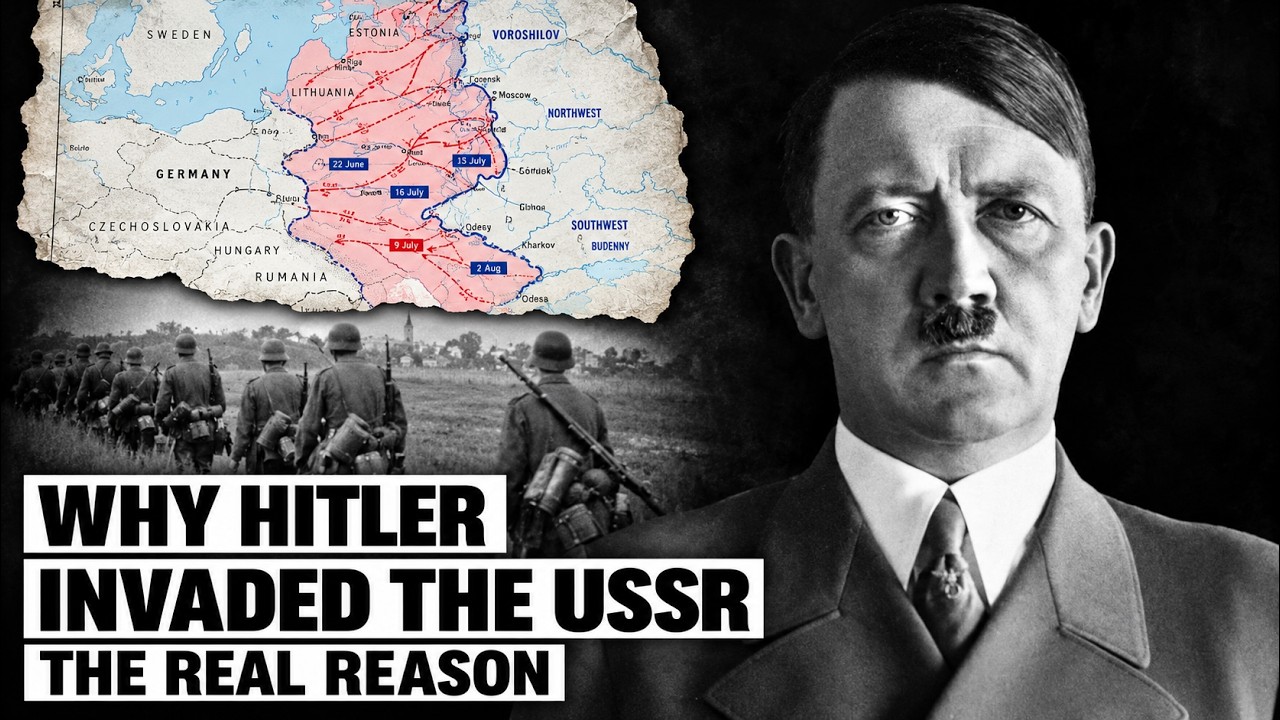
It was the largest invasion force ever assembled, and it has never been surpassed. The strange part was that Nazi Germany and the Soviet Union had signed a non-aggression pact less than two years earlier. They had carved up Poland together. Soviet oil was fueling German tanks, and Soviet grain was feeding German civilians.
On paper, they were the closest thing to allies in Europe. So why did Hitler break that pact and open a second front before he had finished off Britain? The textbook answer usually blames Hitler’s madness or his hatred of communism. Those explanations are partially true, but they are also lazy.
The invasion was not a single decision. It was the collision of three crises: a resource crisis, a strategic crisis, and an ideological crisis that had been part of the Nazi project from the beginning. All three converged at one point, forcing Hitler’s hand in a way that, from his perspective, made sense. The ideological crisis went back to 1924, when Hitler was dictating Mein Kampf from a prison cell in Bavaria.
The concept of Lebensraum, meaning living space, had circulated in German nationalist circles for decades. Geographers in the late 1800s had argued that nations, like organisms, needed room to grow or they would die. Hitler took that idea and turned it into something far darker. He believed the German people were trapped in a small patch of Central Europe, surrounded by hostile powers, lacking colonies and raw materials.
The answer, he wrote, was east, always east. Germany would push into the vast agricultural lands of Russia and Ukraine. The people living there, whom he regarded as racially inferior Slavs ruled by what he called Judeo-Bolshevik masters, would be deported, enslaved, or exterminated. Their fertile black soil would be colonized by German farmers.
The oil fields of the Caucasus and the mineral wealth of the Urals would fuel a thousand-year empire. Hitler stated this openly in speeches and to confidants throughout the 1920s and 1930s, promising as early as 1932 that Germany’s destiny lay in acquiring Eastern territory. The invasion of the Soviet Union was something he had been publicly planning for sixteen years. So why did he sign a non-aggression pact with Stalin in August 1939?
Because in the summer of 1939, Hitler was not in a position to attack Russia. He had taken Austria and Czechoslovakia, and he was eyeing Poland. Britain and France had made clear that invading Poland meant war. Hitler knew that fighting Britain, France, and the Soviet Union simultaneously would be suicide.
Germany had tried that in World War I and been crushed by hunger and attrition. The British naval blockade had killed around 750,000 German civilians through starvation, and that memory haunted Nazi strategic thinking. Hitler needed Stalin out of the way, temporarily, just long enough to deal with Poland and the West. On August 23, 1939, German Foreign Minister Joachim von Ribbentrop and Soviet Foreign Minister Vyacheslav Molotov signed the Nazi-Soviet Non-Aggression Pact.
On the surface, it was a simple promise that neither side would attack the other for ten years. A secret protocol divided Eastern Europe into spheres of influence. Poland would be split down the middle. The Baltic states, Finland, and Bessarabia were assigned to one side or the other.
Four days earlier, the German-Soviet Credit Agreement had been signed, making the two countries trading partners. Germany would supply industrial machinery, weapons technology, and manufactured goods. In exchange, Stalin would send Hitler oil, grain, timber, manganese, chromium, platinum, and other raw materials essential to a modern war machine. Over the next twenty-two months, this trade expanded dramatically.
Nearly a million tons of oil had been shipped from Baku to Germany, along with nearly two million tons of grain and hundreds of thousands of tons of other materials. German factories ran on Soviet copper. German tanks burned Soviet gasoline as they rolled through France. The invasion of France in 1940 was partially fueled by Soviet exports.
Hitler knew this situation was unsustainable. The moment he broke the pact, that supply line would vanish. So why did he burn down the arrangement keeping his war machine running? The answer begins in the summer of 1940, at a mountain retreat called the Berghof in the Bavarian Alps.
France had fallen. The British Expeditionary Force had been evacuated from Dunkirk. Hitler expected Britain to sue for peace, but Churchill refused. Operation Sealion, the planned invasion of Britain, was looking impossible.
The Royal Air Force was holding its own, and the Royal Navy was still the most powerful fleet in the world. Hitler needed another way to break Britain. On July 31, 1940, he laid out his logic to his senior generals. The record of that conference survives.
Hitler told them that Britain was continuing the war because it had two hopes: America and Russia. Britain was gambling that the United States would eventually enter the conflict, and that Stalin would eventually break the pact and attack Germany from the east. With Russia smashed, Hitler argued, Britain’s last hope would be shattered. The shortest path to London, he had convinced himself, ran through Moscow.
But this strategic reasoning was intertwined with something more material. The German economy was running out of oil and food at exactly the same time. Germany’s oil came mostly from Romania and the Soviet Union. Romanian fields around Ploesti accounted for roughly seventy-five percent of Germany’s oil imports, but Romania alone could not sustain wartime consumption.
The next closest major reserves were in the Caucasus, specifically Baku on the Caspian Sea. In 1942, Baku produced about twenty-four million tons of oil, roughly eighty percent of total Soviet production. That single city produced more than three times Germany’s annual consumption. If Hitler captured Baku, the fuel problem would be solved.
If he denied it to the Soviets, the Red Army would be crippled. This is why so much of the Barbarossa plan aimed southward. Army Group South was tasked with driving through Ukraine and down toward the Caucasus. When Barbarossa stalled in late 1941, Hitler doubled down on the oil objective in 1942, launching Operation Case Blue to seize the Caucasus.
He told his generals plainly that if they did not take Baku, they would lose the war. When Case Blue failed and the Sixth Army got trapped at Stalingrad, Hitler’s fate was sealed. The food crisis was even more disturbing. Herbert Backe, State Secretary at the Reich Ministry for Food and Agriculture, was the man responsible for feeding Germany during the war.
He had a cold, mathematical mind. His analysis was that Germany did not produce enough food to feed itself at wartime rations. The only way to prevent civilian hunger was to seize food from occupied territories. The largest potential source of food in Europe was the Ukrainian grain belt.
If Germany captured those lands and diverted their production to feeding Germans and the Wehrmacht, the home front could be sustained. But the Soviet Union had developed enormous urban populations fed by Ukrainian grain. If Germany took that grain, Soviet cities would starve. Backe calculated that this could mean as many as thirty million deaths.
He called the Soviet urban population wasted eaters who had to be eliminated to balance the food equation. The Hunger Plan was formalized in meetings between German military and economic planners in May 1941. The minutes state explicitly that the war could only be continued if the entire Wehrmacht was fed from Russia, and that millions of people would undoubtedly starve to death. Genocide by starvation was not a byproduct of the invasion.
It was a central purpose. The Hunger Plan was never fully implemented because the German occupation never extended far enough east, but it still killed horrifically. Historian Timothy Snyder estimates that around 4. 2 million Soviet civilians were deliberately starved to death by German occupiers between 1941 and 1944.
Of the 5. 7 million Red Army soldiers captured by German forces, approximately 3. 3 million died in captivity, most from deliberate starvation. In occupied Kiev and Kharkov, tens of thousands perished.
In besieged Leningrad, over a million people died, many from starvation. There was also the question of timing. Why 1941? Soviet military strength was growing fast.
Stalin had launched massive industrial expansion, and Soviet tank production was approaching German levels. New tank designs like the T-34 were about to enter production. If Hitler waited two or three more years, the balance of power would tip decisively toward Moscow. Additionally, the Soviet performance in the Winter War against Finland had looked terrible.
Finnish ski troops had ambushed Soviet columns, and entire Soviet divisions were encircled and destroyed. Although the Soviets eventually prevailed, they took approximately 300,000 casualties against about 70,000 Finnish losses. The Red Army looked slow and poorly led. Hitler concluded that the Soviet state would collapse at the first serious blow.
He reportedly said that one only had to kick in the door and the whole rotten structure would come crashing down. He was catastrophically wrong. The preemptive war thesis, which claims Stalin was planning to invade Germany in the summer of 1941, has been rejected by most serious historians. Soviet deployments near the western border were in defensive posture, and Soviet logistics were not configured for an offensive invasion.
Stalin received dozens of warnings about the imminent German attack from his own intelligence services, from British intelligence, and from German defectors, but he consistently refused to believe them and would not put his forces on high alert. If Stalin had been planning to invade Germany, he would not have been shocked and paralyzed when Germany invaded him. On December 18, 1940, Hitler signed Führer Directive 21, the formal order initiating planning for Operation Barbarossa. The directive stated that the German Wehrmacht must be prepared to crush Soviet Russia in a quick campaign, even before the conclusion of the war against England.
Army Group North would drive toward Leningrad. Army Group Center would push toward Moscow. Army Group South would seize Ukraine and move toward the Caucasus. The whole campaign was expected to take at most three to four months.
The invasion was originally scheduled for May 15, 1941, but it was delayed by about five weeks, launching on June 22. The delay was caused partly by Mussolini’s disastrous invasion of Greece and partly by the muddy spring weather. That five-week delay proved crucial, because it meant the German advance into Russia bumped into the brutal Russian winter before Moscow could be captured. In the first weeks, the invasion was spectacular.
German forces advanced hundreds of kilometers. Soviet armies were encircled and destroyed in enormous pockets. Hundreds of thousands of Red Army soldiers were taken prisoner. By October, German troops could see the spires of Moscow in the distance.
Leningrad was besieged. Kiev had fallen. The ancient dream of Lebensraum seemed within reach. Then it began to unravel.
Soviet resistance stiffened the deeper the Germans moved. Supply lines stretched impossibly thin. Autumn mud slowed the Panzers. Winter arrived, and German soldiers, inadequately equipped for Russian temperatures, began freezing to death.
The Soviet counteroffensive at Moscow in December 1941 stopped the Wehrmacht and inflicted the first major defeat Hitler had ever suffered. The war in the East became a brutal, grinding war of attrition that Germany could not win. The Soviet Union ultimately lost approximately twenty-seven million people in the war, about nineteen million of them civilians. One-third of all Soviet buildings and infrastructure were destroyed.
Over a million Soviet Jews were murdered by Einsatzgruppen killing squads. The brutality of the occupation was so systematic that the Germans themselves called it a Vernichtungskrieg, a war of annihilation. The Wehrmacht lost more soldiers in the Soviet Union than in all other theaters combined. The invasion that was supposed to secure German dominance for a thousand years instead destroyed the Nazi state and led to the division of Germany itself.
The real reason for the invasion was never a single factor. Ideology provided the long-term motivation. Material necessity collided with strategic calculation. Germany could not win a long war against Britain and eventually the United States without secure sources of oil, food, and strategic minerals.
The Soviet Union had all three in abundance. Hitler had convinced himself that destroying the Soviet Union would force Britain to make peace. And the timing was dictated by the fact that Soviet strength was rising while German advantages were temporary. All three factors pointed in the same direction.
Barbarossa was not a mistake. It was the direct logical consequence of everything the Nazi project had always been about. If you accepted the premises of Nazi ideology, that Germany needed Lebensraum, that Slavs were subhuman, that the war with Jewish Bolshevism was existential, then Barbarossa was not an error.
It was the whole point of the regime.
