On the morning of December 10, 1945, Dwight Eisenhower sat down to write a letter to a man who was lying in a hospital bed in Germany, paralyzed from the neck down. Twelve days earlier, a car accident outside Mannheim had broken George Patton’s neck. Eisenhower, now in Washington just weeks into his new role as Chief of Staff of the Army, had heard the news first as a rumor. He refused to believe it.
He cabled Frankfurt, learned it was true, and set in motion everything the distance allowed. He notified Beatrice Patton and ordered the fastest available transport to bring her to Germany. Then he wrote to Patton himself. The letter told Patton that the news had come as a shock.
It revealed that only two days before the crash, Eisenhower had been arranging to contact Patton about a vacancy in the United States. There would always be work for him, Eisenhower wrote. The accident had closed no doors. Then came the confession: it was always hard for Eisenhower to express what he really felt when he was deeply affected.
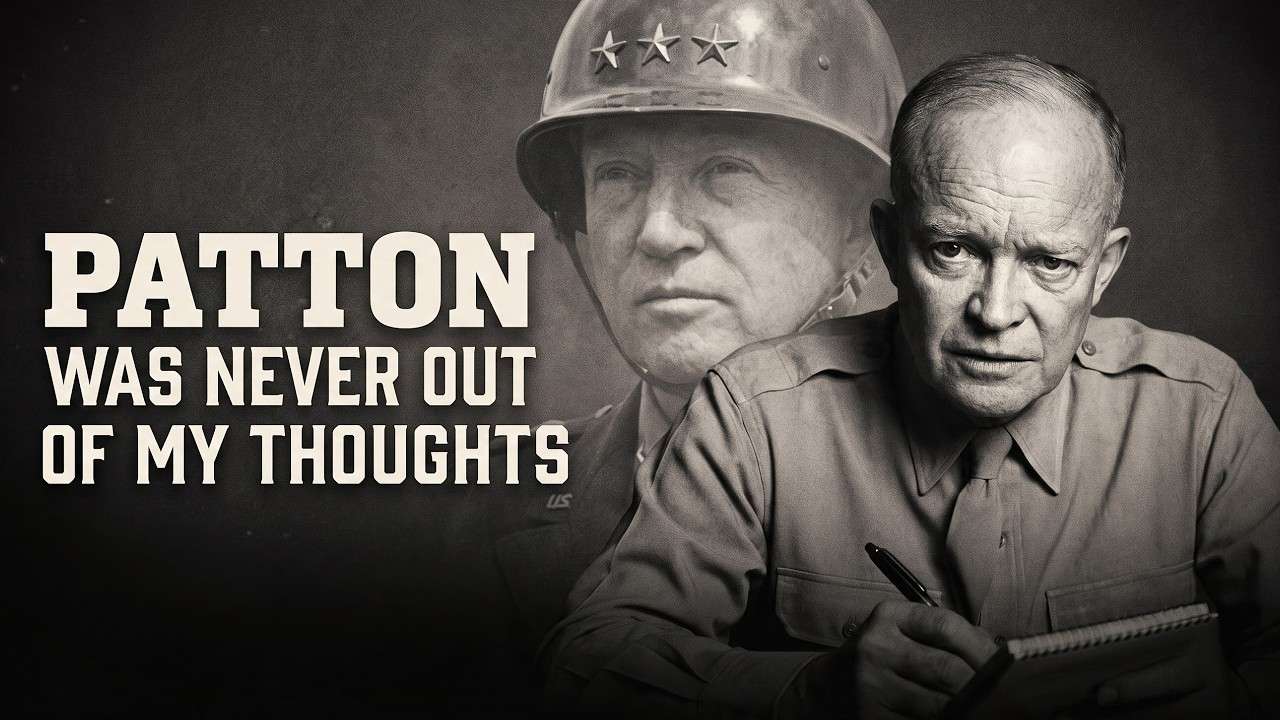
He said it anyway. Patton was never out of his thoughts. Beatrice read the letter aloud to her husband at his bedside. When she reached the end, Patton asked her to read the part about the job again.
He died on December 21, twelve days after the crash. The letter is the strangest piece of evidence in the entire record of their relationship, because it reveals a man fully capable of warmth that his public framework never admitted. In private, at the most critical moment, Eisenhower wrote the words of a friend. In public, for the twenty-two years that remained to him, he told the story of the war years in the vocabulary of a commander.
Both voices were genuinely his. The question worth asking is why only one of them ever reached the version he presented to the world. The pattern is there for anyone who reads the records. Wherever Eisenhower wrote or spoke about Patton, he did more than mention him.
He weighed him, defended him, analyzed him. And the shape of his judgment never changed. It was a positive assessment immediately paired with a reservation. Recognized genius, administrative difficulties.
Victory credited to him, personal friction recorded in the same breath. A man indispensable to the war effort and a burden on the command that had to manage him. Brilliance coupled with difficulty. A triumph achieved despite the weight of managing the very man who achieved it.
This was not a spontaneous habit of speech. It looks like a deliberate framework, maintained for decades. Some men who served under Eisenhower received a paragraph in his memoirs, a professional summary, and then the story moved on. Patton received pages.
The slapping incident alone occupies several pages of Crusade in Europe, where Eisenhower takes the reader through the investigation he ordered, the reprimand he wrote, and the reasons he decided to keep Patton anyway. For most subordinates, a brief evaluation was enough. For Patton, it never was. The framework itself never changed, and it is worth laying out clearly because its constancy is the whole point.
First came the brilliance: tactical genius, offensive leadership, speed of operations, the respect of the German high command, the victories. Then came the reservation: difficult to manage, a political burden, a public relations problem, a man requiring constant supervision, whose eccentricities created leadership challenges of their own. You can trace that structure across the years, and it begins long before the memoirs. In 1943, as the slapping incidents were approaching national scandal, Eisenhower told his surgeon general that Patton was indispensable.
In his letters to George Marshall, he described Patton, in essence, as a man with qualities the army could not afford to lose unless he first destroyed himself. In April 1944, after Patton’s remarks at Knutsford about Britain and America controlling the world, Eisenhower wrote to Marshall that it seemed hopeless to expect Patton ever to overcome his chronic habit of posing and self-dramatization. Patton was days away from being relieved of his command. Eisenhower kept him anyway.
In 1948, in Crusade in Europe, the same double judgment appeared in print. Eisenhower wrote that for certain types of operations, Patton was the most outstanding soldier the country had produced. In the same account, he noted that Patton’s emotional range was so wide that he lived at one or the other of its extremes. The praise and the reservation were impossible for any reader to miss.
The book also introduced Patton, in the period before the North African landings, as one of my oldest friends. That phrase deserves attention because it shows the friendship was never hidden. It was presented simply, alongside the professional biography. In 1967, in At Ease, Eisenhower went back to the beginnings.
He described the two of them as young tank officers at Camp Meade, neighbors living next door to each other, and remembered that from the start they got along wonderfully. According to one historian of that period, Eisenhower was distilling gin in his quarters while Patton was brewing beer in his. It is a wonderfully spontaneous image, and it stands in an interesting relationship with the book that came nineteen years earlier. The warmth lives in the stories of the nineteen-twenties, while the war years are told mostly as evaluation.
Consider what that evaluation does not contain. Across those pages, Eisenhower defends his decisions in the vocabulary of necessity. Keeping Patton after Sicily was necessary. Watching him closely was necessary.
In the most quoted passages, there is no apology and no self-revision. There is no indication that he ever wondered whether a different style of management might have served the friendship as well as it served the war. What those passages do not do is explain how a friendship that began over gin and beer became a subject that required handling. To understand why that gap matters, you have to remember how the story ended.
In late September 1945, after Patton told a press conference that ordinary Nazis had joined the party just as Americans became Republicans or Democrats, Eisenhower summoned him to Frankfurt. Patton came in a plain uniform, without his pistols, and left pale. The Third Army was gone. In its place stood a phantom headquarters, tasked with writing the history of a war Patton had spent his life waiting to fight.
Eisenhower left Europe in November to become Chief of Staff of the Army. On December 9, Patton’s car collided with a truck outside Mannheim. His neck was broken. Now the distance between the two Pattons is visible.
In 1948 and again in 1967, Patton returned. The historians and biographers who came after did much the same. The formula they inherited, indispensable in war and difficult to manage, became the standard account of the relationship. It worked, and that is precisely why it lasted.
There are two ways to explain the gap between the private letter and the public account, and both deserve to be taken seriously. The first is professional. A commander who led a brilliant and difficult subordinate to victory has an interest in explaining how that was achieved. The framework justifies his decisions, vindicates his judgment, and protects his reputation.
It answers in advance every question a skeptic might ask about why he kept a man who slapped soldiers and insulted allies. On this reading, the repetition is simply the work of a man defending his record. The second reading is more personal. Eisenhower spent his presidency, from 1953 to 1961, under public scrutiny that most generals never faced.
Warm and unconditional attachment to a dead and controversial friend would have carried a political cost. A framework of brilliance under control carried no cost at all. From this perspective, the evaluation was a way of keeping the relationship at a safe professional distance in the historical record, long after the reasons for that distance had disappeared. Neither reading can be proven.
They do not exclude each other. But one detail stands out clearly. Patton came back in 1948 and again in 1967. Eisenhower never stopped explaining him.
Other aspects of the war were revisited with the advantage of time. Command decisions were reconsidered. Strategic options were reevaluated. The judgment on Patton remained almost exactly what it had been when it was first recorded in 1943, repeated in one form after another for a quarter of a century.
What a commander explains once is usually a matter of record. What he explains again and again for decades is often something else: a question he answered a hundred times without ever closing it completely. The explanation was useful. It was safe.
Whether it was also the only way he could speak about a friend he lost under circumstances that never allowed him to say so is a question the records cannot answer. What the records do show is the man who wrote the letter in December 1945 and the man who told the story for the rest of his life, and the distance between them. What we cannot stop explaining often reveals what we have not fully settled.
Sometimes the explanation becomes the story itself.
