Leslie Smith and Jack Odell began with six hundred pounds, a bombed-out pub in North London, and no clear plan. Both were ex-Navy men, Smith a salesman who understood die casting and export, Odell a self-taught engineer who had spent the war keeping tanks and lorries running across North Africa and Italy. They called their company Lesney, a mash-up of their first names, and filled the dead hours between industrial orders by making toys. Odell’s first was a small diecast road roller, cheaper than anything Dinky, the market leader, offered, and sellable in any corner shop that would take it.
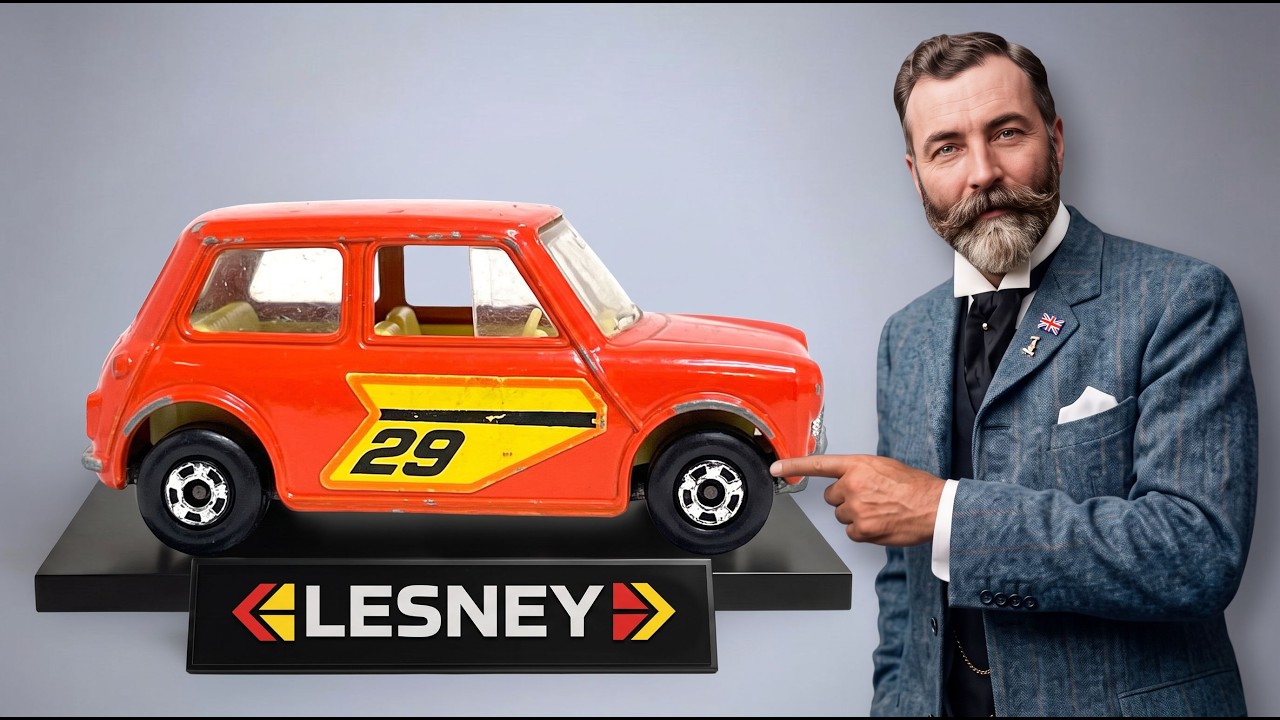
The operation nearly died in 1950 when the Korean War prompted a ban on zinc for toys, the very metal Lesney cast from. A stockpile saved them. But the scare rattled their third partner, Rodney Smith, who walked away in 1951, sold his share, and emigrated to Australia, convinced there was no future in it. The breakthrough came by royal accident.
In 1953, Odell designed a miniature coronation coach for Elizabeth II, complete with tiny horses, and it sold more than a million units. That same year, the Matchbox itself was born. Odell’s young daughter, Anne, was allowed to bring toys to school only if they fit inside a matchbox, so he cast her a tiny brass road roller. The toy was scaled to fit the box, and the packaging, cut to look like a box of matches, arrived with it.
The first four models were working vehicles: a road roller, a dumper, a cement mixer, and a tractor. The muck and machinery of post-war Britain, shrunk to pocket size. What Lesney understood was that a toy car did not have to be a luxury. A Matchbox model cost about a third of a Dinky’s price.
It was cheap enough that any child could own one on an ordinary Tuesday, not just at Christmas. The 1 to 75 range grew fast, with a new model roughly every fortnight, which turned buying into collecting. Children knew the numbers by heart the way others knew football teams. By 1956, Odell had also launched Models of Yesteryear, dearer miniatures of veteran cars and steam engines aimed squarely at adults.
It told the world that Lesney was a serious maker of serious miniatures. The growth became astonishing. In September 1960, Lesney floated on the London Stock Exchange, and the share offer was wildly oversubscribed. Within four years, the company’s value had multiplied five times over.
The man who cracked America was an importer named Fred Bronner, who built the US business so successfully that Lesney bought him out in 1964. By the start of the decade, some 70 million Matchbox vehicles had crossed the Atlantic. In 1967, Lesney earned a place in the Guinness Book of Records: 100 million models in a single year, made in one corner of East London. The workforce that achieved this was overwhelming female.
The models could not be fully automated. Each one in the 1 to 75 range had an average of 13 components, and fitting them together took nimble, fast, skilled hands. The women of East London did that work, thousands of them, along assembly lines in factories that spread across Hackney. Leslie Smith bought a fleet of redundant London Transport double-decker buses, repainted them in Matchbox blue and yellow, and ran the only private bus service in the toy world to carry his staff to work.
The factory was the largest employer in the borough. Around 3,600 people worked there by 1966. Len Mills, the tooling and engineering manager, later described it plainly: Lesney was like a family, not so much a job as a way of life. By the mid-1960s, Lesney was the largest diecast toy maker on Earth, outselling Dinky, the very firm it had once undercut.
In 1966, Leslie received the Queen’s Award for Export Achievement. In 1968, both founders were appointed OBE. By 1969, the works were producing a million toy vehicles a day. It was, by any measure, a national industrial triumph.
At that precise moment, the thing that would undo it was already being built in Southern California. Elliot Handler, a founder of Mattel, watched his son push Matchbox cars across the floor and decided the little English cars were beautifully made but slow. He wanted something a child would actually want to race. He assembled a team from the edges of the aerospace world: a car designer out of General Motors to make the models look like American hot rods, and an engineer who had worked on missiles for Raytheon to solve the problem of speed.
The result launched on 18 May 1968. Hot Wheels ran on thin, hardened piano-wire axles turning in low-friction plastic bushings. They rolled and kept rolling. Set on Mattel’s orange plastic track, they flew.
And Mattel made them cheaply in Hong Kong while Lesney cast and hand-assembled in high-cost East London. The market response was volcanic. The exact figures vary by account, but they all point the same way: in the American market Fred Bronner had spent a decade building, the floor gave way. The myth says Lesney laughed and did nothing.
It did not. Within a year, it had its answer on the shelves: Superfast, launched in 1969. Thin, polished, low-friction axles, free-spinning wheels, brighter colors borrowed from the Californian playbook. Every base in the range had to be re-tooled.
It was a feat of engineering, done by the same in-house toolmakers who had built the machines in the first place. It stemmed the bleeding. But Jack Odell was appalled. Not by the wheels, but by what chasing them would cost.
Every pound spent retooling for speed was a pound not spent on the detailed realism that had made Matchbox great. And once you agreed to fight Mattel on Mattel’s ground, fantasy speed, ever brighter colors, you committed to a race that never ended and that you were structurally worse at running. Then the ground itself moved. In 1973, the Essex plant that made Models of Yesteryear caught fire and was then flooded, halting production of Odell’s beloved line for up to two years.
That was also the year the oil crisis sent inflation tearing through Britain, bringing the three-day week, when factories were rationed to three days of electricity. In 1973, Odell stepped back, resigning as director but staying on as deputy chairman. Leslie Smith was left to run the company alone. In 1975, falling sales forced shift reorganizations and redundancies.
When the night shift was cut, machine setters lost roughly a third of their pay, and a dispute over it went all the way to the Court of Appeal, argued before Lord Denning himself. There was no single fatal mistake. There was a chain of decisions, each defensible on the day it was made. The first was about where to make things.
The logic of the age pointed clearly to moving work East, cutting the labor bill, surviving. Leslie Smith turned away from it. Lesney would keep mass production in Hackney. The workforce was loyal, and Lesney was loyal back.
Those in-house machines and skilled setters were a genuine competitive asset. But a car hand-built in East London could not be made as cheaply as one built in Hong Kong, and no amount of British pride closed that gap. The loyalty that kept jobs in Hackney is exactly what made the eventual collapse total. When it finally went, there was no offshore arm to fall back on.
The second decision was to keep fighting the arms race on Mattel’s terms. The money that might have modernized the works or funded the move offshore went instead into keeping up with a competitor who set the pace precisely so that keeping up would ruin you. The third was to diversify, and to do it badly. Lesney bought the American model kit maker AMT, took on a plastic kit range, and the Vogue Ginny doll brand.
Most of it failed. Each venture drew away management attention and cash at precisely the moment the core business needed both most. The fourth was the crushing weight of the operation itself. The group workforce peaked north of 9,000 people across a sprawling factory estate.
A vast plant and huge hand-assembly workforce is magnificent when demand is climbing, and a millstone the moment it falls. In 1980 alone, the group lost 17. 6 million pounds, and cut its workforce from 9,213 to 5,470. Nearly 4,000 jobs in a single year.
The fifth force was the one they could do least about: the British economy itself. Sterling, oil-shock inflation, and the savage recession of the early 1980s that was tearing the guts out of British manufacturing wholesale. By early 1982, Lesney had posted an operating loss of around 15 million dollars, and the creditors were closing in. At the very end, Jack Odell returned, reportedly at the bank’s urging, as joint vice chairman.
He knew those machines better than any man alive. It made no difference. The proof that this was never one firm’s single blunder is that Britain’s other great toy makers died too. Dinky went.
Corgi went. The same forces, the same decade, the same graveyard. The core Matchbox ranges were still selling strongly. The crisis owed more to the economic climate in the United Kingdom than to any failure of the brand.
The children still wanted the cars. The company simply could no longer afford to go on making them where it made them. In the summer of 1982, the receivers came. Around 1,100 workers lost their jobs, most of them from the streets around the factory, many of them the women who had sat along those lines fitting 13 tiny components at a time for the best part of their working lives.
The blue and yellow buses stopped running. There was no longer any work to carry them to. In September 1982, control passed to a Hong Kong toy maker, the Universal Group, which renamed the business Matchbox International Limited. UK production ceased that same month.
The molds, the dies, the in-house built machinery, everything Odell and his toolmakers had designed over 30 years, was crated up and shipped to Macau, then later to mainland China. The offshoring the board had refused to do while the company lived was done to its corpse within months of its death. The loss was large enough to reach Parliament, where the local member raised the disappearance of the Hackney jobs directly. Jack Odell could not let go.
In 1982 and ’83, even as Universal was shipping the old tooling toward Macau, he bought a great deal of it back. At an age when most men retire, he set up all over again, calling the new firm Lledo, Odell spelled backwards. The first models, launched in 1983, were mostly horse-drawn, a deliberate echo of the Models of Yesteryear he had always loved best. Lledo shipped in real volume and did well for a while, but the economics that had killed Lesney had not gone anywhere.
Lledo, too, could not beat the low-cost producers of Hong Kong and China. It went bankrupt in 1999. Jack Odell died on 7 July 2007, aged 87. He had left exact instructions for how he wished to be remembered.
Not as a tycoon, not as the man who conquered the toy world. He asked that his obituary say one thing and one thing only: that he was a damn good engineer. There is one last turn. Matchbox, under Universal, was sold to Tyco Toys in 1992.
In 1997, Tyco’s toy division was bought by Mattel. Matchbox and Hot Wheels, the English underdog and the Californian giant that had started its long fall, came at last to rest under the same roof, owned by the same rival Elliot Handler had built to beat them. Matchbox is made today in Thailand. Around 4 billion Matchbox vehicles have been made since that first little road roller came out of the bombed pub.
The factories are gone. The great concrete works on Lee Conservancy Road was demolished and is now a housing estate. But at the Hackney Museum, a project called Matchbox Memories gathered the oral histories of the women who worked the lines, so they would not vanish from the record along with the buildings. And the cars themselves survive, in a billion memories, in collectors’ cabinets, in the fist-size weight a grown adult can still feel the moment they close a hand around one.
Somewhere in Britain right now, a child is rolling one across a floor. They have no idea where it came from, or who made it, or what it cost. They don’t need to.
That was always the point.






