Zooming in on the photograph, experts were shocked. On its face, it was just another trench picture from 1916, the kind that filled the archives of the Imperial War Museum in London: muddy trenches, exhausted soldiers, the chaos of the Battle of Flers-Courcelette frozen in time. For decades, historians cataloged it, preserved it, and moved on without stopping to examine it closely. But when the image is enlarged, when every detail is carefully examined, something impossible jumps into view.
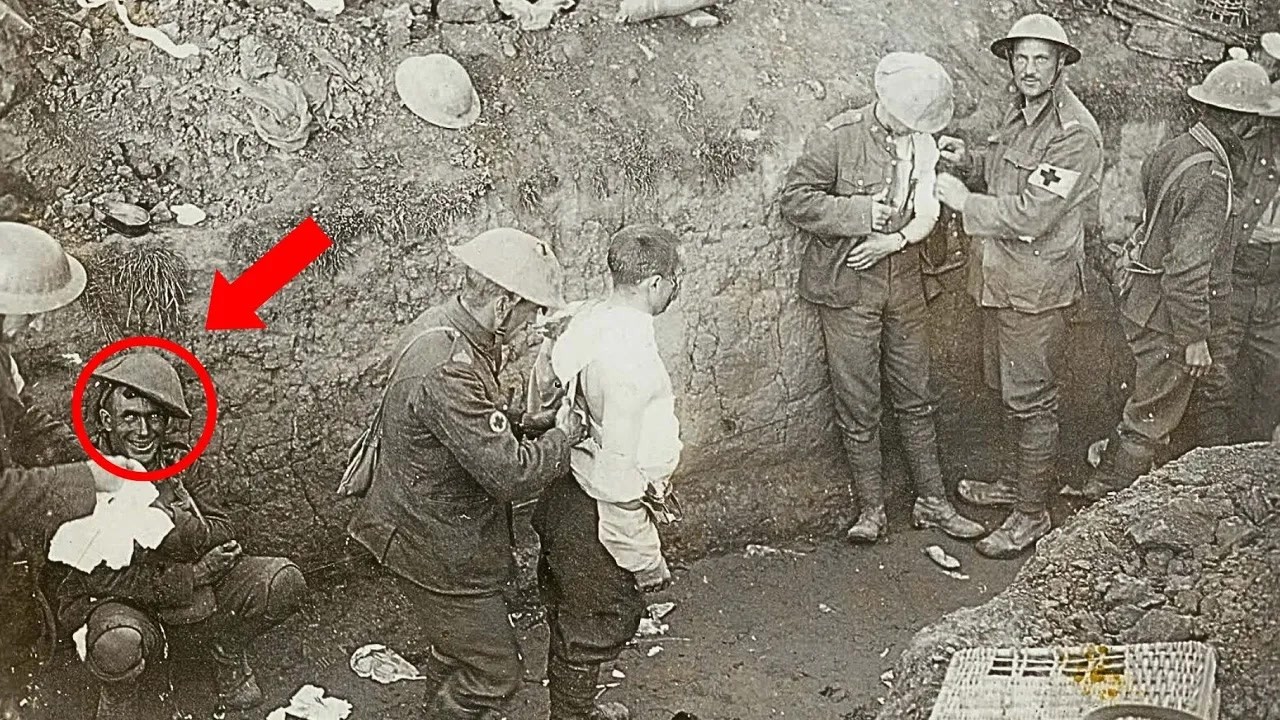
In the lower left corner of the frame, sitting alone in the mud, a soldier displays an expression that shouldn’t be there. His eyes are wide open, and a broad smile is plastered across his face. In the heart of the Somme trenches, surrounded by death and destruction, while his comrades tended to a wounded man in the background, he smiled. That smile revealed a truth about the war that society took a century to officially acknowledge.
The photograph documents the Battle of Flers-Courcelette, fought between September 15th and 22nd, 1916, during the Somme Offensive, one of the bloodiest campaigns of the First World War. At first glance, the image appears typical of war photography of the time. British soldiers in a trench, uniforms covered in mud, Brodie steel helmets, equipment scattered on the dirt floor. In the center, several men surround a wounded comrade, clearly concerned with helping him.
Crumbling earthen walls, the dense atmosphere of exhaustion that characterized the trenches of the Western Front. But there is one detail that, once noticed, makes it impossible to look at any other part of the photograph. In the lower left corner, partially obscured by the shadow of the trench wall, a soldier sits alone. His legs are bent, his arms rest loosely at his sides.
He isn’t helping the others, and he isn’t looking at the wounded. He’s doing absolutely nothing. He just sits there, his face turned directly toward the camera. And he is smiling.
Not a discreet smile, not a nervous half-smile, but a wide smile with his mouth open, his eyes completely wide, as if he were posing for a family photograph on a happy day. But this was not a happy day. It was September 1916 at the Battle of Flers-Courcelette, where tens of thousands of soldiers were killed or wounded in a single week. Back then, people did not smile for photographs, much less in war trenches.
To understand how disturbing this image is, it is necessary to understand the technological and social context of photography in 1916. Cameras of that era still required relatively long exposure times. Although technology had advanced since Victorian daguerreotypes, which required minutes of absolute stillness, it was still necessary to remain motionless for several seconds to ensure a sharp image. Maintaining a natural smile during that time was technically difficult.
Facial muscles tire quickly, and the smile becomes forced, shaky, and unnatural. Therefore, social convention dictated posing seriously, with dignity, with a neutral and controlled expression. Smiling in portraits was considered inappropriate, even vulgar. Serious, respectable people did not smile for the camera.
This cultural norm was so strong that it spanned decades, evident in the solemn, composed faces found in photographs from the 19th and early 20th centuries. But there was another reason why nobody smiled in war photographs. There was nothing to smile about. The Battle of Flers-Courcelette was fought by the French Sixth Army and the British Fourth Army against the German First Army.
It was where tanks were used for the first time in military history, and where the Canadian Corps and the New Zealand Division first fought on the Somme. On September 15th, 1916, the Anglo-French attack began the third phase of the Battle of the Somme. By its end on September 22nd, the strategic objective of a decisive victory had not been achieved. The capture of the villages of Courcelette, Martinpuich, and Flers constituted a tactical victory, but the cost in human lives was devastating.
Soldiers faced constant artillery bombardment, poison gas attacks, and conditions that tested the absolute limits of human endurance. No one who lived through that was smiling, except for the man in the photograph. And that wasn’t normal. It didn’t make sense, unless that smile wasn’t a choice.
Unless it was a symptom. World War I was unlike any previous conflict, not just because of tanks, airplanes, or chemical weapons, although those innovations were devastating, but because of artillery. Artillery was responsible for sixty percent of all casualties in the First World War. Cannons positioned kilometers away fired shells that fell from the sky, turning trenches into instant graves.
There was no heroism possible against artillery. No amount of courage could deflect a shell. No amount of military skill made a difference when a projectile fell directly on your trench. It was pure luck, being in the right place at the wrong time, or vice versa.
For the soldiers who survived, day after day, week after week, the psychological impact was devastating. The sound of approaching shells was unmistakable: a sharp whistle that grew louder, cutting through the air. The soldiers learned to count the seconds. One, two, three, maybe four before impact.
During those seconds, there was nothing to do but wait. Then came the explosion. The earth trembled violently. The air became thick with dust and smoke.
Screams pierced the darkness. When the noise ceased, silence followed, worse than the sound because it meant it was time to look, to check who was still alive and who had been torn to pieces. This cycle repeated itself endlessly. Not for hours, but for days.
Sometimes entire weeks. The soldiers didn’t sleep properly. They didn’t rest. They lived in a constant state of terror, knowing that at any moment the next howitzer could be the last sound they would hear.
The circumstances of the First World War pushed hundreds of thousands of men beyond the limits of human endurance. They faced weapons that negated any chance of heroism or courage because the weapons that killed them were miles away. Eventually, inevitably, something would break. Not the body, but the mind.
The soldiers themselves coined the term “shell shock” because military medicine did not yet have an official name for what they were experiencing. Shell shock, war neurosis, was the psychological collapse caused by prolonged exposure to artillery bombardment. The symptoms were varied and devastating: extreme fatigue, uncontrollable tremors, mental confusion, nightmares that prevented sleep, and impaired vision and hearing without any apparent physical cause. Some men developed hysterical paralysis, their legs simply stopping even though there was no spinal injury.
Others lost the ability to speak even with intact vocal cords. There were those who could no longer hold a rifle or a mug, their hands trembling uncontrollably. And there was a particularly disturbing symptom, less discussed but equally real: inappropriate affect. A vacant, bewildered look was typical, but some soldiers developed facial expressions completely disconnected from their actual emotions or the surrounding situation.
Soldiers who would start laughing for no reason, who would cry in moments of calm and laugh in moments of horror, whose expressions would become random, inverted, paradoxical. Soldiers who smiled when there was absolutely nothing to smile about. The diagnosis was often made when a soldier proved incapable of performing his duties and no obvious cause could be identified. In simple terms, even the most obedient soldier, after being hit by a sufficient number of projectiles without any means of retaliation, often completely lost self-control.
During World War I, it is estimated that 80,000 British soldiers suffered from shell shock severe enough to require documented medical treatment. But this number represents only the official cases, those that were diagnosed and recorded. How many more suffered in silence? The truth is, we’ll never know.
In 1916, shell shock was not viewed with compassion. It was viewed with suspicion, distrust, sometimes with outright contempt. Although it was recognized that the stress of war could lead men to collapse, a prolonged episode was often seen as symptomatic of an underlying lack of character. In his testimony to the post-war Royal Commission that examined shell shock, Lord Gort asserted that war neurosis was a weakness and was not found in good units.
Many military officers believed that soldiers were feigning symptoms to avoid combat. As a result, men with nervous breakdowns often received less attention and sympathy than those with physical injuries. Wounds that bled were honored. A man with a leg shattered by howitzer shrapnel was a wounded hero, deserving of care and respect.
But a man whose mind had been shattered by the same howitzer was questioned. His motives were suspect, his courage was doubted, and in extreme cases, he was punished. During the First World War, 306 British soldiers were executed for military crimes, including desertion and cowardice. Some of these men suffered from stress disorders that led to their breakdown.
It is unclear how many suffered from war neurosis and were convicted of cowardice or desertion when, in fact, they were psychologically incapacitated. Witnesses at military trials reported soldiers visibly trembling, unable to articulate words clearly, and displaying inappropriate facial expressions, all classic symptoms of severe shell shock. But these symptoms were not seen as evidence of illness. They were seen as evidence of guilt.
These men were shot at dawn. It wasn’t until 2006, ninety years after the end of the war, that the British government finally granted a posthumous pardon to those 306 soldiers executed for cowardice and desertion, officially acknowledging the effect of war neurosis on its troops. Ninety years to admit the truth. Let’s go back to the photograph.
That soldier sitting in the corner, smiling broadly with wide eyes. With the context now clear, the constant bombardment of Flers-Courcelette, the symptoms of shell shock, the inappropriate affect, the image can be seen with new eyes. That smile is not joy. It is not relief.
It is dissociation. It is the last gesture of a mind that can no longer process the surrounding horror and has entered a state of total psychological collapse. His eyes are wide but not truly focused. He looks in the direction of the camera, but he doesn’t see the photographer.
He’s looking through him to some distant place that only exists in his fragmented mind. His mouth is open in a wide unnatural smile, as if someone had carved that expression onto his face and forgotten to erase it. There is no genuine joy there, just an empty reflex, an emotional response completely disconnected from the reality around him. And there’s another detail in the photograph that makes it all the more devastating.
Nobody is looking at him. In the center of the image, several soldiers surround a wounded comrade. There is urgency in their movements, concern in their postures. They are clearly trying to help, to stop the bleeding, to offer comfort to a man with visible injuries.
But the smiling soldier sitting just a few meters away, his expression clearly altered, is completely ignored. None of the other men look in his direction. None seem concerned about his obviously compromised mental state. None are trying to help him.
Why? Because visible wounds were understood. Invisible wounds were ignored. Or worse, viewed with suspicion.
His companions wouldn’t look at him because they didn’t want to see. Acknowledging his suffering would mean acknowledging that any one of them could be next. So they looked away. They focused on the physically wounded person whose suffering they could understand.
And the smiling soldier remained there, broken and invisible, even though he was right before their eyes. To fully understand what that soldier had experienced, it is necessary to examine the Battle of Flers-Courcelette in detail. The battle began on September 15th, 1916, with a massive Anglo-French attack. The artillery bombardment that should have destroyed the German defenses was intense, but when the British infantry advanced, they discovered that many enemy positions were still intact.
The German artillery responded with devastating force. Shells rained down on the British trenches. The earth trembled continuously. The air was thick with dust, smoke, and the acrid smell of explosives.
The soldiers faced not only artillery fire but also gas attacks. In the early hours of specific days during the battle, the Germans would release poison gas. British soldiers struggled to put on their masks before inhaling the toxic fumes. Some didn’t manage it in time.
For days on end, the bombardment did not cease. Soldiers in the trenches spent thirty-eight, forty-eight, sometimes sixty hours without adequate sleep, without rest, under constant fire. The sound of the howitzers became part of the very air, a constant inescapable presence that penetrated not only the ears but the bones, the stomach, the very soul. Men watched their comrades being torn apart right beside them.
The First World War was not a war of heroic one-on-one confrontations. It was a war of machines that killed indiscriminately from a distance. At that moment, in trenches like the one shown in the photograph, everything these men had been created for, the social structures that made up every aspect of their lives, simply exploded and shattered. They were there, lying in muddy trenches, afraid to die, hearing and seeing death all around them, their entire psyche being destroyed.
Eventually, inevitably, some broke down completely. The photograph captures one of those moments of complete breakdown. It was taken by an official British Army photographer during the Battle of Flers-Courcelette. Military photographers were instructed to document war operations, including medical evacuations and conditions in the trenches.
The image shows exactly what was happening in those trenches: soldiers tending to the physically wounded while the psychologically wounded were ignored. We don’t know if the photographer realized the importance of what he was capturing. We don’t know if he consciously noticed the smiling soldier in the corner, or if he was focused on documenting the medical care being provided to the wounded man in the center of the scene. What we do know is that the photograph preserves something crucial: visual evidence of severe shell shock, evidence of inappropriate affect, evidence of a man in total psychological collapse.
It also preserved evidence of how this suffering was treated, or rather, ignored. After the war, as photographs were being organized and archived, images like this were often kept but not publicly displayed. Not because they weren’t important, but because they were too important. They showed a truth that post-war British society was not ready to confront.
The official narrative was about heroism, sacrifice, and victory. There was no room in that narrative for men smiling inappropriately in trenches, trembling uncontrollably, or staring blankly into space with empty expressions. These images contradicted the story the nation wanted to tell about itself. But the photographs were preserved, archived, cataloged, stored so that future generations could eventually confront the complete truth.
Today, the truth is available for anyone who wants to see it. The medical and social understanding of shell shock has gradually evolved throughout the 20th century. After the First World War, British veterans suffering from war neurosis faced decades of stigma and lack of adequate treatment. Many lived with nightmares, tremors, and other symptoms for the rest of their lives without proper official support.
During the Second World War, the lessons of the First were partially learned. There was greater recognition that prolonged combat caused psychological damage, and some treatments improved, but the stigma persisted. It wasn’t until the Vietnam War, when post-traumatic stress disorder, PTSD, was formally recognized as a legitimate medical diagnosis, that a broader understanding of war trauma began to emerge. Shell shock and PTSD are not identical, but they share fundamental characteristics.
Both show how extreme mental stress leads to significant physical and psychological difficulties. Finally, in 2006, ninety years after the end of the First World War, the British government granted a posthumous pardon to the 306 soldiers executed for cowardice and desertion. The official acknowledgement admitted that many of these men were victims of war neurosis, not criminals. It was a recognition that took a century, three generations.
It came too late for the men who were executed, too late for their families who lived with the shame. But it arrived. And photographs like this one, showing a soldier smiling in total psychological collapse, served as historical evidence that invisible wounds were always real. It only took a century for a society to finally admit it.
Today, this photograph is available in the archives of the Imperial War Museum. Anyone can access it online, enlarge it, and examine every detail. When people see it for the first time and zoom in on that lower left corner, focusing on that face, the reaction is always the same. A moment of confusion: why is he smiling?
Followed by a growing discomfort as they realize that it’s not joy. It’s a breakdown. We don’t know who that soldier was. His name has been lost to history.
We don’t know his hometown, his age, his story before the war. We don’t know if he survived the conflict, if he recovered his sanity, if he managed to rebuild a life after the armistice. British military records from the First World War are extensive but incomplete. Many documents were lost in bombing raids during the Second World War.
Others were never kept in sufficient detail to allow identification of individual soldiers in uncaptioned photographs. All we have is his face, preserved on photographic film for over a century, digitized, and accessible now. And that face tells a story that words struggle to express. It tells of the psychological cost of industrial warfare, of men pushed beyond the limits of human endurance, of invisible wounds that have been ignored, questioned, and punished for generations.
It tells of how societies prefer narratives of heroism to uncomfortable truths. Above all, that face forces us to look, to see, to recognize. The smiling soldier from Flers-Courcelette can no longer speak. But his preserved face speaks for him.
It speaks for all 80,000 British soldiers documented with shell shock. It speaks for the countless others who suffered in silence. It speaks for the 306 executed before the truth was admitted. Its message is clear.
War breaks not only bodies, but minds. And this breaking has always been real, even when the whole world refused to see it. More than a century later, we are finally looking. Finally, we are seeing that smile for what it truly is: not joy, but evidence of the most invisible and devastating wound of all.
A human mind falling apart, preserved forever in a fraction of a second in September 1916, in a trench at Flers-Courcelette, so that we never forget.
