It was still dark when Patton gave the order, and the officer looked at it, then looked at Patton, and said no. Not in private. Not in a quiet office with the door closed. He said it in front of his men, in the pre-dawn gray of a German field, with the whole battalion listening through the sideways silence of men pretending not to hear.
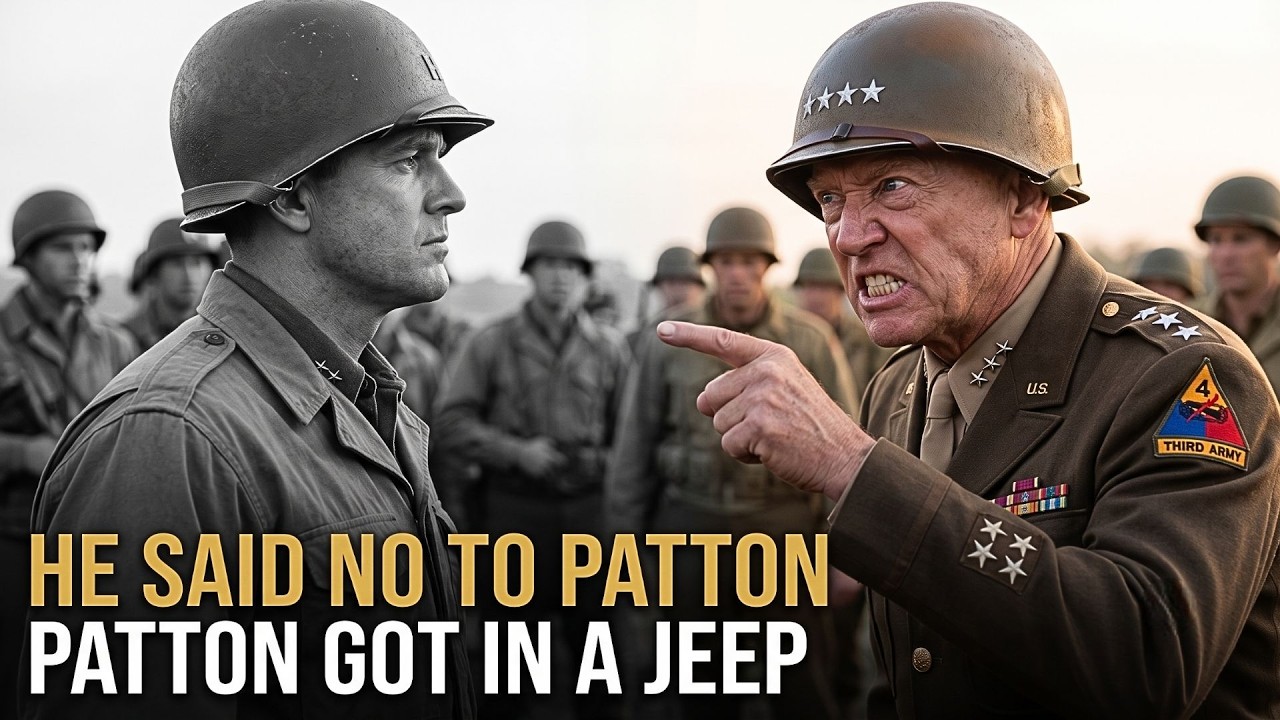
“Sir,” the officer said, “I’ve seen the intelligence. I’ve walked that ground. If I take my men in there at dawn, I will bring back half of them, maybe less. And whatever we take won’t be worth what we lose.
” He did not look away. “This I won’t do. ”
Nobody moved. Nobody breathed.
Every man within earshot was waiting for the same thing, because General George S. Patton was known for two things above everything else: speed and fury. He took one step forward. The officer didn’t move.
Another step. Still nothing. Patton stopped, looked at this man for five full seconds, and then did something nobody in that field had ever seen him do. He turned to his aide and said three words.
It was March 8, 1945. The Third Army was driving hard toward the Rhine, and the advance had been fast—faster than anyone had planned for. The speed created its own momentum. Every day of movement kept the German defenders off balance; every delay gave them time to organize, dig in, prepare.
Patton understood this at a cellular level. He pushed because stopping cost more than moving. The objective that morning was a ridgeline outside the town of Prüm. Taking it would open the road to the Rhine crossing.
The plan called for Lieutenant Colonel James Brennan’s battalion to attack the ridge at dawn. Move fast, hit hard, take the high ground before the Germans could reinforce it. It was the kind of order Patton gave a dozen times a week. Brennan was thirty-three years old, from Fort Worth, Texas.
He had enlisted before Pearl Harbor and had been in Europe since the first week of the Normandy landing. He had fought through the hedgerows of France, through the Ardennes in winter, and across the border into Germany. He was not a cautious officer. By nature, his men would have told you he was the opposite of cautious—he moved fast and expected others to keep up.
But he had spent the previous afternoon on that ridgeline, moving through the sector with two of his officers, looking at the ground the way infantry commanders look at ground when their men are about to fight on it. Carefully. Specifically. With the understanding that everything he saw might matter.
What he had seen had kept him awake all night. The intelligence assessed the ridge as lightly defended. Brennan’s own observation found something different. The approach funneled through a narrow lane bounded by steep embankments on both sides—a natural channel that turned any advancing force into a column.
Any competent defender holding that lane could hold it against a numerically superior force. And the ridge above showed signs of recent fortification that the aerial photographs had not captured. He had written up his findings that evening and sent them to Division with a formal request for reassessment. Division had responded by midnight.
The intelligence assessment stood. The attack would proceed as planned. Brennan had read that response and spent the rest of the night looking at his map. When Patton arrived at the battalion command post at 0500 to observe the pre-dawn preparations, Brennan was waiting for him.
Patton listened to the situation report, nodded at the map, looked at his watch. “Attack at 0600,” he said. Brennan didn’t move. “Sir, I need to raise this before we go.
”
Patton looked at him. Brennan described what he had seen on the ridge: the lane, the embankments, the signs of fortification. He described it in the specific language of a man who has walked ground and knows it—not theory, not assessment, but what he had seen with his own eyes the afternoon before. “If I take my men through that lane at dawn, I will lose half of them in the first ten minutes.
Whatever we take on that ridge will not be worth what we leave in that lane. ” He looked at Patton directly. “I will not give that order. ”
The soldiers nearby had stopped what they were doing—not conspicuously.
They didn’t turn and stare, but the tools stopped moving, and the conversation stopped, and everyone within earshot was listening, because no one within earshot had ever heard an officer say no to Patton before. Patton took one step toward him. Brennan didn’t move. Another step.
Patton was close now, close enough that this was no longer about distance. Brennan held eye contact. Five full seconds of silence. Then Patton turned to Colonel Thomas Reed.
“Get me a Jeep,” Patton said. “Just one. ” Reed looked at him. “Brennan, you’re coming with me.
”
They drove to the base of the ridge in the dark. Patton and Brennan and a driver—no escort, no additional officers. Patton had the map Brennan had marked the previous day. They got out at the base of the approach lane.
Patton walked the entire length of it. He didn’t speak. He moved with the flashlight off, using the gray pre-dawn light and his own eyes. He looked at the embankments rising on both sides.
He looked at the angles they created. He looked at the ridge above, and the sight lines it provided to anyone positioned there. He stopped twice and stood completely still for a full minute each time, just looking. Brennan walked two steps behind him and said nothing.
There was nothing to say. The ground was saying it. When they got back to the Jeep, Patton stood still for a moment at the edge of the road, looking back at the lane. Then he looked up at the ridge.
Then he looked at Brennan. “You’re right,” he said. Two words, nothing else. He got in the Jeep.
“We’re driving back. ”
When they got back to the command post, the assembled officers were waiting. They had seen Patton leave with Brennan in the dark and come back, and they could tell from the way he came through the door that something had shifted. “The attack doesn’t go through the lane,” Patton said to the assembled officers.
“We go wide. Farm track on the left flank. We move the approach two hundred meters west and come up on the ridge from the north face. Softer gradient.
No natural kill zone. ” He looked at Reed. “Push to 0800. That gives recon time to confirm the route and the battalion time to reposition.
” He looked at the map one more time. “Tell Division what we’re doing. They can object afterward. ”
The attack went in at 08:15.
The battalion moved west along the farm track, then turned north and came up the ridge from an angle. The gradient was harder; the men felt it in their legs and their lungs, but the exposure was a fraction of what the lane would have been. The German defenders had organized their positions to cover the lane. When the attack came from the north face, they were caught mid-repositioning, which is the worst moment to be caught.
The ridge was taken by 10:30. Casualties were eleven killed and twenty-four wounded—a number that hurt, as casualties always hurt, but a fraction of what the lane would have produced. Brennan was asked afterward by his intelligence officer what the casualty count through the lane would have been. He thought about it.
“I estimated fifty to seventy killed in the first assault,” he said. “Depending on how well they were dug in. And we might not have taken it at all. ”
Patton received the after-action report as part of his regular review.
He read it. He made no formal comment. But Colonel Reed was in the room and said years later that Patton had set the report down and said one thing. “He was right to stop it,” Patton said.
“And he knew I would be angry. He said it anyway. ” He paused. “A commander who never hears that from his officers will eventually make the wrong call, and there will be nobody in the room to stop him.
That’s how you lose men you didn’t have to lose. Brennan stopped me from doing that. ” He looked at Reed. “That required something.
Saying it in front of his men, when you don’t know if the general is going to relieve you on the spot. ”
Lieutenant Colonel James Brennan received a commendation for the Prüm operation. The citation described the planning and execution. It did not specifically mention the conversation at 0500.
He served through the end of the war and left the army in December 1945. He returned to Texas and ran a construction business for thirty years. He was interviewed once in the 1970s for a book about the Third Army that was never published. The interview transcript was found in a university archive decades later.
The interviewer asked him what he had been thinking during those five seconds when Patton was standing in front of him. Brennan was quiet for a long time before answering—long enough that the interviewer thought he might not answer at all. “I wasn’t thinking about being relieved,” he said. “I wasn’t thinking about my career, or what it would mean, or how it would look.
I was thinking about the lane. I had walked that lane the afternoon before, and I knew what it was. And I kept thinking about the men who were going to go through it at dawn. And I thought, if I don’t say this right now, if I stay quiet because it’s easier and safer, those men go through that lane and they die in it, and I will know for the rest of my life that I had the information and I didn’t say it.
”
He paused. “So I said it. ”
Another pause. “And then Patton said, ‘Get me a Jeep.
‘ Three words. And I thought, all right, whatever comes next, at least he’s going to look. At least the ground is going to get a chance to speak for itself.
“
