In late October 1891, a camp deep in the old-growth forests of northern Oregon found itself short-handed. Black Pine Lumber Camp Number Seven, run by the Hargrove Timber Consortium, sat at the end of a supply road nearly two days from the nearest town, a place called Riddle Creek that was little more than a store and a handful of houses. The men who worked there were the kind who had run out of options elsewhere. The foreman, Ogden Harshaw, was a weathered forty-seven-year-old who had survived the kind of accidents that ended other men.
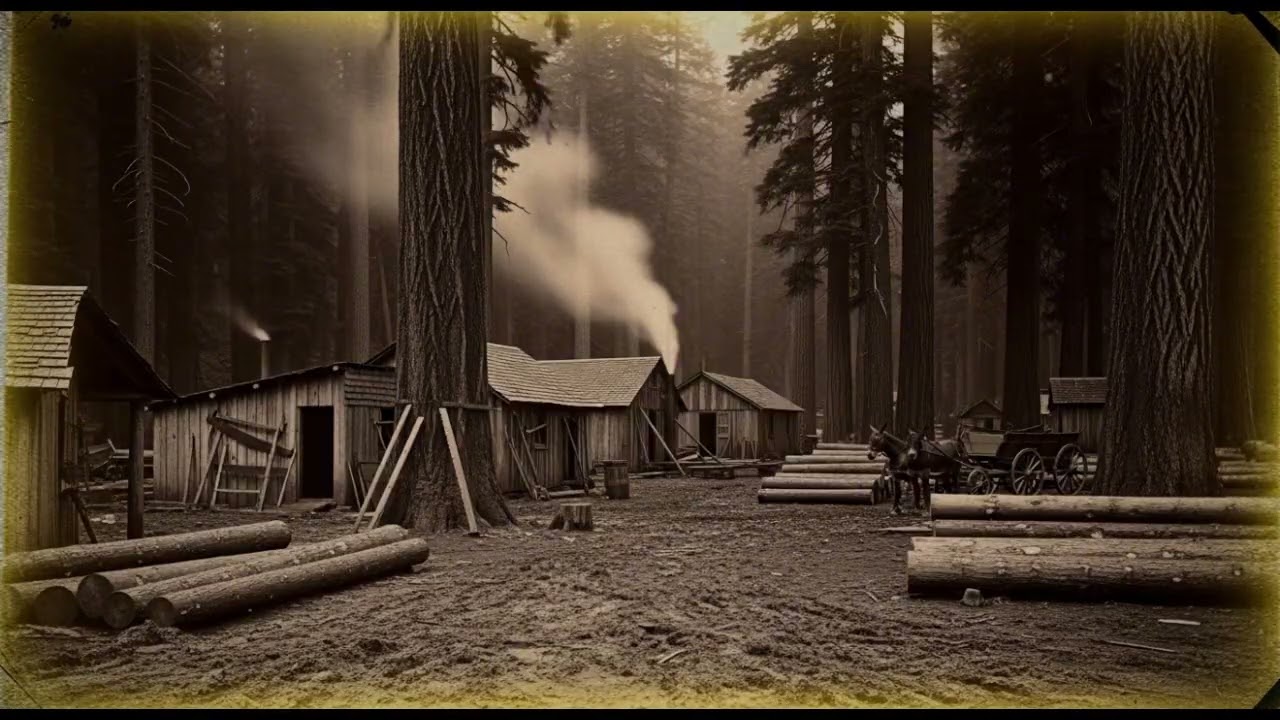
The season was behind schedule, and he needed hands. On the fourteenth of October, a man named Clement Aldridge arrived on foot. He carried a canvas rucksack and wore boots so worn that the left sole was held on with wire. He claimed he had worked camps in Washington and Montana and wanted a season’s wages.
Harshaw, who had seen enough drifters to know when a man was running from something, did not press. He signed him on and assigned him to the felling crew under a senior logger named Wyatt Doss. For the first week, Aldridge worked without complaint. He was skilled, efficient, and silent.
The other men left him alone. But then the camp began to notice things. On the night of October twenty-first, the company clerk, a meticulous man named Prentice Moyle, was working late in the supply shack when he heard a sound from the woods. It was low and rhythmic, almost like breathing, but too deep and too slow to be any animal he could name.
After about two minutes, it stopped, and the silence that followed felt worse than the noise itself. The next morning he mentioned it to the camp cook, Bertha Cleary, a broad-shouldered German immigrant who had been cooking for lumber camps for over two decades. She told him that in all her months in these woods, she had never once heard a bird sing at night. The forest, she said, was the quietest place she had ever worked.
Over the following week, the small things accumulated. Wyatt Doss reported finding a clearing about a mile north of camp where the trees had grown in a perfect circle, every trunk curved slightly inward. The ground inside was bare of any growth and felt oddly warm despite the October frost. Then a logger named Severdt Undset was trimming branches from a felled pine when he looked up and saw a tall, motionless figure at the tree line about two hundred yards away.
He called out and received no answer. When he walked toward it, the figure was no longer there, not gone, but as he would later say, subtracted from the landscape. On the twenty-ninth of October, Harshaw made a decision that would define everything that followed. The company had sent word that production targets had to be met or the camp would close.
He ordered a crew of six men, led by Doss, to push the cutting line north into unmarked territory. Aldridge volunteered, which surprised everyone, because he had never volunteered for anything. As the men disappeared into the tree line, Moyle later wrote in his journal, the forest seemed to close behind them like a curtain, and he felt certain he would never see all of them again. The crew was supposed to return on the evening of the thirty-first.
They did not. By the second of November, Harshaw organized a search party. Six miles from camp, they found the crew’s base site. The tents were standing, the provisions untouched, the saws and axes laid out in a neat row, as though the men had carefully set down their tools before walking away.
There were six sets of boot prints leading north from the site, walking in single file, evenly spaced. They did not wander. They did not hesitate. They moved in a perfectly straight line directly north, and then the prints simply ended in the middle of flat, open ground.
The forest beyond was undisturbed. The men had ceased to exist between one step and the next. That night Bertha did something she had never done in twenty years of camp cooking. She locked the kitchen door from the inside and slept beside the stove with a carving knife within reach.
While the search party was gone, she said, she had heard footsteps on the roof, two feet walking slowly from one end of the building to the other, pausing directly above where she stood, and then walking back. She had gone outside and looked up. The roof was empty. There were no tracks in the frost.
The camp began to change. Men who had been steady made careless mistakes. Two suffered injuries in a single week. And the dreams started.
On November fifth, Moyle noted that four men had reported the same dream: standing in the forest at night, unable to move, watching a pale bluish light move between the trees, feeling an overwhelming urge to follow it, and an equal certainty that doing so would be fatal. By November seventh, eleven men had reported the same dream. Harshaw called a meeting. He told the men that six loggers were missing, that help had been requested, and that the best defense against the unknown was routine and discipline.
It was a good speech, but Moyle noticed that Harshaw’s enormous, scarred hands were trembling. On November ninth, two men deserted. By the fifteenth, the camp’s complement had dropped from thirty-one to nineteen, not counting the six who had vanished. Then Moyle found the drawings.
Behind some empty crates in the supply shack, scratched into the wooden wall, were dozens of crude but deliberate markings: trees arranged in a circle, and inside the circle, a tall, faceless figure with arms extended at impossible angles. Some were old enough that the exposed grain had darkened. Others were fresh enough that the shavings still clung to the grooves. Moyle showed them to Harshaw.
Harshaw stared at the wall for a full minute, then asked when Moyle had last seen Clement Aldridge. Moyle realized he could not remember. Aldridge’s belongings were still in the bunkhouse, but his bed had not been slept in. On the pillow, placed carefully in the center, was a single pinecone.
No one could say when they had last seen him. One man said he had seen Aldridge standing at the edge of the tree line the previous night, called out to him, received no response, and when he walked closer, Aldridge was not there. Bertha added a detail that made Moyle’s arms prickle. She had been setting out plates every evening for the full crew, and every plate came back empty, including the one at the far end of the table where Aldridge always sat.
On November eighteenth, the supply wagon arrived two weeks late. The driver swore the road itself had changed. Turns he remembered as gentle curves had become sharp switchbacks. A wide, shallow creek crossing was now narrow and deep.
And there was a stretch where the trees on both sides had grown so close together his wagon barely fit through, trees he was certain had not been there on his last trip. The night of November twentieth was when everything came apart. At about two in the morning, all three of the camp’s hounds began howling simultaneously, a sustained, rising wail that sounded almost human. They were straining at their chains, not toward the forest, but away from it.
Harshaw stood in the center of camp with a lantern and looked toward the northern tree line. There was a pale bluish glow moving slowly between the trees. It stopped. Then it began to move toward the camp.
Harshaw did not run. He turned to the men and told them they were leaving, all of them, right now. Take nothing except what they could carry in their hands and walk south. Do not run.
Do not look back. Do not stop until they reached Riddle Creek. Nineteen men and one woman walked out of Camp Seven that night, leaving behind equipment, provisions, and months of work. They walked in single file down the supply road.
No one spoke for the first three hours. At one point, Moyle turned and looked back. He saw nothing, but he heard something faint on the wind, lasting only a moment before it was swallowed by the forest. It was the sound of an axe striking wood, slow, rhythmic, deliberate, as if someone had resumed the work the men had abandoned.
They reached Riddle Creek on November twenty-second. A search party of twelve men set out for the camp and found it intact. Every building was standing. Every tool was where it had been left.
But the interior wall of the bunkhouse was covered from floor to ceiling with hundreds of the same drawings: the faceless figure inside a circle of trees, scratched in with such force that in several places the blade had gone clean through the wood. The three hounds were still chained to their posts, unharmed, but sitting perfectly still, all facing north, staring into the tree line. They did not react when the men approached. They did not blink.
When one of the search party unchained them, all three bolted south at full speed. Two were recovered days later near Riddle Creek. The third was never found. The Hargrove Consortium sent its own investigators in December.
Their official report attributed the disappearances to desertion, the drawings to a disturbed individual, and the unease to isolation and mass suggestibility among uneducated laborers. Camp Seven was decommissioned, and no further logging operations were ever conducted in the Black Pine Corridor. In the spring of 1892, a trapper named Josias Farwell, working about fifteen miles north of where the camp had stood, came upon a perfectly circular clearing ringed by trees that curved inward. At the center, an axe was driven blade-first into the ground so deeply that only the handle was visible.
The handle was wrapped in wire, the same kind that might hold a worn boot sole in place. Farwell did not enter the clearing. He felt an absolute certainty that if he stepped into the circle, he would never step out again. When he returned two weeks later with two companions, the clearing was gone.
The trees were dense and unbroken. The forest had closed over the spot as completely as if it had never existed. Moyle left Oregon in the spring of 1892 and returned to Pennsylvania. He never worked for a lumber company again.
In his later years, he added occasional entries to his journal. He noticed that every autumn, the trees near his home seemed to lean slightly toward his house. On certain nights, he could smell pine sap, though the nearest pine was miles away. And sometimes, in the moments just before sleep, he could hear the faint, distant sound of an axe striking wood.
Harshaw retired to a small farm in the Willamette Valley. He lived alone, kept no dogs, and cut no trees. He slept with a lantern burning every night, and he had removed every north-facing window in his house and boarded them shut. When asked why, he said only that some directions should not be looked into.
Clement Aldridge was never found. No record of him was discovered in any company’s employment files. The investigators concluded he was likely a drifter using a false name. But in the final entry of his journal, written in 1929, the year before he died, Moyle wrote that he had spent thirty-seven years trying to understand what happened at Black Pine.
He had arrived at only one conclusion. He did not believe Aldridge had come to Camp Seven looking for work. He believed Aldridge had come looking for something in that circle of trees, something that had been waiting there long before the Hargrove Consortium drove its first stake into the ground. And he believed the six men who walked north in a perfectly straight line, following something only they could see, had not been taken.
They had been invited. The last line of the journal reads simply: I still hear the axe. I fear I always will.
