In the spring of 1943, German fighter pilots sighted an unfamiliar American aircraft over the coast of France for the first time. The machine was large, heavy, and blunt-nosed. Through their radios, they laughed and told one another that the Americans had built a bomber and simply forgotten to install a bomb bay. They nicknamed the plane the flying milk bottle.
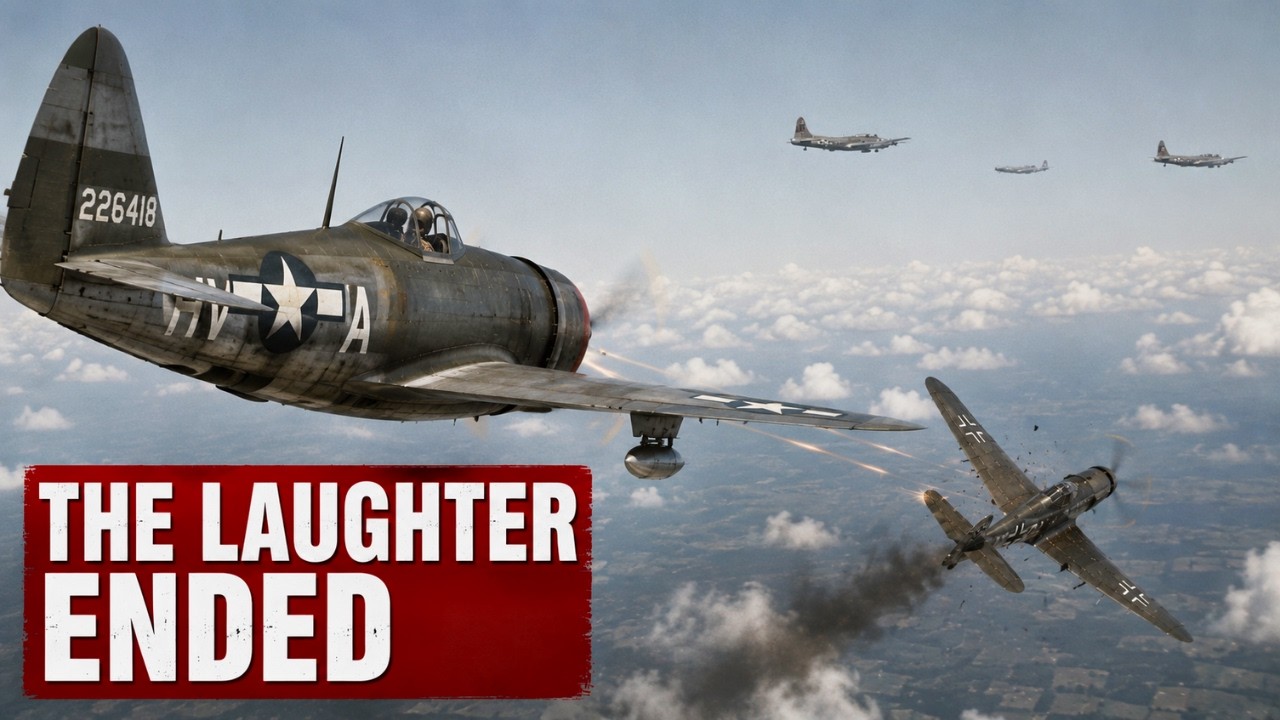
Two years later, the Germans who were still alive had a different name for it. They called the sound of its approach the thunderclap, and when they heard it, they fled. This is the story of how the joke of 1943 became the terror of 1945. In June 1940, Paris fell and the swastika flew over the Eiffel Tower.
In a quiet office at Republic Aviation on Long Island, a telephone rang. An officer from the United States Army Air Forces spoke in short, urgent sentences. Germany possessed fighters that climbed faster than anything the Allies had. The Luftwaffe controlled the skies over Europe.
America needed an interceptor. High altitude, heavy firepower, and it was needed immediately. The man holding the telephone was forty-four years old. His name was Alexander Kartveli.
Born in Tbilisi in what is now Georgia, he had fled the Russian Revolution, studied aeronautical engineering in Paris, and arrived in America with little more than a slide rule and an accent no one could identify. Now the United States government was asking him to design a weapon that might win the war. Kartveli put down the telephone, walked to his drafting table, and examined the specifications the Army had sent him. Then he did something no other designer would have done.
He threw them away. The Army wanted a light, agile interceptor, something to match the Messerschmitts. Kartveli believed this was wrong. He picked up a pencil and began to draw a monster.
He started with the engine, the largest and most powerful radial engine in American production, the Pratt & Whitney R-2800 Double Wasp. Eighteen cylinders arranged in two rows, two thousand horsepower, it weighed more than some entire fighter aircraft. Around this engine, Kartveli built a turbo-supercharger the size of a small refrigerator buried in the fuselage. Pipes twisted through the aircraft like arteries.
Wings were thick enough to hide eight heavy machine guns. The landing gear was strong enough to absorb the weight of a small truck falling from the sky. His engineers looked at the drawings and shook their heads. One said it was not a fighter at all, but a bomber that fired forward.
Kartveli smiled, lit a cigarette, and answered in his slow, measured English that it would be a dinosaur, but a dinosaur with good proportions. Eleven months later, on the morning of May 6, 1941, the prototype rolled out of the hangar at Farmingdale. It was huge. It was ugly.
The propeller measured twelve feet across. The fuselage was cylindrical, swollen with piping, dominated by that massive engine cowling. Ground crews stared in silence. Someone at the back of the crowd spoke the word aloud.
Jug. The name stuck. Test pilot Lowry Brabham climbed into the cockpit, a small man in a very large airplane. He started the engine and the sound was like nothing anyone at Farmingdale had ever heard, a deep rumble that rolled across the airfield like distant artillery.
The P-47 Thunderbolt moved slowly down the runway, taking nearly the entire strip to lift off. Then, slowly and almost unbelievably, it climbed into the air. It flew. But flying was not fighting.
By the summer of 1942, the first production P-47Bs were coming off the assembly line. The Army Air Forces began distributing them to fighter groups for training. One of those units was the 56th Fighter Group, based at Bridgeport Municipal Airport in Connecticut. Its commander was a twenty-eight-year-old lieutenant colonel named Hubert Zemke.
The son of German immigrants, he spoke fluent German, had learned to fly in the years before the war, and had spent time observing RAF operations in England. He was stern, calm, and rarely smiled. His men called him Hub, but never to his face. When Zemke walked the flight line at Bridgeport in September 1942 and looked at his new aircraft, he disliked everything about it.
The weight, the size, the way the nose rose high on the ground and blocked forward visibility, forcing the pilot to swing the aircraft from side to side to see the runway. He disliked the torque of that huge engine trying to flip the airplane on takeoff. He disliked its slow climb. His pilots disliked it even more.
Second Lieutenant Robert S. Johnson was a twenty-two-year-old farm boy from Lawton, Oklahoma. He climbed into a P-47 for the first time in October 1942, strapped in, and looked at the enormous cowl blocking his view. He later wrote that his first flight in the Thunderbolt felt like being tied to a locomotive.
Another pilot, Francis Gabreski, the twenty-three-year-old son of Polish immigrants from Oil City, Pennsylvania, was more direct. He told a fellow officer that the plane handled like a truck loaded with bricks. The accidents began. That October, a P-47 lost power on takeoff at Bridgeport and crashed inverted, killing the pilot instantly.
In November, a pilot entered a dive during gunnery training, the controls froze solid, and the aircraft hit the ground at more than five hundred miles per hour. Nothing was left to recover. By March 1943, the 56th Fighter Group had lost forty-one aircraft and eighteen pilots. They had not yet fired a shot at an enemy.
They had not yet seen Europe. They were dying over Connecticut in training accidents that no one seemed to understand. Zemke drove to the crash sites himself, stood in the snow beside wreckage, and wondered whether headquarters had sent him a fighter or a coffin. The RAF, watching from across the ocean, laughed at the American losses.
Their pilots flew Spitfires, elegant, light, and agile machines that danced in the sky. A British instructor sent to advise the Americans described the P-47 as an aircraft designed by a committee of plumbers. Within the Pentagon, doubts grew. Some senior officers whispered that the program should be canceled, that America should build the North American Mustang instead, or license the Spitfire, or start over with another design.
Kartveli traveled to Washington and spoke for three hours in a windowless room before unsmiling men in uniform. He told them the aircraft was not yet complete. He told them that at altitudes above twenty-five thousand feet, in the thin air where German fighters could not breathe, the Thunderbolt would do things no one had ever seen. The generals listened.
They voted. By a very narrow margin, the program survived. In January 1943, the first P-47s were loaded onto ships in Newark, crossed the Atlantic in convoys beneath the surface, and arrived at Liverpool, where they were trucked to airfields in East Anglia and reassembled by mechanics who had never seen a radial engine of that size. The 4th Fighter Group at Debden received them first.
This was a special unit, made up of Americans who had volunteered for the RAF before Pearl Harbor and flown Spitfires in the Eagle Squadrons. They knew what a real fighter looked like. When their Spitfires were taken away and replaced with Thunderbolts, some refused to fly. One veteran of the Battle of Britain filed a formal complaint, saying the transition was like being asked to replace a sword with a hammer.
But orders were orders. The first combat mission was flown on March 10, 1943. Fourteen P-47s crossed the English Channel at high altitude, flew along the Belgian coast, saw no enemy aircraft, and returned. Nothing happened.
On April 8, 1943, a cold, clear morning over the French coast, the 4th Fighter Group sent sixteen Thunderbolts on a sweep near the town of Cassel. They crossed into occupied territory at twenty-seven thousand feet with the sun behind them. Above and ahead, Focke-Wulf 190s of the German 26th Fighter Wing flew at thirty thousand feet. They were veterans who had fought over Poland, France, the beaches of Dunkirk, and the Channel during the Battle of Britain.
Their leader was the first to spot the American formation. He banked his wing and reported over the radio. The Americans had sent them flying milk bottles. Laughter spread across the German radio net.
Twelve pilots, among the best fighter force in the world, looked at the heavy American machines and saw nothing to fear. They did not know that inside each of those broad wings sat four heavy Browning M2 machine guns, each capable of firing eight hundred rounds per minute. They did not know that behind that massive cowl sat a two-thousand-horsepower engine that could still deliver full power at altitudes four miles higher than their own. They did not know that in one of those cockpits sat a young farm boy from Oklahoma named Robert Johnson, who would one day return home in an aircraft carrying more than two hundred bullet holes and would not die.
The Focke-Wulfs rolled inverted and dropped into a dive. Sixteen aircraft slashed through the thin April air at four hundred miles per hour. The Americans saw them too late. The first wave tore through the P-47 formation.
Cannon shells smashed into cockpits. One Thunderbolt took hits in its engine, began trailing white smoke, then black, then flames. The pilot bailed out over occupied France and would spend the rest of the war in a German POW camp. The Germans pulled up, climbed toward the sun, and laughed again through their radios.
Milk bottles. Flying trucks. Easy prey. In the first weeks of combat, the Thunderbolt lost every fight it tried to fight on German terms.
By the end of April 1943, the score was fourteen P-47s lost against three German fighters destroyed. Fourteen to three. In the bars around Debden and Horscham St. Faith, American pilots drank in silence.
They understood what those numbers meant. Across the ocean, the RAF was watching. Their generals were watching. Somewhere in a meeting room in Berlin, Adolf Galland was reading the reports and smiling.
Robert Johnson was one of those pilots. He had flown four combat missions and had not hit anything. In the headquarters office, Hubert Zemke stayed up past midnight studying gun camera film. He watched his pilots fire and miss.
He watched Focke-Wulfs cross the frame untouched. He watched fifty-caliber tracers fade into empty sky. Then he began to notice something. The P-47 had strengths.
Not the strengths of a Spitfire or a Messerschmitt, but stranger, heavier, more American strengths. From thirty thousand feet, the Thunderbolt could reach five hundred fifty miles per hour in a dive, a speed no German fighter could match even for a moment. It was heavier, and heavier things fall faster. Above twenty-eight thousand feet, where the Focke-Wulf gasped and stumbled in the thin, frozen air, the turbo-supercharged R-2800 breathed as easily as at sea level.
The Thunderbolt could absorb punishment. Gun camera footage showed P-47s taking hits that would have destroyed any European fighter and still returning to base. The radial engine had no coolant lines to burst, no radiator to lose. The airframe was built like a truck.
American steel, American rivets, American extravagance. Zemke wrote three lines in a yellow notebook. Do not turn with them. Do not try to climb with them.
Dive on them from above and tear them apart. In June 1943, he called his squadron commanders and gave each a copy of his notes. The P-47 was not a European fighter. It was an American fighter, fighting the American way, from above, with overwhelming firepower, in one devastating pass.
Then came June 26, 1943, and everything changed. Robert Johnson took off from Horscham St. Faith at eight in the morning. Forty-eight P-47s of the 56th Fighter Group were escorting a formation of B-17 Flying Fortresses toward a target in occupied France.
Johnson flew in the rear of the American formation, the position they called Tail End Charlie, the most dangerous place in the sky, the first place the enemy attacked. The mission went well until the bombers turned for home. Somewhere over the Foret d’Ely, near the Channel coast, sixteen Focke-Wulf 190s dove out of the sun. Johnson did not see them until cannon shells began exploding around his aircraft.
The first hits shattered his canopy, spraying glass across his face. A twenty-millimeter shell exploded in the canopy track above his head, welding the canopy closed. He was now trapped inside the airplane. Another shell tore away part of the cowl.
Hydraulic fluid flooded the cockpit and covered his goggles, blinding him. A third shell exploded in the fuselage behind his armor plate. Shrapnel tore into his legs, his nose, his hands. Blood poured into his oxygen mask.
The Thunderbolt flipped onto its back and began to spin. The engine was on fire. The controls barely responded. He was at twenty-seven thousand feet over enemy territory in an airplane any sensible man would have abandoned.
He fought the stick with both hands, wiped the hydraulic fluid from his goggles with a bloody glove, and somehow leveled the aircraft. He pointed it west, toward England. The engine was running rough, coughing, spitting oil. The airspeed indicator showed one hundred seventy miles per hour, barely above stall speed.
He could not climb. He could not maneuver. All he could do was fly straight and hope. Then, according to the account Johnson wrote fifteen years later in his memoir Thunderbolt, something happened.
Through the corner of his eye, he saw another aircraft pull into formation beside him. A Focke-Wulf 190. The German pilot was young, with blond hair visible beneath his flight helmet. He looked at Johnson with an expression Johnson would remember for the rest of his life.
Not hatred. Not triumph. Confusion. The Focke-Wulf pulled back and settled in behind him.
Johnson felt the impacts as the German opened fire. Twenty-millimeter shells slammed into his aircraft. His armor plate rang like a struck bell. The bullets punched through the fuselage, but the Thunderbolt did not fall.
The German fired until his ammunition ran out, then closed to point-blank range and fired his machine guns. Round after round, Johnson could only crouch behind his armor and wait to die. He did not die. Finally, the German ran out of fuel and ammunition.
He pulled up alongside Johnson again. The two men stared at each other across fifty feet of open air. The German slowly shook his head, raised a gloved hand in what Johnson would later swear was a salute, turned, and disappeared into the haze over France. Robert Johnson flew his shattered Thunderbolt across the English Channel at less than one thousand feet and belly-landed at Manston on the coast of Kent.
Ground crews ran toward the aircraft, expecting to pull out a corpse. Instead, Johnson climbed out alone, blood covering his flight suit, and asked for a cigarette. The crew chief began counting the holes in the fuselage. He stopped at two hundred.
Three of the four main spars were shot through. The engine had taken direct cannon hits. The hydraulic system was destroyed. The canopy was welded shut by molten metal.
Yet the airplane had brought Johnson home. The story spread through the Eighth Air Force within days. Pilots came from other bases to see the wreckage, walking around the shattered Thunderbolt in silence, running their hands over the punctured aluminum and counting the holes. Something changed inside them.
If this airplane had brought Johnson back from all of that, they believed it would bring them back from anything. In August, that confidence began to show in the sky. On the seventeenth, the Eighth Air Force launched its deepest raid yet. More than two hundred thirty B-17s struck the ball bearing plants at Schweinfurt and the Messerschmitt factory at Regensburg deep inside Germany.
P-47s of the 56th Fighter Group escorted them as far as possible. But the Thunderbolts, even with drop tanks, could only reach Aachen on the German border. Beyond that, the bombers were left to their fate. The Germans waited and massacred the unprotected bombers.
Sixty B-17s were lost. Six hundred airmen were killed or captured. The mission was a catastrophe. But over Aachen on the way out, the P-47s did something new.
Major David Schilling led his squadron down from above, directly out of the sun, into a formation of twin-engine Messerschmitt 110s that were lining up to attack the bombers with rockets. The Germans never saw the Thunderbolts coming. Schilling and his pilots closed to very close range and opened fire. The result was unlike anything either side had seen.
Eight fifty-caliber machine guns firing in perfect synchronization poured one hundred rounds per second into a target the size of a truck. The Messerschmitt 110 Schilling fired at did not fall. It came apart. The wings separated from the fuselage.
The tail section broke off and fell burning. Eight more 110s were destroyed in the next sixty seconds. A German gunner who bailed out and survived was captured by the French Resistance and interrogated after the war. He described what he saw in a single sentence.
The Americans came from above like hammers from the sky. Through the summer and autumn of 1943, P-47 pilots learned their trade. They stopped trying to dogfight. They learned to use altitude.
They learned to use speed. They learned to use the eight guns. Kill ratios began to reverse. On October 8, 1943, a P-47 killed a legend.
Major Hans Philipp was twenty-six years old. He had been in the war since its first day, fought over Poland in 1939, over France, over England, over Russia. He had two hundred six confirmed victories. Only two pilots in the entire Luftwaffe had scored more.
He wore the Knight’s Cross with Oak Leaves and Swords. In the corridors of the Reich Air Ministry, they called him one of the immortals. He now commanded the fighter wing tasked with defending northwestern Germany against American bombers. On the morning of October 8, B-17 formations crossed the coast heading for the industrial city of Bremen.
Philipp led his Focke-Wulfs to intercept, climbing hard to gain altitude. He did not see the Thunderbolts. P-47s of the 56th Fighter Group were already waiting at thirty-two thousand feet. When Philipp’s formations leveled off at twenty-eight thousand feet, the Americans rolled over and began to dive.
Philipp saw them only in the last seconds. He tried to turn. His Focke-Wulf responded slowly in the thin air. The Thunderbolt closed on his tail at more than four hundred miles per hour.
Eight machine guns opened fire from three hundred yards. The Focke-Wulf exploded. Two hundred six victories, four years of combat, every campaign of the war, ended by a single burst of fifty-caliber fire over a farmer’s field near Nordhorn on a cold October morning. The news spread through the Luftwaffe like a cold wind.
If Philipp could die from Thunderbolt fire, so could any of them. The pilots stopped joking about milk bottles. In January 1944, a new model of the P-47 began arriving in England. From a distance, it looked the same.
But the propeller was different, wider, thirteen feet in diameter, with paddle-like blades. This new propeller took the two thousand horsepower of the R-2800 and converted it into thrust with far greater efficiency. The climb rate increased by nearly a thousand feet per minute. The acceleration improved.
The top speed rose slightly. The Thunderbolt, once slow to climb, could now match a Focke-Wulf on the way up. At the same time, larger external fuel tanks appeared under the wings, one hundred eight gallons each, two per aircraft. With a drop tank underneath as well, a P-47 could now fly to Berlin and back.
For German pilots, this was the moment the sky closed in above them. There was nowhere left to run, no altitude they could escape to, no distance the Americans could not follow. A Luftwaffe pilot who flew more than two hundred combat missions would later write that, by early 1944, the men realized these were no longer the machines their squadron had mocked the previous year. The wide-bladed propeller spinning at full power pushed its blade tips past the speed of sound.
The result was a deep, mechanical thunder that echoed for miles across the countryside. German civilians on the ground heard it first and knew it was time to run for the cellars. German pilots heard it in the air and knew they were about to fight for their lives. They began to call the sound Donnerschlag.
Thunderclap. In the spring of 1944, the thunder had only just begun. On February 20, the Eighth and Fifteenth Air Forces launched Big Week. For six days, every bomber they owned struck the German aircraft industry.
The goal was to break the Luftwaffe once and for all. P-47s of the 56th, 78th, 353rd, 356th, and 361st Fighter Groups flew on every one of those days, wave after wave of paddle-bladed Jugs climbing through the English clouds to escort the bombers as far east as fuel allowed. The Luftwaffe rose to meet them and died. By the end of Big Week, the Americans had lost two hundred twenty-six bombers and twenty-eight fighters.
The Germans had lost more than three hundred fifty fighters and, most importantly, nearly one hundred experienced pilots. Aircraft could be replaced. Pilots could not. The men shot down over Saxon fields and Bavarian forests that week were the last generation of Luftwaffe veterans.
Those who had trained in peacetime, who had learned their craft over Poland and France, took with them the institutional memory of the German fighter force. For every Focke-Wulf that fell burning in February 1944, a nineteen-year-old boy in a Bavarian training school was told he had completed his course. He had one hundred ten hours of flying time. He had fired at a ground target twice.
He had never flown above ten thousand feet. He was now officially a fighter pilot defending the Reich. His average life expectancy in combat was measured in weeks. The Americans arriving to replace their losses had four hundred hours of training.
They had practiced deflection shooting against towed targets. They had studied gun camera film. They had flown P-47s for one hundred hours before seeing combat. The gap widened every month.
By late spring, Thunderbolt pilots began noticing something new. The German fighters that rose to meet them fought differently now. They attacked from strange angles. They broke formation at the wrong moments.
The veterans were gone, and in their place were boys who looked through gun camera lenses as if they did not yet understand what was coming for them. Then came June 6, 1944. The largest invasion fleet in human history moved toward the coast of Normandy. From sunrise, the sky belonged to the Americans and British.
Five hundred P-47 Thunderbolts patrolled above the beaches on D-Day, stacked from five thousand to thirty thousand feet in overlapping formations, covering every altitude a Luftwaffe fighter might appear. The Germans launched everything they could. It was not much. Almost all their fighters had been pulled east to defend against the Soviets or held back to defend the cities.
Only a few Luftwaffe pilots even managed to see the beaches on June 6. Almost none of them returned. A German pilot named Wolfgang Fischer was one of the few who tried. He took off from an inland airfield with eleven other Focke-Wulfs and flew west toward the coast.
As they approached, Fischer looked up through his cockpit and could not comprehend what he saw. The sky was not empty. The sky was not contested. It was full, layer upon layer, of American fighters.
Thunderbolts stretched to the horizon. He turned to flee. His wingman did not survive. Nor did the man behind him.
Fischer was the only pilot of his formation to land alive that day. He did not sleep that night. He did not sleep well for weeks. In the days after D-Day, the P-47 found a new mission.
The Allied armies were pushing inland from the beaches and needed the roads and railways of France cleared of German reinforcements. So the Thunderbolt, born as a high-altitude interceptor, descended to ground level. Its broad propeller and massive engine were now aimed at a different kind of target. Trains, trucks, tanks, fuel depots, horse-drawn artillery moving through French villages at three in the morning.
The Thunderbolt, with its fifty-caliber machine guns, its two-thousand-pound bombs, and its ten five-inch rockets, became the most feared aircraft the German army faced. They called it the Jabu, short for Jagdbomber, fighter-bomber. But the word carried a weight the Germans had never attached to the Spitfire or the Hurricane. A German colonel who commanded a mechanized infantry regiment through the Normandy fighting wrote in his memoirs about being attacked again and again on open roads, with no cover, no time.
The P-47s came in low, so low he could see the faces of the pilots in their cockpits. He wrote that the sound of the guns was something he still heard in his dreams thirty years later. Columns of vehicles simply ceased to exist. Trucks burned where they stood.
Men died on the roadside in numbers no one bothered to count. The colonel survived only because he threw himself into ditches and kept his head down. But war on the ground is not clean. In July and August 1944, refugee convoys were bombed by mistake.
Trains full of French workers were hit by rockets. Allied prisoners of war being moved by their captors were killed by their own countrymen from the sky. These things happened. They were recorded in unit histories in calm, restrained language and then placed in archives.
The pilots who made those mistakes carried them for the rest of their lives. On July 20, 1944, the top American fighter ace in Europe climbed into his P-47 for what he intended to be his final combat mission before returning home. His name was Francis Gabreski. He was twenty-five years old with twenty-eight confirmed victories.
A quiet, religious son of Polish immigrants, he had flown more than one hundred fifty combat missions. He wanted to reach twenty-nine victories and stand alone at the top. So on his last mission, he volunteered to strafe an airfield. The target was Bassenheim, a Luftwaffe base near Koblenz in western Germany.
Gabreski led his squadron through light cloud cover. The airfield was unfortified. Aircraft stood in neat rows on the concrete runway. He selected a Heinkel bomber, dropped to fifty feet, and opened fire.
Then, in one moment, twenty-eight victories and one hundred fifty missions came to an end. His Thunderbolt’s propeller struck the ground. Not from enemy fire. Not from mechanical failure.
A momentary loss of concentration or misjudgment. The broad propeller dug into the earth at four hundred miles per hour and twisted over the engine cowling. The aircraft vibrated violently. The engine stopped.
Gabreski cleared the airfield fence and belly-landed in a field outside the base. He climbed out, ran, and hid in a ditch for five days, living on raw vegetables. On July 25, he was captured by German soldiers and spent the rest of the war in Stalag Luft I. The American ace in Europe was not shot down and not killed in combat.
He was undone by three feet of altitude and a moment of inattention on the last mission of his war. The war ground on into the autumn. P-47 units turned more and more to ground attack. The bomber escort mission passed to the newer, longer-range P-51 Mustangs.
The Thunderbolts stayed low, hunting trains, trucks, and tanks. Then, on January 1, 1945, the Germans launched their last attempt. Operation Bodenplatte. Nearly nine hundred German fighters, everything the Luftwaffe had left, took off in the pre-dawn darkness to strike Allied airfields across Belgium and Holland.
At an airfield designated Y-34 near the recently liberated city of Metz in eastern France, the 365th Fighter Group had its P-47s on the flight line at dawn, engines warming for a morning mission. German fighters came in low out of the mist at treetop level and opened fire on the parked Thunderbolts. Twenty-two P-47s were destroyed on the ground in under three minutes. Ground crewmen were killed.
Fuel dumps exploded. Ammunition cooked off in long, ragged chains of tracers. When it was over, the airfield was a scene of destruction. A captured German pilot, a nineteen-year-old whose parachute had snagged on a fence, was brought to headquarters.
He looked at the burning P-47s through the window and, according to the report filed later, said one word. Good. Major George Brooking led the young German to the window, not indicating the destroyed flight line, but the horizon to the west. He told the boy, in precise English, that new P-47s would arrive by tomorrow morning, flown in from a depot in England.
He asked how long it would take Germany to replace her pilots. The boy said nothing. Across all the airfields struck that morning, the Allies lost about three hundred aircraft. Nearly all were replaced within a week.
The Germans lost two hundred seventy-one fighters and more than two hundred pilots killed or captured, including squadron commanders, group commanders, and veterans. The Luftwaffe never recovered. Bodenplatte was not just a defeat. It was suicide.
In the weeks that followed, the remaining German pilots simply stopped flying. The sky over Germany, once fiercely contested, grew almost silent. Thunderbolts roamed freely over the collapsing Reich. The war ended in May 1945.
By then, Republic Aviation had built 15,683 Thunderbolts, more than any other American fighter of the war. They had flown more than half a million combat sorties, destroyed nearly four thousand German aircraft in the air and thousands more on the ground, plus eighty-six thousand railway cars, nine thousand locomotives, six thousand tanks and armored vehicles, and sixty-eight thousand trucks, while losing fewer pilots than any other Allied fighter in the war. The men who flew them came home. Robert Johnson returned to Oklahoma, wrote a book, worked in insurance, and died in 1998.
Hubert Zemke retired as a colonel and lived quietly in California until his death in 1994. Francis Gabreski came home from the POW camp in the summer of 1945, flew jets in Korea, added six and a half more victories, and died in 2002. The German pilots who survived went home to a country in ruins. Some became airline pilots.
Some became farmers. Some became silent men who never spoke about the war. In 1985, in a Phoenix hotel ballroom, a group of German pilots met a group of Americans at a gathering of fighter pilots from both sides. Adolf Galland, the former commander of the Luftwaffe fighters, was among the German guests.
Asked on camera about the P-47, he thought for a long moment before answering. He said they had made a mistake in 1943. They saw the huge, heavy American fighter and laughed. They thought the Americans did not understand air combat.
He paused, looked at his hands, then back at the camera. He said the Americans had not been trying to build a European fighter. They had built an American airplane, designed for production, for firepower, and for bringing the pilot home. He said that once he understood that, he understood everything.
He said he realized Germany had never had any chance at all. Then, in words later attributed to him in interviews and recollections, he said something no German pilot would have said in 1943 but all of them thought by 1945. He said the Thunderbolt’s guns were called Roosevelt’s piano, because of the sound they made. Once a man heard that sound, he would never forget it.
Many of his friends had heard it for the last time.
