In December 1904, Dresden police surrounded a palace to keep one woman out. She had slipped back into the city, hoping to reach the Taschenbergpalais in the old town, and the three boys and two little girls she had not held in two years. She never got through the door. Officers stopped her and put her out of Saxony so roughly that one German account says she was removed like a vagrant, which caused outrage across Germany.
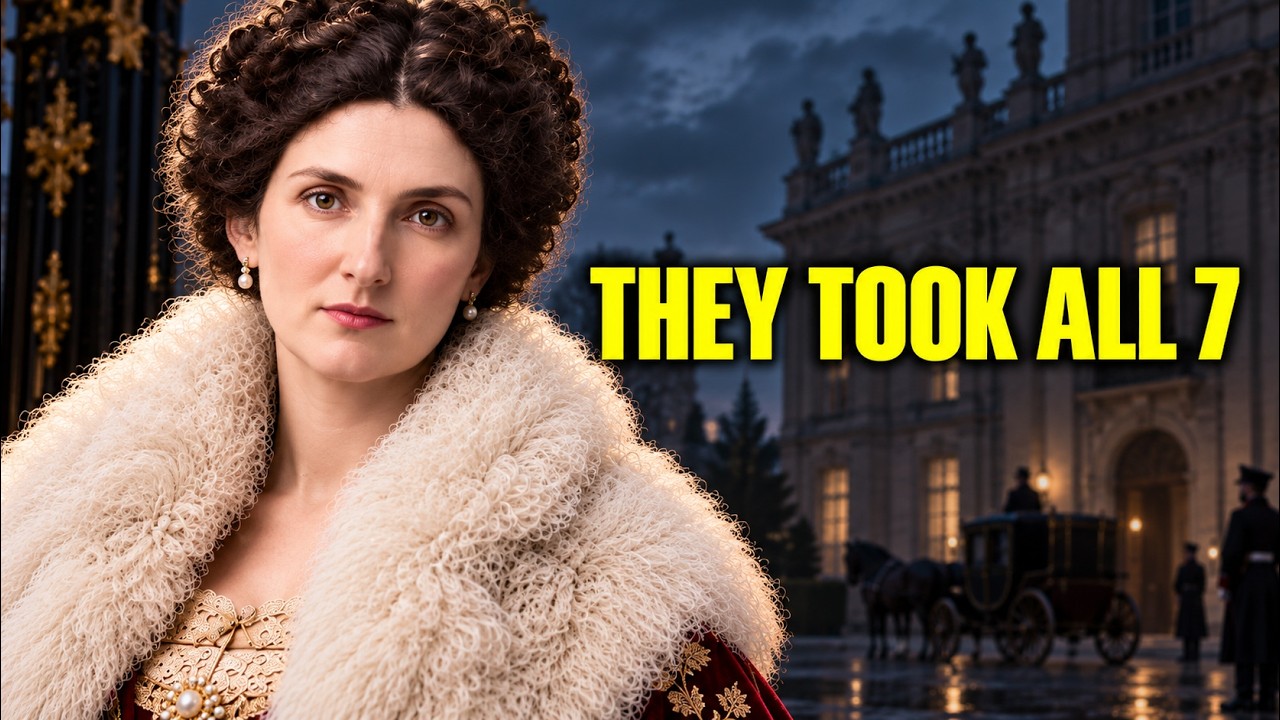
Two years earlier, this woman had been the crown princess. She was supposed to be the next queen of Saxony. Her name was Louise. She fled her palace pregnant, and they kept her children.
How does a future queen lose five sons and daughters without ever being accused of harming them? And did she ever get them back, even one? The two sides tell it very differently. In her memoirs, Louise writes that her husband’s family had already prepared rooms for her in an asylum where she was supposed to give birth.
Dresden announced, in so many words, that she had lost her mind. Either they drove a sane woman out, or they lost a sick one. The baby comes first because she is the strangest part of the story. She was born in May 1903 in Lindau, a lakeside town in Bavaria, at the villa of Louise’s parents.
By then, her mother was no longer married to the crown prince, and Europe’s newspapers had spent five months asking one question. Whose child is it? So the Saxon royal household sent a doctor, a gynecologist named Doctor Leopold, the director of the women’s clinic in Dresden. According to one Saxon history site, he traveled to Lindau, measured the newborn girl, and compared her features with the crown prince’s.
Then he reported that the child’s looks pointed clearly to Friedrich August as the father. A royal family settled the paternity of a baby by looking at her nose and chin. It mattered because if the girl was the crown prince’s daughter, she was a princess of Saxony. And a princess of Saxony belonged to Saxony.
That doctor’s report was the first step toward what the title promises. The family kept the children she left behind, and in the end, it came for the one she took with her. To understand how a dynasty could do that, and why so many ordinary people in Saxony took the side of the woman it was doing it to, you have to go back to Salzburg in 1870. Louise was born there on the 2nd of September 1870.
Her full title was Archduchess of Austria and Princess of Tuscany, because she came from the Tuscan branch of the Habsburgs, the family that ruled Austria-Hungary. Her father, Ferdinand IV, had been Grand Duke of Tuscany until 1859, when the movement to unite Italy swept him off his throne. He kept the title and the money, along with the manners of the court, but not the country. So Louise grew up in exile in Austria, the daughter of a ruler without a realm.
Her mother was Alice of Bourbon-Parma, from another dethroned Italian dynasty. It was a big household. Louise had nine full brothers and sisters, plus a half-sister from her father’s first marriage. It was a household of lost crowns and old habits.
That matters because Louise grew up watching what happens to royalty once the thing that justified it is gone. The rituals go on after their purpose has disappeared. She was a headstrong child and never grew out of it. Her own memoir is full of small rebellions.
She rode and laughed, said what she thought, and took a liking to people who weren’t on the approved list. Later in Dresden, she took up cycling, which was then the fashionable new freedom for women. One chapter of her memoir is headed “The Bicycle Craze,” followed by the words, “I am reprimanded. ” Petty tyranny.
Those two words, petty tyranny, are how she would come to describe the place she married into. One of her brothers, Archduke Leopold Ferdinand, was every bit as restless as she was, and when she ran, he ran with her. A Catholic Habsburg archduchess had a very short list of possible husbands, and in 1891, the list produced one. Prince Friedrich August of Saxony was born in May 1865 into the House of Wettin, which had ruled Saxony for centuries.
He was Catholic in a mostly Protestant kingdom, and he was in line for the throne. On paper, it was a good match and it tied two Catholic royal houses together. They were married in Vienna on the 21st of November 1891. She was 21 and he was 26.
Two days later, she was formally received in Dresden. Friedrich August was not a cruel man, and almost every source agrees on that. He was dutiful and plainly kind and deeply devoted to his father. That was the problem, because his father was Prince Georg.
Georg was the younger brother of King Albert of Saxony. Albert had no children, so Georg was next in line, and his son after him. The Saxon regional biography describes Louise’s life in Dresden as lived under her husband’s strictly religious father. One Dresden history magazine gives him a nickname, Georg the Grumbler, and mentions his habit of having people spied on.
Dresden ran on rules about who could speak to whom, what a princess could wear, and where she could go and with whom. Louise’s memoir complains about all of it, and you don’t need to trust the memoir to see that she did not fit. What she did do, and fast, was produce heirs. Her first son, Georg, named for his grandfather, was born in January 1893.
A second son, Friedrich Christian, came at the very end of the same year, and a third, Ernst Heinrich, arrived in December 1896. The line was secure with three boys in under four years. Then in August 1898, at the family’s summer residence at Wachwitz on the Elbe, Louise gave birth to a daughter who was stillborn. Her name was Maria Alix.
We know almost nothing about how Louise took it, except that she was pregnant again the following year. In January 1900, a daughter, Margarete, was born. In September 1901, back at Wachwitz, another girl arrived, and she too was named Maria Alix, after the sister who died. That made five living children in under nine years, plus the one she lost.
And through all of it, according to Louise, she was watched. In her memoir she names names. She writes that her lady of the bedchamber, a woman called Frau von Fricke, was one of her most relentless enemies. Another target is Georg von Metzsch, the Saxon minister, and what she calls his spies.
That is her side, written years later when she had every reason to be bitter. But we’ll see soon that Saxony did employ agents to watch her, and that part is documented from the other side. Outside the palace, meanwhile, the crown princess was popular because she was warm in public, she was modern, and she didn’t look down on anybody. The Saxon regional biography states plainly that when the crisis came, the Saxon population was mostly on her side.
In a royal house that ran on rules, a princess the public loved was a problem. In June 1902, old King Albert died and Georg became king of Saxony. Louise’s husband became crown prince and she became crown princess, the next queen. The man she had spent eleven years fighting now had total control over the family.
That same year, a young man was working in the royal household as a language teacher. His name was André Giron. He was Belgian, born in Ghent in 1879, which made him 23, while she was 31 and would soon be 32. He taught French to her sons and daughters.
He was a commoner with no money or connections, and his prospects went no further than the next teaching post. We don’t know exactly when they fell in love, how long it went on inside the palace, or how much anyone knew and when, because the letters that would answer that aren’t in any archive anyone has published. What we do know is where it ended up. By the autumn of 1902, Louise was pregnant again.
It was her seventh pregnancy, and this time, nobody in Dresden was sure who the father was. At that moment, Louise was the mother of five young children and the future queen of a German kingdom. She was pregnant. Her father-in-law was now king and disliked her.
And there was a tutor. Why would a mother leave five little ones behind? And once she had, why did the people of Saxony take her side? The answer to the first question, according to Louise, is one word.
Sonnenstein. Sonnenstein was a castle above the town of Pirna, a short way up the Elbe from Dresden. In 1902, everyone in Saxony knew what it was used for. It was a state asylum for the mentally ill.
In her memoir, Louise describes a conversation with Frau von Fricke, her lady of the bedchamber. She writes that the woman told her, “Your accouchement will take place in the asylum of Sonnenstein. ” Accouchement is the old word for childbirth. And Frau von Fricke went on, Louise claims, “Your father-in-law and I have arranged all the details, and your rooms are even now prepared for you.
” Her case rests on this. A pregnant woman is told she will give birth in an asylum, that her rooms are ready, and that her father-in-law has arranged it. If it happened, it explains everything that followed. Did it happen?
We only have her word for that conversation, and no Saxon document ordering her committed has ever been produced. There is evidence on both sides, and we’ll come back to it. What she did next is not in doubt. On the 9th of December 1902, Louise left Dresden.
It was her son Ernst Heinrich’s sixth birthday. According to one German account, two of her maids helped her get away. She went to her parents in Salzburg, not to her lover. Retellings often leave that detail out, and it changes what the flight looks like.
A daughter running home. It didn’t work. In her memoir, she describes trying to tell her father about Sonnenstein, and she writes that he told her the king had only meant a rest cure. She answered, by her account, that Sonnenstein was mentioned, and all the world knows that Sonnenstein is a lunatic asylum, and it made no difference.
Her father simply wouldn’t believe that the royal family of Saxony could be capable of such a thing. By now she had tried her husband’s family and her own. And as she saw it, both had failed her. Two days later, on the 11th of December, she ran again.
And this time her brother Leopold Ferdinand went with her. According to the Salzburg city wiki, a closed carriage was waiting for them at the cathedral square. It took them to Hallein, just south of the city, and from there they went by train to Zurich. On that December night in Salzburg, the carriage held a woman in her thirties, several months pregnant, and a brother who had decided to throw away his own rank alongside her.
Neither of them could have gone back after that. André Giron arrived in Zurich a day later. On the 15th of December, the three of them moved on to Geneva, where, according to the Swiss National Museum, they took four rooms at the Hôtel d’Angleterre. The crown princess of Saxony was now in a Swiss hotel with her brother and her children’s French teacher, and her five little ones were in Dresden with the king.
Why didn’t she take them with her? She couldn’t have. Three of them were boys in the line of succession to the Saxon throne, and all five belonged in law and in practice to the royal house. A mother who carried the heir to a throne across a border would have been treated as a kidnapper.
What she could carry out was the baby nobody could yet see. On the 22nd of December 1902, Dresden issued a statement. The Swiss National Museum, which has studied the Geneva side of this affair, quotes it in English. The crown princess, the statement said, had in “an apparently pathological state of emotional agitation” abruptly left Salzburg and “betaken herself abroad,” severing all ties.
Pathological is a medical word, and the palace chose it. With that one word, a wife leaving her husband became a woman falling ill. If you remember Sonnenstein, the choice starts to look like part of a plan. Dresden went further.
The story spread that she had run off with Saxon crown jewels worth, it was said, 800,000 marks, and that she had done it in a fit of mental confusion. The museum’s researchers described the jewel charge as entirely fictitious, but it put two ideas into print at once: that she was a thief, and that she wasn’t in her right mind. It backfired, because according to the Saxon regional biography, the accusation only increased public sympathy for her. Plenty of people in Saxony simply didn’t believe it.
Inside the German aristocracy, their reaction was different. Baroness Hildegard von Spitzemberg was a Berlin society figure whose diaries were later published. On the 27th of December 1902, she wrote about “Saxon scandals of unparalleled repulsiveness,” to use the English translation of her diary. The streets and the drawing rooms were reading two different stories.
Meanwhile, Dresden sent people to Geneva. A Saxon detective named Arthur Schwarz arrived to watch her. The Swiss National Museum reports that he intercepted her mail and bribed the hotel chambermaids. He drew plans of the rooms, marking where the bed stood, and he prepared a scheme to kidnap her and bring her back to Saxony.
The Geneva police found out and stopped it. Whatever you make of Louise’s claims about spies in Dresden, in Geneva there is no argument. The Kingdom of Saxony put an agent in a Swiss hotel to count the beds in its crown princess’s rooms and planned to carry her home by force. Then Louise did something royal women were not supposed to do.
She talked to the press. She, her brother, and Giron gave interviews to the French paper Le Figaro, to the New York Herald, and to a Munich newspaper. One Dresden history magazine counts more than five hundred newspaper articles about her flight. In Munich, the comedian Karl Valentin wrote a comic song about Louise and her tutor.
Her brother, meanwhile, burned his own boats. On the 14th of December from Zurich, Leopold Ferdinand wrote to the emperor asking to give up his rank as an archduke. He took the name Leopold Wölfling, and he married a woman named Wilhelmina Adamovich, a postal official’s daughter with a scandalous past. That marriage ended in divorce in 1907.
The Habsburgs now had two runaways in one generation. Then the machinery started to move. On the 31st of December 1902, King Georg set up a special tribunal to deal with his son’s marriage. It was a court created for this one case.
In Vienna, the head of Louise’s own family acted as well. On the 20th of January 1903, Emperor Franz Joseph wrote that she was, from now on, to use neither the title of an imperial princess nor that of Archduchess of Austria. She was struck from the family’s rolls. The house she was born into cut her off within six weeks of her flight.
It took the tribunal six weeks. On the 11th of February 1903, it dissolved the marriage. The grounds were adultery by the crown princess. It was a civil divorce, not a church one, so in the eyes of the Catholic Church the marriage was never dissolved.
And the five older children stayed with the royal family in Dresden. She was 32, several months pregnant, and no longer allowed to use the titles she was born with. That same year, a pamphlet appeared in Germany whose title tells you exactly what people were being encouraged to think. In English it would be something like The Hysterical Woman in Family and Society: Medical and Psychological Observations on the Case of the Crown Princess of Saxony.
It went through at least five editions. You now have an official bulletin calling her pathological, a false story about jewels and mental confusion, and a book selling her as a textbook case of hysteria. Whether or not anyone ever drew up papers for Sonnenstein, the idea that Louise was mad was being built in public piece by piece. Now the story gets more complicated, because Louise’s own choices are part of it.
The romance didn’t last. German sources state that she had already split from André Giron before the divorce came through. Nobody knows why, and one Saxon account says simply that the reasons are unknown. The man she was supposed to have given up everything for was out of her life within a couple of months.
We do have his version, and it is not flattering to either of them. Giron gave an interview to a French writer. He said he was born in Ghent in 1879, and he showed the man his diary of the affair. Then, in a line, he said, “She had to choose between her children and me.
She chose me. ” That’s his claim, and it’s a brutal thing to say in public. It also leaves out Sonnenstein, the asylum she said she was running from. In May 1903, the baby was born at her parents’ villa in Lindau.
It was a girl, and they named her Anna Monika Pia, and Louise called her Monika. Dr. Leopold came from Dresden, measured her, and decided she looked like the crown prince. In 1903, no test anywhere could settle a question like that.
A doctor looking at a newborn’s face was the best science a king could buy, and it happened to give the king the answer that suited him. German historians still write that her paternity has never been settled. The decision had a use, though. If Pia was a Saxon princess, the king could claim her.
Why would a royal family rush to claim a child who might be a tutor’s daughter? The alternative was worse. If Dresden had declared the girl illegitimate, it would have admitted in public that the future queen had carried another man’s child while still married to the heir. Claiming her was quieter.
It kept the scandal indoors, and it gave the king a legal right over the one child Louise still had with her. As far as we know, nobody wrote that reasoning down, but the claim was put to use a few years later. In July 1903, King Georg allowed Louise to call herself the Countess of Montignoso and granted her an allowance. It was a title with nothing behind it, the kind you give someone you want to go away without a fuss.
It was also a leash, because the money came from Dresden, and so did the rules. Where did that leave her? She had run to save herself from an asylum, if you believe her. Or run off with a tutor, if you believe the palace.
She had lost her husband, her title, her lover, and her five older children, and she still had one baby. Could they take that one, too? They could. And they’d spend the next four years working toward it.
In October 1904, King Georg died at Pillnitz after only two years on the throne, and Louise’s former husband became King Friedrich August III. Louise, like a lot of people, believed that with the old man gone, the door might open. She went to see for herself. Four days before Christmas 1904, she traveled to Dresden, which is the scene we started with.
She tried to reach the Taschenbergpalais, but the police had surrounded it, and they intercepted her and took her out of the country. One local account records that crowds gathered round her and begged her to stay. It changed nothing. The new king was kinder than his father, but he did not let her in.
He could refuse, because he was king now and nobody in Saxony could overrule him. We don’t have his reasons in his own words, only what he did. He kept her out of the country. He kept the children in Dresden, and within three years he would take the last one too.
Whatever he felt about his former wife, he ran his family the way his father had taught him. Nearly two years passed before she saw any of the five. In October 1906 in Munich, she was allowed a meeting with her two eldest sons, Georg and Friedrich Christian. It lasted about two hours.
In her memoir, she wrote simply that the meeting took place at the Saxon embassy in Munich, and then added four words: “Mama went with me,” as if she needed her own mother there to get through it. Georg was 13 by then, and Friedrich Christian 12. She had last seen them when they were nine and eight. Picture that room at the Saxon embassy.
Two boys in their early teens, brought by officials to meet a woman they had been taught to think of in a certain way, and Louise’s mother with her. We don’t have a record of a single word anyone said. We only know that when the two hours were up, the boys went back to Dresden and she didn’t. That is what four years of trying had got her.
Two hours in one room with a chaperone. Meanwhile, the pressure over Pia never let up. “Every year the king asked me to give up Monika,” Louise wrote. And she adds that each time she begged to keep her.
It became a custody fight that reached the Italian courts. Then Louise did the thing that finally gave Dresden what it wanted. She fell in love again, this time with Enrico Toselli. Toselli was an Italian pianist and composer from Florence, born in 1883, which made him more than twelve years younger than her.
He was talented, and his best known piece is a serenade called Rimpianto. On the 25th of September 1907, they were married in London, at a purely civil ceremony. In Dresden, that settled it. And in October 1907, Friedrich August took Pia from her mother.
She was four. The Saxon State Archive records that on the 7th of April 1908, she was placed in the care of the Saxon royal household. So the last of the first six was gone, and every one of them was now in Dresden. There is a line in Louise’s memoir, written a few years later, about Monika.
“I can only pray,” she wrote, “that my little Monika will have a happier life as a princess than that which fell to my lot. ” What she hopes for is the girl’s happiness, and the line says nothing about seeing her again. In May 1908, Louise gave birth to a son with Toselli, Carlo Emanuele, and for a while she had a child with her again. That didn’t last either.
The marriage broke down, and sources disagree on exactly when they separated, one saying 1908 and another 1911. Louise went to law, accusing Toselli of taking the boy, and according to the Saxon State Archive, on the 21st of November 1911 the judges rejected her claim and gave custody to the father. She kept the right to see him. The divorce followed in 1912.
Toselli then did something that sounds very modern. He wrote a book about his marriage and published it in French under a title that translates as Husband of a Highness: Four Years of Marriage with Louise of Tuscany. In it, he even wrote that the boy had been taken away at his own request. And in 1913 he staged an operetta called The Bizarre Princess.
It’s hard not to hear who he meant. Toselli died of tuberculosis in 1926. Their son Carlo lived until 1969. She had seven living children, counting Carlo.
Five were left behind in Dresden in 1902. One was taken from her at four years old in 1907, and one was awarded to his father in 1911. By the time she was 41, a king or a judge had taken every child she had. Her answer was a book of her own.
In 1911, Louise published her memoirs, which appeared in English as My Own Story in London and New York and in German as Mein Lebensweg. The American edition’s title page states that it was translated under the supervision of the author. It is angry, one-sided, and very readable. It’s also the main source for most of what’s said about her, which is a problem, because it’s the one source that most obviously has an axe to grind.
Now the claims go on trial. The first charge is hers against them: that King Georg and her lady of the bedchamber had arranged for her to give birth in the Sonnenstein asylum. The evidence for it is real. The first official bulletin called her state pathological, and Dresden spread the jewel story with its fit of mental confusion.
A pamphlet sold her as a case study in hysteria. The German reference article on her husband notes that King Georg doubted her mental stability. And in Geneva, Saxony did send an agent who planned to kidnap her and take her back. A government willing to snatch a woman from a Swiss hotel would hardly have balked at a quiet stay in a clinic.
The evidence against it is also real. The quote about the rooms at Sonnenstein comes only from her own memoir, written nine years later. Nobody has ever published a Saxon document ordering her committed. Her own father, in her own telling, refused to believe it.
On this charge, the campaign to paint her as mentally ill is documented. The specific plan for a Sonnenstein is plausible and unproven. The second charge is his against her: that she chose her lover over her children. That’s Giron’s sentence from a French interview, and it’s the harshest version of the story told by the only other person who was there.
It comes from a young tutor, briefly famous and, it seems, enjoying the attention, who was gone from her life soon after. It also leaves something out. If she believed the asylum threat, she didn’t think she was choosing between five children and a man. She thought she was choosing between an asylum and a life.
Whether she was right to believe it is a different question. Whether that makes it better or worse is for you to decide. The third charge is the one people whispered in 1902 and still repeat now: that Giron wasn’t the first. English-language retellings mention rumors about a court dentist.
When you follow them back, they lead to a popular book about Habsburg scandals, not to any document. Nobody can name a source for it from the time. As far as the evidence goes, that one’s gossip. The fourth claim is political, and it’s a strange one.
In June 1903, a few months after the divorce, the Social Democrats won 22 of Saxony’s 23 seats in the elections to the German parliament. It was a landslide in a kingdom whose royal family had just thrown out its popular crown princess. Louise later claimed that socialist leaders came to her and told her, in her words, “You will become the Red Queen of Saxony. ” Did the scandal cause the landslide?
No historian has argued that it did. The timing is real and the link is not proven. And there’s the question raised at the start. Were the people of Saxony really on her side?
On this one, the evidence is good. The Saxon regional biography describes the population as mostly with her. A song postcard printed in 1904 called her “the pearl of Saxony. ” In 1907, a Dresden publisher was still selling picture postcards of Louise holding little Pia in the same city where the king was preparing to take that child away.
A Czech historian who worked through the Tuscan family archive gave his 2019 article a title that sounds like a crowd calling out: “Where is our Louise? ” When she came back that December, ordinary people crowded around her in the street, and the police took her away anyway. The palace could lose the argument with the public and still win the children, because the children were never the public’s to give. Which leaves the question the title asks.
Once they had her children, did she ever win any of them back? From 1911, Louise lived in Belgium, in Ixelles, a district of Brussels. For a time she used a new name, Antoinette Marie, Comtesse d’Y. She lived on a pension paid by the Saxon royal family.
So the same family that had taken her children now paid for her keep. That is how the bargain worked. They wouldn’t let her near the family she’d made, and they wouldn’t let her starve. Then the world she had run away from fell apart without her.
In 1914 the First World War began, and four years later it ended with the collapse of almost every crowned house in central Europe. In November 1918, revolution reached Saxony. On the 13th of November, at a castle called Guteborn, her former husband signed his abdication. The official text is one line: “I renounce the throne.
” A more famous line is attached to that day. Legend has Friedrich August telling the revolutionaries, in broad Saxon dialect, something close to, “Well, then do your own dirty work. ” People in Saxony still quote it. Historians think it was probably attributed to him rather than recorded.
It sounds like him, but it may not be his. Either way, the kingdom that took her children no longer existed. The throne she had been meant to share was gone, and the rules she had called petty tyranny now governed nobody. And it made no difference to her at all.
Her sons and daughters were grown or nearly grown, and they had been raised by the people who had pushed her out. Friedrich August never married again. The Saxon regional biography notes that he preferred to spend the rest of his life alone. He died in February 1932.
The pension to Louise continued after his death, and the German encyclopedia entry on Louise adds that her sons Friedrich Christian and Ernst Heinrich supported her financially. So there was contact of a kind, and money traveled from the sons to the mother, but almost nothing else is documented. The Saxon Palace’s own curator states that Louise saw Pia again only as an adult. By then, Pia had married Archduke Joseph Franz of Austria in 1924, which took her straight back into the Habsburg family that had struck her mother from its rolls.
Louise’s son Ernst Heinrich later said that her leaving had not upset him. He was six on the day she left, and it was his birthday. You can take his words at face value, or you can wonder what a man says about a thing like that when he’s had decades to decide. Then came the Nazis, a second war, and the unexplained death of one of those sons.
In 1939, the German Reich’s Economics Ministry refused to allow her pension to be transferred abroad. Payments started again in 1940 and stopped in 1944. During the occupation, her daughter Margarete sent her money through the German military commander in Belgium. A Saxon princess was sending her mother money in Brussels through the office of the army occupying Brussels.
Her eldest son, Georg, the boy she’d seen for two hours in Munich, had given up his claim to the throne and become a Jesuit priest, ordained in 1924. Under the Nazis, he helped Jews get out of the country, and the Gestapo had him watched. On the 14th of May 1943, Georg went swimming in the Gross Glienicker See, a lake near Berlin. People heard cries for help, and his body was only found three weeks later.
The autopsy found no water in his lungs, so he had not drowned, and it gave heart failure as the cause. His brother Ernst Heinrich later spoke of a concealed murder, and some accounts claim there were a striking number of Gestapo men at the lake that day. Nobody has ever proved it either way. Louise was 72 when her eldest son died.
There’s no record of how she learned of it. Most retellings end her story this way: the fallen crown princess, penniless in Brussels, selling flowers on a street corner to survive. It’s a powerful picture, and as far as anyone can show, it’s not true. When the Saxon Palaces Foundation mounted an exhibition about her at Pillnitz in 2017, one Dresden magazine reported that legends like her death as an impoverished flower girl were cleared up there.
The state archive in Dresden shows that she lived on a family pension and died in her own flat after the payment stopped in 1944. She may well have been poor, but the flower seller is a story someone added because it made a sadder ending, and she doesn’t need it. Louise died in Ixelles on the 23rd of March 1947 at the age of 76. According to the Saxon State Archive, none of her sons or daughters was at her funeral.
She was buried in the cemetery at Ixelles, and that might have been the end of it. But in 1953 her remains were moved to Germany, to Sigmaringen, to the Hohenzollern crypt at the Hedingen Monastery Church. One Saxon history site credits her daughter, who had married into the Hohenzollerns, with arranging it. By then the remains were in such a condition that they were cremated, and her urn went into the crypt.
Two of her children are buried there too. One is her daughter Margarete, who had sent money through an occupying army. The other is her son Ernst Heinrich, the boy whose sixth birthday was the day she left. He died in 1971.
The others are scattered. Georg the Jesuit lies in the royal crypt of the Hofkirche in Dresden, the city his mother was thrown out of. Friedrich Christian, who died in 1968, is buried in a village in the Tyrol. Even in death the family never quite managed to be in one place.
The verdict, then. The title is exactly true. She ran while pregnant, and they held on to every child. Five were kept from the start.
The sixth, the baby she carried out, was measured by a doctor from Dresden, claimed as a Saxon princess, and taken from her at four. The seventh, Toselli’s son, went to his father by order of a judge in 1911. And did they ever come back to her? Not as children.
She had two hours with two of her sons in 1906, and that is the only meeting from their childhood anyone recorded. As adults, some of them helped her with money, and she saw Pia again only when Pia was grown. None of them came to her funeral. Two of them lie beside her now.
Was she mad, as Dresden suggested? The evidence says no. It shows a royal house that called her pathological in its first statement, spread a false jewel story, sent a detective to count her beds, and plotted to kidnap her. Whether a room at Sonnenstein was really waiting for her, we only have her word.
But a dynasty that behaves like that has earned her the benefit of the doubt. And was she innocent? No. She had an affair.
She left five small children. And her lover’s version says she chose him over them. She did wrong, and they punished her by taking her children. A punishment that lasted the rest of her life.
Her son Ernst Heinrich turned six on the 9th of December 1902. His mother left Dresden that day, and there is no record she ever spent one of his birthdays with him again. If you had been in her place that December, told your rooms at an asylum were ready, would you have stayed for your children, or would you have run?
