At 1:30 in the morning of April 15, 1912, John Jacob Astor IV helped his nineteen-year-old pregnant wife, Madeleine, through an open window of the Titanic’s A-deck promenade and into lifeboat number four. He asked Second Officer Charles Lightoller if he might board with her, given her delicate condition. Lightoller refused. No men were to enter the boats.
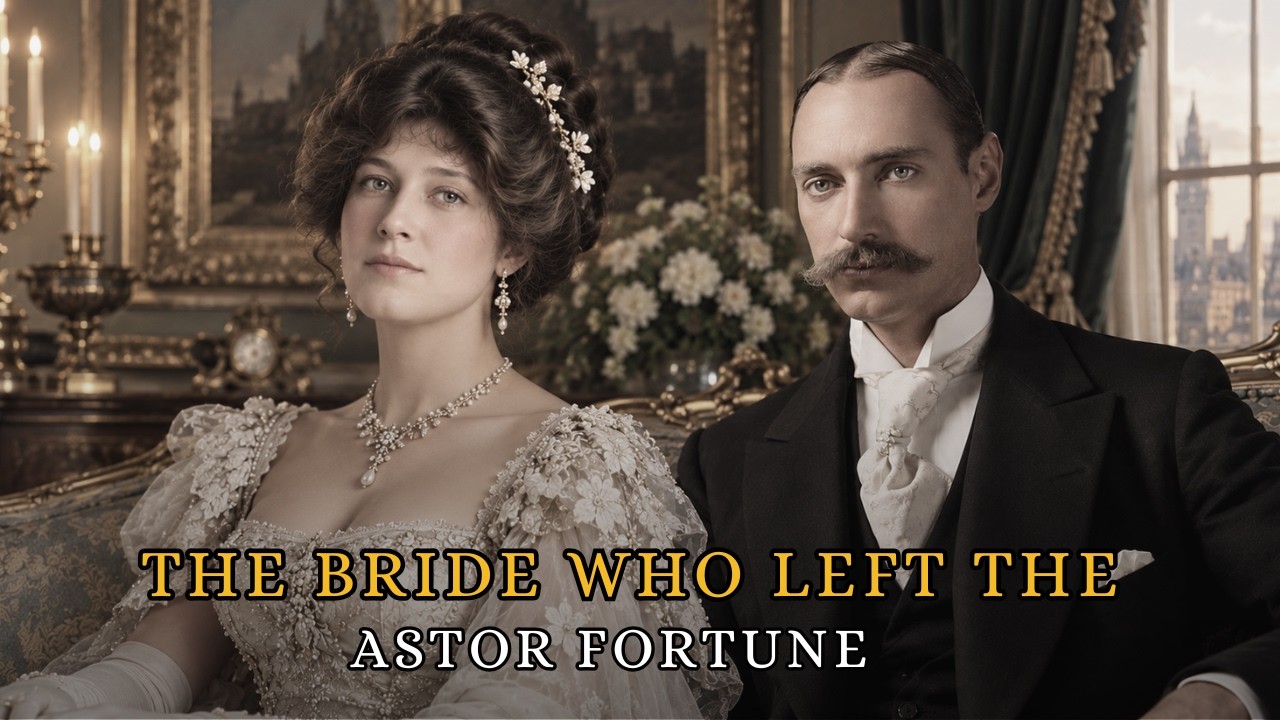
Astor stepped back, tossed his leather gloves down to his wife as a token of comfort, and walked back toward the sloping starboard deck. It was the last time she saw him alive. He died when the ship went down at 2:20 that morning, along with more than fifteen hundred others. She was eighteen when she married him in September 1911, and the country had decided it had the right to judge her.
John Jacob Astor IV was forty-seven, twice married, and the head of the richest family in America. Their engagement, announced in the summer of 1911, ignited a storm of sensational press coverage and moral outrage. Conservative clergymen refused to officiate the wedding, denouncing Astor’s divorce as an unpardonable sin. The couple eventually found a minister from Providence willing to perform the ceremony, and they married quietly on September 9, 1911, at Beechwood, Astor’s Newport mansion.
To escape the hostile scrutiny, they sailed for Europe and then spent the winter cruising the Nile. There, Madeleine became pregnant. By the spring of 1912, she was eager to return home so her child would be born on American soil. They booked first-class passage on the brand-new White Star liner Titanic, which was advertised as the safest, most luxurious ship ever built.
They boarded at Southampton on April 10 with servants and their pet Airedale, Kitty. On the night of April 14, the Astors dined in the first-class restaurant. Shortly before midnight, a dull scraping vibration ran through the ship. Astor assured his wife it was nothing serious, then went up to investigate.
He returned with a grave urgency: the ship had struck an iceberg and was taking on water. He dressed Madeleine warmly, fitted her with a cork lifebelt, and led her up the grand staircase to the boat deck. With the bow settling into the sea and distress rockets bursting overhead, Astor remained composed and escorted her to lifeboat four. Madeleine watched the ship die from the water.
She saw the lights flicker and go out, heard the hull break apart, and listened to the cries of dying men until silence settled over the sea. Hours later, the Carpathia arrived at dawn and pulled the survivors aboard. She was hauled up the side in a wooden bosun’s chair, collapsing into profound shock. On the overcrowded rescue ship, Captain Rostron placed her in a quiet stateroom under medical care.
When the Carpathia reached New York on April 18, more than thirty thousand people crowded the docks. Reporters and photographers circled the ship, hungry for a glimpse of the world’s most famous young widow. Vincent Astor, John Jacob’s twenty-year-old son from his first marriage, boarded the vessel with family physicians. They wrapped Madeleine in blankets and rushed her down a private gangway into a waiting car, delivering her to the Astor mansion at 840 Fifth Avenue.
Doctors ordered absolute bed rest, fearing her shock and hypothermia threatened the pregnancy. In late May, the Surrogate Court of New York unsealed John Jacob Astor IV’s will. Most of his fortune, estimated at nearly $100 million, passed to Vincent. Madeleine received the lifetime income from a $5 million trust fund, the use of the Fifth Avenue mansion, and seasonal occupancy of Beechwood.
But there was a catch buried in the legal language: every dollar and every property was hers only as long as she remained a widow. If she remarried, everything reverted to the estate controlled by her stepson. She spent the summer of 1912 secluded at Beechwood, guarded by staff and surrounded by press cameras. On August 14, she gave birth to a healthy eight-pound boy, christened John Jacob Astor VI and quickly nicknamed Jakey by the papers.
The birth activated a $3 million trust fund for the child. It also sharpened the tension between Madeleine and Vincent Astor, who was two years older than his stepmother and viewed the newborn as a challenger to his control of the family assets. Their relationship, conducted through law firms, remained formal and cold. For the next four years, Madeleine raised Jakey in near total seclusion, shielding him from a public that treated the boy as a curiosity of maritime history.
She fought quiet legal battles to secure her authority over his upbringing. But by 1916, she had come to a difficult realization: remaining an Astor meant a lifetime of solitude, surveillance, and grief as a permanent public monument. She wanted her own life. The catalyst was William Carl Dick, a Brooklyn banker close to her own age whom she had known since adolescence.
Their friendship deepened into romance, and Dick offered her something the Astor fortune never could: warmth, equality, and a normal household. Marrying him meant triggering the forfeiture clause in the will. She would surrender the entire $5 million trust fund, the Fifth Avenue mansion, and Beechwood. On June 22, 1916, she married Dick in Bar Harbor, Maine, and gave it all up with a single signature.
The press reacted with shock and grudging admiration. Vincent Astor moved quickly to take possession of the forfeited assets, closing the doors of the mansion. Madeleine, meanwhile, kept her son’s $3 million trust fund intact and secured legal custody of Jakey, ensuring he would be raised in her new home with her new husband. She settled into a quieter life in Islip, Long Island, and gave birth to two more sons, William Jr.
and Jackson. To her neighbors, she was simply Mrs. William Dick. She rarely spoke of her past and refused all requests for interviews.
She never sailed on an ocean liner again, developing a lifelong phobia of deep water. She avoided survivor gatherings and public anniversaries of the disaster. The domestic stability lasted until the late 1920s, when her marriage to Dick drifted apart. They divorced in 1933.
Four months later, she married Enzo Fiermonte, a thirty-two-year-old Italian heavyweight boxer, in a whirlwind romance that reignited the tabloid press. The marriage was turbulent and financially draining. Fiermonte’s extravagance depleted her remaining savings, and her grown sons disapproved sharply of him. By 1938, she divorced him in Palm Beach, paying a substantial settlement.
She reclaimed her maiden name, Madeleine Force, and retreated permanently from public life. Her health declined steadily. On March 27, 1940, she died in her oceanfront villa in Palm Beach at the age of forty-seven, her heart weakened after decades of strain. Her death came almost twenty-eight years to the day after she was pulled from lifeboat four.
In accordance with her wishes, her funeral was private. She was buried at Trinity Church Cemetery in New York under the name Madeleine Force, the identity she had fought to reclaim. In the years that followed, her story was reevaluated. The press of 1911 had cast her as either a calculating social climber or a helpless victim.
But her life revealed a different kind of figure. When confronted with a will designed to hold her youth and future hostage to a fortune, she chose to walk away from millions rather than surrender her autonomy. Her eldest son, John Jacob Astor VI, lived a turbulent life of legal battles and publicized marital conflicts in the shadow of his inheritance. Madeleine’s younger sons, raised in a quieter household, followed a different path.
She had proven that she could safeguard her son’s inheritance without becoming a prisoner to the fortune herself. She was not merely the young widow who survived the Titanic. She was the woman who looked at the greatest fortune in America, understood its power to destroy her, and chose instead to step out of the gilded cage into a life of her own making.






