On December 13, 1945, a 22-year-old woman walked to the gallows at Hameln Prison in Lower Saxony and spoke a single word, “Schnell,” quickly. Then it was over. Irma Grese was dead, hanged by the British hangman Albert Pierrepoint for war crimes committed at Auschwitz-Birkenau and Bergen-Belsen. But the story did not end with her execution.
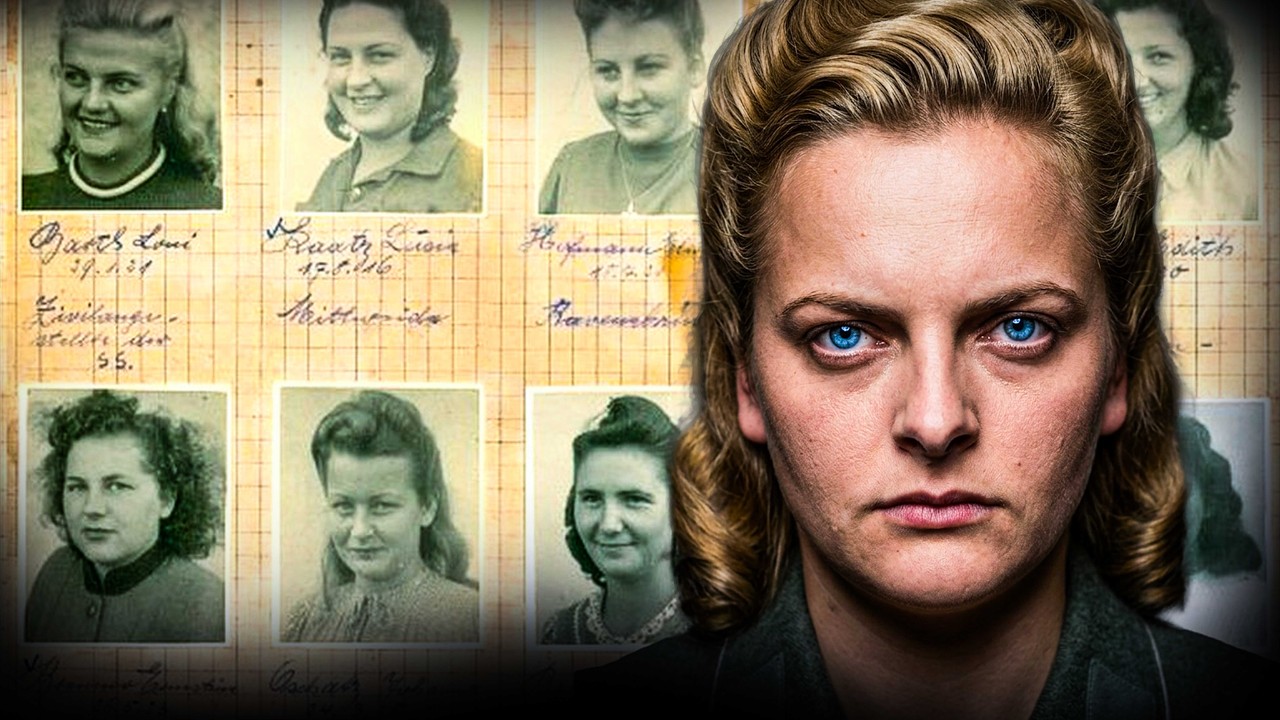
It continued in the lives of the people connected to her—a father who had begged her not to join the SS, siblings who carried her name as a burden, and the families of the women who stood in the dock beside her. Irma Ida Ilse Grese was born on October 7, 1923, in the small village of Wretchen in the Mecklenburg region of northern Germany. Her father, Alfred Grese, was a dairy worker and farm laborer of modest means. Her mother, Berta Grese, née Neufuss, raised five children.
Irma was the third child, born between her older sister Helene and older brother Alfred Jr. , with two younger siblings, Lydia and another brother, following in the years after. Nothing in her upbringing obviously predestined her for the path she chose. There is no evidence of an abusive childhood, no documented history of exceptional cruelty as a young girl, no ideological household in which Nazi thinking was explicitly cultivated.
Alfred Grese was not, by the accounts that exist, a fanatical Nazi. He was a working man living in a Germany coming apart economically and politically, largely trying to keep his family together through the turbulence of the 1930s. The first major tragedy struck the household in 1936, when Irma was 12 years old. Her mother took her own life, reportedly by drinking hydrochloric acid.
The circumstances have been interpreted in different ways by different historians. Some accounts suggest Alfred had begun an affair and that the breakdown of the marriage was the catalyst. Others note simply the economic and social pressures of life in Depression-era rural Germany, where poverty was widespread and psychological support essentially nonexistent for ordinary rural families. Whatever the precise cause, the effect on the children was devastating.
Alfred would later remark that he had tried to be both father and mother to his children after Berta’s death, but that he had felt helpless to guide them in the world they were growing up into. Irma left school at 14, which was not unusual for rural German girls of her background. She worked for a time as an agricultural laborer, moving between farms in the region, and during this period became involved with the Bund Deutscher Mädel, the League of German Girls. Her engagement was reportedly enthusiastic rather than merely compliant.
She thrived in the structured, hierarchical environment, and responded to its ideological framing with a receptiveness that went beyond the ordinary. It was also during this period that she made her first attempt to join the SS system in a formal capacity, applying to work as an Aufseherin, a female SS concentration camp guard. She was initially rejected. She did not give up.
She applied again, and in July 1942, at the age of 18, she was accepted and sent to Ravensbrück, the large concentration camp north of Berlin that served primarily as the training ground for female SS overseers. Ravensbrück had been operating since 1939, and by the time Irma arrived it held tens of thousands of women from across occupied Europe—Jewish women, political prisoners, Roma women, women arrested for resistance activities, women arrested for nothing more than being the wives or daughters of men the regime considered enemies. The senior female overseers had developed a culture of arbitrary brutality, of violence as performance, of cruelty as a demonstration of loyalty and toughness. Junior recruits learned what was rewarded, what was ignored, what was expected.
Irma proved an exceptionally capable student. In March 1943, she was transferred to Auschwitz-Birkenau, the vast killing complex in occupied Poland operating at full industrial capacity as the primary site of the extermination of European Jewry. Assigned to the women’s compound of Birkenau, she served as an Aufseherin and eventually rose to become one of the senior female overseers. She was 20 years old.
She wore her SS uniform with evident pride, carried a plaited cellophane whip and a pistol, and presided over selections at the ramp where newly arrived prisoners were divided between those who would be sent immediately to the gas chambers and those kept for forced labor. Survivor testimony described her walking among lines of terrified women and children, striking out with her whip, apparently at random, for the pleasure of it. Prisoners described her ordering beatings, having dogs set upon women, shooting prisoners herself when the mood took her. There are documented testimonies of her callous behavior during selections, of particular cruelty toward women she found attractive or whom she suspected of attempting to preserve their appearance.
She participated in the murder of hundreds of thousands of people through the machinery of the camp, and added to that institutional evil her own personal violence. In late 1944, as Soviet forces pushed westward, Irma was transferred west to Bergen-Belsen in Lower Saxony. Bergen-Belsen had not originally been built as an extermination camp. It had begun as a POW camp and then a detention camp.
But by late 1944 it had been overwhelmed by the tide of prisoners evacuated from the east, degenerating rapidly into a nightmare of overcrowding, disease, and starvation. There was no functioning gas chamber, but tens of thousands died anyway from typhus, dysentery, starvation, neglect, and the casual violence of the guards. At Belsen, Irma continued to serve as senior overseer, and survivor testimony from this period is, if anything, even more disturbing—the brutality was no longer cloaked even in the pseudo-administrative language of selection and resettlement. It was simply naked cruelty in a setting of total collapse.
When the British 11th Armoured Division entered Bergen-Belsen on April 15, 1945, they found approximately 60,000 prisoners still alive, many of them dying, and 13,000 unburied corpses on the ground. The stench was detectable from miles away. BBC correspondent Richard Dimbleby, who accompanied the liberating forces, delivered a radio broadcast that shocked listeners across Britain. In the midst of this horror, Irma Grese was still there, still at her post, not disguised, not fled.
She was arrested on the spot along with the camp’s commandant, Josef Kramer, and a large number of other staff. She was 21 years old, and by accounts of British soldiers who processed prisoners that day, she was calm, composed, almost eerily so. The Belsen trial, formally known as the trial of Josef Kramer and 44 others, began on September 17, 1945, at the Lüneburg Courthouse in northern Germany, just a few months after the end of the war in Europe. It was one of the first major war crimes trials conducted after Germany’s defeat, predating even the Nuremberg tribunal, which began in November.
The British military had moved quickly. The evidence was overwhelming and largely immediate. Bergen-Belsen had been liberated with its staff still on the premises. Witnesses were abundant and close at hand.
Forty-five defendants were tried. Irma was charged on two counts: first for her conduct at Auschwitz-Birkenau, second for her conduct at Bergen-Belsen. The charges covered participation in a system of mass murder, personal acts of violence against individual prisoners, and cruel treatment of prisoners in her charge. The prosecution brought forward numerous survivor witnesses who gave testimony about specific acts.
Her defense counsel argued that she had been following orders, that she had been trained within a system that normalized violence. The court found the defense unconvincing. Irma made a notable impression on the court. She appeared alert and composed throughout.
When she spoke, she was coherent and articulate. She denied the most extreme accusations, but showed no evident remorse. Several observers noted that she did not appear to comprehend, or at least to accept, the moral gravity of what she was accused of. On November 17, 1945, the verdicts were announced.
Irma Grese was found guilty on both charges and sentenced to death by hanging. When the sentence was read out, she reportedly said nothing, her expression unreadable. Back in Germany, her father, Alfred, was informed of the verdict. He had already been living under tremendous strain since his daughter’s arrest and the public revelation of what she had done.
In the small, tight-knit communities of rural Mecklenburg, there was no anonymity. Everyone knew who Irma Grese was, and by extension everyone knew who Alfred Grese was. To be the father of the “Beast of Belsen” was to wear a mark that could not be removed. On the morning of December 13, 1945, the executions began.
Albert Pierrepoint, the British hangman brought from England specifically for this purpose, carried out the largest multiple execution in British 20th-century history: 13 convicted war criminals from the Belsen trial were hanged on that single day. Irma Grese was among them, along with Josef Kramer, Elisabeth Volkenrath, and Hana Borman. Pierrepoint would later describe Irma as composed and brave in her final moments, walking to the gallows without being carried or supported. She reportedly said only one word before the trap door opened: “Schnell.
”
The other women hanged that day followed different paths to the same end. Elisabeth Volkenrath, born September 5, 1919, in Schönau an der Katzbach in Lower Silesia, had entered the camp system in 1941, served at Ravensbrück and Auschwitz, and rose to become Oberaufseherin, the chief female overseer at Bergen-Belsen, the highest-ranking female SS officer in the camp. She was involved in selections at Auschwitz and had beaten prisoners personally. After the war she had married Hans Volkenrath, a fellow SS man.
After her execution, Hans Volkenrath largely disappeared from the public record, retreating into private life. Hana Borman, born September 10, 1893, in Behr, West Prussia, was 52 years old when executed, considerably older than the other two women. She had joined the camp system in 1938 and served at Ravensbrück and Auschwitz before arriving at Belsen, where she became notorious for unleashing her pack of trained dogs on prisoners—a practice so consistently documented in survivor testimony that it became central to her prosecution. She was unmarried and had no children.
Her home region of West Prussia had ceased to be German territory by the time of her execution, absorbed into Poland. Her immediate family, to whatever extent they survived the war and the expulsion of ethnic Germans, would have been scattered and dislocated. The contrast between the women executed and those given lighter sentences is one of the more morally complex aspects of the trial’s legacy. Hertha Bothe, born January 8, 1921, in Teterow, Mecklenburg—the same region where Irma had grown up—trained at Ravensbrück in 1942, overlapping with Irma, served at Stutthof, and arrived at Belsen in early 1945.
She was convicted and sentenced to 10 years in prison. She was released in 1951, having served less than six years. She was 30 years old when she walked out of prison. She settled in West Germany in the town of Banteln in Lower Saxony, lived a quiet life, married, took her husband’s surname, and had children.
Decades later she gave interviews to researchers, presenting herself as someone who had followed orders in an extraordinary situation, who had been young and had not fully understood what she was participating in. Survivors and historians reacted to her self-presentation with dismay; the gap between it and the testimony of survivors who remembered her conduct was vast. Herta Bothe died on March 16, 2000, at age 79. She had outlived Irma Grese by 55 years.
Josef Kramer, born November 10, 1906, in Munich, had joined the SS in 1932 and risen through the camp system over more than a decade, serving at Dachau, Sachsenhausen, Mauthausen, and Auschwitz-Birkenau before being appointed commandant of Bergen-Belsen in December 1944. At Birkenau he had personally presided over some of the most intensive phases of the extermination of Hungarian Jews in the summer of 1944, when crematoria ran at maximum capacity around the clock. He was the lead defendant at the Belsen trial, was found guilty, and was hanged the same day as Irma. His wife, Rosalie Kramer, was left behind with their children, who grew up knowing their father had been hanged by the British for crimes against humanity.
Fritz Klein, another male defendant born in 1906 in Oberdorf, Bavaria, had served at Dachau, Mauthausen, and Auschwitz-Birkenau, where he had been directly involved in selections and in the coordination of gas chamber operations. He was transferred to Bergen-Belsen in late 1944, was found guilty, and executed on the same December day. He left behind a family that retreated into private life and left almost no trace in the historical record. Beyond the Belsen trial, the broader system of female SS perpetration continued to produce its own stories of justice and evasion.
More than 3,000 women served as Aufseherinnen in the concentration camp network by the end of the war. The vast majority were never tried. Dorothea Binz, born March 16, 1920, in Faulensee, Brandenburg, entered the camp system in 1939 and rose to become the chief Aufseherin at Ravensbrück, one of the most powerful female figures in the entire SS camp apparatus. She was arrested by British forces, tried in the Ravensbrück trials from 1946 to 1948, found guilty, and hanged on May 2, 1947, at Hameln Prison.
She was 27. Like Irma, she left behind a family—her father was a forester in the Brandenburg countryside—that withdrew into silence. Maria Mandl, born January 10, 1912, in Münzkirchen, Upper Austria, was an Austrian, not German, a distinction that matters in understanding the geography of the female SS apparatus. She entered the camp system at Lichtenburg in 1938, transferred to Ravensbrück in 1939, and in 1942 was sent to Auschwitz-Birkenau, where she became Lagerführerin, the chief female administrator of the entire women’s section.
She was directly involved in selections for the gas chambers, ordered beatings and collective punishments, and presided over an apparatus of terror that killed an almost incalculable number of women. She also organized the women’s orchestra at Auschwitz, the girls’ orchestra whose members were required to play as fellow prisoners were marched to their deaths. At the end of the war Mandl attempted to flee, was captured by American forces in the Bavarian Alps in May 1945, and was extradited to Poland, where Polish authorities insisted on jurisdiction. She was tried in Kraków, found guilty, and hanged on January 24, 1948, in the courtyard of Montelupich Prison.
She was 36. Her family in Austria faced the particular complexity of her execution in a foreign country, her body buried in Polish soil. Hildegard Lächert, born February 20, 1920, in Berlin, was posted to Majdanek, the concentration and extermination camp near Lublin, where prisoners called her “Bloody Brigitte” for her violence during roll calls and her beatings. Unlike Irma and Binz, she did not face justice immediately after the war.
She evaded prosecution for years, living quietly in West Germany. She was eventually tried in the 1970s as part of a renewed effort by West German prosecutors, convicted in 1975 in connection with her service at Majdanek, and sentenced to 12 years in prison. She served part of the sentence, was released, and died on May 5, 1995, at age 75. The decades she spent living freely, surrounded by people who knew to varying degrees who she was, raised questions about the adequacy of post-war justice.
Ruth Closius-Neudeck, born November 19, 1920, served at Ravensbrück and at the women’s section of the Neuengamme complex near Hamburg. Her prosecution was also delayed. She was tried by a West German court in 1967, convicted of participating in murder, and sentenced to life imprisonment, though the sentence was subsequently reduced. She was released and died in 1981.
Johanna Langefeld, born March 10, 1900, in Neuss, Westphalia, was one of the most senior women in the entire SS female guard system. She served as chief female administrator at Ravensbrück from 1939 to 1942, effectively building and shaping the training system that produced women like Irma Grese and Dorothea Binz. She was transferred to Auschwitz-Birkenau, where she served as Lagerführerin before being relieved following conflicts with male SS leadership—conflicts reportedly stemming from her attempts to moderate some brutality. After the war she was arrested by American forces, handed over to Polish authorities, but managed to escape from Polish custody in 1946, reportedly with the assistance of a Catholic nun.
She returned to West Germany, lived under her own name without being recaptured, and died in Augsburg in 1974 at age 74, a free woman. She, who had played a foundational role in constructing the system that produced the women who were hanged, died peacefully in her bed. Ilse Koch provided a different counterpoint. Born September 22, 1906, in Dresden, she married Karl Otto Koch, commandant of Buchenwald.
As the commandant’s wife she rode through the camp on horseback, supervised beatings, and was accused of cultivating a collection of human skin taken from murdered prisoners, with lampshades allegedly made from tattooed skin. The lampshade allegations were later strongly contested by forensic examination, which concluded the infamous lampshades displayed at Nuremberg were made of animal skin, not human. This did not exonerate her of real crimes. She was tried by an American military tribunal in 1947 and sentenced to life, but General Lucius Clay reduced her sentence to four years in 1948, provoking enormous outrage.
She was released in 1949, and the West German government, responding to public pressure, charged her again under German law and convicted her in 1951, sentencing her to life imprisonment. In 1967, facing no realistic prospect of release, she hanged herself in her cell. She was 60. She had given birth to a son, Uwe, while in American captivity in 1947; his identity and burden became one of the case studies in the psychological literature on perpetrator family dynamics.
The fate of Irma’s own family was a story of silence. Alfred Grese continued to live in the Mecklenburg region, which by the end of the war had fallen within the Soviet occupation zone, which would become East Germany in 1949. Life in the Soviet zone was hard, politically constrained, and watched over by the apparatus of Communist Party control. For a man with the particular burden Alfred carried, the additional layer of political surveillance and the social pressures of a community that knew exactly who he was made existence particularly difficult.
By multiple accounts he did not speak publicly about his daughter after her execution. He withdrew, lived quietly, worked, and aged in the shadow of what his daughter had done. He died in 1948, just three years after her execution, at a relatively young age. The precise details of his death and final years remain obscure.
His surviving children—Helene, Alfred Jr. , Lydia, and the other brother—faced the task of building adult lives under the shadow of their younger sister’s notoriety. The Grese name became a burden each had to manage individually. In a country engaged in denazification and collective reckoning, being a sibling of Irma Grese was not something that could be kept entirely private.
Communities remembered. Bureaucratic records documented. The particular intimacy of rural northern German communities meant the name echoed in social spaces long after the newspapers moved on. Helene Grese was a teenager during Irma’s SS service and in her early twenties when Irma was executed.
Building a normal life while carrying the Grese name would have required either geographical relocation where the connection was not known, or a quiet deliberate effort to avoid the subject, or both. Alfred Jr. faced the additional complication of having served in the German military himself, as virtually all young men of his generation did. The denazification process required many Germans to complete questionnaires about wartime activities, and having the Grese name would have marked him in ways difficult to manage.
Lydia was a child when her sister went to the camps and a young teenager when Irma was executed. She grew up entirely in the post-war period in East Germany, in a world shaped by the consequences of what her family had been connected to. The communist government of East Germany took the position that fascism had been a bourgeois capitalist phenomenon, and that building a socialist state had fundamentally broken with that past. This ideological framing encouraged silence and forward motion.
There are no published memoirs by Lydia Grese, no interviews, no public statements. She appears to have lived the kind of life that families of Nazi perpetrators across Germany chose: private, quiet, deliberately uncontroversial. The silence that surrounded the family was not unique. Research by scholars like Dan Bar-On, whose work Legacy of Silence examined interviews with the children and grandchildren of Nazi perpetrators, revealed consistent patterns: the tendency to avoid speaking about the past, the transmission of trauma and shame across generations, the difficulty of building a coherent family identity when the founding story is one of crime and guilt.
The Grese family appears to have followed these patterns almost precisely. And unlike most perpetrator families, who could manage their histories through the internal dynamics of family memory without constant challenge from external evidence, the Grese family could not. Irma’s trial was extensively covered. Her photograph was widely circulated.
Her name entered the historical record permanently. Any family narrative that attempted to soften or reframe her story was in direct and visible conflict with an enormous public record. If no narrative can be constructed that doesn’t fall apart on contact with the public record, then perhaps the only viable option is no narrative at all: silence. The town of Wretchen, where Irma was born, no longer exists as an independent settlement.
The physical landscape of her childhood has been transformed by 70 years of German history. The community of people who knew her family has largely died out or dispersed. The Bergen-Belsen memorial site, established at the former camp location in Lower Saxony, underwent a major expansion in 2007 when a new permanent exhibition opened, documenting the history of the camp, its perpetrators, and its victims. The names of the perpetrators, including Irma Grese, are documented in the exhibition.
There is no public record of any Grese family member having visited, though such visits could be private. Albert Pierrepoint, who hanged Irma Grese on that December morning, retired from his profession in 1956, ran a pub in Lancashire, wrote his memoir, Executioner: Pierrepoint, in 1974, and died on July 10, 1992, at age 87. He had outlived Irma Grese by 47 years. In his memoir he did not describe the Nazi war criminals he had hanged as monsters, but as ordinary people who had done terrible things, and he expressed growing skepticism about the deterrent value of capital punishment—a skepticism that contributed to the eventual abolition of the death penalty in Britain in 1969.
Irma Grese was 22 years old when she died. She had grown up in a village in Mecklenburg, lost her mother to suicide at 12, left school at 14, and entered the SS at 18. In the four years between her entry into the camp system and her execution, she participated in the murder of hundreds of thousands of people, and added to that institutional violence her own personal cruelty. She was not unique.
She was the product of a specific historical, social, and institutional context created and maintained by many thousands of ordinary people, including her own family members and neighbors. The family she came from did not share her crimes, but they bore the consequences of them for the rest of their lives. Alfred Grese, the father who had tried to stop her, carried whatever he carried to his grave in 1948. His surviving children lived out decades of ordinary and largely undocumented lives in a Germany that was rebuilding, recovering, and trying with various degrees of success to understand what had happened to it and why.
Their descendants, whoever and wherever they may be, carry a history that is permanently inscribed in the public record, available to anyone who looks. Whether they have looked, whether they have read, whether they have felt shame or sought in some private way to honor the victims of their ancestor’s crimes, is not known. It may never be known. The story of what happened to Irma Grese’s family after World War II is ultimately a story about the persistence of history: the way in which the consequences of human choices extend outward from the moment of action forward through time, outward through communities, down through generations, in ways that cannot be predicted or controlled.
The families she left behind—her own family and the families of the women who stood in the dock beside her—are part of that continuing story. Even in their silence, even in their absence from the public record, they are the human shadow that falls from the historical event, the personal dimension of a public catastrophe that no act of will, however determined, can entirely break.
