The chain went tight, and nothing happened. The horses leaned into their collars. The timber frame flexed and groaned. The iron chain creaked as it took load.
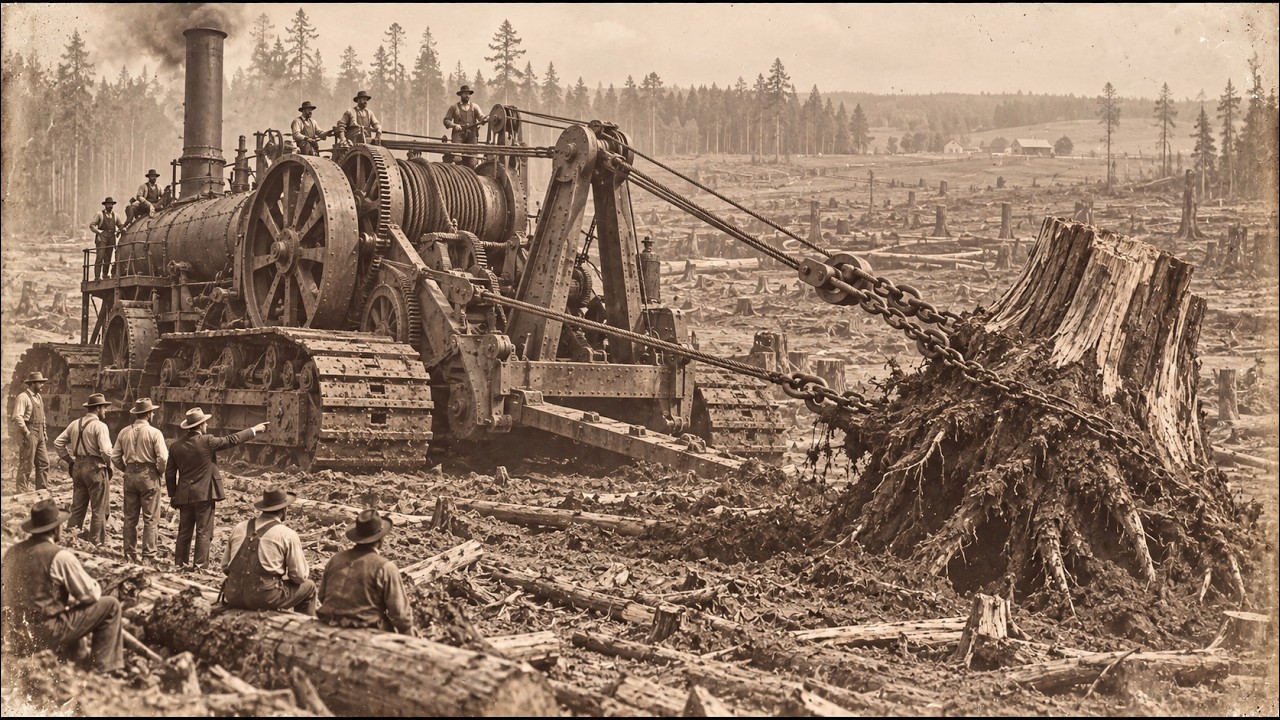
For a long moment, the whole rig sat there, storing force like a wound spring, while the ground stayed silent. Then a root tore loose somewhere underground, with a sound like a dry board breaking. Another root followed. The stump shifted a fraction of an inch, and that tiny movement changed everything.
More roots snapped. The soil cracked around the base and began to lift. Then the whole mass rolled upward, dragging a surprising amount of earth with it, and a field in northern Wisconsin was one stump closer to being a farm. That moment is the reason old stump-pulling photographs look impossible.
The machine in the picture is small, maybe no bigger than a wagon, often made of timber and iron and rope. But the thing coming out of the ground is enormous, a black, ragged mass wider than a wagon, still tangled in roots that had spent decades or centuries holding a tree in place. The people standing beside it look tired. The work is not finished.
They have to clear the dirt, burn or haul the stump away, fill the hole, and then move twenty feet and start over. After the logging crews left the cutover country, the land did not become a farm. It became a field of stumps. The trees were gone, the sky was open, and a farmhouse might stand in the distance, but between the house and anything that looked like a field sat hundreds of black obstacles, each one locked to the earth by its root system.
The lumber industry had solved the first problem. It knew how to cut the forest down. The people who came after it inherited the second problem: how to turn the remains of that forest into ground a plow could cross. For thousands of families, that problem was measured one stump at a time.
The United States Forest Service later described what happened across the lake states after the logging boom. By the late nineteenth century, huge areas of pine had been cut. Land companies and others tried to settle the cutover acres as farms, but pine stumps did not simply disappear. They had to be grubbed or blasted out, the Forest Service noted, and much of the sandy cutover soil turned out to be poorer farm ground than the promoters had promised.
That meant a settler’s first crop was often not wheat, oats, or potatoes. It was stumps. A fresh stump is a remarkable piece of structure. The trunk may be gone, but the base is still a bundle of wood locked into soil by roots spreading outward and downward.
The larger the tree had been, the more soil the root system had gripped. A man with an axe could cut roots. A team of horses could pull. Fire could weaken the wood.
Explosives could break it apart. But none of those methods made the job easy when an entire farm looked the same way. So Americans built an entire family of machines nobody remembers today. Stump pullers, grubbers, capstands, winches, frames, chains, levers, and tractor rigs, all designed around one task: multiply human or animal force until the ground gave up the stump.
Some were simple. Some were ingenious. Some looked like farm equipment. Others looked like improvised siege engines.
Their shared principle was mechanical advantage. A farmer might not have an engine powerful enough to yank a large stump straight out of the earth, but he could use pulleys, gears, drums, screws, chains, and long levers to trade speed for force. Pull slowly enough through enough mechanical advantage, and a horse, a hand crank, or a small engine could apply a tremendous load. The trick was getting that force into the stump without breaking everything else first.
Chains were wrapped around roots or the stump itself. Anchors were set against another stump, a buried dead man, or a heavy frame. A cable or chain ran through the pulling mechanism. Then the operator began to take up the slack.
At first, nothing happened. The machine loaded itself like a spring. Chains tightened. Timber frames flexed.
Roots began taking tension. Dirt cracked. Then one root tore loose, followed by another. The stump shifted, the geometry changed, more roots broke, and the whole mass lifted out of the earth.
Wisconsin’s historical collections preserve the evidence of how common this work became. One photograph from 1895 shows men clearing stumps with a stump machine on a farm near Medford. Another image from the early twentieth century shows a group using a homemade stump piler in northern Wisconsin. A 1925 International Harvester photograph shows a farmer using a McCormick-Deering tractor and chain to remove a stump from cutover farmland.
Together, those images cover a major transition. At first, land clearing depended heavily on human labor, horses, and dedicated mechanical pullers. Then the farm tractor began taking over the role of the power source. The tractor did not eliminate the basic physics.
It simply replaced some of the muscle. Early tractors were not bulldozers. They had wheels, relatively modest power, and limited traction compared with later crawler machines. Pulling a stump directly could still spin the wheels, break chains, or drag the tractor toward the stump instead of the stump toward the tractor.
Operators learned to use low gearing, anchors, pulleys, and careful chain placement to make the available power count. That is why old land-clearing work often looks improvised. There was rarely one perfect machine for the whole farm. A farmer might burn around one stump, dig roots around another, blast a third, and use a puller on the fourth.
The method depended on tree species, soil, stump age, equipment available, and how much time the family could spend on the job. Some stumps were left for years. That sounds lazy until you understand the economics. If a stump was not directly blocking a building, road, or first planting area, leaving it to decay could be rational.
Every hour spent fighting one stump was an hour not spent building a fence, repairing equipment, tending livestock, planting cleared ground, or earning cash somewhere else. Settlers cleared land in stages. The first goal was often enough open ground to survive. Then the clean field expanded over time.
That makes the old photographs of half-cleared farms easier to read. A modern viewer sees unfinished work. The family who lived there saw progress. The stump machines accelerated that progress.
One of the cleverest forms used a tall frame or tripod above the stump. By lifting upward instead of pulling only sideways, the machine could attack the root system more directly. Other pullers used large wheels or drums to wind chain. Some machines were moved from stump to stump.
Some used a neighboring stump as the anchor, turning yesterday’s obstacle into today’s tool. That last detail captures the practical intelligence behind the work. When you have very little equipment, you use the landscape itself as part of the machine. A strong standing stump can anchor a puller.
A log can become a lever. A tree can redirect a cable. A hole dug around one root can weaken the whole system. A little fire can reduce the wood that must be broken.
Mechanical land clearing was often less about raw horsepower than about arranging forces intelligently. The danger was real. Chains under extreme load can fail violently. Cables can snap.
Anchors can shift. A stump can roll. A tractor can rear or slide. Dynamite adds an obvious set of hazards.
Heavy wood and dirt do not always move in the direction the operator expects. The people doing this work often learned by experience because there was no professional land-clearing crew coming to every remote homestead. That experience had value. Some operators became specialists.
A man with a good stump-pulling outfit could hire himself out to neighbors. A machine too expensive for one family might serve several farms. The same pattern happened with threshing machines, sawmills, and other costly rural equipment. Ownership and use did not always belong to the same person.
The stump puller therefore became part of a broader shift in American agriculture, replacing individual muscle with shared mechanical power. But there was an uncomfortable truth beneath the machinery. Some of the land being cleared should never have been sold as prime farmland in the first place. Wisconsin historical research on the cutover region is blunt about this.
Land promoters marketed logged-over northern acreage to settlers in the United States and Europe. Advertising often exaggerated the quality of the soil and the ease of building a farm. The Wisconsin Department of Natural Resources notes that many northern farms later failed because of poor soils and short growing seasons. Imagine arriving after spending your savings on land and discovering that before you can even test whether the soil is good enough, you have to remove the remains of the forest that was there before you.
That changes the emotional meaning of the stump puller. It was not just a clever machine. For some families, it was part of a desperate attempt to make the land match the advertisement. The sequence was brutal.
First, the timber company took the valuable trees. Then, the land company sold the cutover ground. Then, the settler paid again in labor to remove the stumps. Only after that could the soil begin proving whether the farm was viable.
If the land turned out poor, all that clearing did not come back. That is why the story of stump removal cannot be separated from the history of settlement and logging. The machines existed because the logging industry had transformed the land at enormous scale. Before commercial cutting, a northern forest was difficult to farm because it was full of trees.
After commercial cutting, it could be even stranger. The valuable trunks were gone, but the root systems, slash, brush, and stumps remained. The land had been opened visually without being opened mechanically. A plow cannot negotiate a stump field.
A mowing machine cannot work cleanly through it. A wagon route becomes awkward. Fences are harder to build. Buildings need clear sites.
The stump was therefore more than an inconvenience. It blocked the conversion of forest land into agricultural geometry. Machines changed that geometry. As tractors became stronger, the methods changed.
International Harvester photographs from the 1920s show tractors being used directly in land clearing. By then, the power source could move around the farm under its own power and then return to plowing, belt work, hauling, or other jobs. That versatility was a major advantage over a dedicated hand-operated stump machine. Then crawlers changed the problem again.
A tracked tractor spreads its weight, develops high tractive effort at low speed, and can work on softer or rougher ground than many wheeled machines. Add a blade, and the machine can push, dig, pry, and pile instead of only pull. This was the beginning of the modern land-clearing era. The operator could use the blade to cut roots, push dirt away from the base, lean against the stump, and work it loose.
Large crawler tractors eventually turned stump removal from a specialized extraction problem into one part of general earthmoving. The stump puller did not disappear instantly. Cheap equipment survives because it is cheap. Small farms continued using older methods long after contractors had access to better machinery.
But the direction was clear. More horsepower and better traction reduced the need for elaborate leverage systems. The same evolution happened with explosives. Blasting had been useful because it put a huge amount of energy into the stump quickly, but it required skill, carried risk, and left broken material that still had to be handled.
Once powerful earthmoving equipment became available, a machine could often do the work more predictably and then immediately move the debris. That matters because land clearing is not finished when the stump leaves the hole. Now you have a giant stump somewhere else. It must be burned, hauled, piled, buried, or otherwise removed from the field.
Roots hold soil. Dirt clings to the wood. A stump can be too heavy for ordinary wagons. If it is piled for burning, the dirt can slow combustion.
If it is dragged to the edge of the property, it can tear the ground on the way. This is why some historical images show stump piles as large as buildings. The machine that extracts the stump solves only half the problem. The rest is materials handling.
That is also why the evolution toward bulldozers and loaders mattered so much. A machine that could dig, push, carry, and pile reduced the number of separate operations. By the middle of the twentieth century, land-clearing contractors increasingly had equipment that would have looked extraordinary to a settler working with horses only a generation earlier: crawler tractors, cable dozers, hydraulic loaders, excavators, root rakes, winches. The job did not become easy, but it became industrial, and that changed the scale of what America could clear.
Road construction crews could open rights of way faster. Reservoir projects could clear future shorelines. Suburban development could remove orchards and woods. Mining companies could strip vegetation before earthmoving.
Farmers could reclaim brush and timbered ground with hired equipment instead of spending years clearing a few acres at a time. The giant modern excavator gripping a stump with a hydraulic thumb is the descendant of the hand-cranked stump puller. The physics are the same. Break the roots, apply leverage, control the mass, move it somewhere else.
Only the amount of available force changed. That continuity is what makes the old stump machines interesting. They show the same problem before abundant horsepower made the solution look obvious. A farmer in 1895 could not order a forty-ton excavator.
He had wood, chain, iron, horses, hand tools, and perhaps a mechanical puller. So he created force by arrangement. That is one of the oldest patterns in machinery. When power is scarce, engineering multiplies it.
Pulleys trade distance for force. Gears trade speed for torque. Long levers trade motion for lifting power. A capstan lets a relatively small input create a large pull.
A screw turns rotation into slow linear force. The stump puller is almost a museum of basic mechanics applied to dirty work. And because the work was dirty, the machines had to be simple. A mechanism used in a muddy stump field could not depend on delicate alignment.
Chains dragged through soil. Frames sat on uneven ground. Horses shifted. Anchors moved.
Wood splintered. The best equipment was strong, understandable, and repairable with the tools already on the farm. That is why so many designs look crude but intelligent. They were built for failure to be visible.
If a chain link stretched, you could see it. If a timber cracked, you could replace it. If a gear tooth broke, the machine stopped for an obvious reason. The system might be dangerous, but it was not mysterious.
This mechanical transparency gave farmers room to improvise. A homemade stump piler in a Wisconsin photograph may not have carried a famous brand, but it represents the same engineering culture as factory-built pullers. Rural America built equipment when the catalog did not have exactly what the job required. That tradition would later produce homemade log splitters, tractor attachments, loaders, saw rigs, and countless other machines assembled from whatever was available.
The stump field encouraged invention because the alternative was to keep working by hand. Species mattered too. Soft, decayed hardwood stumps and hard, resinous pine stumps did not behave the same way underground. The Forest Service specifically noted that pine stumps in cutover regions did not rot quickly enough to disappear on the farmer’s timetable.
A family could not simply wait one season and expect the field to become plowable. The roots remained strong, and the exposed wood could stand for years. That forced a decision: work around the stump or spend energy removing it. Working around it was possible in the beginning.
A farmer could plant between stumps, graze animals, cut hay where there was room, or use cleared strips first. Historical photographs show implements weaving through partially cleared fields because that was the practical compromise. But every remaining stump reduced efficiency. A horse-drawn mower needed room to turn.
A plow needed a clean line. A wagon needed predictable ground. A mechanical binder or harvester became harder to use when the field was full of immovable obstacles. The more agriculture itself became mechanized, the less acceptable the stump became.
That created an interesting feedback loop. Better farm machinery increased the pressure to clear the field completely. A family might tolerate stumps while farming by hand. Once it owned a tractor, mower, or other powered implement, every stump threatened expensive equipment.
The machine designed to make farming faster therefore increased the value of another machine designed to remove the obstacles. This is why the stump-pulling era overlaps so neatly with the rise of the farm tractor. The tractor did not merely replace horses as a source of pulling force. It changed the standard of what a field was supposed to look like.
A field prepared for mechanized agriculture needed to be straighter, smoother, and more open. Stump removal became part of creating that geometry. The old advertisements for stump pullers often sold more than force. They sold time.
That was the real scarce resource on a new farm. A family arriving on cutover land had to build shelter, establish water, fence livestock, clear roads, plant food, repair tools, and somehow earn enough cash to buy what the farm could not produce. If stump removal consumed entire weeks of labor, everything else slowed down. A machine that could remove the same obstacle in hours instead of days had value far beyond the stump itself.
That is why mechanical advantage mattered so much even before engines became common. Consider a simple capstan or drum puller. The operator does not need to overpower the stump in one violent motion. The machine winds in chain a little at a time.
Gearing reduces speed and multiplies torque. Each turn stores more tension in the system until the roots begin to fail. That slow pull can be more useful than a sharp jerk. A sudden pull wastes energy in wheel slip, animal movement, or shock loading.
A steady mechanical pull keeps pressure on the root system long enough for soil and wood to give way. The process also teaches the operator where the resistance is coming from. If the stump tips but does not release, one major root is still holding. Dig there, cut there, reattach the chain, pull from a different direction.
The machine becomes part of a sequence rather than a one-step solution. This is a pattern that repeats throughout old heavy work. The best machine is not always the one that replaces every human action. Sometimes it is the one that removes the single impossible part of the job.
A stump puller did not clear brush. It did not fill holes. It did not burn debris. It did not grade the field.
It handled the moment when the root system had to lose. Everything before and after still belonged to people, horses, and other tools. That division of labor explains why the machines could remain mechanically simple and still transform productivity. The same logic later made winches so valuable on crawler tractors.
A winch does not make a tractor into an excavator, but it gives the operator a way to apply controlled pulling force from a stable platform. In logging and land clearing, that can solve problems the blade cannot solve alone. By the 1920s and 1930s, tractors were increasingly photographed doing work that had once required specialized pullers. International Harvester’s archival images are especially useful because they show the transition in ordinary farm settings rather than in demonstrations built only for publicity.
A tractor chained to a stump is not elegant, but it is historically important. It shows general-purpose engine power absorbing a job category. This is how many specialized machines disappear. First, a dedicated tool solves the problem better than anything else available.
Then, a more versatile machine becomes powerful enough to solve the same problem while also doing ten other jobs. The dedicated tool survives only where it remains cheaper or more convenient. The stump puller followed that path. The bulldozer accelerated it.
A crawler tractor with a blade could approach the stump from the side, dig around it, cut smaller roots, push high on the trunk remnant to create leverage, and then move the extracted mass without changing machines. As blades became stronger and hydraulic control improved, the operator gained much finer control over where force went. The hydraulic excavator would eventually go further. An excavator can dig beneath roots, curl a bucket around the base, pry upward, rotate the stump, and carry it clear.
The operator can work around the stump in a circle without repositioning the entire machine. Add a thumb or grapple, and the machine can handle the extracted stump directly. That is such an effective solution that it makes the old puller seem unnecessary. But that is the wrong comparison.
The old machine should be compared with the alternatives available to the farmer who used it. Against an axe, shovel, horse team, and fire, the stump puller was a major increase in capability. Against waiting years for decay, it was immediate. Against blasting every stump, it could be reused without buying more explosive for each hole.
Against leaving the land rough, it opened the door to mechanized farming. That is why the machine deserves more than a footnote. It sat at the exact point where mechanical force began replacing the slow biological process of decay. Instead of waiting for weather and rot to return the roots to the soil, Americans built machines that tore the roots out on schedule.
The scale of that ambition becomes clearer when you look at settlement campaigns in the cutover country. Promoters did not advertise one cleared acre. They imagined whole regions becoming agricultural. Railroads and land companies had economic reasons to fill former timber territory with permanent residents.
Farmers would buy land, ship produce, purchase manufactured goods, pay taxes, and create towns. The stump field stood directly in the way of that vision. So land clearing became more than a private farm chore. It became part of regional development policy.
County fairs, agricultural demonstrations, equipment dealers, and extension work all helped spread techniques for converting cutover land. Better clearing methods could be promoted as evidence that the northern farm frontier was practical. The reality was mixed. Some land became productive.
Some never justified the effort. That is the uncomfortable lesson underneath the machinery. Engineering can solve the physical problem perfectly and still fail to solve the economic problem. A stump puller can remove the stump.
It cannot improve poor soil. It cannot lengthen the growing season. It cannot guarantee a market for the crop. It cannot make a marginal farm profitable.
The machine therefore became part of both success stories and failures. In one place, clearing opened productive ground that supported a family for generations. In another, the same labor produced a farm that was later abandoned. The iron did not know the difference.
Eventually, the land itself delivered the final verdict. Some cleared farms prospered. Others did not. Northern cutover regions in Wisconsin and elsewhere discovered that removing the trees and stumps did not automatically create good agricultural soil.
Many farms failed. In some places, abandoned or marginal farmland eventually returned to forest. That reversal gives the story a strange ending. Families spent years removing trees from land that later grew trees again.
The stump puller was therefore part of a temporary historical moment when Americans believed enormous stretches of logged forest should become farms. In the best locations, the machines helped make that transition possible. In the worst locations, they helped reveal the mistake faster. Either way, they changed the ground.
That is why the phrase “turn forests into farmland” should not be heard as a simple triumph. The transformation required labor, money, dangerous machinery, and assumptions about land use that were sometimes wrong. The machine itself remains impressive because the physical problem was real even when the economic plan was not. Stand beside a mature stump and imagine removing it without a hydraulic excavator.
Cut every major root you can reach. Dig in wet soil. Wrap chain. Build an anchor.
Take up the load. Listen to the wood crack underground. Reset the chain. Pull again.
Clear the dirt. Burn or haul the mass. Fill the hole. Move ten feet and start over.
Then look across forty acres. That is the scale the old photographs hide. One extracted stump is a mechanical victory. A cleared farm is thousands of repetitions.
The machines became important because they turned those repetitions from impossible into merely exhausting. By the time tractors and bulldozers took over, the dedicated stump puller had already done its historical job. It had occupied the gap between the axe and the earth mover. It belonged to the period when America had already learned to cut forests industrially but had not yet learned to clear the remains with industrial earthmoving equipment.
That gap lasted long enough to produce a whole lost category of machines. Today, most people will never see one working. A stump is removed by an excavator, grinder, dozer, or specialized attachment. The operator sits behind hydraulic controls and applies more force with one hand than a farmer once created with an entire arrangement of horses, chains, pulleys, and frames.
That makes the old equipment look primitive. It was not primitive to the people using it. It was leverage turned into survival. The old stump-field photographs carry that weight.
They are not simply before-and-after images of progress. They capture a moment of uncertainty. A family has invested in the land. The trees are gone.
The stumps remain. The farm might work. It might not. Before the answer arrives, the roots have to come out.
And so the machine goes to work. Chain tightens. The frame takes load. Horses lean forward or a tractor digs in.
Soil cracks around the base. A root snaps underground. The stump rises. Then the machine is moved twenty feet, and the entire process begins again.
That repetition is the real scale of the story. Not one giant machine performing one spectacular feat, but thousands of modest machines and improvised rigs slowly converting rough cutover ground into straight lines that other machines could finally use. That is how much of industrial America was built: one obstruction at a time, using just enough mechanical advantage to make the next piece of work possible.
