January 7th, 1945. A crowded press room in Belgium. Flashbulbs pop like artillery fire as Field Marshal Bernard Montgomery steps to the microphone. In nine minutes, he will commit professional suicide.
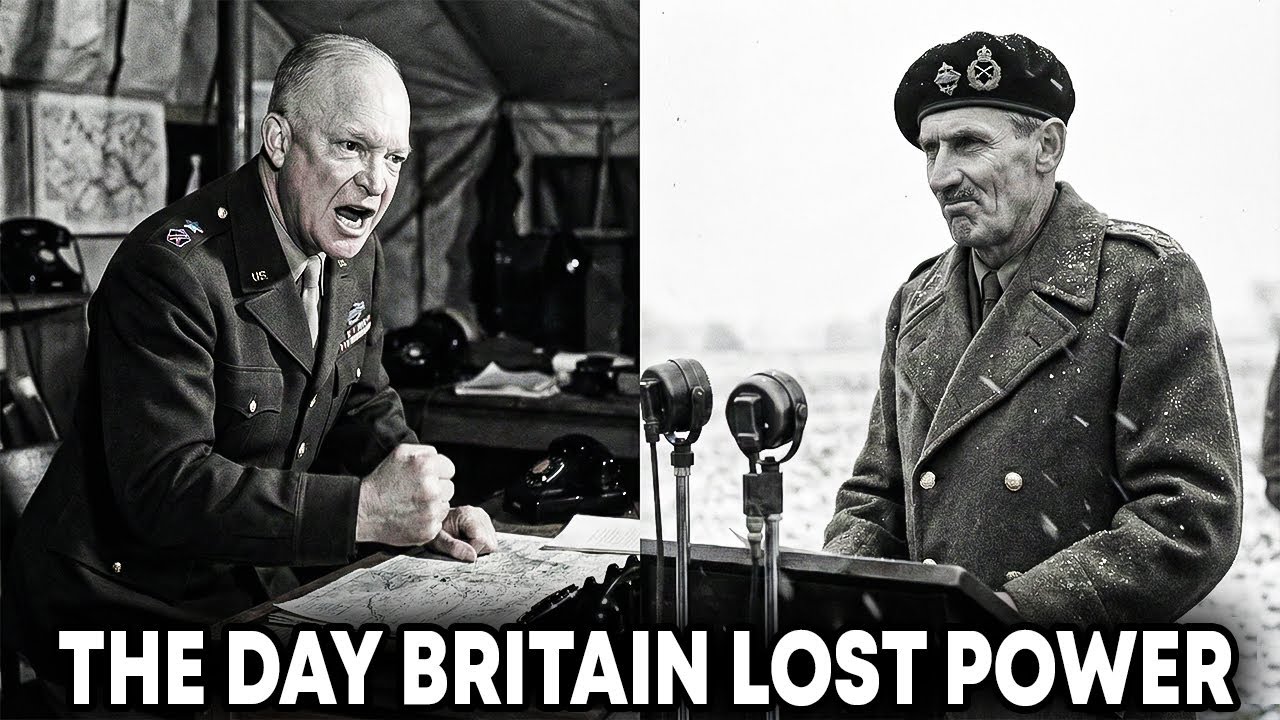
In nine minutes, he will force the Supreme Allied Commander to draft six words that will change history: It’s either him or me. This is not a story about victory. This is a story about the moment an empire died—not on a battlefield, but in a press conference. This is the story of how one man’s ego nearly destroyed the alliance that was winning the war, and how a secret ultimatum shifted the balance of world power forever.
This is the story of Montgomery’s last stand. December 16th, 1944. The Ardennes forest explodes. Hitler has thrown his final dice: 250,000 German troops and 1,400 tanks smash through American lines in what history will call the Battle of the Bulge.
It is the largest and bloodiest battle American forces will fight in World War II. Chaos. Carnage. American units are scattered across frozen hills, communications severed, entire divisions cut off behind enemy lines.
For a terrifying moment, it looks like the whole western front might collapse. The weather is brutal. Thick fog blankets the battlefield, grounding Allied air power. German panzers push deeper into American territory, creating a massive bulge in the Allied lines—50 miles wide, 60 miles deep.
Young American soldiers, many barely out of training, dig frozen foxholes and hold against veteran SS divisions. Eisenhower makes a battlefield decision. He splits the American front, giving Montgomery temporary command of all forces north of the German penetration. It is purely practical.
Montgomery’s headquarters are closer. His communications network is intact. His forces can respond faster. Montgomery will coordinate with General Omar Bradley’s forces south of the bulge to pinch off the German advance.
It is supposed to be temporary—a tactical necessity born of crisis, a practical response to a communications nightmare. But Montgomery sees something else entirely. He sees vindication. He sees destiny.
He sees proof that he has been right all along. To understand what happens next, you need to understand what has been building beneath the surface for months. Montgomery and Eisenhower: British Empire and American Republic. Two men, two nations, two fundamentally different visions of how to end this war.
Montgomery is a British hero. The man who broke Rommel at El Alamein, who turned the tide in North Africa, who led the ground assault on D-Day. He is meticulous, cautious, brilliant. He plans battles like chess matches, moving pieces with mathematical precision.
His soldiers worship him. The British public adores him. He is knighted, celebrated, untouchable. He is also insufferably arrogant—convinced of his own genius, contemptuous of American military capability.
In his mind, the Americans are wealthy amateurs playing at war with unlimited resources but limited understanding. He believes they lack the professional military tradition of Britain, the centuries of imperial warfare that forged the British officer class. They have enthusiasm and equipment, but not expertise. And he is the professional who needs to save them from their own inexperience.
Eisenhower is the opposite. A diplomat in uniform, a coalition builder, a man whose greatest skill is not tactical brilliance but keeping fractious allies pointed in the same direction. He has managed to forge French, British, Canadian, Polish, and American forces into something resembling a unified command. It is like herding cats—except the cats all speak different languages, harbor centuries of mutual resentment, and control armies.
He is not the most brilliant tactical mind, and he knows it. Patton is more aggressive, Montgomery more methodical, Bradley more dependable. But Eisenhower understands something Montgomery fundamentally does not: this is not just a military campaign. It is a political balancing act.
The alliance is as fragile as it is powerful. And Montgomery keeps pushing against it. Every strategic meeting becomes a lecture, with Montgomery explaining why his proposed single thrust into Germany is superior to Eisenhower’s broad-front strategy. Every disagreement becomes a platform for Montgomery to demonstrate his strategic genius and Eisenhower’s supposed mediocrity.
He goes around Eisenhower directly to Churchill. He lobbies with British chiefs of staff. He sends memos that read less like military communications and more like interventions staged by concerned professionals. He treats the Supreme Commander not as his superior, but as an obstacle to overcome—a well-meaning amateur who somehow ended up in charge of professionals.
By January 1945, Eisenhower’s patience is hanging by a thread. And Montgomery is about to cut it. January 7th, 1945. The press conference that changes everything.
Montgomery stands before the assembled journalists—British reporters, American correspondents, wire service photographers. The Battle of the Bulge is essentially over. German forces are in retreat. Allied lines have been restored.
It has been costly—nearly 90,000 American casualties—but it has been a defensive victory. Hitler’s last gamble has failed. And Montgomery is about to turn that victory into a political disaster. He begins well enough, praising the American soldier.
He calls them brave, resilient, magnificent fighters. But there is something in his tone. It is patronizing. Like a headmaster praising students who finally passed a difficult examination.
Like a coach commending a team that overcame its obvious limitations. Then he pivots to the battle itself. He describes how British forces under his command saw the situation being handled with “ragged efficiency. ”
Let that phrase sink in.
He is describing American command during the largest battle they have ever fought as raggedly efficient—barely adequate, chaotic, but survivable. He explains how he took control, how he tidied up the situation, how he implemented proper defensive measures. He uses phrases like, “I sorted out the battlefield and I employed British troops to plug gaps. ” Each sentence is technically accurate but collectively devastating in its implication.
Then comes the knife. He takes credit. Not partial credit, not shared credit. He positions himself as the savior of the American army—the man who rode in like a professional firefighter to rescue amateur homeowners from a blaze of their own making.
He does not explicitly say, “The Americans failed and I saved them. ” Montgomery is far too clever for such crude language. But he does not need to. The implication hangs in the room like cordite smoke.
Every reporter hears it. Every press outlet understands it. Every headline will write itself. He concludes by magnanimously praising Eisenhower’s great courage in asking for British help.
Courage. As if asking Montgomery to coordinate northern forces was an act of brave humility rather than a tactical necessity. The British press eats it up. The British public, exhausted by years of war and hungry for heroes, celebrates their field marshal’s brilliance.
Montgomery the Magnificent saves the Americans again. The American press goes nuclear. Headlines scream betrayal across the United States. Editorial pages burn with fury.
Radio commentators demand Montgomery’s removal. American soldiers who froze in foxholes, who held Bastogne against impossible odds, who died in snow-covered forests—they read Montgomery’s words and feel their sacrifice stolen, their competence questioned, their valor diminished. Congressmen who have been skeptical of the alliance suddenly have ammunition. Isolationists who warned against European entanglements feel vindicated.
The political fallout is immediate and catastrophic. But the real explosion happens in private—in Eisenhower’s headquarters in the days following the press conference. The Supreme Commander receives cables from Washington. Political leaders are furious.
Military chiefs are demanding action. The American public is outraged. But more importantly, Eisenhower himself has reached his breaking point. This is not the first time.
It is not even the tenth time. It is the culmination of months of Montgomery’s casual disrespect, his strategic lobbying, his barely concealed contempt for American military leadership. It is every memo that questioned Eisenhower’s competence. Every meeting where Montgomery lectured rather than collaborated.
Every end-run around the chain of command. Eisenhower sits down and drafts a cable to the Combined Chiefs of Staff in Washington and London. The language is stark, professional, final. He cannot continue in command if Montgomery remains.
The alliance, he writes, cannot function with this level of division and disrespect. The command structure cannot survive this corrosion of trust and unity. A choice must be made. It’s him or me.
Think about what this means. Eisenhower is not throwing a tantrum. He is not making an empty threat. He is forcing the political leadership of both nations to make an impossible choice.
Keep your supreme commander, or keep your field marshal. Keep the man managing the entire western front, or keep the man commanding one army group. This is the nuclear option. This is a five-star general telling presidents and prime ministers that the alliance itself is at stake.
And everyone with any political sense knows what choice will be made. Montgomery commands the 21st Army Group—British and Canadian forces in northwest Europe. He is important, celebrated, beloved by his troops. But Eisenhower commands the coalition.
He manages Americans, British, Canadians, French, Poles—the entire intricate political machinery of the Western alliance. He is the face of Allied unity, the symbol of Anglo-American cooperation, the man Roosevelt and Churchill personally selected to lead the liberation of Europe. Montgomery can be replaced. Eisenhower cannot.
The political machinery grinds into motion with terrifying speed. Churchill is horrified—not just at the diplomatic crisis, but at what it represents. Britain desperately needs American support, American resources, American manpower. The empire is exhausted, financially shattered, bleeding from six years of total war.
Britain cannot afford to alienate the United States over one general’s ego. British Chief of the Imperial General Staff Alan Brooke—Montgomery’s friend, patron, and protector—is frantic. He pulls Montgomery aside for what must have been an excruciating conversation. They explain in terms even Montgomery’s towering ego can understand: You’re about to be fired.
You’re about to disgrace yourself. And you’re taking Britain’s credibility with you. This is the moment. This is when the British Empire—exhausted by two world wars, economically shattered, militarily dependent on American industrial might—confronts a simple reality.
They are no longer the dominant partner in this alliance. Britain won the war. But America will define the peace. The age of British supremacy is over.
The American century has begun. And it is happening not in a treaty conference or a grand political summit, but in the desperate backrooms of military headquarters because a field marshal could not control his arrogance. What happens next is almost painful to watch. Montgomery—the proud warrior, the hero of El Alamein, the victor of Normandy, the man who has never admitted a mistake in his entire career—writes a letter to Eisenhower.
Not a clarification of his press conference comments. Not a strategic reassessment. Not a political repositioning. An apology.
He grovels. The word is not too strong. He praises Eisenhower’s leadership in effusive terms. He pledges absolute loyalty.
He promises cooperation. He practically begs to keep his command. The letter is a humiliation for a man who has built his entire identity on professional superiority. It is degrading.
It is necessary. And it works. Eisenhower, ever the diplomat, accepts the apology. He is not interested in humiliating Montgomery further or creating a bigger crisis.
He needs unity, not vengeance. The ultimatum is quietly withdrawn. The political crisis passes. The alliance holds.
But something fundamental has changed. Something that can never be reversed. From this moment forward, there is no question about who is in charge of the Western alliance. British generals will continue to lead British troops with distinction.
British strategy will continue to influence Allied planning. But American strategic vision will dominate. When conflicts arise, American preferences will prevail. When resources are allocated, American priorities will determine distribution.
The special relationship between Britain and America continues—strengthens, even—but the roles have permanently shifted. Britain is the junior partner. That is not anti-British propaganda. That is not American triumphalism.
That is not revisionist history written by the victors. That is the reality negotiated in the tense days after Montgomery’s catastrophic press conference, codified in an apology letter from a field marshal to a general. Five months later, the war in Europe ends. Montgomery takes the German surrender at Lüneburg Heath on May 4th, 1945.
It is a moment of triumph—German officers surrendering to the field marshal who broke them at El Alamein, who hounded them across North Africa, who led the assault on Fortress Europe. He will go on to serve with distinction in post-war positions. He will become Chief of the Imperial General Staff, Deputy Supreme Commander of NATO. He will be celebrated, honored, elevated to Viscount Montgomery of Alamein.
History will remember him as one of Britain’s greatest generals. But he will never again wield the influence he had before that January press conference. He will never again be able to challenge American strategic dominance. He will never again lobby to replace Eisenhower or redirect Allied strategy according to British preferences.
The Battle of the Bulge was the last great German offensive. It failed spectacularly. The Allies won. Hitler’s final gamble collapsed.
The road to Berlin opened. But in the smoke and chaos and political fury surrounding that victory, a different kind of battle was being decided—a battle over leadership, over primacy, over whose vision would shape the post-war world, over which nation would emerge from the carnage as the dominant Western power. Montgomery thought he was claiming credit for a military victory, cementing his reputation as the savior of the American army. Instead, he presided over the end of British strategic independence and global dominance.
The old empire bowed to the new republic not in a formal treaty hall, not in a grand ceremonial surrender, but in a forced apology from a humiliated field marshal to an American general who had finally had enough. That is how power shifts in the real world. Not with dramatic pronouncements or signed documents. Not with a bang, but with a press conference gone catastrophically wrong.
Not with armies, but with words that revealed too much pride and too little awareness. The British Empire did not fall at Yorktown or Singapore. It ended in Belgium in January 1945, when Montgomery’s ego finally wrote a check his nation could no longer cash.
