In the summer of 2018, Dr. Rebecca Torres sat in the dimly lit archive of Harvard University’s Widener Library, surrounded by boxes of deteriorating photographs from the turn of the century. An expert on American immigration and labor movements, she had spent countless hours studying images of working families, hoping to recover the forgotten stories of those who had built the nation from the shadows. That afternoon, she carefully pulled a fragile photograph from a manila envelope marked “Boston Railway Station Collection 1900–1905.
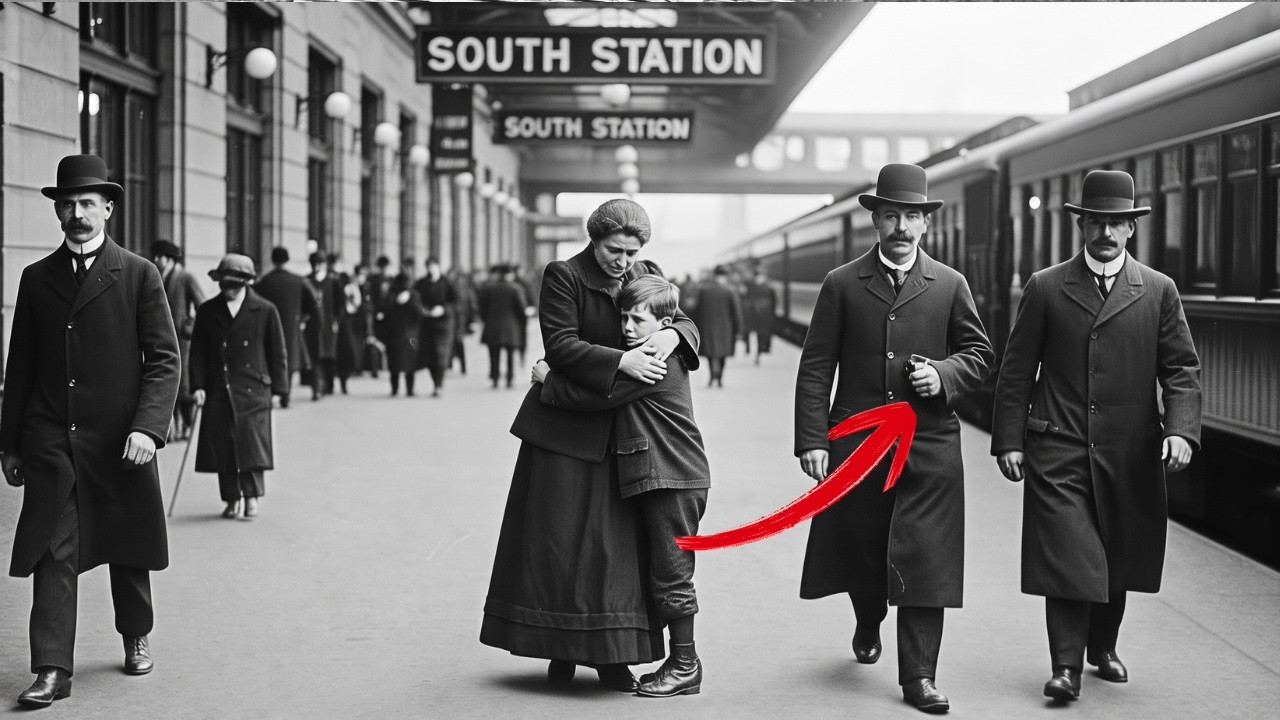
” It showed a woman in dark, worn clothing embracing a boy of about eight, possibly on a train platform. Her face was turned downward, her expression hidden, but her posture carried immense sorrow. The boy stared directly at the camera with empty, tired eyes that seemed far older than his small frame. Rebecca had seen hundreds of such photographs—immigrants, laborers, families broken by circumstance.
But something in this one held her attention. It was ordinary, almost unremarkable, yet the captured moment had a weight that went beyond the faded sepia tones. She noted it for the university’s ongoing digitization project, which used high-resolution imaging to reveal details invisible to the naked eye. Three weeks later, she received an email from the digitization team with the subject line “Unusual finding in item Nator 1847.
” Curious, she opened the message and downloaded the scanned file. As the image loaded on the screen, she leaned forward. The clarity was extraordinary. She could see the threads of the woman’s dress, the grain of the wooden platform, the worn leather of the boy’s boots.
But something else caught her breath. In the boy’s small hand, pressed into the folds of his mother’s dress and almost invisible in the original, was an object she had not noticed before. She zoomed in, her pulse quickening. It was a small metal disc, reflecting light in the enhanced image.
A medal of some kind. This was no ordinary family portrait. Rebecca immediately contacted her colleague Dr. James Mitchell, a military historian specializing in American conflicts of the late nineteenth and early twentieth centuries.
Within an hour, he stood beside her desk, studying the enlarged image with focused intensity. James adjusted the contrast and sharpness settings using specialized software designed for historical image restoration. With each adjustment, the metallic object became clearer, revealing faint engraved details. “It’s a military medal,” he said at last, his voice calm but certain.
“The shape, the place for the ribbon. I think it’s from the Spanish-American War era, 1898 or 1899. ” Rebecca felt a chill run down her spine. The photograph was dated 1900, just two years after the war that established America as a world power.
But why would a small boy be clutching a military medal hidden in his mother’s dress? And why did the mother look so devastated? James shook his head slowly. He could not identify the specific medal with certainty, but its size and form matched campaign medals given to soldiers serving in Cuba or the Philippines.
“We need to find out who these people were,” he said. “If this boy is holding his father’s medal, and his mother is clearly in mourning, we might be looking at a widow and an orphan. ” The Spanish-American War had sent thousands of men into combat. Though American casualties were relatively low compared to other conflicts, many soldiers died not only in battle but from disease—yellow fever and malaria in particular.
The war was short but brutal, and its aftermath destroyed countless families. The photograph had been taken at a Boston railway station. The archive’s original notes were incomplete: “Mother and child, platform seven, morning departure. ” No names, no destination, nothing else.
James pulled up a chair, determined. “Then we start with the station,” he said. Boston had several major railway terminals in 1900. They would need to identify which one, check passenger records if they still existed, and cross-reference military discharge papers and war casualty lists.
Rebecca nodded, feeling the familiar excitement of uncovering a historical mystery. But this was not just a theoretical puzzle. This was a story of real people, real grief, and a secret hidden in plain sight for over a century. Over the next two weeks, Rebecca and James worked tirelessly.
Rebecca focused on identifying the station and searching immigration and passenger records while James dove into military archives, looking for Irish immigrant soldiers who had served in the Spanish-American War and died or gone missing shortly after. The work was painstaking and often frustrating. Many records from that era had been lost to fire, flood, or neglect. Immigration documents were incomplete, and military record-keeping, especially for immigrant soldiers, was inconsistent and sometimes deliberately negligent.
Rebecca began with the photograph itself, examining every visible detail for clues. The architectural elements in the background—the iron support beams, the distinctive roof structure, the platform numbering—eventually led her to identify South Station, which had opened in Boston in 1899. It was one of New England’s busiest railway terminals, serving thousands of passengers daily, many of them immigrants traveling between cities in search of work. She gained access to South Station’s historical archives, preserved at the Massachusetts Historical Society.
After days of digging through fragile ledger books and passenger logs, she found a note from September 14, 1900: Platform 7, morning departure to Providence, Hartford, and New York. But no passenger names were listed for that specific date. The records were kept primarily for maintenance and operational purposes, not for detailed tracking of travelers. Meanwhile, James made slow but steady progress through military records.
He gained access to Spanish-American War service records at the National Archives, focusing on soldiers of Irish descent who had enlisted from Massachusetts. The lists were long. Immigration and military service often went hand in hand, as young men saw the army as a path to acceptance and citizenship. One afternoon, James called Rebecca from the National Archives reading room in Washington.
His voice carried a mix of excitement and unease. He had found that forty-seven Irish-born soldiers from the Boston area had died during or shortly after the Spanish-American War. But strange among them, twelve had files marked “status disputed” or “records incomplete. ” Some were listed as deserters, others as missing in action, and a few had conflicting death reports.
“The paperwork is a mess, Rebecca,” he said. “Given the anti-immigrant sentiment of the time, I think some of these men were simply forgotten. Or worse, deliberately misrecorded. ”
Rebecca thought of the medal hidden in the boy’s fist and the mother’s grieving posture.
If a soldier had been falsely listed as a deserter, his family would receive no pension or benefits. They would be left with nothing but shame. “Exactly,” James replied. “And if this boy’s father was one of those men, that medal might be the only proof of his actual service and sacrifice.
I’m sending you the list of names. Let’s see if any match Boston immigration records or city directories from 1898 to 1900. ” Rebecca began cross-referencing the names against Boston immigration records, city directories, and church documents. The process was complex and exhausting, requiring visits to multiple local archives.
She spent long hours in dusty basements and cold storage rooms, turning the pages of century-old documents. On the fourth day of searching, at the Boston Archdiocese’s historical archives, Rebecca found something promising. In a parish register from St. Augustine’s Church in South Boston, where many Irish immigrants lived, she found a baptismal record from 1892 for a boy named Thomas, son of Patrick and Mary, immigrants from County Cork.
The surname caught her attention. She matched it against James’s list of disputed military records. There it was: Patrick, enlisted August 1898, Company K, 2nd Massachusetts Volunteer Infantry, deployed to Cuba. Status: deserter, October 1898.
Rebecca’s hands trembled as she photographed the registry page. A deserter? That single word could destroy a family’s honor, cut off all military benefits, and brand Patrick a coward in the eyes of the community. But the medal in the photograph suggested an entirely different story.
She called James immediately. “I think I found them,” she said. “Patrick, Mary, and their son Thomas. The father was listed as a deserter, but if he actually died in battle and someone made a mistake—or worse, deliberately falsified the record—this family was destroyed.
”
James’s response was thoughtful. They needed to find Patrick’s complete military file. If there was documentation of how he came to be listed as a deserter, there might also be evidence proving the record wrong. Sometimes these files contained letters, witness statements, or transfer orders that told a different story than the official account.
Over the following week, James worked with archivists at the National Archives to track down Patrick’s full military record. What he discovered was deeply troubling. The desertion charge was based on a report filed by a Lieutenant Howard Sterling, who claimed Patrick had abandoned his post during a skirmish near Santiago de Cuba in October 1898. There was no investigation, no supporting testimony, no follow-up.
But deeper in the file, James found something else: a handwritten note from a different officer, Captain William Harrison, dated November 1898. It read: “The man reported as a deserter by Lieutenant Sterling, I saw fall during combat with the enemy on October 4th. Due to the terrain, recovery of the body was not possible. I recommend a review of his status.
”
James leaned back in his chair, anger rising in his chest. Patrick was not a deserter. He had died in battle. But Lieutenant Sterling’s report had been accepted as official, and Captain Harrison’s contradictory account was ignored or overlooked.
Bureaucratic indifference, or perhaps prejudice, had stained an immigrant soldier’s memory and destroyed his family’s future. “Patrick died a hero,” James told Rebecca that evening, his voice heavy. “And his family lived with the shame of a lie. ”
With Patrick’s identity confirmed and the truth of his death uncovered, Rebecca turned to understanding what had happened to Mary and Thomas after 1900.
She knew the photograph captured a moment of farewell, but where were they going and why? She returned to South Boston, walking the narrow streets Mary would have known, trying to imagine the life of a widow in those hard days. The area had changed greatly, but some buildings from that era still stood, their brick walls worn but enduring. At the Boston Public Library, Rebecca found city directory listings that painted a heartbreaking picture.
In 1899, Mary was living at a boarding house address on East 4th Street, listed as a laundress. By 1900, she had moved to a smaller, cheaper residence on West Broadway. By 1901, her name disappeared from the Boston directory entirely. Rebecca also found records at the Massachusetts State Archives showing that Mary had applied for a military widow’s pension in early 1899.
Because Patrick’s status was listed as deserter, the application was rejected. Mary applied twice, each time writing letters in her own hand, requesting an inquiry into her husband’s death. Both were denied with form letters. Reading Mary’s perfect but imperfect English words, the weight of the injustice pressed deeply on Rebecca’s mind.
“My husband Patrick was a good man,” Mary had written. “He loved his country. He went to war proudly. Please, my son needs help.
Please look again. He did not run away. He died fighting. ” No one listened.
Rebecca found more pieces of the story in an unexpected place. A note in the records of the St. Vincent de Paul Society showed that Mary had requested assistance in August 1900 for a railway ticket for her son to Providence, Rhode Island. The note stated that she was sending the boy to her sister’s family because she could no longer afford to feed him.
The meaning of the photograph suddenly became clear. It was a mother’s farewell, a painful separation forced by poverty and injustice. Mary was sending her only child away, the last memory of Patrick, because bureaucratic error or deliberate discrimination had deprived her of her husband’s pension and her means of survival. But why was Thomas holding the medal in that moment?
Rebecca found a possible answer in an unusual source: a small diary kept by a volunteer at the Providence City Mission, now held at the Rhode Island Historical Society. An entry from September 1900 mentioned a boy named Thomas from Boston who had come to stay with his aunt’s family. The boy carried a military medal, which he said his mother had given him before the train. She had told him it was his father’s, a brave soldier, and that no matter what anyone else said, he must never forget that truth.
Rebecca sat alone in the reading room, tears blurring her vision. Mary had given Thomas the medal—the only proof of Patrick’s service and honor—a final gift, a piece of truth to hold onto when everything else had been taken. It was an act of deep love and defiance. James, meanwhile, grew increasingly concerned about Lieutenant Howard Sterling, the officer who had filed the desertion report.
Something about the situation did not sit right with him. An accusation without proof, a witness ignored, no formal investigation—it all seemed too convenient, too quick. He decided to research Sterling’s background and military career. What he found painted an uncomfortable picture.
Sterling came from a wealthy Boston family with deep political connections. He had attended Harvard and had received his commission through family influence rather than merit or training. His service record showed patterns of conflict with enlisted men, particularly those of immigrant background. James found several disciplinary complaints filed against Sterling by fellow officers, alleging favoritism toward soldiers from established American families and contempt for immigrant soldiers.
A report filed by Captain Harrison, the same officer who had witnessed Patrick’s death, accused Sterling of unprofessional conduct and discriminatory treatment of soldiers under his command. But Sterling’s family connections protected him. The complaints were dismissed, and he completed his service without consequence. After the war, Sterling returned to Boston, where he built a career in business and local politics, serving on the city council in the 1910s.
In Sterling’s post-war correspondence, preserved at the Massachusetts Historical Society, James found more. In a letter to a friend from 1899, Sterling wrote casually about his time in Cuba. “The immigrant rabble proved as untrustworthy as expected. One Irish fool tried to play the hero and got himself killed.
I marked him a deserter to save the government a pension and taught the rest their place. ” James felt sick reading those words. Patrick had not suffered a bureaucratic failure. He had been deliberately dishonored by a bigoted officer who considered immigrant soldiers beneath contempt and undeserving of honor.
The desertion report was not a mistake; it was an act of malice. James immediately shared his findings with Rebecca. Her reaction was immediate and fierce. “We have to fix this.
We have to tell Patrick’s story and clear his name, even if it’s over a century too late. ” But James had doubts. Sterling’s descendants might still be influential in Boston. They would need to be careful about how they presented the evidence.
Rebecca understood his caution, but her resolve was unwavering. “This isn’t about destroying Sterling’s legacy. It’s about restoring Patrick’s dignity. Mary and Thomas carried that shame their whole lives.
If we can give them back the truth, we have to do it. ” James slowly nodded. “Then we need to find out what happened to them. If Thomas is still alive, or has descendants, they deserve to know the real story.
”
Finding Thomas’s life after 1900 was difficult but not impossible. Rebecca traveled to Providence, where she searched local records, school registries, and church documents. She discovered that Thomas lived with his aunt’s family, his mother’s sister and her husband, in a working-class neighborhood near the Providence River. School records showed Thomas attended classes irregularly between 1901 and 1905, often absent for weeks at a time, likely working to help his aunt’s family.
Teacher notes described him as quiet, serious beyond his years, and diligent when present. In 1906, when Thomas was about fourteen, city records showed him as an apprentice at a textile mill, one of the principal factories of the city’s economy. Rebecca found his name in employment ledgers, which documented his progress from apprentice to skilled worker over the following years. But what had happened to Mary?
Rebecca returned to Boston records, searching for any trace of Thomas’s mother after 1900. After days of combing through death records, hospital admissions, and poorhouse registers, she found the heartbreaking answer. Mary died at Boston City Hospital in February 1902. The cause of death was listed as pneumonia and physical exhaustion.
She was thirty-one years old. The record noted that she had been brought to the hospital from a lodging house where she worked as a cleaning woman, already in critical condition. She died alone, with no family named and no possessions beyond the clothes she wore. Rebecca sat in the archive room, overwhelmed with grief.
Mary had sacrificed everything to give her son a chance to survive, then worked herself to death over the next two years. Did Thomas know his mother had died? Had anyone told him? Rebecca found the answer in an unexpected place: a letter preserved in the archives of the Rhode Island Catholic Orphanage.
The letter, written in March 1902 by Thomas’s aunt to the Providence diocese, requested help because she could no longer care for her nephew after his mother’s death. The letter noted that Thomas had been told of his mother’s passing and had been devastated. Orphanage records showed Thomas was admitted in April 1902 at age ten and remained there until 1906, when he reached the age of full-time work. The brief time with his aunt’s family between the train station farewell and entering the orphanage was the last family contact of his life.
Despite everything, Rebecca noticed something peculiar in the institutional records. A military medal was repeatedly mentioned, kept hidden among Thomas’s few possessions. An inventory list from the orphanage in 1902 described it: “One small military medal, brass, worn ribbon, property of the boy. ” Through everything—separation from his mother, her death, the years in the orphanage—he had kept it close.
It was a physical manifestation of a truth he refused to let fade. Rebecca’s research into Thomas’s adult life revealed a man shaped by the deep shadows of his childhood sorrow. After leaving the orphanage in 1906, he worked for several years in Providence’s textile mills before enlisting in the U. S.
Army when America entered World War I in 1917. He was twenty-five years old. His enlistment documents at the National Archives showed that instead of accepting the officially declared “deserter” label for his father, he had written “Killed in Cuba, 1898. ” It was a silent protest, a refusal to bow to the lie that had destroyed his family.
Thomas served with distinction in France with the 26th Infantry Division, fighting in several major battles. He was wounded twice but survived the war, returning to Providence in 1919. James found his discharge papers, which included commendations for bravery on the battlefield. Like his father, Thomas proved himself a courageous soldier.
After the war, in 1921, Thomas married a woman named Catherine. Rebecca found their marriage certificate in Providence records. Between 1922 and 1928, they had three children—two daughters and a son. Thomas worked as a foreman at a textile mill and provided his family with a stable, hardworking life.
But Rebecca found something more that showed how deeply the past had affected him. In a collection of personal papers donated by one of his descendants, she found a diary Thomas had kept in the 1930s. The entries were brief and practical, mostly notes about work and family matters, but one stood out. It was dated September 14, 1940, exactly forty years after the photograph was taken at South Station.
Thomas wrote: “Today I remembered the day Mother said goodbye to me. I was 8 years old and very afraid. Mother put Father’s medal in my hand and told me that no matter what the government said, I must remember that he was brave and good. Mother was crying but trying to hide it.
I knew then that I might never see her again. I still carry that medal with me today. My children know this story. They will pass it on to their children.
The truth will not die with me. ” Reading those words, Rebecca’s throat tightened. Thomas had made it his life’s mission to keep his father’s true story alive, ensuring it would pass through generations, so that Patrick’s honor would outlast the lie that had stained it. She discovered that Thomas died in 1964 at the age of seventy-two, survived by his wife, children, and several grandchildren.
His obituary in the Providence Journal made no mention of his father’s service or family history, but it noted that he was a devoted father and grandfather, a veteran of World War I, and a man of quiet dignity and unwavering principles. Now Rebecca faced an important question. Did any of Thomas’s descendants still live in the area? And if so, did they know about the medal, the photograph, and the story Thomas had been so determined to preserve?
Rebecca began searching for Thomas’s living descendants, working from the most recent generation backward. Using genealogical databases, obituary records, and public documents, she traced his family line through the decades. His son had died in 1998, but his two daughters had lived past 2000. Their children and grandchildren were scattered across New England.
After weeks of careful research and discreet inquiry, Rebecca managed to contact a woman named Sarah, Thomas’s granddaughter, who lived in Cranston, Rhode Island, just outside Providence. She was seventy-one years old, a retired public school teacher, and initially wary when Rebecca emailed her about the research. “My grandfather didn’t talk much about his childhood,” Sarah wrote in her first response. “It was clearly painful for him.
But he did tell us about his father, the soldier who died in Cuba, and he always insisted the official records were wrong. He kept a medal in a wooden box. I remember seeing it as a child. ”
Reading those words, Rebecca’s heart raced.
The medal had survived. Over a century later, the physical proof of Patrick’s service endured. With Sarah’s permission, on a cold November morning in 2018, Rebecca and James drove to Cranston. Sarah welcomed them into her modest home, a comfortable house filled with generations of family photographs.
She offered them tea and sat in an armchair in the living room, a mixture of curiosity and caution in her manner. Before showing them anything, she wanted to understand what they were trying to do. Her grandfather had been fiercely protective of his father’s memory. She was not sure she wanted to participate if this was merely academic research that would end up gathering dust in an archive.
Rebecca understood her concern. She explained everything they had discovered: the photograph, the hidden medal, Patrick’s wrongful designation as a deserter, Lieutenant Sterling’s prejudice, Mary’s desperate struggle and early death, and Thomas’s determination to preserve the truth. She showed Sarah the documents, the letters, and the military records. Sarah listened in silence, her eyes filling with tears as the full story of her family’s tragedy unfolded.
When Rebecca finished, Sarah rose without a word and left the room. She returned a few moments later carrying a small wooden box, its surface smoothed by generations of handling. “My grandfather gave this to my father before he died,” Sarah said softly, placing the box on the coffee table. “My father gave it to me.
I have spent my whole life waiting to know what to do with it. ” She opened the box. Inside, resting on faded velvet, was the medal from the photograph. Even after 120 years, a faint luster remained.
The engraved inscription was still visible—a campaign medal awarded for service in Cuba during the Spanish-American War. On the back, someone had carefully engraved a name: “Patrick. ” “He was a brave man,” Sarah said, gently touching the medal. “My grandfather told me that over and over.
He said his mother made him promise never to forget it, and he didn’t. He passed that promise down to us. ” James carefully photographed the medal, documenting every detail. Rebecca explained what they wanted to do next: publish their research, formally petition the Department of Defense to review Patrick’s service record, and secure a posthumous honorable status.
“It’s over a century late,” James added, “but it still matters. Your great-grandfather’s name should be cleared. ” Sarah looked at the medal, then at the researchers who had uncovered her family’s hidden truth. “Do it,” she said with quiet firmness.
“Do whatever it takes. Let us finish what my great-grandmother started when she put that medal in my grandfather’s hand. ”
Over the following months, Rebecca and James worked with military historians, legal advisors, and the Department of Defense’s Board for Correction of Military Records to build a complete case for Patrick’s posthumous exoneration. They submitted every piece of evidence they had gathered: Captain Harrison’s testimony, Sterling’s prejudiced correspondence, Mary’s pension applications, and the medal itself, which Sarah agreed to lend as evidence.
The process was bureaucratic and slow, but the evidence was compelling. In June 2019, nearly 121 years after Patrick’s death in Cuba, the Department of Defense issued a formal correction to his military record. His status was changed from “deserter” to “killed in action,” and the recognition he had earned in 1898 was posthumously granted. Rebecca organized a small ceremony at the Massachusetts State House in August 2019, inviting Sarah and her family, military officials, and representatives of Irish-American veteran organizations.
The atmosphere was solemn and emotional as a military officer placed in Sarah’s hands her great-grandfather’s corrected service record and a certificate of honorable service. “Patrick served his country with courage and died with honor,” the officer said. “The error in his record was a grave injustice to him and his family. Today, we correct that error.
” Sarah accepted the documents with trembling hands, tears streaming down her face. Beside her stood her children and grandchildren, Patrick’s descendants, carrying on the line he had fought to protect. They had brought the medal, resting in its wooden box on a small table draped with the American flag. Rebecca spoke briefly at the ceremony, telling the story of the photograph, the hidden medal, and the family’s century-long struggle for truth.
She spoke of Mary’s sacrifice, Thomas’s resilience, and the unbroken chain of memory that had preserved Patrick’s honor across five generations. Holding up a large print of the 1900 photograph, she said, “This photograph captures one of the most painful moments in this family’s history. A mother saying goodbye to her son, both of them carrying the weight of an injustice they could not fight. But hidden within that moment was an act of profound resistance.
A medal passed from one hand to another, a truth preserved against all odds. ”
After the ceremony, Sarah approached Rebecca and James privately. She told them she had found a diary entry from September 1940 in which her grandfather had written about the day his mother gave him the medal. He had written, “The truth will not die with me.
” She had always thought it was his way of coping with grief. Now she understood it was a mission, and they had helped him complete it. The photograph, neglected in an archive for 118 years, now holds a place of honor in Harvard’s collection, accompanied by the full account of the story it tells. The medal has returned to Sarah’s family, where it will be passed down through generations, not as a symbol of a hidden truth, but as a testament to justice restored.
Rebecca often thought of Mary standing on that platform in 1900, pressing the medal into her son’s hand, whispering words of truth and love that she knew he would need to survive. Mary died believing her husband would only ever be remembered as a deserter, never knowing that her final gift to her son would one day restore everything they had lost. But Thomas knew. He carried that medal for sixty-four years, protecting his father’s honor with the same courage Patrick had shown in Cuba.
And now, five generations later, the truth has emerged, overcoming the lie. The photograph remains as it always was, a mother comforting her son in a moment of grief. But now, when people look at it, they see what was hidden for so long.
A small hand gripping a medal, holding onto love, memory, and the unwavering belief that truth, no matter how long suppressed, will one day come to light.
