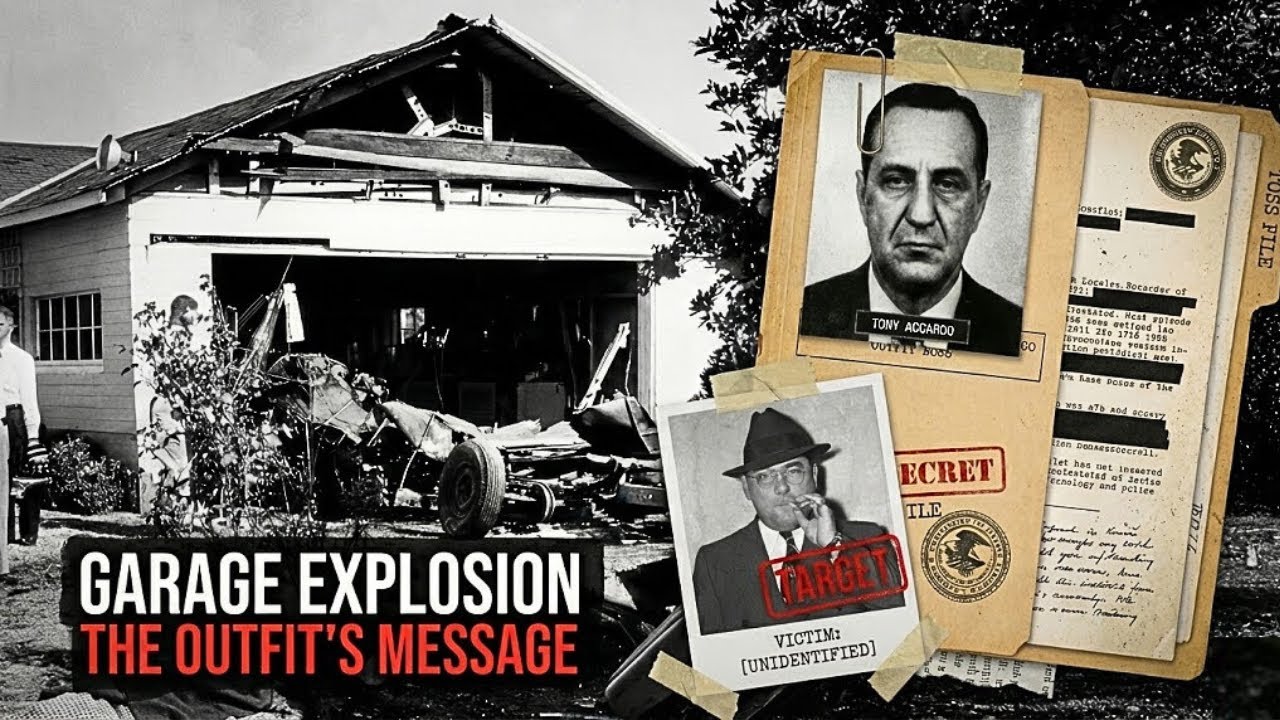
On November 4, 1955, a quiet Phoenix suburb was shattered by an explosion so powerful that neighbors initially believed a plane had crashed. Windows blew out blocks away, and a pickup truck was scattered across the neighborhood like debris. At the center of the devastation, in a cratered driveway, was the man his community knew as William Nelson, a popular cattle rancher who had joined the local rodeo committee and seemed to have found peace in the Arizona sun. But Nelson was not who he claimed to be.
He was Willie Boff, a man who had been living under a borrowed identity for more than a decade, a man the Chicago Outfit had never stopped hunting. To understand why Willie Boff had to be erased, one must return to the 1930s, when the Chicago Outfit realized it was missing out on a gold mine: the motion picture business. Hollywood was booming, and the mob wanted a cut. Boff provided the entry point.
He partnered with George Brown, head of the stagehands union, and together they devised one of the most audacious extortion schemes in American history. Boff would walk into the offices of the biggest studio heads in the world, the leaders of MGM, Paramount, and 20th Century Fox, and present a simple offer. Pay us, or we shut you down. Because he controlled the projectionists and stagehands, he could turn off the lights in theaters across the country.
If the theaters went dark, the studios made nothing. The scheme was brilliant and entirely illegal. The demands were massive. Suitcases full of cash changed hands in hotel lobbies, with millions of dollars flowing from Hollywood directly into the pockets of Chicago Outfit leaders like Frank Nitti and Paul Ricca.
Willie Boff was the golden goose, living lavishly, rubbing shoulders with movie stars, buying land, and feeling untouchable. But fortune has a way of attracting scrutiny. The IRS and federal investigators began closing in, and the extravagant lifestyle Boff enjoyed did not match his reported income. The heat descended, and the Chicago Outfit expected Boff to follow the code: keep your mouth shut, go to prison, do your time, protect the family.
That was the contract. Willie Boff, however, was not built for prison. He loved his silk sheets and expensive cigars too much. Facing a long sentence, he decided loyalty was a fool’s game and cut a deal.
And this was no ordinary deal. Willie Boff sang. He gave federal prosecutors everything they needed to indict the entire leadership of the Chicago Outfit. His testimony sent the top tier of the underworld to prison and caused a rupture that nearly destroyed the organization.
Frank Nitti, the man who had succeeded Al Capone, was so terrified of returning to prison because of Boff’s testimony that he walked to a railroad track and took his own life. Willie Boff, a chubby, unassuming union man, had toppled a kingdom. After the trial, Boff entered the 1940s version of witness protection. He moved around, changed his name, and eventually settled in Phoenix as William Nelson.
He reinvented himself as a cattle rancher, joined the rodeo committee, and became a well-liked figure in town. Years passed. Ten, then twelve, then fifteen. He likely believed the Outfit had forgotten him, that new bosses did not care about old history.
But the Chicago Outfit was not a normal corporation. In the corporate world, a new CEO does not inherit a grudge from decades past. In the mob, a grudge is an inheritance, passed down and carried forward. Paul Ricca, one of the men Boff had sent to prison, sat in his cell for years, stewing in hatred.
Every day he remained locked up was a day he blamed on Willie Boff. When Ricca and the others were eventually released, they did not hold a welcome home party. They held a meeting, and the agenda had only one item: find Willie. They found him.
It was not difficult. Boff could not resist the spotlight. He socialized, made noise, and lived openly. It was only a matter of time before a whisper reached Chicago that the cattle guy in Arizona looked a lot like Willie the Squealer.
On the morning of November 4, 1955, a Friday, Willie, now calling himself Bill, planned to go on a hunting trip. It was a mundane morning. He had coffee, said goodbye to his wife, and walked out to the garage. He passed her car, opened the door of his pickup truck, slid into the seat, and placed the key in the ignition.
At that moment, the circuit completed. A mechanism wired to the starter motor triggered a large quantity of dynamite. The person who planted it had known exactly what they were doing. This was not a warning.
It was not designed to scare. It was designed to erase. The resulting blast left a crater in the concrete driveway, disintegrated the truck, and killed Willie Boff in a fraction of a second. The aftermath was as significant as the killing itself.
Usually, a murder prompts a frantic search for the killer. In this case, there was almost a collective shrug from the underworld. Everyone knew who was responsible. Not necessarily the specific hitman, though names were whispered, but the entity that ordered it.
The Outfit wanted the world to see the wreckage. They wanted that image of the destroyed garage and scattered truck plastered on front pages across America. It was a terrifying advertisement. It told every potential informant that running to Arizona, changing your name, waiting fifteen years, and becoming a cowboy changed nothing.
They would find you, and they would crush you. The assassination of Willie Boff closed one of the most turbulent chapters in mob history. It was the final act of the Hollywood extortion scandal, and it restored the balance of fear the Outfit relied upon. What Boff felt in his final years remains unknown.
Perhaps he felt safe, or perhaps there was always a shadow at the back of his mind, a racing heart at a slow car passing by, a fear when the phone rang at night. Living with that level of paranoia is its own form of imprisonment. In a way, he never really escaped. He traded a cell with bars for one made of fear.
The moral question remains complicated. Willie Boff was a criminal who extorted millions and ruined lives. He was also the victim of a brutal murder, a predator consumed by larger predators. His death stands as one of the most definitive mob hits in American history.
It was not a shooting in a dark alley but a spectacle, a demonstration of the Outfit’s technical reach, its ability to track a target across state lines, and its psychological dominance. The organization that built its power on money and politics ultimately relied on violence. In that world, human resources was a man with a stick of dynamite. The Outfit wanted to send a message, and they did.
They sent it to Willie Boff, to every potential informant, and to history itself.
