The field outside the village of Azincourt was a heavy clay that held water for days, and it had rained most of the night before. On the morning of the 25th of October 1415, several thousand French noblemen, in full armor, on foot, began walking across it toward an English army a fraction of their size. A good part of that English force was sick and half-starved. The French had about 300 yards to go.
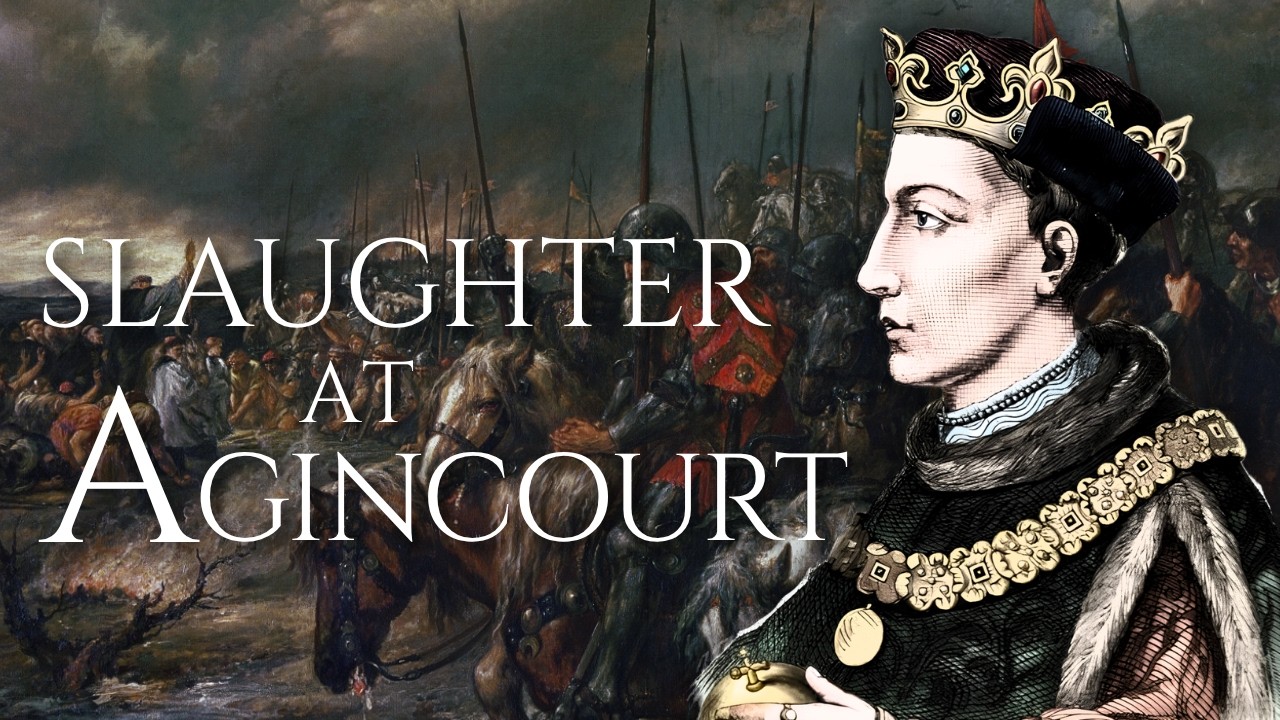
An hour or so later, the front of the English line was hidden behind three mounds of French bodies, living men and dead men stacked together, each mound taller than a standing man. English soldiers climbed the sides and killed downward from the top with axes and with the mallets they had used that morning to hammer in stakes. The man who had marched an army onto that field was Henry V, a 29-year-old king who knew from the inside what an arrow does. At sixteen, serving as Prince of Wales at the Battle of Shrewsbury, he had taken an arrow in the face beside his nose.
It drove in slantwise about six inches, missing his eye and his brain, and the head buried itself in the bone at the back of his skull. A surgeon named John Bradmore opened the wound over several days with linen-wrapped rods of elder pith soaked in rose honey, built a pair of thin hollow tongs with a screw, gripped the arrowhead, and rocked it loose. Henry was awake through all of it. The wound healed, and the scar was considerable.
Portrait painters always showed him strictly side-on. Henry became king in 1413. His father had taken the crown by force from a cousin, so his family’s title was thin, and everyone knew it. Across the Channel, France looked like an open door.
King Charles VI had been going in and out of madness for more than twenty years. In his bad spells he believed his body was made of glass, and he had iron rods sewn into his clothes to hold himself together. The great lords of France had split into two factions and were killing each other. In 1407, the king’s brother, Louis of Orléans, was pulled off his mule in a Paris street by men in the pay of the Duke of Burgundy and hacked apart.
He left a twelve-year-old son, Charles, who inherited the feud. In April 1415, Henry’s council approved war. He revived an old family claim to the French crown and sent ambassadors to Paris demanding the unpaid balance of a ransom sixty years old, vast sums of money, and several French provinces. The French refused.
Somewhere around 12,000 fighting men gathered at Southampton, along with gunners, miners, carpenters, cooks, minstrels, about twenty surgeons, and thousands of horses. The archers were a particular English product, farm workers and tradesmen who had trained at the butts since childhood. Before the fleet sailed, a plot was uncovered. Three men had conspired to put the Earl of March on the throne.
One of them was Henry’s own friend, Lord Scrope, his treasurer. Scrope was dragged through the streets and beheaded. His head was sent to York. The fleet crossed in fair weather.
They landed in Normandy and laid siege to the walled port of Harfleur. The town held out for five weeks under a veteran captain named Raoul de Gaucourt. Inside, the defenders built back the walls every night with timber and tubs of earth. Henry ran the siege personally, moving round the lines day and night.
Dysentery came with the heat and the stench. The army sat in a salt marsh, drank from the river, and died of what they called the bloody flux. Men went twenty or thirty times a day until they were passing blood, then water, then nothing but the urge. The dead and the sick were counted by the hundreds.
The Bishop of Norwich, the king’s closest friend, died in the tent next to Henry’s, and the king closed his eyes with his own hands. Harfleur fell on the 22nd of September. The town’s people, some 2,000 of them, were driven out with what they could carry. One chronicler wrote that it was pitiful to see and hear their sorrow.
Henry had lost perhaps a third of his army without fighting a battle. His council advised him to go home. He said he had a mind to see his territories. He would march overland to Calais, the one town on that coast England already held.
He left a garrison and set out on the 8th of October with something like 6,000 men, a fair share of them still sick. The rain started almost immediately. For the first days it went to plan. Small towns gave up bread and wine rather than be burned.
Then the army reached the Somme and found the ford at Blanchetaque guarded and planted with stakes. Henry turned the army upstream, away from Calais, deeper into France. Every bridge was broken. Every crossing had French troops on the far bank.
The eight days of food ran out. They ate walnuts and hazelnuts off the trees and drank from ditches. Some of the archers, sickened with dysentery, cut away their soiled breeches and walked bare-legged under their jackets in the October rain. Near the town of Corbie, the English learned from prisoners what the French intended.
Companies of armored horsemen were to ride down the archers. Henry’s order went through the army that day: every archer was to cut a stake six feet long, sharpened at both ends, and carry it. On the 19th, they finally got across the Somme at a narrow ford, laying house beams and doors over the broken causeways. They slept on the north bank, thinking they had slipped the French.
The next morning, French heralds arrived. The lords of France would fight him before he reached Calais. From that hour, Henry wore his coat of arms over his armor, and he ordered his knights to do the same. On the 24th, the English crested a ridge and saw the French army coming up out of a valley about a mile away, forming across the road to Calais.
The chaplain who rode with the English wrote that they were like an innumerable multitude of locusts. The English formed up on the ridge, expecting an attack before dark. A knight wished aloud that they had ten thousand more of the good archers of England. Henry heard him.
It was foolish talk, he said. By the God in whose grace he trusted, he would not have one man more than he had. These few were God’s people, and God could bring down the pride of the French with them as easily as with a host. In the dark, the French camped across the road near the villages of Agincourt and Ruisseauville.
Henry ordered complete silence. A gentleman who made a noise would lose his horse and his armor. An archer would lose his right ear. Six or eight thousand men stopped talking.
They lay down under hedges and apple trees in the rain. The French, with fires and wine and servants, played dice that night over who would get which English prisoner. Dawn came cold and gray. The rain had stopped.
Henry heard three masses in full armor and had the helmet with its crown of gold set with pearls brought to him. Over his plate he wore a surcoat with the leopards of England and the lilies of France sewn on it in quarters, making himself the most visible man on the field on purpose. He was so short of armored men that they stood only four deep, in three blocks, with the archers on the wings, pushed forward and angled in. Each archer hammered his stake into the mud in front of him.
Henry spoke along the line. He told them he had come to recover his lawful inheritance and that his quarrel was just. He told them England would never have to pay a ransom for him, because he meant to win or die on that ground. And he told them the French had sworn to cut the fingers off the right hand of every archer they took.
The French had formed up across the field. Their numbers ran to tens of thousands of men, the flower of the northern nobility under the constable, Charles d’Albret. Their plan called for archers and crossbowmen to stand in front and for cavalry to sweep round and hit the English bowmen from the side. But in the narrow funnel between two woods, nothing could sweep round anything, and the noblemen shouldered the crossbowmen out of the way.
For three hours, the two armies stood looking at each other. The French had every reason to wait. More men were arriving by the hour. Henry had nothing to feed his men, nowhere for them to sit in the wet, and many still had the flux.
He ordered the army to advance. Before they moved, every man knelt, made the sign of the cross on the ground, kissed the soil, and took a small piece of it into his mouth. Then the old knight commanding the archers threw his baton high into the air and shouted the word to strike. The English gave a great shout and came forward slowly across the wheat.
At about 300 yards, the archers halted, drove their stakes in again, and put an arrow on the string. The first flights went high, nearly vertical, and came down onto the French ranks. Most did no harm to a man in full plate, but some found a seam in the armor, an armpit, a visor slit, the back of a knee. The storm stung the French into moving.
The cavalry charged and came apart almost at once. The horses were too tired and the ground was too soft for a gallop, and the archers shot them flat in the flanks and the rumps. The wounded horses bolted, some of them directly back into the French front line, breaking it in many places. Then the first French division stepped off on foot, about 5,000 men, with the dukes and counts in the front rank.
They marched through the middle of the mud, where they sank up to their knees. The monk who gathered accounts from survivors wrote that they were already overcome with fatigue before they ever reached the enemy. Each step meant dragging a steel-shod foot out of clay against the suction, with a visor closed and a man’s breath coming through a grill the size of a palm. The arrows kept coming, flat now, from the sides.
The French stooped, heads bent, and as the field narrowed between the woods, they pressed inward, converging on the three English banners. They hit the English line with their weight. For a moment, the English were driven back almost a lance’s length. Then the line held.
The French front rank could not raise their arms to strike, packed so tight that their weapons were pinned against their own chests. Behind them, the second division came down the funnel and shoved. A man fell, and could not get up. The man behind tripped over him and went down on top of him.
The chaplain watched it build. The living fell on top of the dead, and others falling on top of the living were killed in their turn. In the three places where the strong contingents guarded our standards, such a great heap grew of the slain and of those lying crushed in between that our men climbed up those heaps, which had risen above a man’s height, and butchered their enemies below. Men at the bottom of those piles drowned in four inches of muddy water inside their own helmets.
Others died of compression as the weight on their chests settled with each breath out and would not lift again. The constable of France was found afterwards among the heaps without a mortal wound on him. The archers had shot themselves dry. They threw down their bows, seized axes, stakes, swords, and the mallets they had used to drive the stakes, and went along the edges of the French columns, working in small groups, knocking men down and killing them with daggers through the eye slits and under the arms.
The French who were still upright tried to surrender, holding out a gauntlet and shouting their rank. Nobody had leisure to take them prisoner, and almost all, without distinction of person, were put to death as soon as they were struck down. Henry stood in the front rank under his banner, with the crown on his helmet drawing every Frenchman who wanted a king’s ransom. Somebody landed an axe on his helmet and sheared a piece off the crown.
His youngest brother, the Duke of Gloucester, went down with a wound in the abdomen, and Henry stood over his body with his feet on either side of it until men could drag him out by the shoulders. The second French division came into the back of the crush and made it worse, adding its weight until it too collapsed. By about noon, the first two divisions had ceased to exist as fighting bodies. The mounted third division sat its horses on the slope and watched, and nobody was left to give it an order.
In the lull, the English turned to the heaps of bodies and began digging out the living to hold them for ransom. It was slow, filthy work, hauling the dead off by the heels. Hundreds of prisoners were taken, including the highest names in France, the Duke of Orléans, the Duke of Bourbon, the Marshall Boucicaut. The prisoners were gathered behind the English line, bareheaded under guard, many of them wounded and all of them spent.
Then the lord of the local castle, with about 600 peasants, fell on the English baggage and came away with the king’s own crown and his seals. At the same time, fresh French cavalry began forming at the top of the field. Henry gave the order. Every man was to kill his prisoners.
The men at arms did not want to do it. Each of the kneeling Frenchmen was a small fortune to the man who had taken him. Henry picked out an esquire and gave him 200 archers with orders to go through the host and kill every prisoner, whoever he might be. The esquire fulfilled the command of his sovereign lord, and, as one of the French witnesses wrote, it was a most pitiable thing.
All that nobility of France was there killed, heads and faces cut to pieces. One wounded knight was shut in a house with a dozen others and the thatch was lit. He dragged himself out on his hands and one good knee. He lived another forty-seven years.
The Duke of Brabant, who had ridden in at the last moment in borrowed armor and a trumpeter’s banner as his surcoat, had his throat cut by the man holding him. The killing stopped when the danger passed. The French cavalry charge was shot down, and the rest of the third division turned its horses and left. The English went back to their prisoners, but most of them were already dead.
By early afternoon it was over, three hours from start to finish. Henry asked the French herald to whom the victory belonged. The herald answered that it was his. Then he asked the name of the castle he could see through the trees.
Agincourt, they told him. And so the battle was named. The rain came back that afternoon. The English were too tired to march and too hungry to do anything but eat, and for the first time in three weeks they had a meal from the abandoned French camp.
The stripping began before dark. A dead knight wore more wealth than an archer would see in ten years. Henry put a limit on it, concerned that a tired army bent under loot would be an easy target, and the surplus was gathered into a barn. That night the field was full of sound, men calling for water, for a priest, crawling away into the woods to die.
The peasants of the neighboring villages came out once the English had gone to their camp and took the linen and the shoes. The English marched out at dawn, and their road to Calais ran straight back across the battlefield. The bodies had been stripped naked by the peasants during the night. The chaplain, the closest witness we have, wrote that he went through the masses, the mounds, and the piles of the slain, and it was not without the grief and tears of many.
No heart of flesh or even of stone, he wrote, could have seen and pondered the terrible deaths of so many Christians without dissolving into tears. As they went through, they finished the job. Men who had survived the night were checked for value. A knight who could convince them he had land and family behind him was added to the column.
A common soldier, or a man too badly hurt to walk, was killed where he lay. The Duke of York and the Earl of Suffolk were too grand for the barn. Their bodies were boiled in cauldrons until the flesh came away from the bones, and the bones were packed in chests and carried home to England. The rest of the English dead, and the surplus armor, went into a barn at Maisoncelles and were burned.
The French dead were left on the field for four days, until the son of the Duke of Burgundy sent men to bury them. Three trenches were dug, and 5,800 bodies were thrown in. The pits were fenced with a hedge of thorns to keep the wolves and dogs out, and the location of those graves is forgotten today. Every search of the battlefield for physical evidence has come up empty.
The French death toll was beyond recovering. The dead included three dukes, five counts, more than ninety barons, upward of fifteen hundred knights, and between four and five thousand other gentlemen, along with the constable of France, the admiral, the master of the crossbowmen, and nine of the king’s chief district officers. Whole families had come as father and son, and whole families died together. One knight and his wife sent four sons to Agincourt, and all four were killed.
The royal administration in the north was gutted. The English lost the Duke of York, the Earl of Suffolk, and somewhere between a handful and several hundred men, depending on who was counting. Agincourt gave Henry a reputation. Two years later he came back to France to spend it, and this time he meant to take the duchy town by town and keep it.
Caen was stormed, and Rouen was starved into surrender in a siege that lasted through the winter, with 12,000 of its poor pushed out into the ditch between the walls and the English lines to die. Henry married the French princess Catherine, became regent of France, and was installed as heir to the French crown. In 1422, besieging a town on the Marne, he caught the same dysentery that had emptied his army before Agincourt. He died on the 31st of August, thirty-five years old, fifty-one days short of the French crown.
Charles VI followed him within weeks, and both kingdoms went to a baby of nine months. Henry’s body was boiled in a cauldron until the flesh came away from the bones, the same method he had ordered for the Duke of York. The bones were carried slowly through France and England, and he was buried in Westminster Abbey, beside the grave of his friend the Bishop of Norwich, the man whose eyes he had closed in the tent at Harfleur. The field at Agincourt grows wheat and sugar beet these days.
The pits are still out there somewhere, three trenches side by side, under somebody’s field.
